
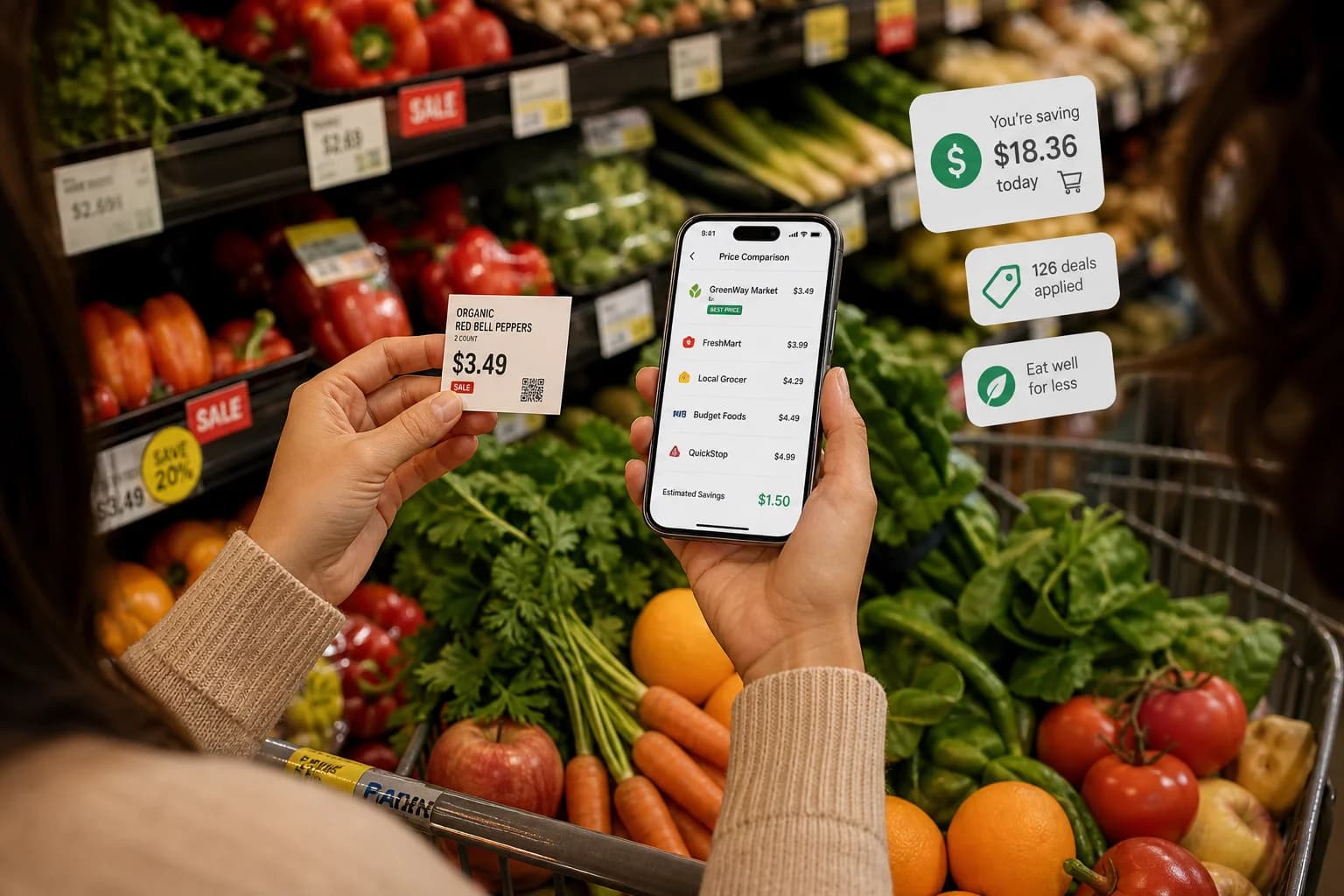
The average American family wastes $1,500+ on groceries every year — not on things they need, but on things they buy and never use. Food spoils. Impulse purchases pile up at checkout. Store brands sit next to name brands that are chemically identical at double the price. Most households could cut their grocery bill by 30–40% without eating worse. Here is exactly how to save on groceries every month — with real strategies, real prices, and real systems that work in 2026.
Saving on Groceries Every Month: 15 Proven Ways to Cut Your Bill by 30–40% (2026 Guide)
How Much Should You Spend on Groceries? (2026 Benchmarks)
Before you can cut your bill, you need to know where you stand. The USDA publishes monthly food cost plans at four levels: Thrifty, Low-Cost, Moderate, and Liberal. For 2026, the Thrifty Plan suggests approximately $250–$300 per month for a single adult, $450–$550 for a couple, and $750–$950 for a family of four. These figures reflect cumulative food-at-home inflation of roughly 22% since 2020, according to Bureau of Labor Statistics data. You can check the latest USDA food cost plans at fns.usda.gov and current CPI figures at bls.gov.
If your current grocery spending exceeds these benchmarks, you are not alone. The average American household now spends $475–$1,000+ per month on groceries — and much of that is preventable waste. Understanding your baseline is the first step toward meaningful savings.
The 30% Rule of Thumb
Most financial advisors suggest groceries should consume no more than 30% of your total food budget. If you are spending $800/month on groceries and dining out combined, your grocery target should be around $600 or less. Track your current spending for one month using a budgeting app — you might be surprised how much leaks out through small, untracked purchases. To learn how to track expenses effectively, see our guide on how to track expenses as a beginner.
Strategy 1: Master the Art of Meal Planning
Meal planning is the single highest-impact change you can make to cut your grocery bill. Studies show that people who plan their meals weekly spend 30–40% less than those who shop impulsively. The reason is simple: when you know what you are cooking, you only buy what you need.
The Sunday Reset — 30-Minute Weekly Planning System
Set aside 30 minutes every Sunday. Open your fridge and pantry to see what you already have. Then plan breakfast, lunch, and dinner for the coming week — accounting for nights you will eat out. Build your grocery list from the meals you planned, not the other way around. This prevents the "I have nothing to eat" spiral that leads to takeout orders and duplicate purchases.
Apps like Paprika, Plan to Eat, and $5 Meal Plan can streamline this process, but a simple notebook works just as well. The goal is not perfection — it is awareness. Building this habit is the foundation of every successful grocery savings strategy.
Batch Cooking and Freezer Meals
Cooking in bulk and freezing portions is one of the most effective ways to save both money and time. A $12 package of chicken thighs can become four dinners when you cook it all at once and freeze individual portions. Soups, stews, casseroles, and marinara sauce all freeze beautifully and cost a fraction of convenience foods.
Strategy 2: Choose the Right Store (2026 Price Comparison)
Where you shop matters as much as what you buy. A 2026 price comparison across 20 common items reveals significant price variation between store types. Here is a quick breakdown:
- Aldi: 30–50% cheaper than traditional supermarkets on most items. Their store brands are produced in the same facilities as name brands.
- Walmart: Everyday low prices, particularly strong on pantry staples and packaged goods. Grocery pickup is free and reduces impulse purchases.
- Costco and Sam's Club: Best for bulk buying on non-perishables, household items, and paper products. Annual membership pays for itself if you shop strategically.
- Kroger and Safeway: Strong loyalty programs and digital coupons. Kroger's app automatically applies available discounts at checkout.
- Farmers markets: Sometimes cheaper for seasonal produce, but not always. Compare unit prices carefully.
The key is matching the store to the item. Buy bread and dairy at Aldi. Buy bulk rice, beans, and oats at Costco. Use Kroger's digital coupons for things Aldi does not carry. No single store has the best price on everything — strategic multi-store shopping can save the average family $150–$300 per month.
Strategy 3: Use Digital Tools and Apps
Digital savings tools have transformed grocery shopping in 2026. The key is stacking multiple apps and strategies rather than relying on one.
- Ibotta: Earn $0.25–$5.00 cashback per item on groceries. New users frequently earn $20–$50 in sign-up bonuses. Stack with store brands and credit card cashback for maximum savings.
- Fetch Rewards: Scan any grocery receipt for points redeemable for gift cards. Takes 30 seconds per trip and averages $3–$10 per week in rewards.
- Kroger, Target Circle, and Walmart+ apps: Exclusive member discounts, personalized coupons, and fuel points that add up quickly.
- Flipp and Basket: Compare prices across nearby stores before you shop. Especially useful when deciding between Aldi and Walmart for your weekly trip.
- Cashback credit cards: The Amex Blue Cash Preferred earns 6% at U.S. supermarkets (up to $6,000/year), and the Citi Custom Cash earns 5% on your top spending category including groceries.
Warning: Do not buy things you do not need just because there is a cashback offer. The savings disappear if you are spending on unwanted items. Stick to your list and use apps as a bonus, not a shopping guide.
Strategy 4: Buy Smart — Unit Pricing and Bulk Strategy
Every major retailer displays unit pricing — the cost per ounce, pound, or liter. This number tells you the true value, regardless of package size. Always compare unit prices, not shelf prices. A larger package is not always cheaper per unit.
When Bulk Buying Saves Money (and When It Does Not)
- Always buy in bulk: Rice, beans, oats, pasta, flour, sugar, spices, canned goods, paper products, and cleaning supplies. These items have long shelf lives and genuine per-unit savings at Costco or Sam's Club.
- Never buy in bulk: Fresh produce you will not eat in time, dairy for a small household, and items you have not tried before. A $15 rotisserie chicken from Costco is only a good deal if you actually eat it before it spoils.
The cost-per-serving calculation is your best friend. If a family-size cereal box costs $9.50 for 20 servings ($0.47/serving) versus a regular box at $4.50 for 10 servings ($0.45/serving), the smaller box is actually marginally better value — and will stay fresher longer.
Strategy 5: Go Store Brand (Generic vs. Name Brand)
Store brands — sometimes called "private label" — have narrowed or eliminated the quality gap with name brands in most categories. In blind taste tests, most consumers cannot distinguish store brand cereals, canned goods, dairy products, or baking supplies from their name-brand counterparts. The average savings by switching to store brands is 20–30% per item.
- Highest savings categories: Canned tomatoes, beans, pasta sauce, bread, milk, cheese, yogurt, cereal, rice, and baking supplies.
- Categories where name brands may be worth the premium: Certain condiments, specialty coffee, baby food, and specific medication formulations where consistency matters.
- Exceptions: When store brand is out of stock or when a name brand is on a genuine sale (not a fake was/now promotion).
The rule: if it is a commodity ingredient used in cooking, buy the store brand. If it is a specific flavor or formulation you are loyal to, the name brand is occasionally worth the premium — but only when on sale.
Strategy 6: Reduce Food Waste (The Hidden Savings)
The USDA and EPA estimate that 30–40% of the food supply in the United States goes to waste. For a household, this translates to roughly $1,500 per year in food that is bought and never eaten. Reducing food waste is not just environmentally responsible — it is one of the biggest line items in your grocery budget you have not yet optimized. Every dollar you save on groceries is a dollar that can go toward your emergency fund.
- First-in-first-out (FIFO): When unpacking groceries, move older items to the front and new purchases to the back. This takes 30 seconds and prevents spoiled food from hiding at the back of the fridge.
- Freezer management: If you bought too much fresh produce, freeze it before it goes bad. Berries, bread, extra meat portions, and cooked grains all freeze and thaw well.
- Eat what you have weeks: Once a month, challenge yourself to cook only from your pantry, fridge, and freezer. This clears out items you forgot existed and reveals patterns in what you repeatedly waste.
- Proper storage: Many fruits and vegetables last 2–3x longer when stored correctly. Potatoes and onions go in a cool, dark cabinet. Lettuce and herbs last longer in airtight containers with a paper towel.
Strategy 7: Behavioral Tricks to Avoid Impulse Buys
Grocery stores are professionally designed to make you spend more. End caps, checkout lanes, samples, and aromatic displays are all deliberate. Here is how to fight back.
- Never shop hungry: Studies consistently show that hungry shoppers spend 20–40% more and make more impulse purchases. Eat a small meal or snack before heading to the store.
- The grocery list rule: If it is not on your list, it does not go in the cart. This simple rule alone can save $50–$100 per trip.
- Online pickup vs. in-store: Grocery pickup services (Walmart+, Kroger, Target) prevent you from walking the aisles entirely. You shop online, employees pick the items, and you pull up to collect them. Removes most impulse triggers.
- Store layout awareness: The most expensive items are at eye level and at the ends of aisles. Look high and low on shelves for better prices. The perimeter of the store (fresh produce, dairy, deli) tends to be more expensive than the center aisles.
- The 10-second rule: Before adding anything unplanned to your cart, wait 10 seconds and ask yourself: "Did I plan for this?" The pause is often enough to prevent the purchase.
Strategy 8: Seasonal and Strategic Shopping
Produce prices fluctuate dramatically by season. Buying strawberries in December, when they are shipped from Chile, costs 2–3x more than buying them in June from a local farm. Understanding seasonal price cycles lets you stock up when prices are lowest.
- Winter (December–February): Root vegetables (carrots, potatoes, squash), citrus, and frozen produce are at their cheapest and most abundant.
- Spring (March–May): Asparagus, peas, artichokes, and leafy greens hit their lowest prices.
- Summer (June–August): Stone fruits (peaches, plums, cherries), berries, corn, tomatoes, and zucchini are cheapest and most flavorful.
- Fall (September–November): Pumpkins, squash, apples, and pears come into season at excellent prices.
When produce is in season and cheap, buy extra and freeze it. Frozen fruits and vegetables are nutritionally equivalent to fresh and often cheaper year-round. Similarly, stock up on pantry staples when they go on sale around major holidays.
How Much Can You Actually Save? (Real Examples)
Case Study 1: Single Person — From $400 to $250/Month
Sarah, 28, was spending $400/month on groceries in a mid-sized city, frequently buying lunch at work and impulse purchasing at the checkout. After implementing meal planning on Sundays and switching to store brands, her grocery bill dropped to $250/month within two months. She saves an additional $60/month by using Ibotta and Fetch Rewards. Total annual savings: $2,520.
Case Study 2: Couple — From $600 to $400/Month
Mike and Lisa, both 34, were spending $600/month and eating out 3–4 times per week. By committing to a shared meal plan, buying in bulk at Costco for non-perishables, switching to Aldi for weekly produce runs, and using Kroger digital coupons, they brought their grocery bill to $400/month. They redirected the $200 monthly savings to their emergency fund.
Case Study 3: Family of 4 — From $1,000 to $650/Month
The Thompson family, two adults and two children (ages 8 and 12), was spending $1,000/month on groceries plus $300 on dining out. By batch cooking on Sundays, switching to store brands, using Costco for bulk staples, and implementing a strict no-unplanned-purchases rule, they reduced their grocery bill to $650/month while actually eating more home-cooked meals. The dining out budget dropped to $150/month as a result of better meal planning.
Grocery Budget by Household Size (Quick Reference)
Use this table as a starting benchmark based on the USDA Thrifty and Low-Cost Food Plans, adjusted for 2026 inflation. These figures represent total monthly grocery spending at the Thrifty Plan level (lower number) and Low-Cost Plan level (higher number). For more on setting up a complete household budget, see our guide on how to budget for groceries.
- Single adult: $250–$350/month
- Couple (no children): $450–$600/month
- Family of 3: $600–$800/month
- Family of 4: $750–$950/month
- Family of 5+: $900–$1,150/month
These are food-at-home figures. If you spend significantly more, the strategies in this guide can help close the gap. If you spend less and are eating well, you are already ahead of the curve.
FAQ — Saving on Groceries
How much should I budget for groceries per month?
A general guideline is $250–$350 for a single adult, $450–$600 for a couple, and $750–$950 for a family of four, based on USDA 2026 Thrifty and Low-Cost Food Plans. Your actual budget depends on location, dietary needs, and whether you are including household items.
Is Aldi really cheaper than Walmart?
Yes, on most items Aldi is 15–30% cheaper than Walmart, and 30–50% cheaper than traditional supermarkets. Walmart has lower prices than most stores but Aldi consistently undercuts it on produce, dairy, and staples. The trade-off is limited selection and no national brand products.
Does buying in bulk actually save money?
Only when the items are non-perishables you will definitely use, or when the per-unit cost is genuinely lower. Bulk buying perishables for a small household often results in waste that erases the savings. Stick to bulk for rice, beans, oats, pasta, canned goods, paper products, and frozen items.
How can I save on groceries without coupons?
Meal planning, switching to store brands, shopping at budget stores like Aldi, buying seasonal produce, and avoiding impulse purchases are all coupon-free strategies that typically save more than couponing alone. Digital cashback apps like Fetch and Ibotta add extra savings without clipping anything.
What are the best grocery cashback apps?
Ibotta (best for targeted brand offers), Fetch Rewards (easiest — scan any receipt), and store apps like Kroger and Target Circle (best for personalized discounts) are the top three. Using all three together can save $10–$30 per month on average.
Is it cheaper to buy frozen or fresh vegetables?
Frozen vegetables are often cheaper per serving than fresh, especially out of season. They are frozen at peak ripeness so nutrient content is comparable. For salad greens and herbs, fresh is worth the premium.
How much can I save by switching to store brands?
The average household saves 20–30% on each store brand item purchased instead of the name brand equivalent. For a family spending $900/month on groceries, switching half the items to store brands saves approximately $90–$135 per month, or $1,080–$1,620 per year.
What is the cheapest grocery store in America?
Aldi consistently ranks as the overall cheapest, followed by Walmart. Costco has the best per-unit prices on bulk non-perishables but requires a membership. The absolute cheapest store depends on what you buy — shop strategically at multiple stores rather than committing to one.
Should I use grocery delivery or shop in-store to save money?
In-store shopping saves money because delivery fees ($7–$10 per order) and tips add up. However, in-store shopping triggers more impulse purchases. If you are confident you can stick to your list, in-store saves money. If you consistently overspend when walking the aisles, delivery or pickup services may be worth the fee.
What foods should I always buy in bulk?
Rice, dried beans, oats, pasta, flour, sugar, canned tomatoes, canned tuna, peanut butter, paper towels, toilet paper, and household cleaners. These items have long shelf lives, high per-unit savings in bulk, and are used regularly in most households.
Prices and availability vary by location and season. This article is for informational purposes only. Consult a financial advisor for personalized budgeting advice.
Take control of your money today
Start free with Spendmate — track expenses, plan budgets, and reach your financial goals.
Start free with Spendmate