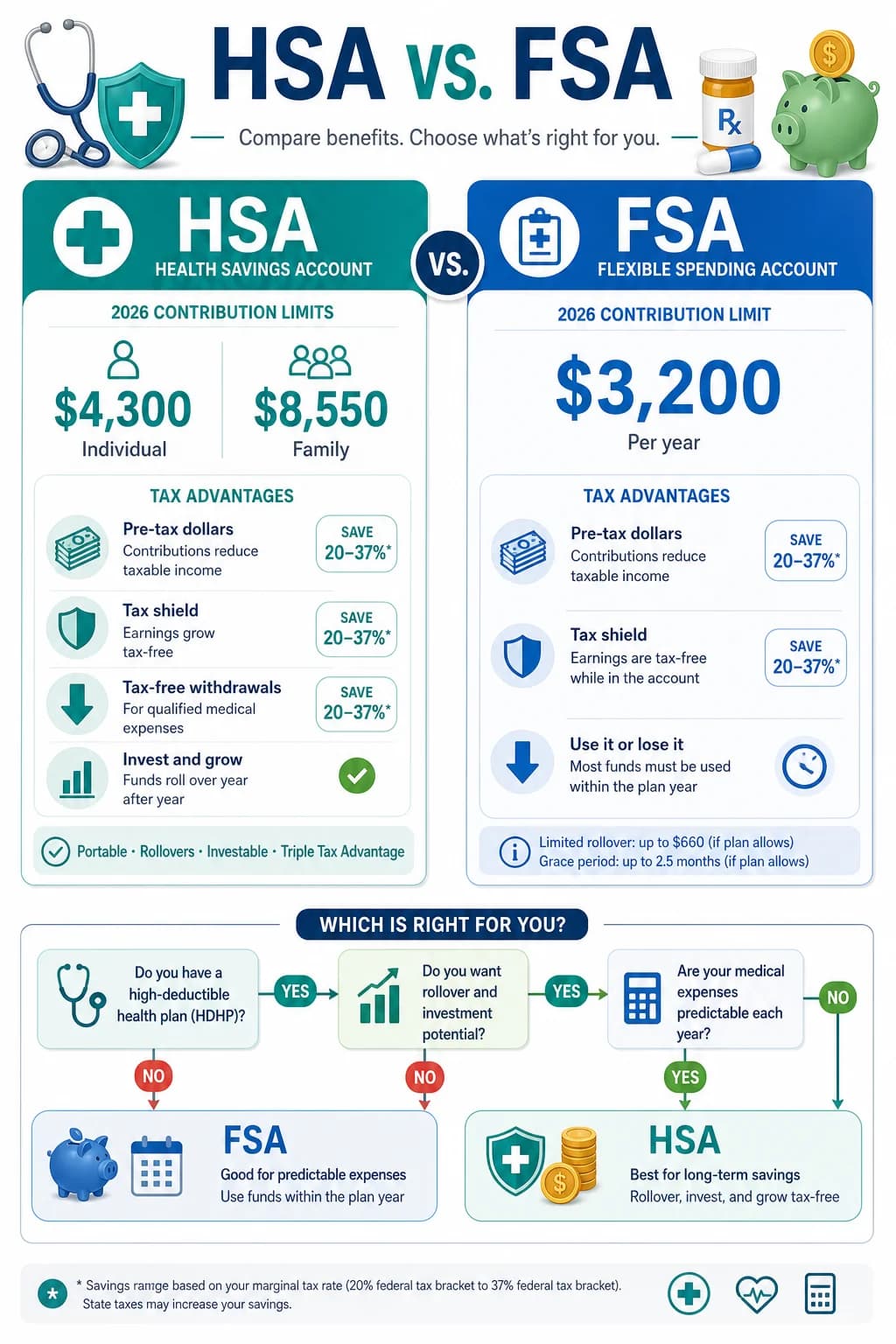
Executive summary: HSA vs FSA are both tax-advantaged accounts but differ significantly in ownership, rollover rules, and investment options. HSAs offer triple tax savings and carry-over benefits, while FSAs have stricter use-it-or-lose-it rules. This guide compares 2026 limits, rules, and scenarios to help you choose the right account for your healthcare financial planning.
What Are HSA and FSA Accounts?
Health Savings Accounts (HSAs) and Flexible Spending Accounts (FSAs) are employer-sponsored benefit accounts designed to help you save money on qualifying medical expenses. Both accounts let you set aside pre-tax dollars, but they work very differently when it comes to ownership, rollover, and investment potential.
An HSA is individually owned, meaning the money is yours to keep even if you change jobs. An FSA is employer-owned, so unspent funds typically return to the employer at year-end (with limited grace period exceptions).
2026 Contribution Limits Compared
For 2026, the IRS has set the following contribution limits:
- HSA Individual Coverage: \,300
- HSA Family Coverage: \,550
- FSA Employee Contribution Limit: \,300
- Catch-up contributions (age 55+): an extra \,000 for HSA only
HSA contributions roll over indefinitely. FSA contributions generally do not, making the HSA the stronger long-term savings vehicle for predictable healthcare costs.
Tax Advantages: HSA Wins on Three Fronts
HSAs offer a rare triple tax advantage: contributions are tax-deductible, growth is tax-free, and withdrawals for qualifying expenses are tax-free. FSAs only offer a pre-tax contribution benefit — there is no tax-free growth or tax-free withdrawal advantage.
Portability and Ownership
One of the biggest practical differences is ownership. HSA funds belong to you personally, even after you leave your employer. FSA funds, by contrast, are typically forfeited if unused at year-end (unless your plan offers a grace period or carryover).
This makes HSAs far superior for employees who want to build a long-term healthcare nest egg, while FSAs may suit those with predictable, high annual medical expenses who can spend down their balance reliably.
Investment Opportunities
Many HSA providers offer investment accounts once your balance exceeds a minimum threshold (typically \,000-\,000). This allows HSA funds to grow tax-free beyond just cash savings. FSAs do not offer investment options — any balance sitting in an FSA is essentially idle cash.
Which Account Is Better for You?
Choose HSA if: You want long-term healthcare savings, investment growth, and maximum tax benefits. HSAs are ideal for healthy individuals or families with low expected medical costs who want to build a financial cushion for future medical expenses.
Choose FSA if: Your employer offers a generous FSA match, you have high predictable medical expenses (like prescriptions, therapies, or ongoing treatments), and you can realistically spend the full balance each year without waste.
Can You Have Both?
Yes — you can potentially use both an HSA and an FSA in the same year if you are covered by a high-deductible health plan (HDHP) that qualifies you for an HSA. However, you cannot double-dip: an HSA cannot be used to pay for expenses that were reimbursed through an FSA in the same year.
Key Takeaways for 2026
- HSA limits for 2026: \,300 (individual) / \,550 (family), plus \,000 catch-up for age 55+
- FSA limit for 2026: \,300 with use-it-or-lose-it rules
- HSA offers triple tax savings; FSA offers pre-tax contributions only
- HSA funds roll over indefinitely; FSA funds generally do not
- HSA is better for long-term savers and investors; FSA suits those with predictable high expenses
Take control of your money today
Start free with Spendmate — track expenses, plan budgets, and reach your financial goals.
Start free with Spendmate