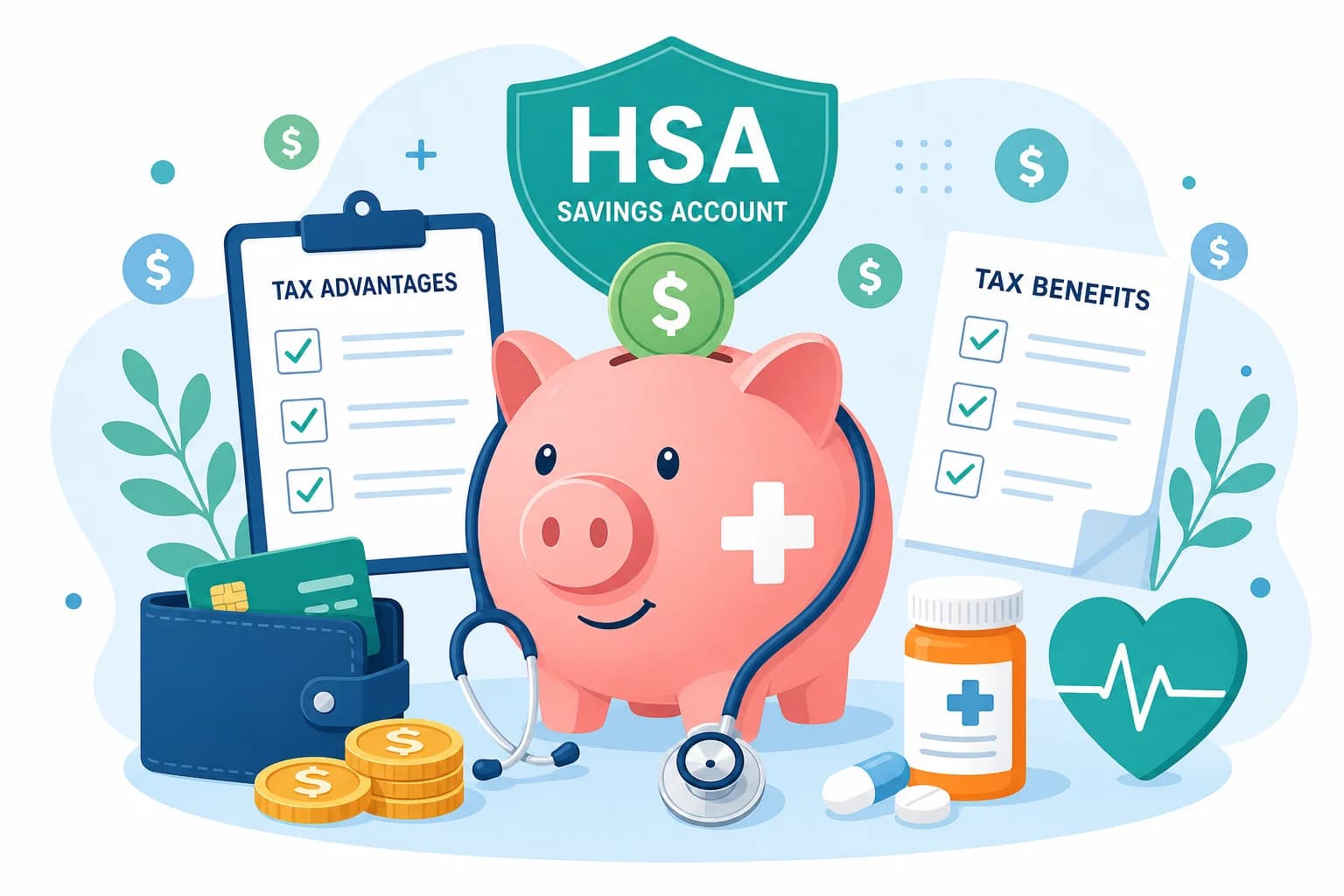
If you have a high-deductible health plan, there is a savings account that triples your tax advantage: the HSA explained in plain terms. An HSA (Health Savings Account) lets you save pre-tax money for medical expenses, grow it tax-free, and spend it tax-free. With HDHP enrollment now representing more than 30% of all employer health plans in 2026, understanding how an HSA explained setup works has become essential for anyone trying to control healthcare costs. This guide covers who qualifies, what you can spend funds on, and how to decide whether to use the money now or let it compound for future medical bills.
What Is an HSA? (Health Savings Account Explained Simply)
An HSA is a tax-advantaged savings account available to anyone enrolled in a High-Deductible Health Plan. You contribute pre-tax money, the account grows through investments tax-free, and withdrawals for qualified medical expenses come out tax-free too. That three-layer tax benefit is why financial experts call it the "triple tax advantage" and why it stands apart from regular savings or brokerage accounts.
The HSA was created by the Medicare Modernization Act of 2003 and got a significant boost from the CARES Act in 2020, which expanded what counts as a qualified medical expense. Unlike a Flexible Spending Account, HSA funds roll over forever and stay yours even if you change jobs, retire, or leave your health plan.
The Triple Tax Advantage and Why HSAs Are So Powerful
The triple tax advantage is what makes the HSA genuinely special. Here is how each layer works:
- Pre-tax contributions: Money you contribute reduces your taxable income. In a 22% federal tax bracket, contributing $4,300 saves roughly $946 in income tax, plus another $329 in FICA savings — about $1,275 total per year for an individual.
- Tax-free growth: Interest, dividends, and investment gains inside the HSA grow without capital gains tax. Over 20 or 30 years, this can mean tens of thousands of dollars in additional growth compared to a regular taxable brokerage account.
- Tax-free withdrawals: HSA funds spent on qualified medical expenses — doctor visits, prescriptions, dental work, vision, mental health services — come out completely tax-free. This is different from a 401k or Traditional IRA, where withdrawals are taxed as ordinary income.
After age 65, you can withdraw from your HSA for any purpose without penalty (though ordinary income tax applies to non-medical withdrawals, similar to a Traditional IRA). This makes the HSA also a potential retirement supplement. If you want to understand how much you should set aside for medical expenses, see our guide on how much Americans should save for medical emergencies.
Who Qualifies for an HSA? (Eligibility Requirements)
Not everyone can open and contribute to an HSA. The IRS sets specific eligibility rules, and violating them results in penalties plus back taxes on excess contributions. You can check the official eligibility rules at IRS Publication 502 and contribution limits at IRS HSA Information Sheet.
Must Have an HDHP
You must be enrolled in a High-Deductible Health Plan. For 2026, the IRS defines an HDHP as a plan with a minimum annual deductible of $1,600 for individual coverage or $3,200 for family coverage. Your plan also cannot have total out-of-pocket expenses exceeding $8,050 for an individual or $16,100 for a family. To understand how HDHPs compare to other plans, see our HDHP vs PPO comparison guide.
Cannot Have Disqualifying Coverage
You are generally not eligible if you have other health coverage that pays for medical expenses before you meet your deductible, unless that coverage is specifically a "limited-purpose" FSA, HRA, or certain types of accident or disability insurance. Being enrolled in Medicare Part A or Part B also disqualifies you from making HSA contributions (though you can still use existing HSA funds). Being claimed as a dependent on someone else tax return also disqualifies you.
What You Can Have Alongside an HSA
You can still be HSA-eligible if you have dental-only insurance, vision-only insurance, accident insurance, disability insurance, or a "limited-purpose" FSA that only covers dental and vision costs. Workers whose employers offer an HDHP alongside a separate limited-purpose FSA for dental and vision are still fully HSA-eligible.
HSA Contribution Limits (2026)
- Individual coverage: $4,300 per year
- Family coverage: $8,550 per year
- Catch-up contribution (age 55 or older): Additional $1,000 per year
Important rules around contributions: If you become eligible mid-year, your contribution limit is prorated by the number of months you were enrolled in an HDHP. However, the "last-month rule" lets you contribute your full annual limit if you are enrolled in an HDHP on December 1, as long as you remain eligible through the end of the following year. Employer contributions count toward your annual limit, so if your employer puts in $1,000, you can only contribute $3,300 more as an individual. Married couples with separate HDHPs can each contribute up to the individual limit to their own accounts.
How to Open and Fund an HSA
There are two primary ways to open an HSA: through your employer or on your own. Employer-sponsored HSAs are typically set up through the company benefits portal and often include payroll deductions, which saves you FICA taxes. If you are self-employed or your employer does not offer an HSA, you can open one independently at major providers like Fidelity, Lively, HealthEquity, or HSA Bank.
- Payroll deduction: Best option — saves both income tax and FICA tax
- Direct contribution: Tax-deductible for income tax purposes, but FICA taxes still apply
- Rollover from another HSA: Unlimited transfers with no tax consequences
- One-time IRA-to-HSA transfer: Allowed once in a lifetime, counts toward HSA limit
Real example: A 38-year-old software engineer in Austin, Texas contributes $4,300 to her HSA through payroll at work. She is in the 24% federal tax bracket. That contribution saves her $1,032 in federal income tax plus $329 in FICA taxes — $1,361 total saved in one year, just by directing money she would have spent on medical expenses into her HSA instead.
What Can You Use HSA Funds For? (Qualified Medical Expenses)
The list of IRS-qualified medical expenses is broader than most people realize. The CARES Act of 2020 expanded the list significantly. See the full list at IRS Publication 502.
Qualified Expenses
- Doctor visits, copays, coinsurance, and deductibles
- Prescription medications (OTC medications like pain relievers now qualify without a prescription as of 2020)
- Dental care: cleanings, fillings, crowns, root canals, braces, dentures
- Vision: eye exams, prescription glasses, contact lenses, LASIK surgery
- Mental health: therapy, counseling, inpatient psychiatric treatment
- Medical equipment: crutches, blood pressure monitors, thermometers, glucose monitors
- Menstrual products: tampons, pads, menstrual cups (added by CARES Act 2020)
- Sunscreen SPF 15 or higher (prescription sunscreen also qualifies)
- First aid supplies
- Transportation to medical care: mileage at the IRS rate, parking, tolls
Non-Qualified Expenses
- Health insurance premiums (exception: Medicare Part B, Part C, and Part D premiums qualify; COBRA continuation coverage qualifies)
- Long-term care insurance premiums (eligible under certain limits based on age)
- Cosmetic procedures without a medical necessity
- Gym memberships (unless prescribed for a specific medical condition)
- Over-the-counter vitamins and supplements (unless prescribed for a specific medical condition)
- Funeral expenses
For a complete list, see IRS Publication 502. You can use HSA funds for your spouse and dependents, even if they are not covered by your HDHP. For a full breakdown of what medical costs to budget for, see our guide on how to budget for medical expenses in America.
HSA vs FSA vs HRA: What the Difference?
These three accounts sound similar but have very different rules. Here is a side-by-side comparison:
- HSA: Available only with HDHP enrollment. Funds roll over forever and are portable. You own the account. 2026 limits: $4,300 individual / $8,550 family. Can be invested. Withdrawals tax-free for qualified medical expenses. Learn more at IRS HSA Info Sheet.
- FSA (Flexible Spending Account): Available with most employer plans. "Use-it-or-lose-it" rule applies (up to $610 can roll over per year in 2026). Not portable. No investing. Funds cover only people included in your plan.
- HRA (Health Reimbursement Arrangement): Funded entirely by your employer. Not portable. No contribution limits, but employer sets the rules. You have no control over the account.
If you have an HDHP, the HSA is almost always the better choice over a general-purpose FSA, because the funds persist and grow rather than expiring annually. See our guide on deductible vs copay vs coinsurance to understand how your health plan interacts with your HSA.
HSA Strategy: When to Use It vs Pay Out-of-Pocket
One of the most powerful HSA strategies is counterintuitive: pay your current medical expenses out of pocket and let your HSA grow for future use. Because HSA funds roll over forever, there is no deadline for reimbursement.
Strategy 1: Pay Out-of-Pocket, Let HSA Grow (Best for Long-Term)
If you can afford to pay your deductible and medical expenses from your regular budget, do it. Keep all your receipts. Your HSA investments grow tax-free. Years or decades later, you can reimburse yourself for those past expenses tax-free, effectively giving yourself a tax-free loan from your past self.
Strategy 2: Use HSA for Current Expenses (Best for Cash Flow)
If you cannot afford to pay out-of-pocket without going into credit card debt, use your HSA. The tax savings still apply, and HSA funds are cheaper than carrying high-interest debt. This is the right move when an unexpected medical bill would otherwise derail your budget.
Strategy 3: Hybrid Approach
Keep your deductible amount in cash inside your HSA for immediate access. Invest everything above that threshold for long-term growth. When you have a qualified expense, pay from the cash portion if you can. If a large expense hits, reimburse yourself from the invested portion. After age 65, you can withdraw for any purpose without penalty, though ordinary income tax applies.
Real example: A 45-year-old teacher in Ohio had $6,000 in his HSA by age 40. He paid his annual physicals and prescriptions out of pocket (about $400/year) and let the rest grow. By 45, his HSA was worth $14,000 because his provider (Fidelity) invested it in index funds. He had a knee surgery at 46 with a $4,000 deductible. He paid the $4,000 from his regular savings, then reimbursed himself from his HSA two years later, tax-free. His $14,000 never stopped growing.
For more on building financial security for medical events, see our guide on building an emergency fund from scratch.
Common HSA Mistakes to Avoid
- Not contributing enough to cover your deductible: Your HSA only provides value if you actually fund it. Aim to at least cover your HDHP deductible.
- Using HSA for small expenses when you can pay cash: For larger predictable expenses, paying cash and keeping the HSA intact gives you more long-term flexibility.
- Not investing HSA funds: Most HSA providers offer investment options. Leaving HSA cash sitting in an account earning minimal interest means your money is not working for you. Invest funds you do not need for near-term medical expenses.
- Not tracking receipts for future reimbursement: Keep a digital folder of all medical receipts. You can reimburse yourself years from now for expenses you paid today.
- Confusing HSA with FSA: Unlike an FSA, HSA funds do not expire. You do not need to spend your HSA balance by year-end.
- Not contributing through payroll: If your employer offers a payroll deduction HSA, use it. Direct contributions cost you an extra 7.65% in FICA taxes.
- Closing your HSA when changing jobs: Keep it. Your HSA is yours. Closing it means losing the tax-advantaged growth potential.
- Ignoring HSA provider fees: Some HSA custodians charge monthly maintenance fees. Fidelity charges no fees and offers index fund investments, making it a preferred choice for HSA investors.
FAQ: HSA Questions Answered
- Is an HSA worth it if I rarely go to the doctor?
- Yes. Even if you are healthy, the tax advantages make an HSA valuable. Contribute up to your deductible, invest the rest, and keep receipts for future reimbursement. After age 65, you can withdraw for any purpose. The HSA essentially functions as an additional IRA specifically for healthcare costs.
- Can I have an HSA and an FSA at the same time?
- Only a limited-purpose FSA that covers dental and vision costs. A general-purpose FSA covering doctor visits and prescriptions disqualifies you from HSA contributions. Check which type of FSA your employer offers before assuming you are eligible.
- What happens to my HSA if I change jobs?
- Nothing changes. Your HSA is fully portable. The funds are yours, the account is yours, and you can keep using it with the same tax advantages. You can roll it over into a new HSA at a different custodian with no tax consequences.
- Can I use HSA funds for my spouse or dependents?
- Yes. HSA funds can be used for qualified medical expenses for you, your spouse, and any dependents claimed on your tax return, even if they are not covered by your HDHP.
- Do HSA funds expire?
- No. Unlike an FSA, HSA funds roll over year after year with no expiration. You keep your balance regardless of how long you keep the account or whether you change jobs or health plans.
- Can I invest my HSA funds?
- Yes. Most HSA providers offer investment accounts where you can buy stocks, bonds, and index funds. Once your HSA balance exceeds your deductible, investing the excess is one of the most tax-efficient things you can do with money.
- What if my employer contributes to my HSA?
- Employer contributions count toward your annual HSA limit. If your employer contributes $1,000 and the individual limit is $4,300, you can contribute up to $3,300 more. Employer contributions are not taxable income to you.
- Can I have an HSA if I am self-employed?
- Yes. Self-employed individuals with an HDHP can open and contribute to an HSA. Contributions are tax-deductible, reducing your self-employment tax bill. You can set up an HSA independently through providers like Fidelity, Lively, or HSA Bank.
- Is HSA better than a 401k?
- They serve different purposes. A 401k is for general retirement savings. An HSA is specifically for medical expenses but has better tax treatment for medical withdrawals. After maxing out any employer 401k match and building an emergency fund, maxing an HSA is a powerful next step, especially if you expect high medical costs in retirement.
- What happens to my HSA when I die?
- Your HSA passes to your beneficiary. If your spouse is the beneficiary, the account transfers to them tax-free and they can treat it as their own HSA. Non-spouse beneficiaries receive the account as a taxable lump sum. Your estate can use HSA funds for your final medical expenses before death.
Understanding your health insurance options is the first step to managing healthcare costs. See our full guide on how health insurance affects your monthly budget, and use our HDHP vs PPO calculator to determine which plan actually saves you more money.
Take control of your money today
Start free with Spendmate — track expenses, plan budgets, and reach your financial goals.
Start free with Spendmate