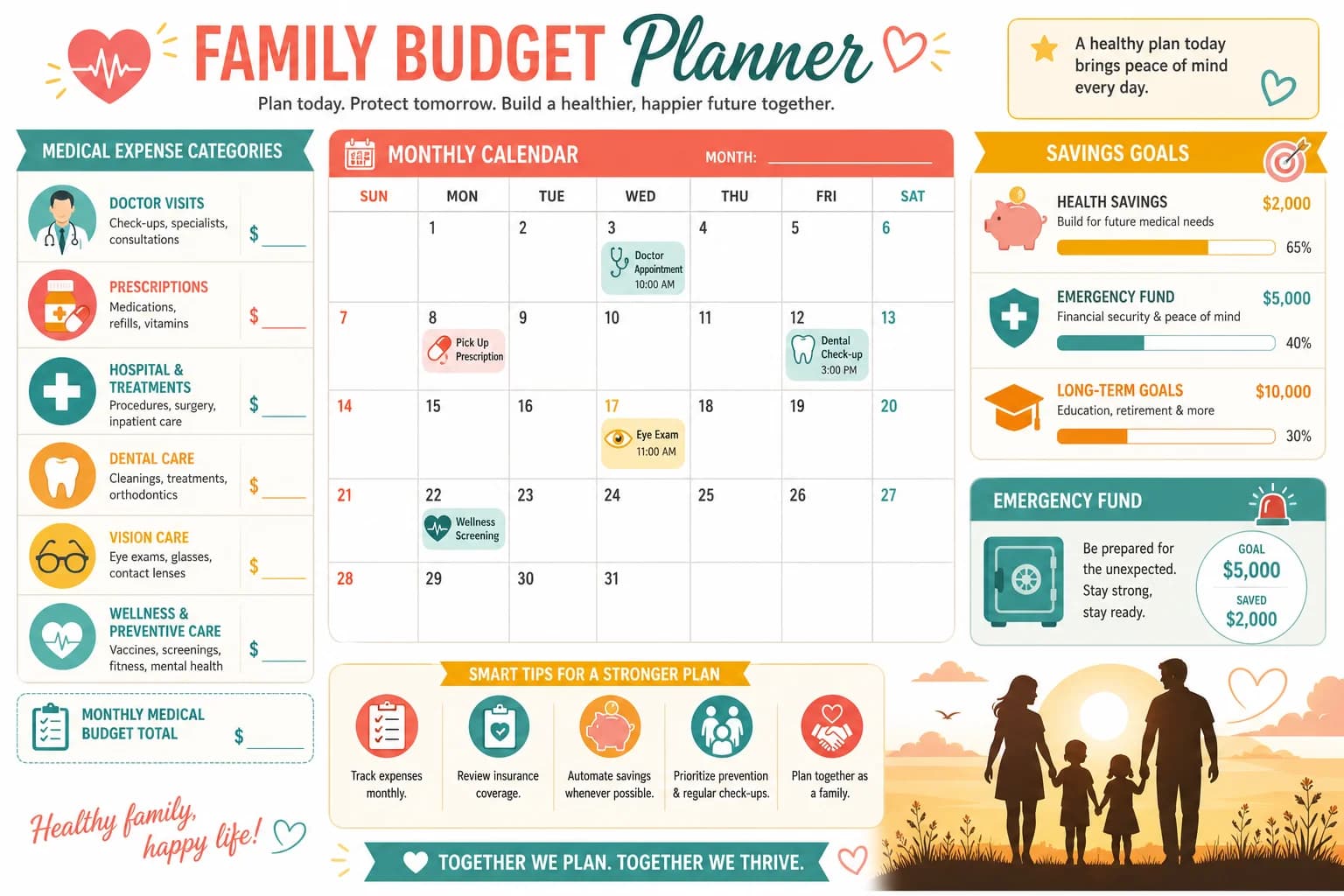
The average American family of four spends $25,000–$30,000 per year on healthcare when you factor in premiums, deductibles, copays, coinsurance, and out-of-pocket costs. Yet most families have no structured healthcare budget for family of four expenses. They only react when bills arrive. This guide provides a complete, realistic framework for building and managing a healthcare budget that actually works — not just in theory, but in real household finances.
Written by a certified financial planner who has helped hundreds of families navigate open enrollment and medical billing disputes. The strategies here come from real client situations, not textbook theory.
Why Healthcare Budgets Fail (And Why Most Families Do Not Have One)
Healthcare is the only major budget category that is impossible to predict with certainty. You cannot know in January whether you will need emergency surgery in March or just routine physicals. This unpredictability causes most families to avoid budgeting for healthcare entirely — they pay bills when they arrive and hope for the best. The problem: surprise medical bills are a leading cause of personal bankruptcy in the United States, accounting for approximately 66% of all bankruptcies tied to financial distress.
A healthcare budget does not eliminate uncertainty. What it does is ensure you have financial reserves built up before you need them, and it makes the predictable portions — premiums, preventive care, routine prescriptions — feel manageable instead of overwhelming. For more context on how these cost-sharing mechanisms work, see our guide to understanding deductibles, copays, and coinsurance.
The Complete Family Healthcare Cost Landscape
Before you can budget for healthcare, you need a complete picture of all the ways healthcare costs appear in your life. Most families only see the obvious ones — monthly premiums and the occasional doctor bill. But there are at least seven distinct cost categories that should appear in your planning.
Monthly Premiums — The Most Visible Cost
This is the cost every family knows they have. In 2026, employer-sponsored family coverage averages $1,350–$1,800 per month, with employees typically contributing $300–$600 per month through payroll deductions. ACA marketplace plans for a family of four range from $800–$1,800 per month before subsidies, depending on income level and plan tier.
Annual Deductibles — Your Entry Fee
Your deductible is the amount you must pay out-of-pocket before your insurance starts sharing costs. For a family of four in 2026, average deductibles range from $3,000–$6,000 for employer plans and $6,000–$14,000 for ACA bronze plans. The critical point: deductibles reset every January 1. You are starting from $0 again every single year.
Copays and Coinsurance — The Post-Deductible Layer
Even after meeting your deductible, you still pay for a portion of each service. Copays are fixed amounts ($25–$80 per visit for specialists). Coinsurance is a percentage (typically 10–30%) of major services like surgeries, MRI scans, and hospital stays. For a family with two teenagers involved in sports, these post-deductible costs add up quickly.
Prescription Medications — The Hidden Budget Killer
For families managing chronic conditions such as asthma, diabetes, ADHD, or mental health, prescription costs can rival or exceed out-of-pocket medical costs. Monthly prescriptions for common family conditions in 2026: albuterol inhaler ($35–$150/month), metformin ($15–$50/month), lisinopril ($10–$30/month), lexapro ($20–$80/month), and methylphenidate ($75–$200/month). Specialty medications can run $2,000–$10,000 per month.
Vision Care — The Overlooked Category
Eye exams ($100–$200), prescription eyeglasses ($200–$600 per person), contact lenses ($300–$600 per person annually), and progressive or specialty lenses ($400–$1,200 per person). Most insurance plans cover basic vision care but leave significant out-of-pocket exposure for frames and lenses.
Dental Care — Separate but Essential
Dental costs are often overlooked in healthcare budgeting despite being separate from medical insurance. Two cleanings per year ($150–$400), potential fillings ($150–$400 per tooth), crowns ($800–$1,500 per tooth), and orthodontics ($4,000–$8,000 per child). Most families with children need to budget $1,500–$3,000 annually for routine and basic restorative dental work.
Emergency and Unplanned Care — The Unknown Variable
This category is the hardest to budget for because it is inherently unpredictable. A broken arm costs $2,500–$5,000 even with insurance. An appendectomy runs $15,000–$30,000. A 3-day hospital stay averages $30,000–$75,000. Your out-of-pocket maximum is your protection here — budgeting to reach it ensures you have a worst-case ceiling.
How to Calculate Your Annual Healthcare Budget
Building a healthcare budget requires gathering 12 months of historical data and then projecting forward. Here is the exact process:
Step 1: Pull Your Annual Costs
- Annual premiums: Multiply your monthly payroll deduction by 12.
- Deductible spending: Add up every deductible payment from last year (check EOBs and HSA statements).
- Copay and coinsurance spending: Total all post-deductible payments.
- Prescription spending: Check your pharmacy receipts and insurance pharmacy statements.
- Vision and dental: Add last year total out-of-pocket for both categories.
- Unplanned care: If you had an emergency or hospitalization, include that out-of-pocket amount.
Step 2: Identify Your Insurance Parameters
- Annual premium (what you pay, not what your employer pays)
- Individual and family deductibles
- Coinsurance percentage
- Out-of-pocket maximum
- HSA eligibility (if you have a high-deductible plan)
Step 3: Add a Contingency Buffer
Healthcare costs are inherently variable. Your budget should include a buffer for unexpected events. Recommended approach: take your calculated total and add 20%. If your calculation comes to $14,000, budget $16,800. This buffer protects you from year-to-year variance. In low-spend years, the buffer accumulates. In high-spend years (accidents, new diagnoses), the buffer covers the gap.
A Real Family Budget Example
The Martinez family: two adults (ages 38 and 36) and two children (ages 8 and 14). Here is how they built their 2026 healthcare budget.
Their Starting Point
- Insurance: Employer-sponsored PPO, family coverage
- Employee monthly premium contribution: $425/month ($5,100/year)
- Annual premiums (employee portion): $5,100
- Family deductible: $3,000
- Coinsurance after deductible: 20% in-network
- Out-of-pocket maximum: $14,000
- HSA available with $1,500 employer contribution
The Martinez Family Budget Breakdown
- Monthly premiums: $425/month × 12 = $5,100
- Preventive care (covered 100%, no deductible): $0 out-of-pocket
- Budgeted deductible reserve: $3,000
- Budgeted coinsurance reserve: $1,500 (estimated post-deductible costs)
- Prescription budget: $1,200 ($100/month average)
- Vision budget: $600 (two kids need glasses, annual exams)
- Dental budget: $2,400 (routine care + one child orthodontic visit)
- Emergency contingency buffer (20%): $2,760
- Total annual healthcare budget: $16,560
Monthly allocation: $1,380/month. The Martinez family auto-deducts this from their checking account into a dedicated healthcare savings account each month. In low-spend years, unused funds roll over. In high-spend years (there is always at least one unexpected event), the accumulated buffer covers the gap.
The HSA Strategy: The Most Powerful Healthcare Budgeting Tool
If you have a high-deductible health plan (HDHP), you qualify for a Health Savings Account. HSAs are arguably the most tax-advantaged accounts in the US tax code — triple tax advantaged. Money goes in tax-free, grows tax-free, and comes out tax-free when used for qualified medical expenses. If you are deciding between an HDHP vs PPO, our guide breaks down which plan saves more money based on your utilization pattern.
2026 HSA Contribution Limits
- Individual coverage: $4,300
- Family coverage: $8,550
- Catch-up contribution (age 55+): additional $1,000
How the Martinez Family Uses Their HSA
- Employer contributes $1,500 to their HSA on Day 1 of the plan year.
- Family contributes $583/month via payroll deduction ($7,000/year total).
- Total annual HSA contribution: $8,500
- They pay their $3,000 deductible from the HSA throughout the year.
- After deductible, they pay coinsurance from their regular checking account (their budget covers this).
- Unused HSA funds roll over indefinitely — no use-it-or-lose-it.
- At age 65, HSA funds can be withdrawn for any purpose (just taxed as ordinary income).
The strategic benefit: by paying deductible and post-deductible costs from HSA funds, families effectively convert taxable income into tax-free healthcare spending. A family in the 24% tax bracket contributing $8,500 to an HSA saves $2,040 in federal taxes annually — making their actual net healthcare cost $14,520 instead of $16,560.
5 Mistakes That Derail Healthcare Budgets
After reviewing hundreds of client healthcare budgets, five mistakes show up repeatedly. Here is how to avoid them.
Mistake 1: Only Budgeting for Premiums
Premiums are the most visible cost, but they are typically only 40–60% of total healthcare spending. A family paying $400/month in premiums ($4,800/year) that only budgets premiums is ignoring $5,000–$10,000 in additional annual costs. Always include all seven cost categories — premiums are just the starting point.
Mistake 2: Skipping the Emergency Buffer
Healthcare is the one budget category where unpredictability is guaranteed. Without a 20% contingency buffer, one unexpected surgery can blow an entire budget and force credit card debt. Build the buffer in. It is not optional — it is risk management. If you are not sure how much to save for medical emergencies, our guide has specific benchmarks by age and family size.
Mistake 3: Not Opening an HSA When Eligible
If you have an HDHP and are not maximizing your HSA, you are leaving thousands of dollars in tax savings on the table every year. The 2026 family contribution limit is $8,550. Even contributing $500/month to an HSA saves a 24% taxpayer $1,440 in federal taxes annually. HSAs are the only account that triples in tax benefit — contribution, growth, and withdrawal all tax-free when used for medical expenses.
Mistake 4: Ignoring Open Enrollment
Open enrollment is your once-per-year opportunity to change plans based on your family actual healthcare utilization. If you spent $18,000 out-of-pocket last year on a bronze plan with high deductibles, switching to a gold plan with higher premiums but lower deductibles might save you money overall. Run the numbers every open enrollment. According to KFF 2026 employer health benefits survey, families who compare plans annually save an average of $2,400 compared to those who auto-renew.
Mistake 5: Paying Bills Without Reviewing EOBs
Medical billing errors affect approximately 80% of hospital bills according to the Medical Billing Errors and Fraud report. Always compare your Explanation of Benefits to your provider bill. Look for: services you did not receive, incorrect insurance coding, and balance billing beyond the allowed amount. A 30-minute review could save you hundreds or thousands of dollars. Our article on hidden medical costs Americans forget to budget for has a full checklist of commonly overlooked charges.
FAQ — Healthcare Budget for a Family of Four
- How much should a family of four budget for healthcare in 2026?
- A realistic range is $18,000–$28,000 per year when including premiums, deductibles, coinsurance, prescriptions, vision, dental, and emergency reserves. The wide range reflects differences in plan type (HDHP vs PPO), employer subsidies, health status, and whether you use in-network providers exclusively.
- Is healthcare considered a necessity in a family budget?
- Yes. Healthcare is a non-negotiable necessity, not a discretionary expense. Failing to budget for healthcare does not eliminate the costs — it just means you are unprepared when they arrive, which typically leads to debt. Treat healthcare premiums the same way you treat rent or mortgage payments — as fixed, non-negotiable monthly obligations.
- What is the average healthcare cost for a family of four with insurance?
- Total annual spending (employee premium contribution plus all out-of-pocket costs) averages $22,000–$26,000 for a family of four with employer-sponsored insurance in 2026. This includes approximately $6,000–$8,000 in annual premiums and $14,000–$18,000 in out-of-pocket costs for those who use moderate-to-high amounts of care.
- How do I budget for unpredictable medical expenses?
- Use the contingency buffer approach: calculate your predictable costs (premiums, known prescriptions, scheduled appointments), add 20%, and build that total into your monthly budget. In low-spend years, the surplus accumulates. In high-spend years, the buffer prevents budget failure. An HSA is the ideal vehicle for accumulating these reserves.
- Should I use an HSA for healthcare budgeting?
- If you have a high-deductible health plan, absolutely. HSAs offer triple tax advantages (tax-free contributions, growth, and withdrawals for medical expenses). Funds roll over indefinitely, unlike FSAs. After age 65, HSA funds can be withdrawn for any purpose. Maximize your HSA contribution before contributing to other savings vehicles if you have high-deductible coverage.
- How do I reduce my family healthcare costs without sacrificing care quality?
- Use in-network providers exclusively — out-of-network costs can be 2–5x higher. Take full advantage of preventive care covered at 100% before deductible. Ask for generic prescriptions and compare pharmacy prices. Schedule elective procedures at the beginning of the calendar year when your deductible resets. Review every EOB for billing errors. Consider telehealth for minor acute issues — these visits typically cost $30–$75 versus $150–$300 for in-person urgent care.
- What is the out-of-pocket maximum and why does it matter for budgeting?
- The out-of-pocket maximum is the most you pay in total cost-sharing (deductible + coinsurance + copays) for covered services in a plan year. Once you hit this cap, insurance covers 100% of allowed charges for the rest of the year. Your OOP max is your worst-case ceiling. Budget to at least have enough liquid savings to cover your OOP max in case of a serious health event.
- How do I estimate my deductible spending for the year?
- Look at your last 2–3 years of EOBs and HSA withdrawals. Calculate the average annual deductible spending. If you have had zero deductible spending in recent years, budget for at least routine care ($500–$1,000) since most families use some care. If you have met your deductible in past years, budget for at least that amount.
- Should I choose a lower premium plan or lower deductible plan?
- It depends on your expected utilization. If your family is healthy with mostly preventive care, a higher-deductible plan with lower premiums saves money overall. If your family has chronic conditions, regular prescriptions, or expect significant medical use, a lower-deductible plan with higher premiums typically costs less total because insurance kicks in sooner. Run the math for your specific situation during open enrollment.
- What healthcare costs are often missed in family budgeting?
- The most commonly missed costs: prescription medication costs (especially for chronic conditions), dental work beyond cleanings, vision care including glasses and contacts, mental health services (therapy and psychiatry), physical therapy and rehabilitation, medical equipment and supplies, and transportation costs to medical appointments. All of these should appear in a comprehensive healthcare budget.
Take control of your money today
Start free with Spendmate — track expenses, plan budgets, and reach your financial goals.
Start free with Spendmate