
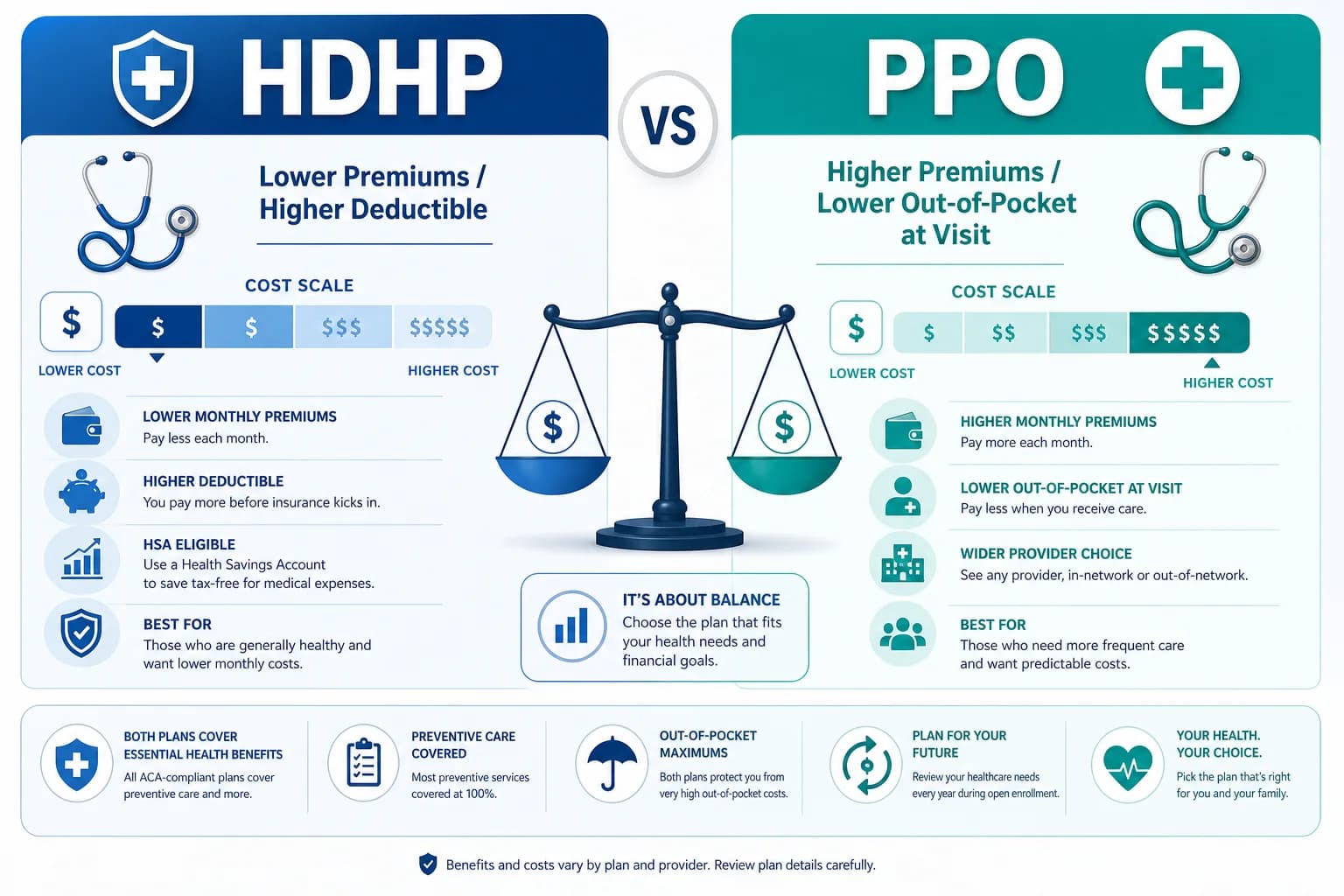
Open enrollment season is here, and your HR portal presents the same confusing choice: a PPO with a $500 deductible and $600 monthly premiums, or an HDHP with a $5,000 deductible and $350 monthly premiums. Which one actually saves you money? The answer is not as simple as "healthy people choose HDHP." It depends on your expected medical spending, your employer HSA contributions, your tax bracket, and your risk tolerance. This guide gives you the calculator, the scenarios, and the decision framework to choose confidently. We compare six real-world situations — from young singles to families with kids to planned pregnancies — and show you exactly when each plan wins.
The Quick Answer — When Each Plan Wins
Choosing between an HDHP and a PPO is not a one-size-fits-all decision. The right answer depends on three factors: your health status, your HSA discipline, and your risk tolerance. Here is the quick framework to determine which plan works for your situation.
Choose HDHP If:
- You are generally healthy with few doctor visits and no chronic conditions
- Your employer contributes to your HSA — that is free money on top of your premium savings
- You can afford to fund the HSA and let it grow year over year
- You want lower monthly premiums and are comfortable with higher deductible risk
- You are disciplined about saving and investing
- You are under age 50, giving you a longer time horizon for HSA investment growth
Typical annual savings with HDHP: $1,200–$3,600 when you factor in premium differences plus HSA contributions plus employer match. Over a 10-year career, that is $12,000–$36,000 in net savings plus accumulated HSA balances that continue growing tax-free.
Choose PPO If:
- You have ongoing medical needs — chronic conditions, regular specialist visits, or daily medications
- You expect major procedures in the coming year such as surgery, pregnancy, or fertility treatment
- You value provider flexibility and want to see specialists without needing referrals
- You prefer predictable costs over variable surprise bills
- You struggle with consistent saving and prefer forced savings via higher premiums
- You have children with frequent medical needs
PPO plans cost more in premiums but reduce the risk of surprise medical bills. For families with asthmatic children or couples planning pregnancy, that predictability is worth the premium premium.
The Break-Even Formula
Here is the math that determines which plan wins for your situation. The break-even point is the annual medical spending level at which both plans cost approximately the same.
Break-Even Medical Spending equals Annual Premium Difference divided by Coinsurance Rate Difference. Using a real example: PPO premium at $6,000 per year versus HDHP premium at $3,600 per year gives a $2,400 difference. If your coinsurance rate is 20% on both plans after the deductible, the break-even medical spending is $12,000 per year. If you expect to spend below $12,000 on medical care annually, the HDHP wins. Above that threshold, the PPO becomes more competitive.
Understanding the Core Differences
What Is a PPO (Preferred Provider Organization)?
A PPO is a health plan with higher monthly premiums but lower deductibles and broader provider networks. You pay more every month regardless of whether you use care, but you pay less when you actually need it.
Typical 2026 costs for an employer PPO family plan include monthly employee premium contributions of $400–$800, annual deductibles of $1,000–$3,000 for families, primary care copays of $20–$50, specialist copays of $40–$80, coinsurance of 10–20% after deductible, and out-of-pocket maximums of $12,000–$18,000 for families. Key PPO advantages include no referral requirements for specialists, out-of-network coverage at higher costs, and predictable copays for routine care.
What Is an HDHP (High-Deductible Health Plan)?
An HDHP is IRS-defined as a plan with a minimum deductible of $1,650 for single coverage or $3,300 for family coverage in 2026. The trade-off is lower monthly premiums in exchange for higher deductibles. The major benefit is HSA eligibility — you can open a Health Savings Account and get triple tax advantages on contributions, growth, and withdrawals for qualified medical expenses.
Typical 2026 costs for an employer HDHP family plan include monthly employee premium contributions of $200–$500, annual deductibles of $3,300–$7,000 for families, preventive care at $0 copay, and out-of-pocket maximums capped by the IRS at $14,100 for families. The critical limitation is that you must meet the full deductible before most coverage kicks in, and out-of-network coverage is often very limited or nonexistent.
Side-by-Side Comparison: HDHP vs PPO (2026 Data)
Here is the head-to-head comparison based on typical 2026 employer-sponsored family plans.
The Real Math — 6 Scenarios Compared
Scenario 1: Young and Healthy Single (Age 26)
Profile: No chronic conditions, annual physical only, no prescriptions. Expected annual care includes one primary care visit covered at $0 for preventive and zero specialist visits.
PPO total annual cost: $4,800 in premiums plus $0 in medical care equals $4,800. HDHP total annual cost: $2,880 in premiums plus $0 in medical care plus $1,000 employer HSA match equals $1,880 net cost. Winner: HDHP saves $2,920 per year. For a healthy young professional, the math is overwhelming.
Scenario 2: Healthy Couple, No Kids (Ages 30–35)
Profile: Both healthy, occasional urgent care visits, no chronic conditions. Expected annual care includes two primary care visits and one urgent care visit.
PPO total annual cost: $7,200 in premiums plus $210 in copays equals $7,410. HDHP total annual cost: $4,200 in premiums plus $500 in medical care minus $1,500 employer HSA match equals $3,200 net cost. Winner: HDHP saves $4,210 per year plus builds a $2,000 HSA balance that remains yours forever.
Scenario 3: Family of 4 with Young Kids (Ages 35–45 Parents)
Profile: Two kids with frequent ear infections, occasional ER visits, no chronic conditions. Expected annual care includes four pediatrician visits, two urgent care visits, one ER visit, and some antibiotics.
PPO total annual cost: $9,600 in premiums plus $1,020 in copays equals $10,620. HDHP total annual cost: $5,400 in premiums plus $3,500 in medical care minus $2,000 employer HSA match equals $6,900 net cost. Winner: HDHP saves $3,720 per year plus builds a $3,000 HSA balance. Caveat: If kids have asthma, allergies, or other chronic conditions requiring monthly specialist visits and daily medications, the PPO may become the better value.
Scenario 4: Chronic Condition Management (Type 2 Diabetes, Age 45)
Profile: Monthly endocrinologist visits, quarterly lab work, daily medications including metformin and insulin. Expected annual care includes 12 specialist visits, four lab panels, and 12 prescription fills.
PPO total annual cost: $6,000 in premiums plus $1,400 in copays equals $7,400. HDHP total annual cost: $3,600 in premiums plus $4,500 in medical care minus $1,500 employer HSA match equals $6,600 net cost. Winner: HDHP saves $800 per year plus builds a $4,300 HSA balance. Note that HSA funds can be used tax-free for all these medical expenses, effectively reducing the net cost further over time.
Scenario 5: Planned Pregnancy (Couple, Age 32)
Profile: Planning pregnancy in the next 12 months with prenatal care and delivery expected. Prenatal care plus vaginal delivery or C-section plus postpartum care and newborn care are factored in.
PPO total annual cost: $7,200 in premiums plus approximately $4,000 in patient responsibility for delivery equals $11,200 estimated total. HDHP total annual cost: $4,200 in premiums plus $6,500 in medical care minus $2,000 employer HSA match equals $8,700 estimated net cost. Winner: HDHP likely saves $2,500 per year if you max HSA and use it for pregnancy costs tax-free. Critical: Start HSA contributions before pregnancy begins — you cannot make catch-up contributions retroactively.
Scenario 6: Near-Retiree with Multiple Conditions (Age 58)
Profile: Hypertension, arthritis, and sleep apnea. Quarterly specialist visits, multiple daily medications, and CPAP equipment. Expected annual care includes eight specialist visits, four primary care visits, 24 prescription fills, and durable medical equipment.
PPO total annual cost: $7,800 in premiums plus $2,300 in copays and prescriptions equals $10,100. HDHP total annual cost: $4,500 in premiums plus $7,050 in medical care minus $2,000 employer HSA match minus $4,300 HSA contribution tax savings equals approximately $5,250 net cost. Winner: HDHP saves $4,850 per year plus builds a $4,300 HSA that becomes a powerful retirement healthcare vehicle after age 65.
At age 58, the HSA takes on added significance. After age 65, HSA funds can be withdrawn tax-free for Medicare premiums, making it a supplemental retirement account with better tax treatment than a 401k or traditional IRA.
The HSA Factor — Why It Changes Everything
Triple Tax Advantage Explained
The HSA is the most tax-advantaged account in the US financial system. It offers three distinct tax benefits working in your favor simultaneously.
- Pre-tax contributions: Money going into your HSA reduces your taxable income the same way a 401k contribution does
- Tax-free growth: Investments inside the HSA compound without capital gains tax
- Tax-free withdrawals: When you spend HSA funds on qualified medical expenses, you pay zero tax
Compare this to a 401k, which has pre-tax contributions but taxed growth and taxed withdrawals. The HSA beats the 401k on every single tax dimension for medical spending.
2026 HSA Contribution Limits
- Single coverage: $4,300 per year
- Family coverage: $8,300 per year
- Catch-up contribution (age 55 or older): additional $1,000 per year
These limits are set annually by the IRS. For a family in the 32% federal tax bracket maxing their HSA at $8,300 per year, the federal tax savings alone are $2,656 annually. That is on top of the premium savings and employer HSA contributions.
Employer HSA Contributions — Free Money
Typical employer HSA contributions range from $500–$2,000 per year for single coverage and $1,000–$4,000 per year for family coverage. This money is not taxable income — it is additional compensation deposited directly into your HSA. A $2,000 employer contribution effectively reduces your net HDHP premium cost by $2,000, making the already-lower HDHP premium even more advantageous.
HSA Investment Strategy for Long-Term Wealth Building
Once your HSA balance exceeds $1,000–$2,000 (varies by provider), most HSA platforms allow you to invest in index funds. The most powerful strategy is to pay current medical expenses out-of-pocket from your regular budget and let the HSA investments grow untouched for decades.
Here is the secret most people miss: you can reimburse yourself for past medical expenses from your HSA at any point in the future, as long as you were enrolled in an HSA-eligible plan at the time of the expense. There is no time limit on HSA reimbursements. This means you can save receipts from 2026 and reimburse yourself in 2046 tax-free.
After age 65, you can withdraw HSA funds for any purpose without penalty. Regular income tax applies on non-medical withdrawals, but the account still functions like a traditional IRA with better tax treatment for medical expenses.
Risk Assessment — What If Things Go Wrong?
Worst-Case Scenario Comparison
PPO worst case: You hit the out-of-pocket maximum of $9,000 for single or $18,000 for family, plus annual premiums. Total maximum annual exposure is $15,000 for single or $27,600 for family.
HDHP worst case: You hit the IRS out-of-pocket maximum of $7,050 for single or $14,100 for family, plus annual premiums, minus any employer HSA contribution. Total maximum annual exposure is approximately $9,150 for single or $16,500 for family — often lower than PPO maximums even in worst-case scenarios.
The Emergency Fund Requirement
The critical requirement for choosing an HDHP is having enough liquid savings to cover your deductible if something goes wrong. For a $5,000 family deductible, you need at least $5,000 in accessible savings — whether in your HSA, emergency fund, or both.
If you cannot fund this reserve, the PPO may be the safer choice because its lower deductible ($500–$1,500) requires less upfront savings to feel secure. The strategy is to build your HSA reserve over time: start with $1,000 in year one, grow to $3,000 in year two, and reach the full deductible level by year three.
When HDHP Becomes Dangerous
HDHP is the wrong choice in these specific situations.
- You have no emergency savings and cannot build an HSA reserve within 12 months
- You have a known major procedure coming — surgery, fertility treatment, or joint replacement — and you cannot afford the deductible
- You have chronic conditions requiring expensive medications that are not covered until the deductible is met
- You are financially stressed and medical debt would cause severe hardship
In these cases, the PPO's predictable costs are worth the premium premium. Healthcare decisions should not add financial crisis on top of medical challenges.
Decision Framework — Choose Your Plan
Quick Decision Matrix
HDHP Decision Checklist
Choose HDHP if you answer YES to four or more of these questions.
- Are you generally healthy with no chronic conditions requiring monthly care?
- Do you have $3,000 or more in emergency savings or can you build an HSA reserve within 12 months?
- Does your employer contribute to your HSA at $500 or more per year?
- Are you disciplined about saving and investing money?
- Do you want to maximize tax-advantaged retirement space?
- Are you under age 50 with a longer time horizon for HSA investment growth?
- Are your expected annual medical costs below $2,000 for single or $4,000 for family coverage?
- Are you comfortable with higher financial risk in exchange for lower premiums?
PPO Decision Checklist
Choose PPO if you answer YES to four or more of these questions.
- Do you have chronic conditions requiring regular specialist visits and medications?
- Do you expect major medical procedures in the coming year such as surgery, pregnancy, or fertility treatment?
- Do you have children with frequent medical needs?
- Do you struggle with consistent saving and prefer forced savings via higher premiums?
- Do you value provider flexibility including out-of-network options without referral requirements?
- Do you have limited emergency savings and cannot build an HSA reserve?
- Are your expected annual medical costs above $4,000 for single or $8,000 for family coverage?
- Do you prefer predictable monthly costs over variable surprise bills?
FAQ — HDHP vs PPO
- Can I have an HSA with a PPO?
- No. HSAs are only available with IRS-qualified High-Deductible Health Plans. Some PPOs have high deductibles but are not HSA-eligible because of their copay structures. Always verify HSA eligibility with your HR department before assuming.
- What happens if I hit my HDHP deductible mid-year?
- After meeting your deductible, your plan pays its share — typically 80 to 100 percent — for remaining covered services for the rest of the year. You still pay copays or coinsurance until hitting the out-of-pocket maximum. Preventive care remains at zero cost throughout the year regardless of deductible status.
- Does my HDHP deductible reset every year?
- Yes, on January 1st for calendar-year plans. Some employers offer deductible carryover where expenses incurred in October through December count toward the next year's deductible. Check your specific plan documents for this benefit.
- Can I switch from HDHP to PPO during the year?
- Generally no, unless you have a qualifying life event such as marriage, birth of a child, job loss, or loss of other coverage. Open enrollment is your annual opportunity to change plan types.
- Are prescriptions covered before deductible on HDHP?
- Sometimes. Many HDHPs cover preventive medications — certain generics and contraceptives — at zero cost before the deductible is met. Most brand-name and specialty drugs require full payment until the deductible is satisfied. Review your plan formulary for specific details.
- How do I know if my HDHP is HSA-eligible?
- Look for three criteria: the plan meets the IRS minimum deductible of $1,650 single or $3,300 family in 2026, there are no non-preventive copays before the deductible, and the out-of-pocket maximum does not exceed IRS limits of $7,050 single or $14,100 family. Your W-2 Box 12 Code W reports any HSA contributions made by your employer.
- Is HDHP worth it if I am pregnant or planning pregnancy?
- Often yes, if you can maximize your HSA and use it for pregnancy costs tax-free. Prenatal care plus delivery typically exceeds the HDHP deductible, but HSA funds offset this cost. The key is starting HSA contributions before conception — you cannot make new HSA contributions after becoming pregnant if you are not enrolled in an HDHP at the time.
- What if I cannot afford my HDHP deductible?
- Prioritize building at least a partial reserve of $1,000 to $2,000 in your HSA. Even small HSA contributions provide tax advantages. Ask healthcare providers for cash-pay discounts which are often 20 to 40 percent off billed rates. Apply for hospital financial assistance programs and negotiate payment plans. Consider switching to a PPO during the next open enrollment if financial stress is severe.
- Do HDHPs cover preventive care before the deductible?
- Yes, by law. Annual physicals, immunizations, cancer screenings, contraceptive counseling, and other USPSTF-recommended preventive services are covered at zero cost on all ACA-compliant plans including HDHPs. However, diagnostic tests triggered by symptoms may apply toward your deductible.
- Can I contribute to an HSA if my spouse has non-HDHP coverage?
- It depends on the coverage type. If your spouse has family coverage under a non-HDHP plan, you cannot contribute to an HSA. If your spouse has self-only non-HDHP coverage, you can contribute up to the family HSA limit minus any HSA contributions your spouse makes. These rules are complex — consult IRS Publication 969 or a tax professional.
- What happens to my HSA if I switch to a PPO next year?
- You keep your HSA forever. Funds roll over indefinitely with no expiration. You can continue using HSA funds for qualified medical expenses tax-free even without HDHP coverage. The only restriction is that you cannot make new contributions while enrolled in non-HSA-eligible coverage.
- Is HDHP or PPO better for retirement planning?
- HDHP wins decisively for retirement planning due to the HSA. After age 65, HSA funds can reimburse Medicare premiums (Part B, Part D, and Medicare Advantage) tax-free. The HSA effectively becomes a supplemental retirement account with better tax treatment than a 401k or IRA for medical-related spending. A PPO offers no equivalent wealth-building vehicle.
Next Steps
Now that you understand the HDHP vs PPO decision framework, take these concrete steps during your next open enrollment.
- Calculate your expected annual medical spending based on your health history and any known upcoming procedures
- Check your employer's HSA contribution amount — this free money significantly changes the math
- Verify you have an emergency fund sufficient to cover your chosen plan's deductible
- If choosing HDHP, open your HSA account early and start contributing before January 1
- Use your HSA as a long-term investment vehicle rather than a spending account — pay current expenses from your regular budget
The right health plan is the one that matches your health reality, your financial situation, and your risk tolerance. Neither plan is universally better — the math determines which one wins for your specific circumstances.
Take control of your money today
Start free with Spendmate — track expenses, plan budgets, and reach your financial goals.
Start free with Spendmate