
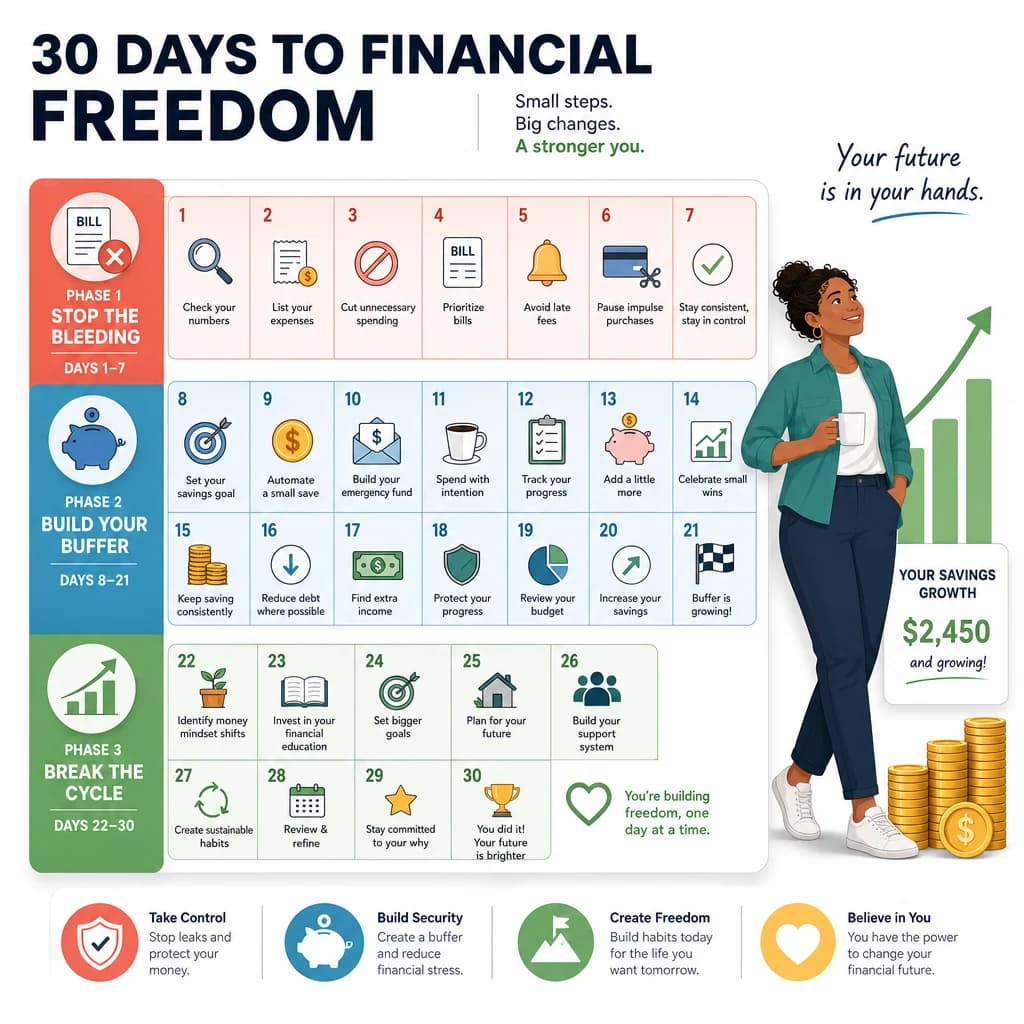
Living paycheck to paycheck is not a character flaw — it is a system problem. Approximately 64% of Americans report covering their expenses with each paycheck, leaving little to no room for emergencies, goals, or peace of mind. The good news: you do not need a higher income to break this cycle. You need a better system. This 30-day plan is designed to help working adults move from surviving each month to actually building financial momentum — one actionable step at a time.
Why Paycheck-to-Paycheck Living Feels So Overwhelming
The stress of living paycheck to paycheck is not just about money. It is about the mental load of not knowing if your income will cover your expenses before the next paycheck arrives. That anxiety leads to decision fatigue, reactive spending, and a persistent sense that you are falling behind — even when you are working hard.
Most people in this situation have one of two root problems: either their income does not cover their essential expenses, or their income does cover essentials but they have no visibility into where their money is actually going. Both are solvable — but they require different approaches.
- Income covers essentials but there is nothing left over — the spending leak problem
- Income does not cover essentials — the income-to-expense gap problem
- No clear picture of monthly cash flow — the visibility problem
- No emergency buffer — any surprise expense triggers debt
- Multiple sources of debt with varying interest rates — the priority problem
Week 1: Build Financial Visibility (Days 1–7)
Before you can change your financial trajectory, you need an honest picture of where you stand. This week is not about making dramatic cuts — it is about getting clear.
Day 1–2: Track Every Dollar for Two Weeks
You cannot fix what you cannot see. For the next 14 days, record every single expense. Use a simple spreadsheet, a notebook, or an app — but commit to capturing everything. This is not about judgment. It is about data.
Day 3–4: Categorize Your Spending
After two weeks of tracking, group your expenses into four categories: Essential (housing, utilities, groceries, transport), Lifestyle (dining out, subscriptions, entertainment), Financial (debt payments, savings contributions), and Waste (impulse buys, unused subscriptions, fees). The goal is not to eliminate everything you enjoy — it is to make intentional choices instead of reactive ones.
Day 5–7: Calculate Your Real Monthly Gap
Take your total monthly income and subtract your essential expenses. What remains is your discretionary budget. From that number, you need three things: a minimum debt payment buffer, an emergency fund allocation, and a realistic lifestyle budget. If your essential expenses exceed your income, that is the gap you need to close — and we will address that in Week 2.
Week 2: Close the Gaps (Days 8–14)
Now that you have visibility, it is time to take action. Depending on your situation, your path will differ.
For the Income Gap Problem
If your essential expenses exceed your income, start by auditing your essential spending for hidden waste. Utility bills, insurance premiums, and subscription services often have lower-cost alternatives. Even a $50 reduction in fixed costs per month closes $600 of annual gap.
Next, explore income levers. Can you pick up a side gig for just 10 hours per month? Can you negotiate a raise, or ask for overtime? Even a modest income increase of $200–$400 per month can fundamentally change your cash flow picture.
For the Spending Leak Problem
If your income covers essentials but nothing remains, your problem is a spending leak. The 50/30/20 framework is a useful starting point: 50% of income toward essentials, 30% toward lifestyle, and 20% toward debt and savings. If your lifestyle spending exceeds 30%, identify the top three categories eating into your budget and set specific reduction targets.
Week 3: Build Your Buffer (Days 15–21)
Living paycheck to paycheck without an emergency fund means any surprise expense — a medical bill, car repair, or appliance failure — forces you into debt. This week is about breaking that cycle.
Open a Separate Emergency Savings Account
If you do not already have one, open a high-yield savings account. Keep it separate from your daily checking account so it is harder to access for non-emergencies. The goal is to build toward three months of essential expenses — but start smaller. Even $500 as a starter buffer eliminates the immediate debt spiral for most minor emergencies.
Automate Your Savings
Set up an automatic transfer of a fixed amount — even $25 or $50 per paycheck — to your emergency account the day after you get paid. When saving is automatic, you spend with intention rather than accident. This is one of the most powerful behavior shifts you can make.
Create a No Spend Challenge
For one week, commit to zero discretionary spending. No dining out, no impulse purchases, no subscription upgrades. Use what you already have. This is not about deprivation — it is about resetting your relationship with spending and demonstrating that you have more control than you think.
Week 4: Make It Permanent (Days 22–30)
Temporary fixes do not create lasting change. This final week is about locking in the systems that will keep you out of the paycheck-to-paycheck cycle for good.
Implement the Pay Yourself First System
The most effective financial habit for breaking the paycheck-to-paycheck cycle is paying yourself first. The moment you receive your paycheck, move your savings allocation to your emergency fund and debt payments before spending on anything else. This flips the default — you no longer save what is left over; you spend what is left after saving.
Build a Debt Priority System
If you carry debt, use the avalanche method: list all debts by interest rate, make minimum payments on all of them, and put every extra dollar toward the highest-interest debt. This minimizes total interest paid over time. If your debt includes multiple high-interest sources, focus on eliminating the smallest balance first for a psychological win — then roll that payment into the next debt.
Set Monthly Financial Reviews
Block 30 minutes at the start of each month to review your previous month spending against your plan. Look for deviations, celebrate wins, and adjust your system if needed. This monthly check-in is what separates people who temporarily improve their finances from those who sustain financial progress year after year.
Common Pitfalls to Avoid
- Trying to overhaul everything at once — pick one change per week and stick with it
- Setting budgets so restrictive that they trigger binge spending — give yourself a realistic lifestyle allocation
- Ignoring irregular expenses — annual subscriptions, insurance premiums, and seasonal costs need to be in your monthly plan
- Using credit cards as an emergency buffer — this often deepens the cycle rather than solving it
- Comparing your progress to others — your starting point, income, and expenses are unique to you
Your 30-Day Starting Point
Here is the sequence: Week 1 is about seeing clearly. Week 2 is about closing the gaps you find. Week 3 is about building a buffer. Week 4 is about making the system automatic. You do not need to have perfect finances to start — you just need to start.
The paycheck-to-paycheck cycle is not a permanent condition. It is a pattern — and patterns can be changed with consistent, intentional action. If you have been putting off getting your finances in order, today is a fine day to begin. The 30-day plan above is designed to be realistic for working adults with limited free time and real financial constraints. Start with Day 1. That is all it takes.
Take control of your money today
Start free with Spendmate — track expenses, plan budgets, and reach your financial goals.
Start free with Spendmate