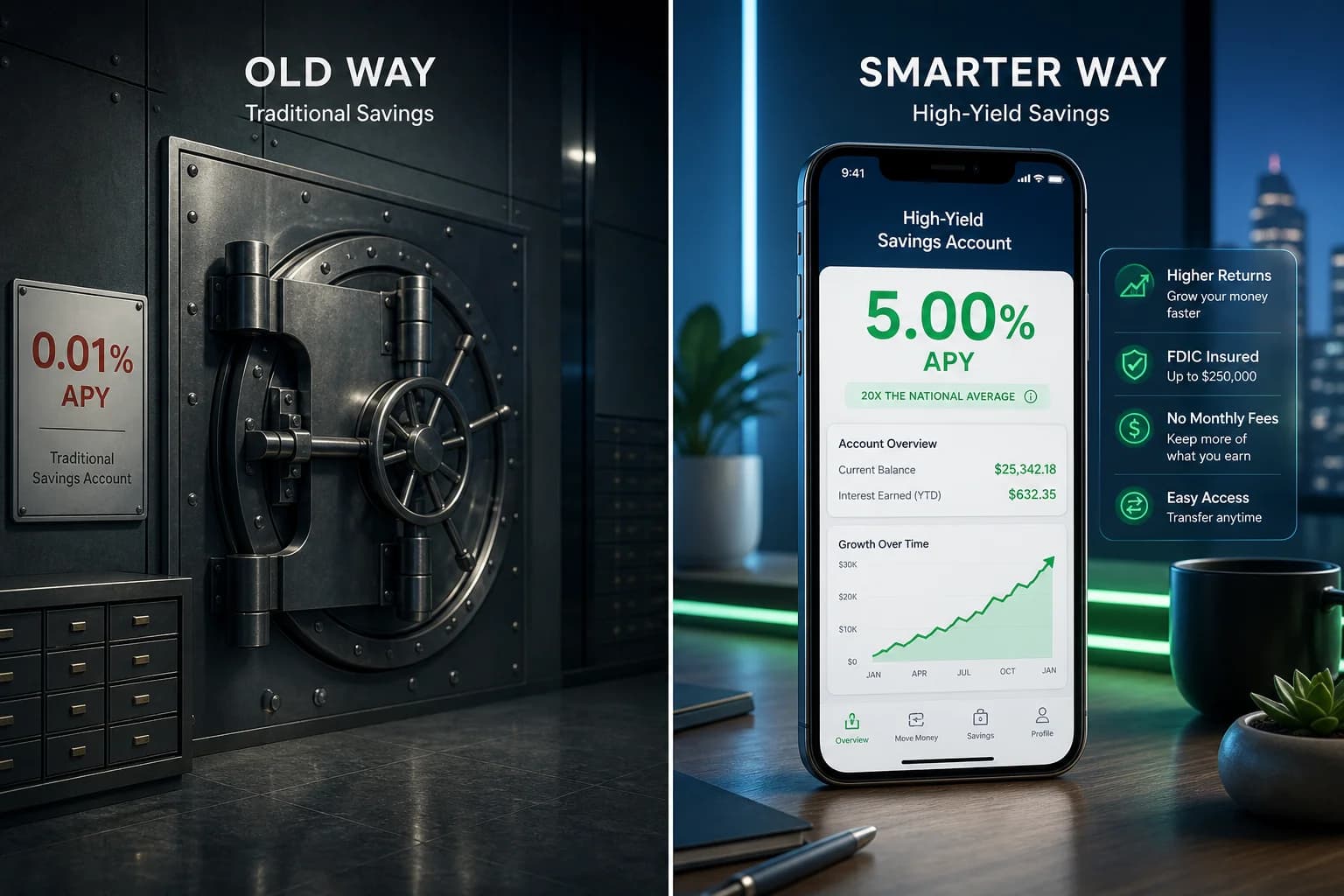
If your emergency fund is sitting in a traditional bank account, you are leaving money on the table. Not to fees, not to fraud — to missed opportunity. While Chase, Bank of America, and Wells Fargo pay 0.01% APY on savings, online banks are paying 5.00%+ APY. On a $10,000 emergency fund, that is the difference between earning $1 per year and $500 per year. Over five years, you would miss out on $2,500+ — not because you did anything wrong, but because you did not know this option existed. This guide changes that.
The Emergency Fund Mistake Millions Are Making
Financial advisors universally recommend keeping three to six months of expenses in a readily accessible savings account. The problem: most Americans follow that advice while earning almost nothing on it. According to Federal Reserve data, 64% of Americans keep emergency savings in traditional checking or savings accounts earning 0.01–0.05% APY. Another 23% keep it in cash at home or non-interest accounts. Fewer than 13% have emergency funds in high-yield vehicles. budgeting rules BNPL vs credit cards
Where Americans Actually Keep Emergency Savings
- 64% in traditional checking/savings (0.01–0.05% APY)
- 23% in cash at home or non-interest accounts
- Only 13% in high-yield vehicles (HYSA, money market, Treasury bills)
The Hidden Cost of Traditional Savings
The numbers are stark. A $10,000 emergency fund at 0.01% APY earns approximately $1 per year. The same $10,000 at 5.00% APY earns roughly $500 per year. Over five years, the gap widens to $2,500+. That is not hypothetical — it is real money earned by people who made a five-minute decision to move their savings to a high-yield account. budgeting rules BNPL vs credit cards
Why This Happens: Inertia and Misconceptions
Three myths keep people in low-yield accounts. First: "My bank is safe." That is true — but online banks carry the same FDIC insurance as Chase or Bank of America. Second: "I do not want to deal with a new bank." Opening an account takes about 15 minutes. Third: "I will lose access to my money." False. You can transfer funds back to your checking account within one to three business days. budgeting rules BNPL vs credit cards
What Is a High-Yield Savings Account?
A high-yield savings account (HYSA) is a savings account that pays significantly higher interest than traditional banks. These accounts are typically offered by online-only banks, which have lower overhead costs and pass those savings along to customers through higher APYs. Despite the name, HYSAs are not risky investment products — they are savings accounts with the same federal protections as any bank. budgeting rules BNPL vs credit cards
How HYSA Interest Works
APY stands for Annual Percentage Yield, and it includes the effect of compounding. Most HYSAs compound interest daily and credit it monthly. When a bank advertises 5.00% APY, that is the total annual return you would earn if you left your money in the account for a full year without making any withdrawals. Rates are variable, meaning they can go up or down as the Federal Reserve changes its benchmark rate.
Current Rate Environment (June 2026)
The Federal Reserve has held its benchmark rate at 5.25–5.50% since mid-2024, and no cuts are expected through 2026. This has created historically favorable conditions for savers. Top HYSAs are currently paying 4.75–5.25% APY, while traditional bank savings accounts average just 0.03–0.05% APY. If you are earning less than 4% on your emergency fund, your bank is not giving you a competitive rate.
Is Your Money Safe in a High-Yield Savings Account?
This is the most common objection to HYSAs, and it deserves a thorough answer. Your money is just as safe in an online high-yield savings account as it is in a traditional bank. Here is why. BNPL vs credit cards
FDIC Insurance Explained
The Federal Deposit Insurance Corporation (FDIC) insures deposits up to $250,000 per depositor, per bank, and per ownership category. This protection applies to all FDIC-insured banks, including online-only institutions. If the bank fails, the FDIC reimburses your deposits. You can verify any bank is FDIC-insured at fdic.gov/bankfind. HYSAs from Ally Bank, Marcus by Goldman Sachs, American Express, and Discover Bank all carry FDIC coverage through their respective banking affiliates. BNPL vs credit cards
Online Bank Safety Concerns Addressed
Online banks are real banks. They are regulated by the same federal agencies as Bank of America and Wells Fargo. Many are owned by large financial institutions you already know: Marcus is backed by Goldman Sachs, and American Express High Yield Savings is backed by American Express. Online banks use the same 256-bit encryption, two-factor authentication, and fraud monitoring as traditional banks. budgeting rules
Can You Lose Money in a HYSA?
No. Unlike brokerage or retirement accounts, HYSAs do not invest your money in stocks or bonds. Your principal deposit is fully protected. The only real risk is inflation outpacing your interest rate — but at 5% APY and with inflation running at 2–3%, your money is growing in real terms. By comparison, a traditional savings account at 0.01% APY is losing purchasing power every year. budgeting rules BNPL vs credit cards
HYSA vs Money Market vs CDs — Which Is Best for Emergency Funds?
Before choosing a home for your emergency fund, it helps to understand the three most common alternatives.
- HYSA: APY 4.75–5.25%, funds accessible anytime, no minimum deposit at most banks, variable rates
- Money Market Account: APY 4.50–5.00%, may include check-writing or debit card access, sometimes requires $1,000–$2,500 minimum
- Certificate of Deposit (CD): APY 4.50–5.50%, funds locked until maturity, early withdrawal penalties of 3–12 months interest
For emergency funds, HYSAs win because they combine competitive yields with full liquidity. Money market accounts can be useful if you want check-writing access, but most offer similar or slightly lower rates. CDs are poor choices for emergency funds because emergencies are unpredictable — you cannot wait for a CD to mature if your car breaks down tomorrow. BNPL vs credit cards
Top 7 High-Yield Savings Accounts for Emergency Funds (June 2026)
Here are the seven best HYSAs currently available for emergency fund storage. All are FDIC-insured, and all are available to open online in approximately 15 minutes.
#1 — Ally Bank Performance Savings — Best Overall
- APY: 5.00%
- Minimum: $0
- FDIC: Yes
- Key Features: No monthly fees, Buckets goal-tracking feature, 24/7 customer support, strong mobile app
- Transfer Speed: 1–3 business days
- Best For: Most people looking for a reliable, full-featured HYSA
#2 — Marcus by Goldman Sachs — Best Brand Trust
- APY: 5.10%
- Minimum: $0
- FDIC: Yes (Goldman Sachs Bank USA)
- Key Features: Backed by Goldman Sachs, no fees, easy external transfers, strong security reputation
- Transfer Speed: 1–3 business days
- Best For: People who want the reassurance of a big-bank name with online rates
#3 — Capital One 360 Performance Savings — Best for Existing Customers
- APY: 5.00%
- Minimum: $0
- FDIC: Yes
- Key Features: Integrates with Capital One checking, physical Capital One Cafés available for in-person support, no fees
- Transfer Speed: 1–2 business days
- Best For: Existing Capital One customers, or people who want branch access as an option
#4 — Discover Bank Savings — Best Cashback Debit Integration
- APY: 5.00%
- Minimum: $0
- FDIC: Yes
- Key Features: Strong mobile app, Discover debit card integration with cashback rewards, no fees
- Transfer Speed: 2–3 business days
- Best For: Discover card users who want to consolidate banking with a rewards brand
#5 — American Express High Yield Savings — Best for AmEx Customers
- APY: 5.05%
- Minimum: $0
- FDIC: Yes (American Express National Bank)
- Key Features: Trusted American Express brand, simple interface, quick setup for existing AmEx cardholders
- Transfer Speed: 1–3 business days
- Best For: American Express credit card holders who already trust the brand
#6 — CIT Bank Platinum Savings — Highest Available Rate
- APY: 5.25% (tiered — requires $5,000+ balance for top rate; $100 minimum for standard rate)
- Minimum: $100 standard, $5,000 for top tier
- FDIC: Yes
- Key Features: Highest published rate among major online banks, no monthly fees
- Transfer Speed: 1–3 business days
- Best For: People who already have $5,000 or more for their emergency fund
#7 — SoFi Checking + Savings — Best All-in-One Banking
- APY: 5.00% (requires direct deposit for top rate; otherwise 1.20%)
- Minimum: $0
- FDIC: Yes (through partner banks, up to $2M via sweep network)
- Key Features: Checking and savings in one app, early direct deposit, member perks, no fees
- Transfer Speed: Instant between SoFi accounts, 1–3 business days for external transfers
- Best For: People who want to consolidate checking and savings in one app
How to Open a High-Yield Savings Account (Step-by-Step)
The process takes about 15 minutes. Here is how to do it, step by step.
Step 1: Choose Your Bank
Use the comparison above to match your priorities. If brand trust matters most, go with Marcus. If you want the highest possible rate and have $5,000 to deposit, CIT Bank is the top choice. If you want a balanced all-around option, Ally is the safest pick. Verify the bank is FDIC-insured at fdic.gov/bankfind before proceeding. BNPL vs credit cards
Step 2: Gather Required Information
- Social Security Number
- Government-issued photo ID (driver license or passport)
- Current address and proof of address if recently moved
- Existing bank account routing and account numbers (for linking and initial transfer)
- Email address and phone number
Step 3: Complete the Online Application
Go to your chosen bank website or download their mobile app. Click "Open Account" and select the savings account option. Enter your personal information, answer identity verification questions (these are automated), set up your login credentials, and link your external bank account. The entire process takes 10–15 minutes. budgeting rules
Step 4: Fund Your Account
You can fund your new HYSA via ACH transfer from your existing bank (one to three business days), wire transfer (same day, typically $15–30 fee), or mobile check deposit if your new bank offers it. Set up direct deposit if you want ongoing contributions from your paycheck to happen automatically — this also triggers the highest APY at SoFi.
Step 5: Set Up Automation
This is the step most people skip, and it costs them long-term returns. Schedule a recurring transfer from your checking to your HYSA — even $100–200 per paycheck adds up faster than you think. If your chosen bank has a savings goal or "bucket" feature (Ally calls theirs Buckets), use it to label your emergency fund clearly so it feels psychologically distinct from your spending money.
Step 6: Update Your Financial Plan
Add your new HYSA to your net worth tracker and budget spreadsheet. Make sure anyone who might need emergency access knows the account details and how to transfer funds back to a checking account. Review your HYSA balance quarterly to ensure you are on track with your emergency fund goal — and check whether your APY has changed, since rates are variable. budgeting rules
Moving Your Emergency Fund — What You Need to Know
Timeline Expectations
ACH transfers take one to three business days to clear. Wire transfers are same-day but usually cost $15–30. The most important rule: do not close your old account until the transfer has fully cleared and you can confirm the funds arrived in your new HYSA. Rushing to close the old account before verification is the most common mistake people make. budgeting rules BNPL vs credit cards
Tax Implications
Interest earned on your HYSA is taxable income. You will receive a 1099-INT form from your bank at the end of the year if you earn more than $10 in interest. This is the same tax treatment as interest from a traditional savings account. There is no tax penalty for moving money between accounts, and you do not need to report the transfer itself. budgeting rules BNPL vs credit cards
Common Mistakes to Avoid
- Closing your old bank account before the transfer fully clears
- Forgetting to update automatic transfers or direct deposits after moving accounts
- Not verifying FDIC coverage before opening an account
- Choosing a bank based only on rate while ignoring fees or access features
- Opening multiple HYSAs and losing track of balances — one account is simpler
Maximizing Your HYSA Returns
Understand Rate Changes
All HYSAs have variable rates. This means your APY can go up or down when the Federal Reserve changes its benchmark rate. Set a calendar reminder to review your rate quarterly. If your bank drops significantly below market rates, consider moving your emergency fund to a higher-yielding option — the switching process takes about 15 minutes, just like opening the original account. budgeting rules
Avoid Fees That Erase Your Gains
One of the advantages of online HYSAs is that most charge zero monthly fees, zero overdraft fees, and zero withdrawal fees (up to the regulatory limit of six per month). Before opening an account, confirm the fee schedule. The banks recommended above all offer fee-free structures, which means 100% of your interest rate goes straight to your balance. budgeting rules BNPL vs credit cards
Compound Interest Acceleration
The most powerful force in savings is compounding. Leave your interest payments in the account rather than withdrawing them. Add to your principal regularly, even in small amounts. A $10,000 emergency fund at 5% APY, with $200 added monthly, grows to approximately $22,000 in five years. That is $10,000 in contributions and $2,000 in interest earned — with zero investment risk. budgeting rules BNPL vs credit cards
FAQ — High-Yield Savings Accounts for Emergency Funds
- Are high-yield savings accounts safe?
- Yes. HYSAs are FDIC-insured up to $250,000 per depositor, per bank, per ownership category — the same protection as traditional banks. Your money is not invested in stocks or bonds, so there is no market risk.
- Can I lose money in a high-yield savings account?
- No. The principal balance in a HYSA is protected. Unlike brokerage accounts or retirement accounts, HYSAs do not hold stocks, bonds, or any investment product. You can only lose money if inflation dramatically outpaces your rate — which is not the case at 5% APY in 2026.
- What is the best APY for savings accounts in 2026?
- The highest available APY for standard HYSAs in June 2026 is approximately 5.25% (CIT Bank Platinum Savings, for balances of $5,000 or more). Most top HYSAs are in the 5.00–5.10% range. Compare APYs directly, not advertised rates, and confirm whether minimum balance requirements apply for the top tier.
- How fast can I withdraw money from a HYSA in an emergency?
- Most HYSAs allow transfers back to your linked checking account within one to three business days via ACH. Some banks, like SoFi, offer instant transfers between internal accounts. You can also wire funds for same-day delivery, though wire transfers typically carry a $15–30 fee.
- Are there withdrawal limits on high-yield savings accounts?
- Yes. Federal Regulation D limits savings accounts to six "convenient" withdrawals or transfers per month. This includes transfers, automatic payments, and online banking transfers. After six, your bank may decline the transaction or charge a fee.ATM withdrawals and in-person withdrawals at a bank branch typically do not count toward this limit.
- Do I pay taxes on HYSA interest?
- Yes. Interest earned on a HYSA is taxable income, just like interest from a traditional savings account. If you earn more than $10 in interest during the year, your bank will send you a 1099-INT form for tax filing. The interest is taxed at your ordinary income rate.
- Should I keep my emergency fund in a HYSA or money market account?
- For most people, a HYSA is the better choice for an emergency fund. HYSAs typically offer equal or higher rates than money market accounts, have no minimum deposit requirements (or very low ones), and are simpler to manage. Money market accounts make sense if you need check-writing or debit card access to your savings.
- What happens to my HYSA if interest rates drop?
- Because HYSA rates are variable, they will decrease if the Federal Reserve cuts rates. When this happens, your APY will fall. This is why it is worth reviewing your rate quarterly — if your bank drops significantly below competitors, you can transfer your emergency fund to a higher-yielding option in about 15 minutes.
- Can I have multiple high-yield savings accounts?
- You can, but it is usually unnecessary and complicates tracking. FDIC coverage protects up to $250,000 per bank, so if your emergency fund exceeds that amount, splitting across two FDIC-insured banks makes sense. Otherwise, one HYSA with a clear label is easier to manage and track.
- How do I verify a bank is FDIC insured?
- Use the FDIC BankFind tool at fdic.gov/bankfind. Enter the bank name or URL to see its FDIC certificate number, coverage details, and any history of mergers or acquisitions. All banks recommended in this guide are currently FDIC-insured.
Take control of your money today
Start free with Spendmate — track expenses, plan budgets, and reach your financial goals.
Start free with Spendmate