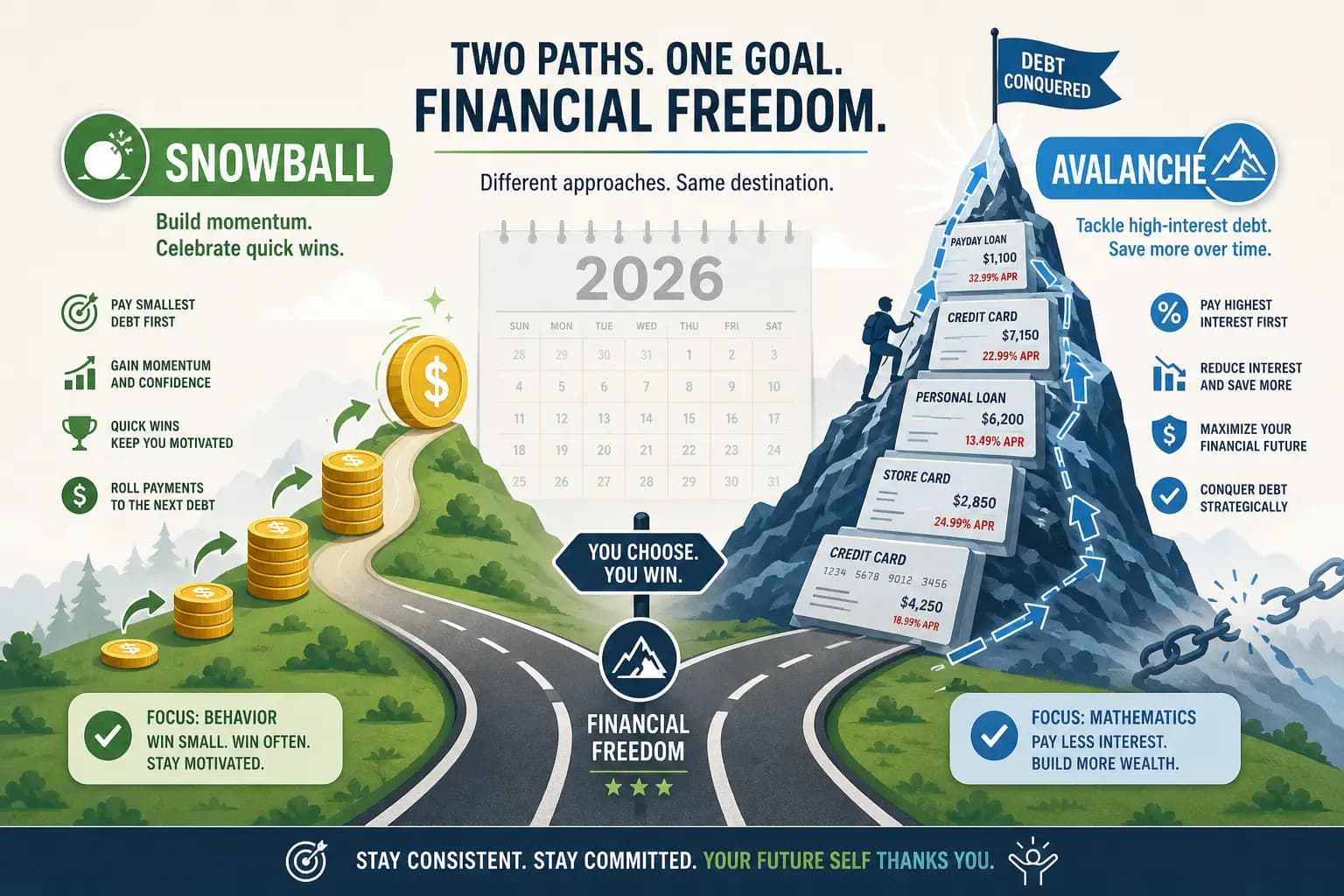
You have made a decision most people never get around to: you are going to attack your debt head-on. Good for you. Now comes the part where most guides dump a ton of math on you and expect you to figure it out. Here is the short version: debt snowball and debt avalanche are both legitimate ways to become debt-free. But the method that actually works for you depends entirely on your personality, your debts, and whether you can stick with it long enough to finish. This guide breaks down everything so you can pick the right approach in 2026.
The Quick Answer: Math Says Avalanche, Behavior Says Snowball
The debt snowball and debt avalanche methods share the same foundational steps: make minimum payments on everything, put extra money toward one debt, and roll payments forward as each debt is paid off. The difference lies in which debt you target first, and that single decision changes how much interest you pay and how motivated you stay.
In 2026, credit card interest rates remain historically high. Average APRs are above 20%, according to Federal Reserve data. That makes your payoff method more consequential than it was during the low-rate years of 2020 to 2024. Behavioral science also shows that the method you actually stick with beats the method that looks better on paper.
What Is the Debt Snowball Method? How It Works
The debt snowball method, popularized by financial coach Dave Ramsey, prioritizes paying off your smallest debts first, regardless of interest rate. You line up all debts from smallest balance to largest, make minimum payments on everything, and throw every extra dollar at the smallest debt. Once it is paid off, you move to the next smallest, building momentum like a snowball rolling downhill.
Here is how to do it step by step:
- List all your debts from smallest balance to largest
- Make minimum payments on every debt
- Put any extra money toward the smallest debt
- When the smallest debt is paid off, take that full payment and add it to the next smallest
- Repeat until every debt is gone
The psychological appeal is real: you get quick wins. Paying off a debt in weeks or months rather than years triggers dopamine and builds confidence. That momentum helps you stay committed when the journey gets long.
What Is the Debt Avalanche Method? How It Works
The debt avalanche method targets your highest-interest debt first, regardless of balance size. You line up debts from highest APR to lowest, make minimum payments on everything, and focus extra cash on the most expensive debt. Mathematically, this is the most efficient approach. You pay less total interest and usually become debt-free faster.
Here is how to do it step by step:
- List all your debts from highest interest rate to lowest
- Make minimum payments on every debt
- Put any extra money toward the highest-APR debt
- When it is paid off, move to the next highest rate
- Repeat until every debt is gone
The avalanche method requires more patience upfront. The highest-interest debt is often the largest balance, meaning it takes longer to see your first win. But the numbers are on your side.
Snowball vs Avalanche vs Hybrid: Side-by-Side Comparison
Here is how the three approaches stack up against each other:
The Real Question: Which One Will YOU Stick With?
Here is the question that actually matters: Does it matter which method is mathematically superior if you quit after three months because you lost motivation? A study from Northwestern University Kellogg School of Management found that households using the snowball method were more likely to stay committed to their payoff plan and ultimately paid off more debt. The method that keeps you in the game wins.
Both methods work when applied consistently. The best method is the one you will actually follow.
When to Choose Debt Snowball
Debt snowball is the right choice if:
- You have tried to pay off debt before and lost steam. Quick wins help you rebuild momentum
- Your smallest debt feels embarrassingly small (under $500) and paying it off would feel like a genuine victory
- You are the type who needs visible, tangible progress to stay motivated
- You have a history of starting strong but fading out. Snowball early wins help prevent that
- Your debts are fairly similar in interest rates. The psychological boost of snowball matters more when rates do not vary dramatically
- You have already tried the avalanche approach and abandoned it
When to Choose Debt Avalanche
Debt avalanche is the right choice if:
- You have high-interest credit card debt at 20%+ APR. The savings from targeting high-rate debt first are substantial in 2026
- You are data-driven and the idea of paying more interest than necessary bothers you
- You can stay motivated without immediate validation. You trust the process even before seeing wins
- Your highest-interest debt is also one of your smaller balances. You get the best of both worlds
- You have a stable income and a financial runway. You can afford to wait several months for your first payoff
- You have strong willpower and a history of sticking to long-term financial plans
The Hybrid Approach: Best of Both Worlds?
Can you combine the two methods? Absolutely. Many financial coaches recommend a hybrid approach, sometimes called the debt snowball avalanche. The idea is simple: start with snowball to get 2-3 quick wins and build momentum, then pivot to avalanche once you have established the habit and confidence. At that point, you are paying off high-interest debt efficiently while having already built the discipline and motivation to continue.
Here is how to execute the hybrid approach:
- Pay off your 2-3 smallest debts using snowball logic. Get quick wins
- Reassess your remaining debts and their interest rates
- Pivot to avalanche: target the highest-APR remaining debt
- Roll all freed-up payments from paid-off debts into your avalanche target
- Continue until all debt is cleared
This approach acknowledges the behavioral science behind debt payoff: momentum matters. You build habits and confidence early, then optimize once the system is running.
Real Examples: How Long Each Method Takes
Let us look at a realistic scenario to see how the math plays out. Suppose you have:
- Credit Card A: $3,000 balance, 22% APR, minimum payment $75
- Credit Card B: $5,000 balance, 18% APR, minimum payment $125
- Personal Loan: $8,000 balance, 12% APR, minimum payment $200
You have $400/month total to put toward debt beyond minimums. That is $400 extra on top of the $400 in minimums you are already paying.
With the Snowball Method: You attack Credit Card A ($3,000) first. With extra payments, you pay it off in about 8 months. Then you roll $75/month (plus the $400 extra = $475/month) toward Credit Card B. You pay off Card B around month 18. Then you roll $200/month toward the personal loan and pay it off around month 32. Total interest paid: approximately $4,100.
With the Avalanche Method: In this scenario, the highest-rate debt (Credit Card A at 22% APR) is also the smallest balance. Both methods point to the same debt first. You get the best of both worlds without choosing. When the highest-rate debt is also the largest balance, avalanche would save more interest. The conflict between snowball and avalanche becomes sharpest when your highest-rate debt has a very large balance, meaning months of waiting before your first win.
Key insight: When your highest-interest debt also happens to have a manageable balance, both methods align and you get the best outcomes without choosing.
Tools and Apps That Make Debt Payoff Easier in 2026
Technology has made tracking debt payoff dramatically easier. Automation removes the need for willpower. Once you set up your system, the app handles the tracking and calculations. Here are tools that support both snowball and avalanche strategies:
- Undebt.it. Free tool that lets you input your debts and choose your payoff method, showing exactly how long each approach takes and how much interest you save
- Debt Payoff Calculator. Simple calculator for comparing snowball vs avalanche with real numbers
- YNAB (You Need A Budget). Zero-based budgeting app that helps you allocate every dollar toward debt payoff
- Rocket Money. Tracks your debts, shows your payoff timeline, and helps identify subscriptions to cancel for more debt-payoff cash
For a complete budgeting system that complements your debt payoff journey, check out our guide on how to track expenses. And if you want to build an emergency fund alongside your debt payoff, our article on how much emergency fund you actually need covers exactly that.
Why 2026 Makes This Decision More Important
The 2026 interest rate environment changes the calculation. With average credit card APRs still above 20%, the cost of carrying high-interest debt is substantial. The Federal Reserve current monetary policy has kept rates elevated compared to the near-zero era of 2020-2021. This means:
- The interest savings from avalanche are larger in a high-rate environment. More reason to consider it if you can stay motivated
- Minimum payments cover less principal now. Paying extra is more critical than ever
- Balance transfer offers are still available but at higher qualification thresholds. Not everyone qualifies for 0% intro APR cards
- The psychological pressure of debt is heightened. Making the motivation factor of snowball more valuable
Whatever method you choose, the single most important action is paying more than the minimum. That is where your real progress lives.
What to Do When You Lose Motivation
Both methods hit a wall. Here is how to handle it for each:
Snowball motivation dips: Revisit your paid-off debts list. Look at how far you have come. The quick wins from snowball are meant to prevent this. If you are losing steam, check whether you are celebrating small victories. Every paid-off debt deserves acknowledgment.
Avalanche motivation dips: Calculate how much interest you have saved so far versus snowball. Sometimes seeing the math makes the patience worthwhile. If the highest-rate debt is taking too long, consider a temporary pivot to snowball for one small debt. Get a win, then return to avalanche.
Can you switch methods mid-stream? Yes. There is no penalty for changing your approach. If you started with avalanche and it is not working, try snowball for your next debt. The best debt payoff plan is the one you finish.
FAQ: Debt Snowball vs Debt Avalanche
Take control of your money today
Start free with Spendmate — track expenses, plan budgets, and reach your financial goals.
Start free with Spendmate