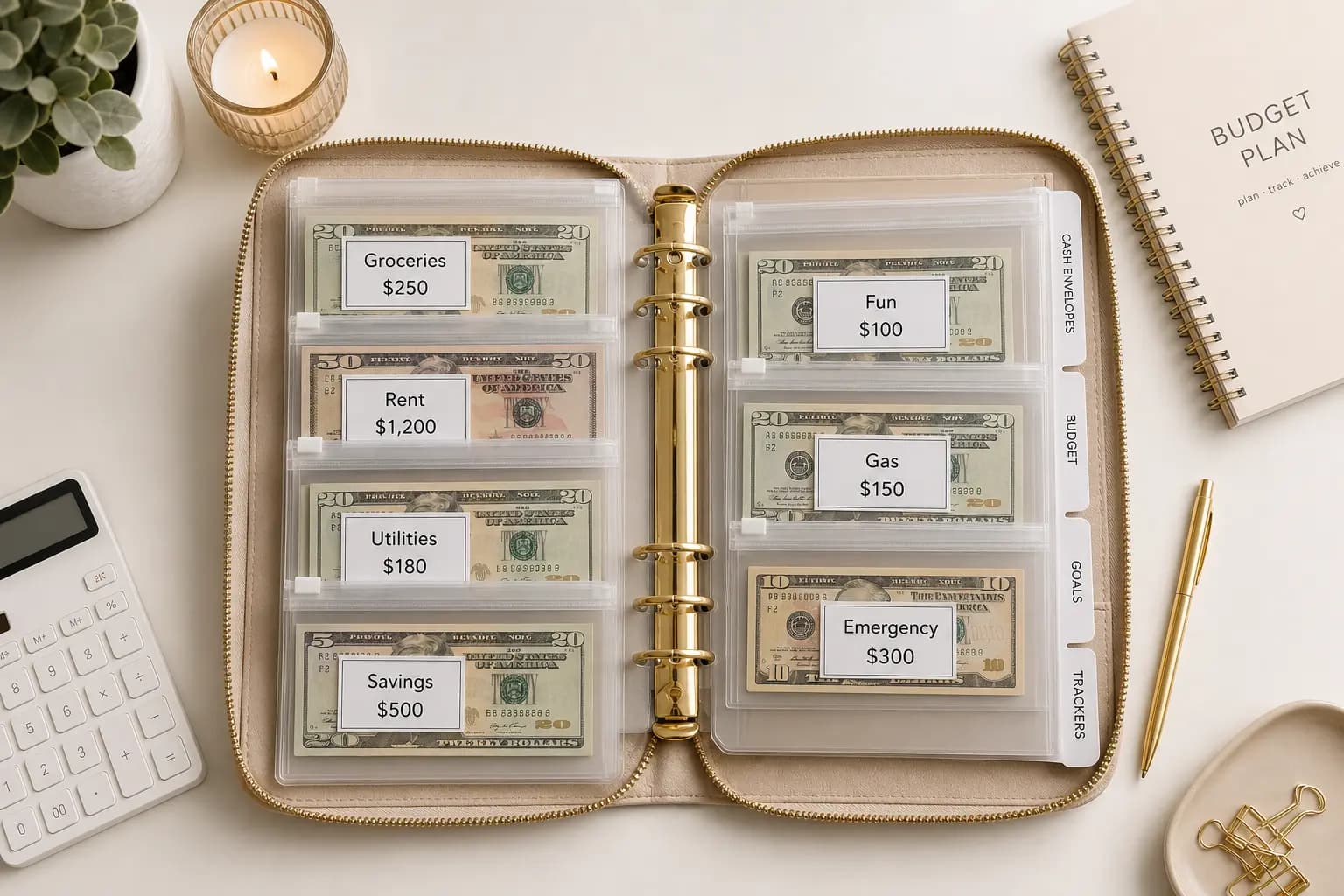
On TikTok, creator @meganbuysstuff gained 2.3 million followers by filming herself sorting cash into labeled envelopes every payday. Her most-watched video shows the moment she pays off her last credit card using money she saved from her dining envelope. The comments are flooded with people asking where to start. Cash stuffing, the budgeting method behind those satisfying envelope videos, has become one of the most searched personal finance topics of 2025 and 2026, with the hashtag #cashstuffing accumulating over 500 million views. But beyond the aesthetic appeal of organized binders and crisp bills, does this viral envelope budgeting system actually work for building real financial discipline? And is it the right tool for your specific money challenges? This guide covers how cash stuffing works, the psychology behind why it helps certain people, exactly how to set it up, the safety trade-offs, and who benefits most from this budgeting revival.
What Is Cash Stuffing? (Beyond the TikTok Hype)
Cash stuffing is a budgeting method where you withdraw your monthly spending money in physical cash and divide it into labeled envelopes, each representing a spending category. When the cash in an envelope is gone, you stop spending in that category until the next month. It is a simple concept rooted in the envelope budgeting system popularized by Dave Ramsey, now experiencing a viral revival among younger generations discovering its tactile benefits. The core principle remains unchanged: assign every dollar a job before you spend it.
The Basics: Physical Cash + Categories = Spending Awareness
- Withdraw your monthly variable spending budget in cash
- Divide the cash into envelopes labeled by category (groceries, dining, entertainment, etc.)
- Spend only from the relevant envelope, no dipping into other categories
- When an envelope is empty, that category is done for the month
- Track what remains at the end of the month to adjust future allocations
Why It Went Viral in 2025-2026
Several converging factors drove this resurgence. Financial anxiety is at an all-time high, with approximately 61% of Americans reporting they live paycheck to paycheck, according to a 2025 CNBC survey. Digital spending through cards and apps feels invisible and frictionless, making it easy to overspend without registering the loss. The TikTok algorithm amplifies satisfying organization content, and there is a growing backlash against complex budgeting apps that feel overwhelming. For many, physically handling cash creates a psychological barrier to spending that feels reassuring.
Dave Ramsey Envelope System Origins
The envelope budgeting system dates back to the mid-20th century and was popularized by Dave Ramsey in the 1990s and 2000s as part of his debt snowball method. Gen Z and Millennials are now reinventing it for their own context: digital-first banking, student loan debt, and economic uncertainty. Cash stuffing is essentially the original envelope budgeting system, now dressed up for TikTok.
The Psychology: Why Cash Stuffing Works (For Some People)
Cash stuffing is not just about the money itself. It is about the psychological relationship you develop with your spending, and research in behavioral economics explains why physical cash creates a fundamentally different experience compared to swiping a card.
The Pain of Paying: Cash Hurts More Than Cards
In their 2001 paper "Mental Accounting and Envelopes," Thaler and Johnson demonstrated that physical cash activates different brain regions than digital payments. When you hand over a $20 bill, your brain registers the loss more acutely than when you swipe a card. Cards create frictionless spending: no immediate pain, no physical reminder of depletion. Cash makes spending visible and visceral. Watching bills leave your wallet creates a natural psychological brake on unnecessary purchases. This phenomenon, sometimes called "the pain of paying," is well documented in behavioral economics research.
Visual Accountability: You See Exactly What Is Left
One of the biggest advantages of cash stuffing is immediate visual feedback. You do not need to open an app, log into a banking portal, or memorize numbers. The thickness of each envelope tells you exactly how much is left in that category. This real-time awareness prevents the shock of checking your account balance only to find it nearly empty. For people who avoid checking their finances, this tactile system forces honest visibility.
Forced Boundaries: When It Is Gone, It Is Gone
Unlike budgeting apps that warn you when you are approaching a limit but still let you spend, cash stuffing creates a hard physical boundary. You cannot spend what is not there. There are no overdrafts, no "I will pay it back later" excuses, no category creep where one budget bleeds into another. These constraints, while sometimes inconvenient, build discipline by teaching you to live within set limits.
Who Benefits Most?
- Chronic overspenders in specific categories like dining out, shopping, or entertainment
- People who feel disconnected from their money because spending feels invisible
- Those recovering from debt who need strict, non-negotiable boundaries
- Visual and tactile learners who respond better to physical cues than digital numbers
- Anyone seeking a reset after a period of uncontrolled spending
How to Start Cash Stuffing: Step-by-Step Setup
Starting cash stuffing does not require special skills or expensive supplies. Follow these five steps to set up your system correctly from day one.
Step 1: Choose Your Categories (Start Small)
Resist the urge to create a category for everything. Start with 3-5 variable spending categories maximum. Recommended starter categories include Groceries (your food and household items), Dining Out (restaurants, coffee shops, takeout), Entertainment (movies, streaming if you pay in cash, hobbies), and Personal Care (haircuts, toiletries, gym membership). Fixed bills like rent, utilities, or insurance do not go into envelopes. Pay those through automatic transfers or recurring payments.
Step 2: Determine Cash Amounts Per Category
Review your last three months of spending in each category you want to cash-stuff. Look at bank and credit card statements to get realistic numbers rather than aspirational ones. Suppose you spent $350 on groceries historically. Budget $350 and adjust downward gradually. Example allocation: Groceries $400, Dining Out $150, Entertainment $100, Personal Care $75. Total: $725 in cash per month.
Step 3: Get Your Supplies
You need envelopes (plain manila envelopes from an office supply store work perfectly), a binder or accordion folder to organize them, a marker or labels for writing category names, and a safe storage location at home. You do not need the decorative binders marketed on TikTok. Function matters more than aesthetics, and our guide on how to track expenses shows a complete tracking system that complements your cash stuffing setup.
Step 4: Withdraw Cash on Payday
Choose a consistent day, ideally payday, to visit your bank or ATM and withdraw your total envelope budget. The discipline happens here: withdraw the full amount and immediately stuff your envelopes before spending anything. Do not skip straight to spending and plan to stuff envelopes later. That approach almost always fails. If you get paid twice a month, align your withdrawals with each payday.
Step 5: Track and Adjust Monthly
At the end of each month, examine what happened. Which envelopes ran out early? Which ones had money left over? Use this information to adjust next month's allocations. If the dining envelope consistently runs out by the third week, either reduce discretionary dining or increase that allocation. If $50 consistently remains in entertainment, reallocate that to savings. This monthly review is where real budgeting improvement happens.
Cash Stuffing Supplies: What You Actually Need
Bare Minimum (Under $10)
- Standard envelopes from any office supply or dollar store
- A shoebox, desk drawer, or small storage container for organization
- A pen for writing category names on each envelope
Popular Upgrades ($20-$50)
- A budget binder with pre-formed pockets or zipper compartments
- Pre-printed category labels or a label maker for a cleaner look
- Decorative envelope designs available on Etsy or Amazon if aesthetics motivate you
- Cash tray inserts to keep bills organized and flat
What You Do Not Need
- Expensive custom binders costing $60 or more. They do not budget better than cheap ones
- Matching aesthetic sets. Focus on function over Instagram appeal
- Hundreds of envelopes. Start with 5 categories maximum
- Fancy accessories like specialized cash counters or decorative washi tape. This is about budgeting, not crafts
Safety Considerations: The Real Risks of Cash Stuffing
Before you withdraw $700 in cash and start stuffing envelopes, understand the genuine risks. Most social media posts about cash stuffing skip this conversation entirely, but it is arguably the most important section of this guide.
Risk 1: Theft or Loss
Cash is not protected by FDIC insurance the way bank deposits are. If your cash is stolen from your car, lost during a move, or taken from your home, it is gone forever with no recourse for recovery. Mitigation: never carry more cash than you need for that specific outing, keep your envelope storage location discreet, and do not label anything obviously as "CASH ENVELOPES."
Risk 2: Fire or Damage
Cash can burn, get wet, deteriorate over time, or be damaged by pests. Paper money is surprisingly fragile. Mitigation: store your envelopes in a fireproof safe or locked waterproof container. Do not keep large sums of cash in your home long-term. Only keep your monthly budget in envelopes.
Risk 3: Temptation to Borrow From Envelopes
One of the most common failures of cash stuffing is the "I will put it back tomorrow" trap. Borrowing from one envelope "just this once" almost always becomes a habit that undermines the entire system. Mitigation: if you must borrow, physically write an IOU in the envelope and treat it as a debt you repay. Better yet, do not carry all your envelopes with you. Keep most at home in your safe storage location.
Risk 4: Inconvenience in a Digital-First World
Many transactions in 2026 require a card or digital payment: online shopping, bill payments, vending machines, rideshares, and many retailers are cashless. Mitigation: accept that some categories will always require a card and do not try to force everything into cash. A hybrid approach works better for most people.
Safe Storage Recommendations
- Home safe (fireproof and locked): the single best investment for cash stuffers
- Locked drawer or cabinet in a discreet location
- Do not keep all your envelopes in one obvious place
- Consider keeping only one or two envelopes with you daily and the rest at home
Hybrid Approach: Cash Stuffing for the Digital Age
Full cash stuffing is not realistic or necessary for everyone. A hybrid approach often works better, giving you the psychological benefits of envelope budgeting without the security risks and inconveniences of going all-cash.
Full Cash vs Hybrid vs Digital: Which Approach Is Right for You?
Option 1: Partial Cash Stuffing
Cash stuff only the categories where you have the most overspending problems, typically dining out, entertainment, and impulse purchases. Keep groceries, fixed bills, and regular expenses on autopay or cards. This approach gives you the control and friction where you need it most, while maintaining convenience for everyday transactions.
Option 2: Digital Envelope Apps
Apps like Goodbudget, Monefy, and other envelope-style budgeting tools simulate the psychological experience of cash stuffing without physical cash. You allocate money into digital envelopes, receive alerts when a category is running low, and get the same visual feedback as physical envelopes. This approach eliminates theft and fire risk while maintaining the boundary-setting benefits.
Option 3: Separate Checking Accounts per Category
Open multiple online checking accounts, each allocated to a specific spending category. Use dedicated debit cards for each account. This creates hard boundaries between categories without any physical cash handling. When one account is empty, you cannot spend from it. This approach works well for couples who want shared visibility into category budgets.
Who Should Use Hybrid vs. Full Cash?
- Full cash stuffing suits people with severe overspending issues who need maximum friction, those with a safe place to store cash, and visual learners who respond strongly to physical cues
- Hybrid approach suits most people, especially those who bank primarily online, travel frequently, or live in urban areas where card payments dominate
- Digital-only suits people uncomfortable holding cash, frequent travelers, or those who already have strong budgeting discipline and just want a tracking system
Cash Stuffing on Low Income: Adaptations for Tight Budgets
One of the most common concerns about cash stuffing is that pulling $500 or more in cash feels impossible when every dollar is already allocated before payday arrives. This concern is valid, and the solution is to start much smaller.
Challenge: Pulling $500+ in Cash Feels Impossible
If you are living paycheck to paycheck, the idea of withdrawing several hundred dollars in cash can feel stressful rather than liberating. You may worry about the safety of having that much cash at home or simply not have the liquidity to withdraw it all at once. These are real concerns that full-cash proponents often dismiss. The answer is not to abandon cash stuffing but to scale it appropriately for your situation.
Starter Strategy: The $100 Test
Pick your single most problematic spending category, likely dining out, coffee purchases, or impulse buys. Commit to cash stuffing only $100 per month in that one category. Prove to yourself that the method works at a small scale before scaling up. This approach reduces financial risk while you learn the system. After two or three months, if you consistently stayed within your $100 limit and noticed improved awareness of that category, consider adding a second category.
Alternative: Weekly Cash Allowance
Instead of withdrawing your full monthly budget at once, withdraw a weekly allowance. For example, if your dining budget is $200 per month, withdraw $50 every week. Smaller amounts feel more manageable and less risky. This approach also resets your mental accounting more frequently, which some people find more effective for controlling spending.
When Cash Stuffing Is Not Right for You
- Your income is highly irregular (gig work, commission-based, seasonal employment). Cash stuffing works best with predictable income
- You have no safe place to store cash (unstable housing, shared living spaces without privacy, homelessness)
- Your anxiety about having cash at hand outweighs the budgeting benefits. Financial stress is not the goal
- You are unbanked or underbanked. You need a bank account before you can effectively cash-stuff
- You already have strong budgeting discipline and do not need additional friction to stay on track
FAQ: Cash Stuffing Method
The Verdict: Should You Try Cash Stuffing?
Try It If:
- You consistently overspend in variable categories like dining, shopping, or entertainment
- Digital budgeting through apps feels abstract and easy to ignore
- You want a simple, visual system that does not require constant app checking
- You have a safe place to store cash at home
- You want to build stronger awareness of your spending habits before committing to a more complex system
Skip It If:
- You travel frequently or live in an area where cash is inconvenient for most transactions
- You are uncomfortable holding significant amounts of cash at home
- Your income is highly irregular and predictable budgeting is not feasible
- You already have strong budgeting discipline and do not need additional friction
- Safety concerns about cash would cause you stress that outweighs the budgeting benefits
Bottom Line
Cash stuffing is a tool, not a religion. It works best as a temporary reset, think 3 to 6 months, to build spending awareness and break overspending habits. Once you have developed that awareness and discipline, you can transition to a hybrid or fully digital system that maintains the psychological benefits without the security trade-offs. The goal is spending awareness and financial control, not cash worship. If the TikTok videos make you curious, give it a try with a single category and $100. The worst-case scenario is you learn it is not for you. The best-case scenario is you find a budgeting approach that actually sticks.
Take control of your money today
Start free with Spendmate — track expenses, plan budgets, and reach your financial goals.
Start free with Spendmate