
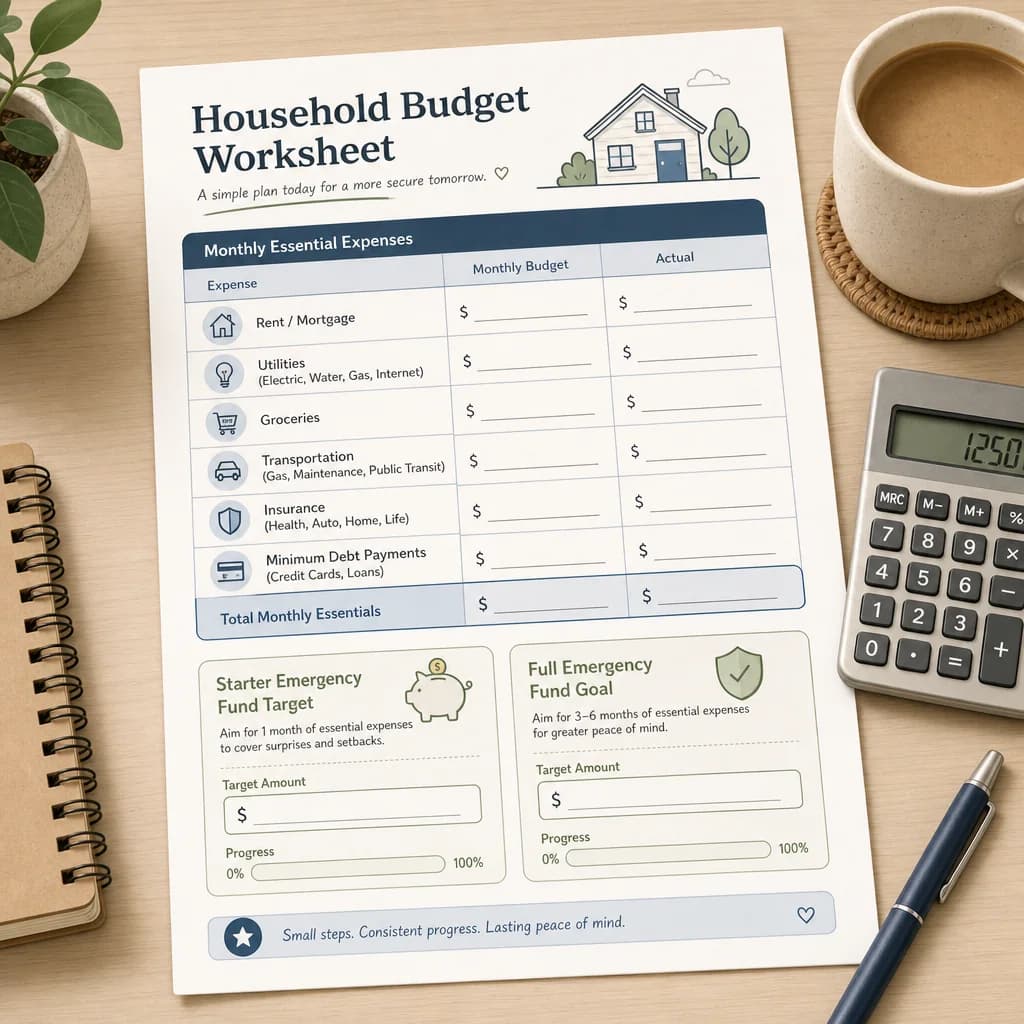
If you have ever wondered how much emergency fund do I need, the short answer is this: start with a small, reachable goal, then build toward three to six months of essential expenses. The exact number depends on your bills, job stability, dependents, and how predictable your income is. A good emergency fund should make real life feel less fragile, not make you feel guilty for not saving a perfect amount right away.
Many people hear the usual advice to save three to six months and stop there. That is a useful rule of thumb, but it is not personal enough. A renter with stable work needs something different from a single-income parent, a freelancer, or a homeowner with irregular repair costs. The better approach is to calculate your essential monthly expenses first, then choose the number of months that fits your risk level.
What an emergency fund is
An emergency fund is money set aside for true unexpected problems. Think job loss, medical bills, urgent car repairs, emergency travel, or a home repair you cannot delay. It is a cash reserve that helps you handle a hard moment without relying on credit cards, payday loans, or panic.
It is not the same thing as vacation savings, holiday shopping money, or a general checking balance. The point of emergency savings is to protect your basic life when something goes wrong.
Quick answer: starter fund vs full fund
A starter emergency fund is your first safety cushion. For many beginners, that means saving 500 dollars, 1000 dollars, or one month of essential bills. It is designed to cover the smaller shocks that happen often, like a car battery, a copay, or a last-minute flight.
A full emergency fund is larger. Most households should aim for three to six months of essential expenses. If your income is unstable, you support children, or your household depends on one paycheck, nine to twelve months can make sense. The goal is not to pick the biggest number. The goal is to choose a number that matches your real risk.
Step 1: Add up your essential monthly expenses
Start with the bills you must pay to keep life running. This is the foundation of your emergency fund amount. Use expenses, not income, because emergencies are about covering what you need to survive, not replacing every dollar you normally earn.
- Housing: rent or mortgage
- Utilities: electricity, water, gas, internet, phone
- Groceries and basic household supplies
- Transportation: gas, transit, minimum car costs
- Insurance premiums
- Minimum debt payments
- Childcare and necessary medical costs
Do not include dining out, gifts, subscriptions, entertainment, or extra debt payments in this number. Your emergency fund calculator should reflect your lean survival budget, not your ideal lifestyle budget.
Step 2: Decide how many months you need
Once you know your monthly essentials, multiply that number by the number of months that fits your situation. This is the simple formula behind how much should I save for emergencies: essential monthly expenses x target months = emergency savings goal.
1 month vs 3 months vs 6 months
One month is a strong starter target if you are just beginning. Three months is a common goal for people with fairly stable work and fewer dependents. Six months is often better for people with children, higher fixed bills, or more uncertainty. The bigger the risk of income disruption, the more valuable a larger financial cushion becomes.
When 9 to 12 months makes sense
If your income is seasonal, commission-based, freelance, or tied to one major client, a larger emergency savings goal may be smart. The same is true if you are the only earner in your household, have ongoing medical needs, or would need extra time to replace your income after a layoff.
Step 3: Adjust for job stability, dependents, and debt
This is where the usual advice becomes personal. Two households can spend the same amount each month and still need very different emergency fund targets.
Renters vs homeowners
If you rent, your housing costs may be simpler and more predictable. If you own a home, you may need a larger cash reserve because major home repairs can hit without warning. A broken water heater or roof issue is a real emergency, and homeowners should plan for that added risk.
Single income vs dual income
A dual-income household may be able to lean on one paycheck if the other income disappears for a while. A one-income household usually has less margin for error. If one job supports everyone, a larger emergency fund often makes sense.
Low-income and variable-income households
If money is already tight, a giant savings goal can feel impossible. That is why a starter emergency fund matters. Save the first reachable amount, then build in stages. If your income changes month to month, your full target may need to be closer to six months or more because pay gaps are part of the risk.
Debt matters too. If you have high-interest debt, the usual middle ground is to build a starter emergency fund first, then attack expensive debt while still protecting a small cash cushion. Without that cushion, even a small emergency can push you deeper into debt again.
Step 4: Set a realistic starter target
The best starter emergency fund is the one you will actually finish. If 1000 dollars feels doable, start there. If one month of essential bills is possible, even better. The point is to create immediate breathing room while you work toward a full fund.
A good path looks like this: save your first 500 to 1000 dollars, then grow to one month of essentials, then move toward three to six months. This keeps the process practical and less overwhelming.
Step 5: Build the fund automatically
Emergency savings grow faster when you do not rely on memory or motivation. Set up an automatic transfer to a savings account every payday. Even small weekly transfers add up. You can also send tax refunds, side-income money, bonuses, or one-time gifts straight to the fund.
- Automate a fixed transfer every payday
- Save windfalls instead of spending all of them
- Cut one or two low-value expenses and redirect the money
- Track progress with a simple goal amount instead of chasing perfection
Where to keep your emergency fund
Your emergency fund should be safe, easy to access, and separate from everyday spending. For most people, a high-yield savings account is the best fit. It keeps the money liquid while earning some interest.
High-yield savings vs checking
A checking account is easy to reach, but it is also easy to spend by mistake. A savings account is usually better because it creates a little distance while still keeping the cash available. Look for an FDIC-insured bank account so your money stays protected within coverage limits.
Avoid investing your emergency fund aggressively. This money is for stability, not growth. If the market drops right when you need cash, the fund stops doing its job.
What counts as an emergency
A real emergency is urgent, necessary, and unplanned. Medical bills, job loss, emergency travel, car repairs needed to get to work, and home repairs that protect your safety all count. Concert tickets, holiday shopping, routine annual bills, and sales do not.
This boundary matters. If you use emergency savings for non-emergencies, it becomes harder to trust the fund when a real problem shows up.
A simple example
Let us say your essential monthly expenses are 2200 dollars. A one-month starter fund would be 2200 dollars. A three month emergency fund would be 6600 dollars. A six month emergency fund would be 13200 dollars. If you are a renter with stable work and no dependents, three months might be enough for now. If you support a family on one income, six months or more may be a better target.
That is the real answer to how much emergency fund do I need for a family or on one income: base it on essential bills first, then increase the number of months when your risk is higher.
FAQ
Is 3 months enough?
Three months can be enough if your income is stable, your household has fewer dependents, and you could replace your income fairly quickly. If your risk is higher, aim for six months or more.
Should I save 6 months of expenses or income?
Use essential expenses, not full income. Your emergency fund is meant to cover the bills required to keep life running during a crisis.
Where should I keep emergency savings?
A separate high-yield savings account is usually the best place because it keeps the money liquid, safe, and less likely to be spent accidentally.
What counts as a real emergency?
True emergencies are urgent, necessary, and unplanned, such as job loss, medical bills, emergency travel, major car repairs, or essential home repairs.
Should I pay off debt first or save an emergency fund?
Most people do best with a small starter fund first, then focus on high-interest debt while continuing to protect a cash cushion.
Add up your essential monthly expenses today, choose a starter goal, and set your first automatic transfer before the week ends.
Take control of your money today
Start free with Spendmate — track expenses, plan budgets, and reach your financial goals.
Start free with Spendmate