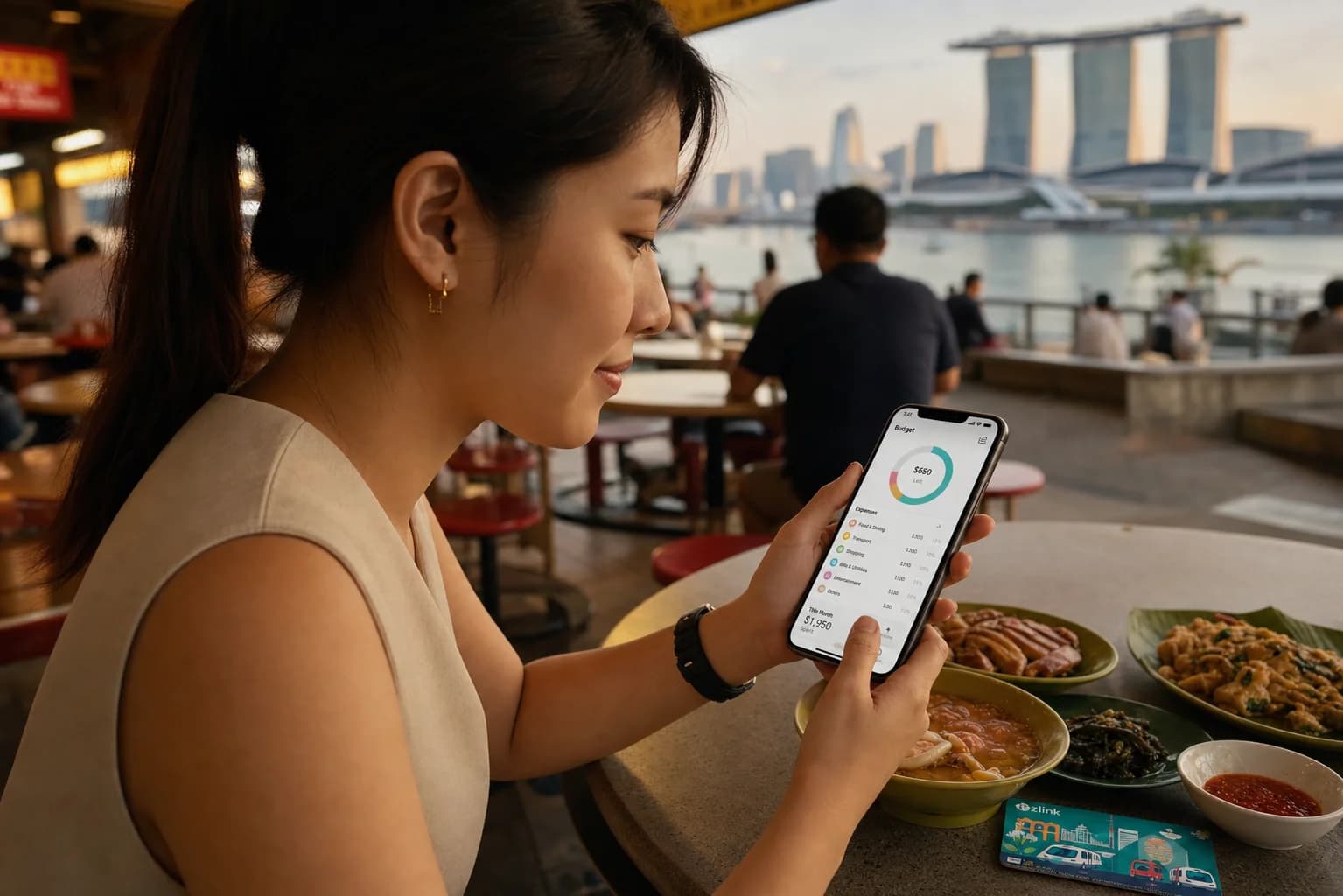
You just received your first paycheck. After CPF deduction, the number in your bank account is smaller than expected. Rent, food, transport, phone bills — the numbers do not add up. You are not alone. Most Singaporeans never learn how to budget properly. This guide fixes that — with real Singapore numbers, CPF explained plainly, and a framework that actually fits a Singaporean salary.
The Short Answer (For Skimmers)
- Average starting salary in Singapore: $2,500–$3,500 (fresh diploma/degree, 2026)
- Recommended savings rate for beginners: 10–20% of take-home pay
- CPF contribution: 20% of wages (employee) + 17% (employer) — included in your total compensation
- A simple beginner framework: 50/30/20 adapted for Singapore
If you are new to managing money in Singapore, this guide covers everything — from understanding your CPF deduction to building your first monthly budget with real local cost examples.
Why Budgeting Matters More in Singapore
Forget the welfare state. Singapore runs on a personal responsibility model — no universal healthcare, no pension, no housing safety net beyond your own CPF savings. HDB resale prices now average $550,000–$800,000+ (HDB Resale Statistics, Q1 2025), and Singapore inflation hit 3.1% in 2025 (SingStat), squeezing household budgets across the board. The comparison culture does not help either: social media makes it feel like everyone else has more than you.
Here is the truth nobody tells you: most Singaporeans do not budget systematically. If you start now, even with a modest income, you build an advantage that compounds over decades.
Understanding Your Singapore Income (CPF Breakdown)
What Is CPF and How Does It Affect Your Budget?
Central Provident Fund (CPF) is Singapore's mandatory savings scheme for citizens and permanent residents. Every month, a cut of your salary lands in three accounts — each with a specific purpose.
- Ordinary Account (OA): Used for housing, investment, and education. Earns 2.5% interest.
- Special Account (SA): Retirement savings. Earns 4% interest.
- Medisave (MA): Medical expenses. Earns 4% interest.
Contribution rates for employees aged 55 and below: you contribute 20% of your wages, and your employer adds another 17%. That 37% total is part of your total compensation — it is not gone. It is savings you will eventually use.
What Is Your REAL Take-Home Pay?
The formula: Gross Salary minus CPF Employee Contribution minus Income Tax equals Take-Home Pay.
- $3,000 gross to approximately $2,400 take-home (after ~$600 CPF)
- $4,500 gross to approximately $3,600 take-home (after ~$900 CPF)
- $5,000 gross to approximately $4,000 take-home (after ~$1,000 CPF)
Always build your budget around take-home pay, not gross salary. This single habit prevents most overspending problems.
The 50/30/20 Rule — Singapore Edition
How to Adapt the Framework for Singapore Costs
The 50/30/20 rule divides your take-home pay into three buckets. Here is how it translates to Singapore:
- NEEDS (50%): Rent or household contribution, groceries (hawker and home cooking), transport (MRT), insurance, phone, utilities
- WANTS (30%): Dining out, entertainment, subscriptions, travel, lifestyle spending
- SAVINGS/DEBT (20%): Emergency fund, CPF top-ups, investments, debt repayment
What Does 50/30/20 Actually Look Like on $2,500/Month?
Picture this: $2,500 hits your bank account each month after CPF. Here is how the 50/30/20 rule plays out in Singapore.
- Needs (50% = $1,200): Parent household contribution ($400–600), MRT pass ($100), groceries ($300), phone plan ($40), utilities ($60), insurance ($100–150)
- Wants (30% = $720): Dining out ($200), entertainment ($100), mobile data ($40), subscriptions ($80), savings for travel ($200)
- Savings (20% = $480): Emergency fund ($200), CPF SA top-up ($150), regular savings ($130)
What Does 50/30/20 Look Like on $4,500/Month?
- Needs (50% = $2,250): Rent or household contribution ($800–1,200), groceries ($400), transport ($120), utilities ($80), insurance ($200), phone ($50)
- Wants (30% = $1,350): Dining out ($400), entertainment ($200), travel ($300), lifestyle ($450)
- Savings (20% = $900): Emergency fund ($400), CPF top-ups ($300), investment ($200)
These are guides, not rules. Adjust based on your actual situation — if you pay higher rent, your needs percentage will shift accordingly.
Step 1 — Calculate Your Monthly Income (Real Numbers)
Identify ALL Income Sources
- Base salary (with CPF deduction visible on your Payslip)
- Overtime, bonuses, and commission
- Allowances and stipends
- Side income or freelance work
Track your last three months of bank statements. Use your average monthly income — not your highest month — as your baseline.
Use Your Actual Take-Home Pay
Do not budget based on gross salary. Your CPF contribution, income tax, and any deductions happen before money reaches your bank account. Budget with what actually arrives.
Step 2 — Track Your Spending (The Hard Truth)
Why Tracking Is Non-Negotiable for Beginners
Research from the National Financial Literacy Council of Singapore suggests that most Singaporeans underestimate their monthly spending by 20–40%. Those $4 kopi and $6 bubble teas add up fast — one Grab ride at $15, three times a week, comes to $180 monthly. That is $2,160 per year, spent almost without noticing.
Before you can budget, you need to know where your money is actually going.
Tools for Tracking (Singapore-Friendly)
- Bank apps: DBS, OCBC, and UOB all have built-in spending categorization — zero extra effort required
- Spark by DBS: Free, Singapore-focused, syncs with local bank accounts
- Seedly / MoneySmart: Community-verified spending tracker
- Excel or Google Sheets: Manual but fully customizable
The best tracking tool is the one you will actually use every day.
How to Categorize Spending the Singapore Way
- Home: Rent, utilities, household supplies, parent contribution
- Food: Hawker ($3–6 per meal), supermarket, restaurants, delivery (GrabFood, Foodpanda)
- Transport: MRT and bus ($100–150 per month typical), taxi, Grab
- Insurance: Hospital plan, term life, critical illness coverage
- Lifestyle: Entertainment, subscriptions (Netflix, Spotify, Disney+), shopping, bubble tea
- Savings: Emergency fund, CPF top-ups, investment contributions
Step 3 — Build Your First Budget (With Singapore Examples)
The Zero-Based Budgeting Lite Approach
Zero-based budgeting means every dollar has a job before the month starts. For beginners, a lighter version works:
- List all income sources at the start of the month
- Assign every dollar to a spending category
- Track actual spending against your plan weekly
- Adjust for surprises like GES (Great Singapore Sale), birthday gifts, or wedding ang baos
The Envelope System (Singaporean Adaptation)
The traditional envelope system uses physical cash. In Singapore cashless environment, use digital equivalents — separate bank accounts or sub-accounts for different spending categories.
- One account for fixed needs (rent, transport, utilities)
- One account for lifestyle spending
- One account for savings goals
- When an envelope (or account) is empty: stop spending in that category until next month
Common Budget Mistakes Singaporeans Make
- Mistake 1: Not accounting for CPF — treating gross salary as real income
- Mistake 2: Ignoring small daily purchases ($4 kopi and $6 bubble tea add up to $15–30 per day)
- Mistake 3: No emergency fund before investing — one setback derails everything
- Mistake 4: Underestimating annual expenses — birthdays, weddings, holidays cost more than expected
- Mistake 5: Lifestyle inflation when salary increases — more income does not mean more savings
Step 4 — Set Up Your Singapore Financial Foundation
Priority Order for Beginners
- Track spending for one full month — know where your money goes before you change anything
- Build a $1,000–$2,000 starter emergency fund in a high-yield savings account
- Get basic insurance: MediShield Life plus private hospital plan, term life if you have dependents
- Contribute to CPF: Start with OA housing down payment if planning to buy an HDB flat
- Top up your SA for retirement after housing is secured
- Start investing: ETFs, CPF Investment Scheme (CPFIS), or Supplementary Retirement Scheme (SRS)
Which Singapore Bank Account Should You Use?
- CPF Ordinary Account: For long-term savings and housing down payment — earns 2.5% interest
- High-yield savings account: UOB One, OCBC 360, or DBS Multiplier for your daily savings
- For beginners: Start with one savings account plus your bank built-in spending tracker
High-yield savings accounts in Singapore currently offer up to 3.5–4% p.a. with minimum salary crediting requirements (MAS Interest Rate Data, 2025). These are significantly better than the 0.05% from standard savings accounts — the difference on a $20,000 balance is roughly $700 per year in lost interest.
Emergency Fund Target for Singaporeans
- Minimum: $10,000 (three months of essential expenses)
- Ideal: $20,000–$30,000 (six months, especially important for sole breadwinners)
Keep your emergency fund in a high-yield savings account — not invested, not in CPF. It needs to be accessible within one to two days.
Step 5 — Build Momentum (Small Wins Matter)
The $20 Per Week Challenge
- Week 1: Track every expense, even the $2 kopi
- Week 2: Reduce one want category by $20
- Week 3: Cook one meal at home instead of eating out
- Week 4: Transfer $80 to savings — the result of the previous three weeks
Small consistent actions beat dramatic changes that do not last.
When to Increase Your Savings Rate
- After your emergency fund is complete: Move from 10% to 15% savings rate
- After a salary raise: Increase savings by 50% of the raise amount
- After paying off any debt: Roll that payment directly into savings
Singapore Budgeting Communities
- r/singaporefi — Singapore-focused financial independence community on Reddit
- Seedly Community — Singapore personal finance discussions and article reviews
- EDMW (HardwareZone) finance threads — candid Singapore money discussions
- Facebook groups: SG Budget Moms, Singapore Personal Finance
You do not have to figure this out alone. Communities provide accountability, real examples, and moral support when things get hard.
Budgeting Methods Compared: Which Framework Works Best for Singaporeans?
Not all budgeting methods are equal — especially in Singapore's unique cost environment. Here is how the most popular frameworks stack up against each other:
For most beginners in Singapore, a hybrid approach works best: use the 50/30/20 framework as your baseline, automate your savings the day you get paid (Pay Yourself First), and run a no-spend challenge once a quarter to reset your spending habits.
FAQ — Budgeting for Beginners Singapore
How much should a fresh grad save in Singapore?
Aim for 10–20% of your take-home pay as a starting point. On a $2,500 take-home salary, that is $250–$500 per month. Do not stress if you can only save $100 — something is better than nothing. As your salary grows, increase your savings rate gradually. The key is starting, not saving perfectly. Source: Singapore Ministry of Manpower (MOM) Salary Survey 2025.
Should I save or invest first in Singapore?
Save first. Build your emergency fund ($10,000 minimum) before investing. The exception: if your employer offers CPF contributions beyond the mandatory or if you have a matching RSP program, take it — that is essentially free money.
How do I budget when I am living with my parents and paying minimal rent?
Lucky you — use this as an advantage. Contribute fairly to household expenses ($400–$800 per month is reasonable), keep wants in check, and save aggressively. The goal is to build wealth now while your expenses are low. Many Singaporeans wish they had done this.
What is a realistic food budget in Singapore?
Hawker meals average $3–6 per meal. Budget $400–$600 per month for food if you cook some meals at home. Eating every meal at hawker centres costs approximately $450 per month. Cooking at home most days brings it down to approximately $300 per month. Eating out at restaurants regularly: $800 or more per month. Hawker prices based on NEA hawker centre survey data 2024.
How does CPF affect my take-home budget?
CPF reduces your take-home pay by 20% (for employees aged 55 and under). Always budget based on your take-home pay, not gross. On a $3,000 per month salary, your take-home is approximately $2,400. Plan around what actually hits your bank account. Source: CPF Board official contribution rates (cpf.gov.sg).
Is it possible to save money as a Singaporean on a low salary?
Yes, but it requires intentionality. Start with any amount — $50 per month is fine. Focus on reducing small daily expenses (kopi, bubble tea, Grab rides), cook more meals at home, and use government schemes (KidSTART, CDC vouchers, ComCare) if you qualify. The key is starting.
Should I use a budgeting app or Excel for Singapore budgeting?
For beginners: Start with your bank built-in tracker (DBS, OCBC, and UOB all have spending categorization). This requires zero extra effort. Once you are ready for more control, migrate to a spreadsheet or an app like Seedly. The best system is the one you will actually use.
How do I budget for irregular Singapore expenses?
Create sinking funds for: Income tax (estimated 4–8% of income annually), birthday gifts ($50–$100 per event), wedding ang baos ($50–$150 per event), school fees (if applicable), and holidays or staycations ($100–$300 per month). Divide your annual costs by 12 and save that amount monthly into a dedicated sub-account.
About the Author: This guide was written by the Shoninfox editorial team, personal finance writers and editors with backgrounds in banking, financial planning, and consumer advocacy. Our team has published 200+ articles on personal finance topics across Southeast Asia and the United States, with a focus on practical, locally relevant advice backed by real cost-of-living data.
For more on building your financial foundation, learn how CPF works in our comprehensive guide, and understand why an emergency fund is your first financial priority. If you want to understand how Singapore budgeting compares globally, our analysis of the 50/30/20 rule in Singapore shows whether it actually works for local salaries.
Take control of your money today
Start free with Spendmate — track expenses, plan budgets, and reach your financial goals.
Start free with Spendmate