
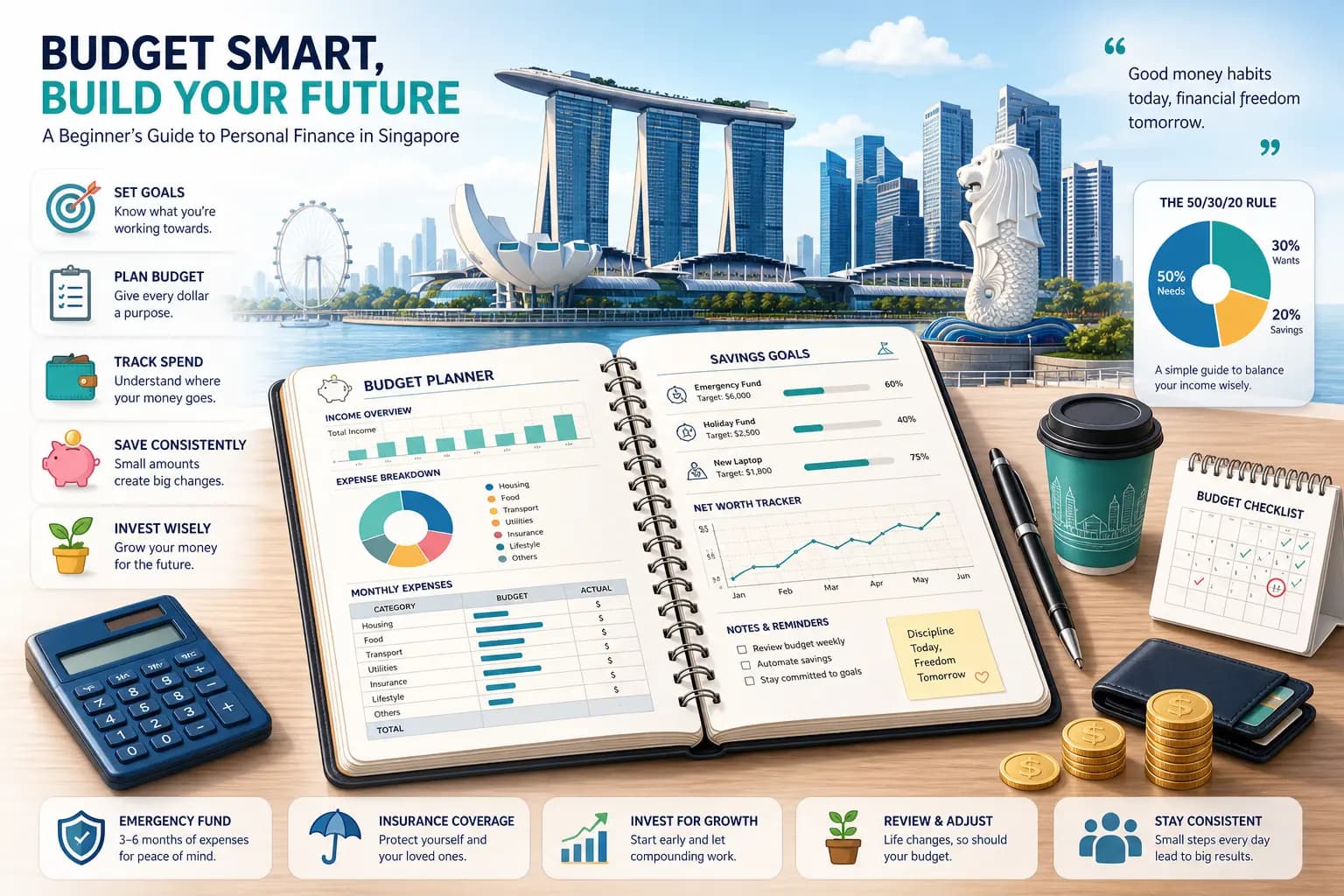
Let me be honest with you: I grew up hearing "budget" and thinking it meant restricting yourself, feeling guilty about every purchase, and arguing about money. That is not what a good budget does. A good budget is the opposite — it is the thing that gives you permission to spend on the things you actually care about without the constant background anxiety of wondering where your money went. This guide is specifically for Singapore residents who have never been shown how to budget properly — or who tried the standard Western advice, found it did not fit their Singapore reality, and gave up. We use real S$ amounts, cover actual Singapore expenses (including CPF, which most Western guides pretend does not exist), and give you a step-by-step system you can start this weekend. No complex spreadsheets. No overwhelming math. Just a clear picture of your money and a plan for every dollar.
Why Budgeting Feels Different in Singapore
Singapore is expensive — but it is manageable with a plan. The average Singapore household spends S$4,000–S$6,500 per month on essentials, with housing, transport, and food taking the biggest shares. Housing alone can consume 30–50% of take-home pay for HDB residents, and CPF contributions — while technically yours — reduce the cash you see in your bank account every month. The tricky part for most Singaporeans is that our biggest expenses are either fixed (housing, CPF) or socially pressured (dining out, entertainment, "人情" gifts). A budget that ignores CPF is a budget that is lying to you.
Most Singaporeans grew up hearing "save money" without ever being taught how. Singapore has one of the highest household savings rates in the world — but much of that savings is forced (CPF) rather than intentional. A budget is what turns passive saving into active control. It shows you where your money actually goes, gives you power to make intentional choices, and builds the foundation for your first emergency fund, your first investment, and your first financial goal.
Your Singapore Income: What You Are Actually Working With
Before you can budget, you need to know what you are actually working with. Many beginners make the mistake of budgeting from their gross salary — then wondering why the numbers never add up. The number that matters is your actual take-home pay, and in Singapore that means understanding CPF.
CPF and Take-Home Pay
For employees under 55, CPF contribution rates in 2026 are 20% from you (employee) and 17% from your employer — totaling 37% of your salary, capped at the Salary Ceiling of S$6,800 per month. If you earn S$4,000/month gross, your CPF deduction is S$800, leaving S$3,200 before other deductions like taxes or deductions for corporate passes. A S$5,000/month gross salary gives you approximately S$4,000 take-home after CPF. A S$6,800 salary gives you approximately S$4,640 after CPF. These numbers matter because if you budget from your gross salary, you will always be S$800–S$1,360 short before you spend a single dollar.
Other Income to Account For
- Allowances, bonuses, and AWS (Annual Wage Supplement) — set aside 70–80% as savings; enjoy 20–30%
- Commission or freelance income — budget based on your average monthly take-home, not the peak month
- Government payouts — CDC vouchers, Baby Bonus, SINGPASS rebates — treat these as windfalls, not income. Save or invest them, do not spend them as "free money"
- Side income — anything beyond your primary salary should go toward savings or debt repayment, not lifestyle inflation
Irregular Income in Singapore
If you are a freelancer, gig worker, or on commission-based pay, budget using your lowest-earning month over the past three months. Bank everything above that baseline as a buffer or savings. When you have a high-earning month, do not upgrade your lifestyle — upgrade your emergency fund instead. Annual bonuses or commissions should be set aside fully and divided by 12 to find your realistic monthly average. For more on budgeting with irregular income, see our detailed guide.
Step 1 — Calculate Your Fixed Monthly Expenses
Fixed expenses are the ones that stay the same every month — or that you cannot easily change in the short term. These are your non-negotiables, and they should be the first line in your budget. Get these right and the rest becomes much simpler.
Housing (S$1,200–S$2,500/month for HDB)
Housing is typically the largest fixed expense for Singapore residents. HDB rents range from S$1,200–S$2,500/month depending on location and size. If you own a HDB and are repaying a mortgage, add utilities and maintenance fees. Condo residents typically pay more — S$2,500–S$5,000/month when you factor in mortgage, property tax, and maintenance. If you are planning to buy your first BTO, our BTO budgeting guide covers the full cost breakdown including renovation and furnish costs that surprise most first-timers.
Transport (S$100–S$300/month)
- Public transport (Ez-Link, concession passes): S$100–S$150/month
- Taxi/Grab (occasional use): S$30–S$100/month
- Car and COE (if applicable): S$1,500–S$2,500/month — include separately as a lifestyle choice, not a necessity
Insurance (S$100–S$400/month)
Health and term life insurance — either through employer group plans or personal policies. If your employer covers your health insurance, your personal insurance cost may be lower. Budget for your share of premiums and any gap coverage.
Phone, Internet, and Subscriptions (S$50–S$150/month)
Mobile plan (Singtel, StarHub, M1, Circles.Life): S$20–S$50/month. Home internet: S$30–S$60/month. Streaming services (Netflix, Spotify, Disney+): S$20–S$45/month. For a full guide on auditing your subscriptions — a step most beginners skip entirely — see our subscription audit guide. Most people are paying for at least 2–3 subscriptions they have completely forgotten about.
Loan Repayments
Education loans, personal loans, car loans — budget the monthly installment amount. Note: your CPF OA can be used for education and housing, which reduces the cash you need to service these from your income.
Step 2 — Estimate Your Variable Monthly Expenses
Variable expenses change month to month. These are where most budget blowouts happen — but they are also where you have the most control when you track them consistently. The key is to be honest about what you actually spend, not what you think you should spend.
Food and Groceries (S$400–S$800/month)
This is the category most beginners underestimate. Hawker meals at S$4–S$8 per meal add up fast — two meals a day at S$6 average = S$360/month in hawker spending alone. Add groceries for home cooking (NTUC, FairPrice, Sheng Siong, Cold Storage): S$200–S$400/month. A realistic total for someone who cooks some meals and eats out others: S$500–S$800/month. If you are spending more than S$1,000/month on food as a single person, there is usually fat to trim there.
Lifestyle and Entertainment (S$100–S$300/month)
Dining out, movies, concerts, hobbies, Grab rides, short trips to Malaysia. This is the easiest category to cut if you need to save more, but it is also the category that makes life worth living. Set a cap and track it loosely — overshooting this category occasionally is fine. Overshooting every month is a problem.
Healthcare (S$30–S$100/month)
GP visits (S$25–S$50 without subsidies), dental checkups, medication, TCM. Budget S$50–S$100/month on average and bank the unused amount for months when you need it more.
Miscellaneous (S$50–S$100/month)
Toiletries, household supplies, personal care, gifts, donations, unexpected expenses. Having a miscellaneous category prevents one-off purchases from derailing your entire budget. If you do not use it one month, carry it forward or add it to your savings.
Step 3 — Set Your Savings and Goal Allocations
After you account for expenses, the remaining money is yours to allocate intentionally. Many beginners make the mistake of "saving what is left over" — which usually means nothing. Instead, pay yourself first: set your savings target before you start spending. This single habit is the difference between people who save consistently and people who tell themselves they will start next month.
The Singapore Savings Benchmark
Singapore's household savings rate averages around 45% — but much of that is CPF. For cash savings outside of CPF, a realistic target for a working adult is 10–20% of take-home pay to start. If you earn S$3,000/month after CPF, that is S$300–S$600 per month going to savings. As your income grows, increase this to 30–40%. That sounds ambitious, but here is the truth: if you do not save aggressively in your 20s, you will be making difficult choices in your 40s.
Priority: Emergency Fund First
Before you invest, before you save for a holiday, build an emergency fund — 3–6 months of fixed expenses in a savings account you can access quickly. If your fixed expenses are S$2,000/month, your target is S$6,000–S$12,000 in an accessible account. This is your financial buffer — it means a job loss, a medical emergency, or an unexpected home repair does not become a crisis. Our emergency fund guide walks you through building one from scratch.
Short-Term and Long-Term Goals
- Short-term goals (1 month–1 year): Holiday fund, new phone, wedding expenses, big purchase. Use a separate savings account or sub-account for each goal.
- Long-term goals (1 year+): Retirement (CPF + SRS + investments), home ownership (BTO/downpayment), children's education. These require larger accounts and longer time horizons.
- CPF is part of your long-term plan: OA for housing, SA/RA for retirement, MA for healthcare. Do not ignore it — but also do not rely on CPF alone to fund your retirement.
Step 4 — Choose a Budgeting Method That Fits
The best budgeting system is the one you will actually use. Here are three proven methods, adapted for the Singapore context — with honest notes on who each one works for and who it does not.
50/30/20 Rule — Singapore Version
The standard 50/30/20 rule allocates 50% to needs, 30% to wants, and 20% to savings. In Singapore, housing often consumes 40–60% of take-home pay — making the "needs" category larger than the rule assumes. A Singapore-adapted version: 40% housing and transport, 20% food and daily needs, 20% wants and lifestyle, 20% savings and goals. If housing takes 50%+, adjust the other categories down proportionally. For a deeper look at whether the 50/30/20 rule actually works in Singapore, read our full breakdown with real salary examples.
Zero-Based Budgeting
Every dollar of income gets assigned a job before the month begins. Income minus all allocated categories equals zero. This method gives you maximum control and is especially useful if you are trying to pay off debt or accelerate savings. It takes more effort to maintain, but the visibility is worth it for detail-oriented budgeters. If you hate tracking things and will give up after a week, this method is not for you — try pay-yourself-first instead.
The Pay-Yourself-First Method
Set your savings allocation on the first of the month — transfer it to a separate account before you spend anything. The rest of your money is for spending. This works well for people who hate tracking every transaction but still want to save consistently. The key: the savings transfer must be automatic, not optional. If you have to decide to save, you will not do it.
Step 5 — Track, Review, and Adjust Monthly
A budget is not a one-time exercise — it is a living system. Review it monthly, compare planned vs. actual spending, and adjust categories that keep overshooting. Most people find their first month is eye-opening, the second month is better, and by the third month they actually know where their money goes.
Best Budgeting Apps in Singapore
- Seedly: Community-verified expense tracking, automated categorization from bank feeds. Best for beginners who want peer validation on their spending.
- Sparkbook: Singapore-based, automated categorization, visual dashboards. Good balance of simplicity and depth.
- MoneyMind: Supports multiple account types, debt tracking, and goal setting. Best for users who want a comprehensive financial overview.
- Bank apps: DBS, OCBC, and UOB all have built-in spending trackers with transaction categorization. Free and already installed — good starting point before adding a dedicated app.
The Monthly Budget Review
Once a month — last day or first day of the next month — spend 20 minutes reviewing: What did you spend vs. what you planned? Which category went over? Why? Did you forget to account for any expenses? What savings did you actually achieve? Adjust next month's budget based on what you learn. This review habit is what turns a budget from a restriction into a useful tool.
Common Budgeting Mistakes in Singapore
- Ignoring CPF as part of your total compensation — it is money, just locked away. Include it in your big-picture financial plan.
- Underestimating hawker and cafe spending — S$6 hawker meals sound cheap until you add up 60 meals a month.
- Forgetting irregular annual expenses — insurance premiums, income tax, school fees, and festive ang pau spending all hit once a year. Budget for them monthly so you are not caught out.
- Not reviewing subscriptions — see our guide on auditing subscriptions to find out how much you might be wasting on services you forgot about.
- Gifting and wedding costs — Singapore's "人情" culture can produce huge budget blowouts. Set a separate annual budget for wedding ang paos and festive gifts.
FAQ — Budgeting for Beginners Singapore
- How much should a beginner save in Singapore?
- Aim for 10–20% of your take-home pay as a beginner. If you earn S$3,000/month after CPF, that is S$300–S$600/month toward your emergency fund and goals. As your income grows, increase this to 30–40%. The key is to start — even S$50/month is progress. Many Singaporeans in their first job underestimate how quickly small consistent savings add up over time. S$300/month invested at 5% returns becomes roughly S$20,000 in 5 years without touching it. That is the power of starting early.
- What is a realistic budget for a Singapore fresh grad?
- For a fresh graduate earning around S$2,800/month after CPF, a practical first budget: Housing S$800–S$1,200 (if living with parents or renting a room), food and groceries S$300–S$500, transport S$100–S$150, insurance S$100–S$200, phone and internet S$30–S$50, entertainment S$100–S$200, savings S$280–S$560 (10–20%). Adjust based on your actual living situation — if you live with parents, your housing cost may be much lower, freeing up more for savings. The biggest mistake fresh grads make is upgrading their lifestyle the month they get their first job. Resist this. Bank the difference while your expenses are low.
- How do I budget with CPF contribution?
- CPF is deducted from your gross salary before you receive it — so you budget from your take-home pay (the amount deposited to your bank account). CPF contribution rates for employees under 55 are 20% of your wage (capped at S$6,800/month). This 20% goes into your OA (housing and investment), SA/RA (retirement), and MA (healthcare). While CPF is not cash you can spend today, it forms a critical part of your long-term financial plan. Budget around your take-home pay, not your gross salary, and do not make the beginner mistake of pretending CPF does not count as part of your compensation.
- Is the 50/30/20 rule realistic in Singapore given housing costs?
- The 50/30/20 rule is difficult to apply directly in Singapore because housing (HDB or condo) often consumes 40–60% of take-home pay, leaving less room for the "wants" and "savings" categories in the original framework. A Singapore-adapted version works better: 40% housing and transport, 20% food and daily needs, 20% wants and lifestyle, 20% savings and goals. If your housing exceeds 50% of take-home pay, you will need to adjust other categories down or find ways to reduce housing costs. See our full analysis of the 50/30/20 rule in Singapore for worked examples at different income levels.
- How to budget if I live with my parents?
- Living with your parents significantly reduces your fixed expenses. Your main costs are likely transport, phone, personal spending, and some share of food. This means you can allocate 50–70% of your take-home pay to savings — an incredible advantage that will not last forever. Use this time to build an emergency fund of 3–6 months of expenses, max out your CPF contributions voluntarily if you can, and start investing early. When you eventually move out, your budget will need to accommodate housing costs that are currently zero, so plan for that transition and do not let lifestyle inflation eat the difference.
- What budgeting app do Singaporeans use?
- Seedly, Sparkbook, and MoneyMind are the most popular Singapore-specific budgeting apps. Most major Singapore banks (DBS, OCBC, UOB) also offer built-in spending trackers that automatically categorize your transactions. For a full comparison of features and which one suits your needs, see our guide on the best budgeting apps in Singapore. The best app is the one you will actually open every week — try one for a month and switch if it feels like a chore.
- How to budget for irregular income?
- Budget based on your lowest-earning month over the past three months — this is your baseline. Bank everything above that baseline as excess income. During high-earning months, do not upgrade your lifestyle. Upgrade your emergency fund or savings goals instead. When you receive annual bonuses or large commissions, set aside 70–80% immediately and treat only 20–30% as "fun money." If your irregular income is significantly below your average for 3+ consecutive months, revisit your budget and reduce discretionary spending accordingly. Our guide on budgeting with irregular income covers this in more depth.
- How much should I allocate to entertainment monthly in Singapore?
- A realistic entertainment and lifestyle budget in Singapore is S$150–S$300/month, depending on your social life and relationship status. This covers dining out, movies, concerts, hobbies, and occasional Grab rides. Couples will spend more than singles; people with active social lives will spend more than homebodies. Set a number that feels comfortable, track it loosely, and adjust if you are consistently overshooting. The goal is not to eliminate enjoyment — it is to enjoy without guilt because you have already allocated for it. If you are regularly blowing S$500/month on entertainment as a fresh grad earning S$3,000, that is worth a conversation with yourself.
Your Next Steps
Budgeting is a skill — and like any skill, it gets easier the more you practice it. Start with one month of tracking your actual expenses before you try to build a full budget. You might be surprised by where your money actually goes. Once you know your real spending, use the steps above to build a simple plan that fits your income, your life, and your goals.
If you found this guide useful, explore these next steps: Open a high-yield savings account to grow your emergency fund faster than your regular bank account allows. Learn about CPF contribution rates and how to optimize your CPF accounts for retirement. Or start with our budgeting apps comparison to find the right tool for tracking your Singapore expenses. The hardest part is starting. This weekend is a good time.
Take control of your money today
Start free with Spendmate — track expenses, plan budgets, and reach your financial goals.
Start free with Spendmate