
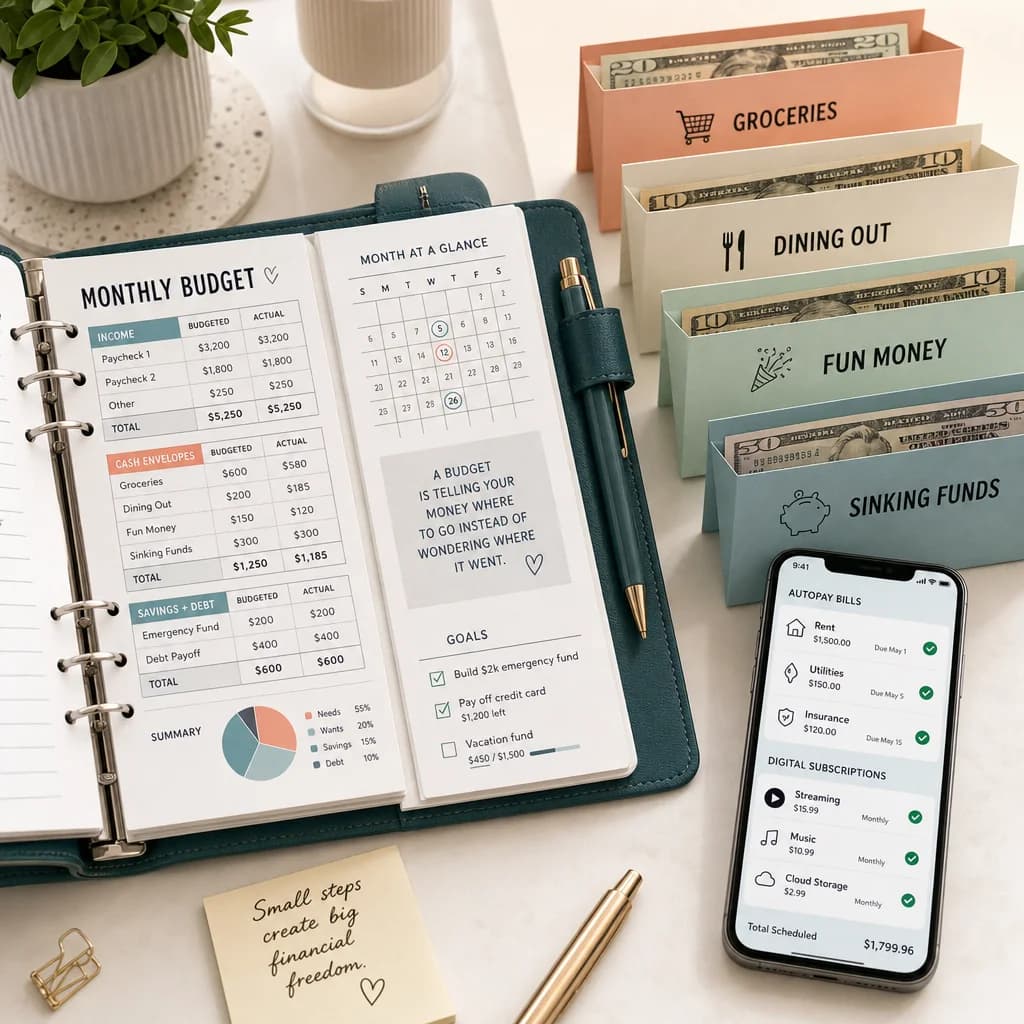
Cash stuffing is a budgeting method where you pull out cash for selected spending categories and put each amount into a labeled envelope, wallet section, or budget binder. When the envelope is empty, that category is done until the next refill. It is simple, visible, and still useful in 2026 because it puts a hard stop between you and mindless card spending.
That said, most people do not live in an all-cash world anymore. Rent, utilities, subscriptions, and online shopping usually stay digital. So the best version of cash stuffing today is a hybrid system: use cash for the categories where overspending happens fast, and keep fixed bills and autopay online where they are easier to manage.
If you are curious about the cash envelope system but do not want budgeting to feel outdated or awkward, this guide walks you through a practical modern setup. You will learn which categories should use cash, what should stay digital, how to refill envelopes on payday, and how to handle safety, leftover cash, and online spending without breaking the system.
What cash stuffing is
In plain English, cash stuffing means giving physical cash a specific job before you spend it. Instead of swiping your card and hoping you stay within budget, you decide upfront that groceries get one amount, dining out gets another, and fun money gets its own limit. That structure makes spending feel real in a way that cards often do not.
Cash stuffing is closely related to the cash envelope system and envelope budgeting. The idea is the same: put boundaries around variable spending so you can see your limit at a glance. It works especially well for people who overspend with cards, tap-to-pay, or impulse app purchases.
Why cash stuffing still works in 2026
Cash use is lower than it used to be, but lower is not the same as useless. The Federal Reserve has repeatedly shown that cards and digital payments dominate many purchases, which is exactly why cash stuffing can help. The more invisible spending becomes, the more helpful a visible limit can be.
Cash stuffing still works because it adds friction. You pause before spending. You see what is left. You feel the tradeoff. That is valuable if your weak spots are groceries that keep creeping up, casual coffee runs, fast food, beauty spending, or weekend fun that quietly eats your budget.
It also works because you do not have to use it for everything. A hybrid cash stuffing budget lets you keep modern payment habits for fixed bills while using cash only where behavior matters most.
Cash stuffing vs the cash envelope system
People often use these terms like they mean different things, but they are basically the same method. Cash stuffing is the newer, more social-media-friendly name. Cash envelope system is the older budgeting term. In practice, both mean assigning cash to categories and stopping when the cash runs out.
The useful 2026 update is not the name. It is the setup. Instead of forcing every expense into cash, a modern envelope budgeting plan separates variable categories from fixed digital bills.
Step 1: Choose the categories that should use cash
Start small. You do not need ten envelopes on day one. The best categories for cash stuffing are usually the ones that change month to month and are easy to overspend.
Best categories for cash stuffing
- Groceries
- Dining out or takeout
- Coffee and snacks
- Gas if you usually buy it in person
- Personal spending
- Entertainment
- Kids spending
- Small sinking funds like gifts or holiday cash
These categories work well because the spending happens often, the total can drift upward fast, and using cash gives you a natural limit. If you are new, start with three to five envelopes only. That is enough to test the method without turning your budget into a craft project.
Step 2: Leave fixed bills and subscriptions digital
Not every expense belongs in cash. Rent, utilities, phone bills, insurance, streaming subscriptions, debt payments, and most online purchases are usually easier and safer to leave digital. This is one of the biggest mistakes beginner articles miss. In 2026, trying to force everything into cash creates friction in the wrong places.
What should stay on autopay
- Rent or mortgage
- Utilities and internet
- Phone plan
- Insurance premiums
- Minimum debt payments
- Subscriptions you actually use
- Savings transfers if they help you stay consistent
This hybrid split is what makes cash stuffing practical for digital-first households. Use cash where choice and temptation matter. Use digital payments where timing, records, and convenience matter more.
Step 3: Set your cash withdrawal schedule
Next, decide how often you will refill the envelopes. Most people do best with either a weekly or biweekly schedule tied to payday. Weekly refills give tighter control. Biweekly refills are simpler if that matches your pay cycle.
If you get paid monthly, you can still divide the cash into smaller weekly amounts so you do not burn through the full category in the first ten days. If you have irregular income, base the envelope amounts on your lowest reliable month and refill cautiously when stronger income comes in.
How to handle groceries, gas, and fun money
Groceries usually work best with a weekly amount. Gas can be weekly or per paycheck. Fun money should be whatever amount you can spend guilt-free without disrupting bills or savings. If one category always runs out early, that is a signal to adjust the number or change the habit, not proof the system failed.
Step 4: Build your envelopes or binder
You do not need a fancy budget binder to start. Regular envelopes, a simple wallet organizer, or even labeled zip pouches can work. The point is to separate the money clearly enough that you always know what each amount is for.
How to do cash stuffing without a binder
- Use plain paper envelopes in a drawer at home
- Use labeled wallet sleeves for categories you carry often
- Keep one envelope at home for less frequent spending like gifts or sinking funds
- Track envelope balances in a notes app if you sometimes spend the category digitally
Label each category, write the budgeted amount, and keep the setup boring and easy. A budget system you actually use beats a prettier one you abandon in two weeks.
Step 5: Track spending and refill on payday
Each time you spend from an envelope, check the remaining cash. Some people like writing each purchase down. Others just count the cash left. Either is fine as long as you know the real balance. A refill routine matters because it turns cash stuffing from a one-time experiment into an actual budget habit.
On payday, review what is left in each category, refill the envelopes, and look for patterns. If dining out is always empty while groceries still have cash, move the numbers around next cycle. That is normal budgeting, not failure.
What to do with leftover cash at month-end
- Roll it into next month for the same category
- Move it to a sinking fund like gifts, travel, or car maintenance
- Send it to savings or extra debt payoff
- Split it between savings and next month if you want a little cushion
Leftover cash should not be treated like bonus permission to spend recklessly at the end of the month. It is better used as proof that the category is working or as money that can strengthen another goal.
Safety tips for cash stuffing
Cash stuffing is useful, but it does come with tradeoffs. Cash can be lost, stolen, or damaged. That does not mean the method is unsafe by default. It means you should be practical.
How much cash to carry safely
- Do not carry every envelope with you all the time
- Keep only the categories you need for that day or week in your wallet
- Store the rest at home in a secure place
- Withdraw only what fits your refill cycle instead of carrying a full month of spending cash
- If a category is mainly online, keep it digital instead of forcing cash into the plan
A good hybrid setup lowers the risk. You are not walking around with rent money in a binder. You are carrying controlled amounts for selected everyday spending categories.
Cash stuffing mistakes to avoid
- Starting with too many envelopes
- Trying to pay every bill in cash
- Ignoring subscriptions and autopay bills
- Refilling envelopes randomly instead of on a schedule
- Treating leftover cash like free-for-all spending
- Carrying more cash than you need
- Quitting after one imperfect month
CFPB and FDIC budgeting guidance both support the bigger principle behind this method: give your money a plan, track what you spend, and make adjustments from real behavior. Cash stuffing is just one way to make that principle easier to follow.
Is cash stuffing worth trying if you use cards for most spending?
Yes, if your problem is overspending in a few flexible categories. You do not need to become an all-cash person. You just need to use the tool where it helps. Many people find that a hybrid budget works better than either pure cash or pure digital because it matches how real life works now.
If you shop online a lot, keep those categories digital but tracked. If you regularly overspend in stores, cash may help more there. The goal is not to copy a trend perfectly. The goal is to create better spending boundaries.
FAQ
Is cash stuffing still worth it in 2026?
Yes. It is still useful because it creates visible limits for categories where card spending feels too easy. Most people do best with a hybrid version instead of an all-cash lifestyle.
What bills should not be cash stuffed?
Rent, utilities, subscriptions, insurance, debt payments, and most online bills usually work better as digital payments or autopay. Cash stuffing is strongest for variable day-to-day spending.
Is cash stuffing safe?
It can be, if you carry only what you need, store the rest securely, and avoid keeping large amounts of cash on you. A hybrid setup is usually safer than carrying every category everywhere.
How many envelopes should I start with?
Start with three to five categories. That is enough to test the method without making it complicated.
Can I do cash stuffing without using all cash?
Absolutely. That is the most practical way to do it in 2026. Use cash for flexible spending and keep fixed bills digital.
Start with three to five categories, keep your fixed bills digital, and test a hybrid cash stuffing method for one month before you make it more complicated.
Take control of your money today
Start free with Spendmate — track expenses, plan budgets, and reach your financial goals.
Start free with Spendmate