
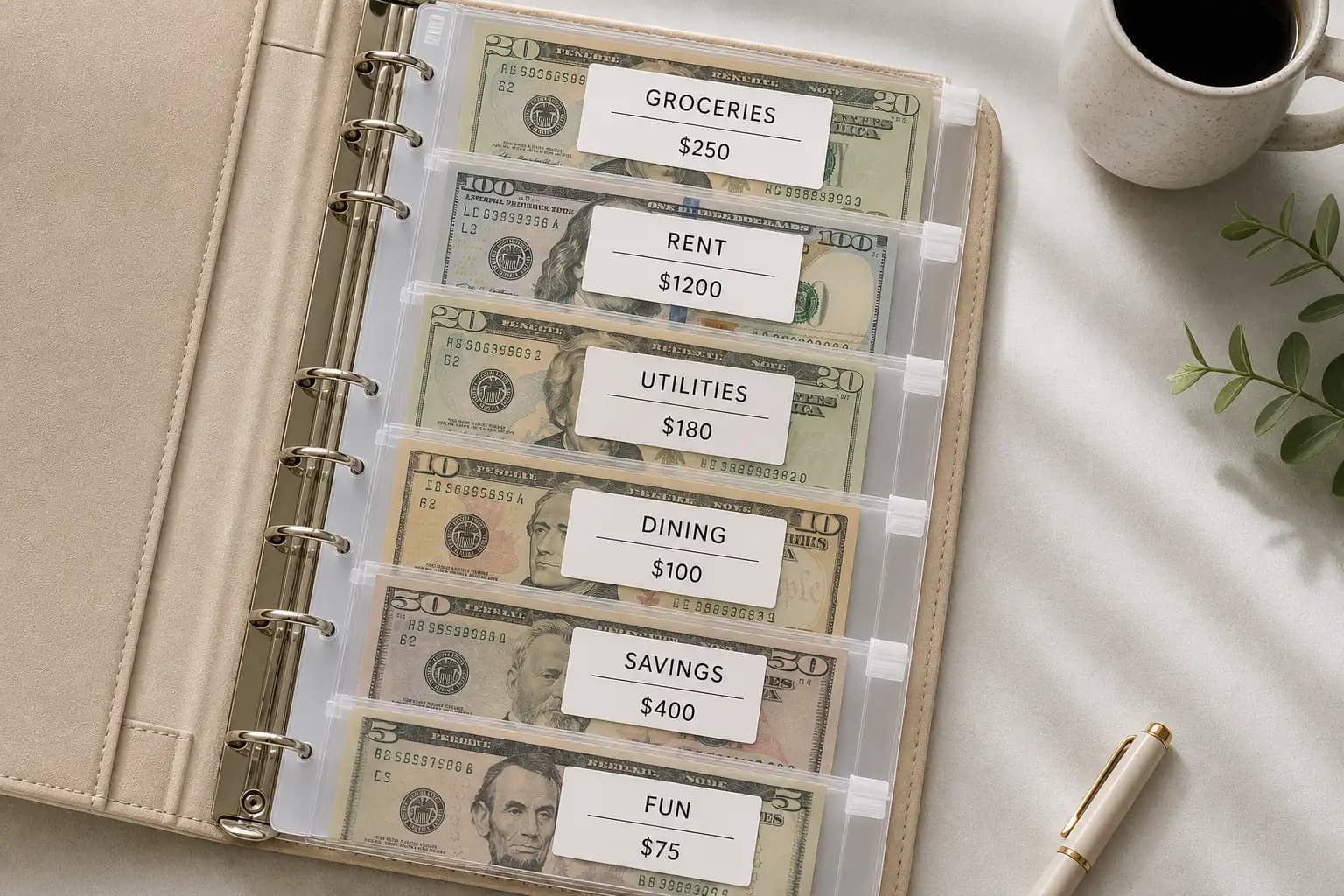
Cash stuffing — physically dividing your income into labeled envelopes for each spending category — has exploded across TikTok with over 2.8 billion views. The appeal is simple: when you can see and feel your money disappearing in real time, you spend less instinctively. Research shows people spend 12–18% less with cash versus cards. But cash stuffing is not a magic solution. It works best for variable, day-to-day categories like groceries and entertainment, and it requires honesty about which expenses actually belong in physical envelopes. This guide covers the complete setup, a real $4,200/month example, honest pros and cons, safety tips, digital alternatives, and the common mistakes that make people quit after one month.
What Is Cash Stuffing? (And Why Is It Everywhere Right Now?)
Cash stuffing is a budgeting method where you withdraw physical cash at the start of each pay period and divide it into envelopes labeled by spending category — groceries, dining out, entertainment, gas, personal care, and so on. Each envelope becomes a hard spending limit. When the envelope is empty, you stop spending in that category until the next pay period.
The method is essentially the envelope budgeting system popularized by Dave Ramsey, but it has been reborn for a generation that grew up on tap-to-pay. The hashtag #cashstuffing has accumulated over 2.8 billion views on TikTok, with creators posting satisfying videos of envelopes being filled, labeled, and slowly emptied throughout the month. The ASMR-quality sounds of cash being counted and sorted add to the appeal — it makes budgeting feel tangible and almost meditative, rather than stressful and abstract.
But this is not new. The envelope budgeting system has been a personal finance staple for decades. What is new is the Gen Z and Millennial audience rediscovering it as a counterweight to budgeting app fatigue — the cycle of downloading an app, tracking transactions religiously for two weeks, getting bored, and abandoning it entirely. With cash stuffing, there is no app to open, no notification to dismiss. The limit is physical and immediate.
The Psychology — Why Physical Cash Changes Spending Behavior
Behavioral economists have long studied what they call the "pain of paying" — the phenomenon where using cash feels more expensive than swiping a card. When you hand over physical bills, your brain registers the loss more acutely. Studies consistently show people spend 12–18% less when using cash instead of credit or debit cards. Cards abstract the transaction; cash makes it real.
Cash stuffing amplifies this effect by making depletion visible. Watching the stack of twenties in your groceries envelope shrink week by week creates a visual accountability that a spreadsheet simply cannot match. You are not looking at a number on a screen — you are watching actual money leave your possession. This visual trigger prompts reflection at the moment of purchase rather than after the fact.
There is also a friction element that actually works in your favor. When you have to physically go to an ATM, withdraw cash, and count it out before buying something, that small inconvenience adds a decision point. Psychologists call this a "commitment device" — an action that forces a pause before spending. In a world of one-click purchasing and tap-to-pay, a little friction can be exactly what separates intentional spending from impulse buys. This psychological principle is also why why budgets fail — understanding what triggers overspending is the first step to fixing it.
Finally, there is a ritual effect. Sitting down at the start of each month to fill your envelopes — sorting cash, labeling categories, physically distributing your income — creates a psychological "fresh start" moment. This monthly ceremony reinforces your commitment to the budget in a way that opening an app never will.
Cash Stuffing Setup — Step-by-Step Guide
Before you touch any cash, you need a complete picture of where your money actually goes. This is not optional — skipping this step is the fastest path to an envelope system that falls apart by week three.
- Calculate your monthly budget. Pull your last three months of bank and credit card statements. List all your fixed expenses (rent, utilities, insurance, debt payments, subscriptions) and estimate your variable spending (groceries, dining, gas, entertainment, personal care). The goal is a realistic total, not an idealistic one.
- Choose your cash categories. Not everything should be in an envelope. Cash works best for spending categories that vary month to month and tempt impulse purchases — groceries, dining out, entertainment, personal care, gas, and a general "fun money" bucket. Fixed bills like rent, utilities, insurance, and debt payments stay on autopay. Online shopping and travel expenses are usually easier to manage digitally.
- Withdraw cash on payday. Take out the total amount you have allocated for your cash categories. Do this on the same day you receive your paycheck so the money never feels "available" in your account.
- Set up your envelopes. You can use a simple shoebox, a binder with plastic sleeves, or a dedicated envelope wallet. Label each envelope with the category name and the budgeted amount. Some people also track the remaining balance on the outside of each envelope with a pen.
- Spend from envelopes only. When you buy groceries, take the groceries envelope to the store. Pay with cash. If you are paying with a card because cash is inconvenient, you are bypassing the system and will likely overspend. Cash works because it forces intentionality.
- Reset monthly. On your next payday, total up what remains in each envelope. Carry over positive balances — do not just zero them out. If you underspent in dining out, that money rolls forward and can build toward a larger goal. Negative balances mean you need to adjust next month's allocation.
The most important rule of cash stuffing is honesty: if you borrowed from the entertainment envelope to cover a grocery overrun, write it down and track it. The envelope system only works if you treat it as a real accounting system, not a suggestion. To get a clearer picture of where your money currently goes, start a track expenses habit — it takes 10 minutes a day and will reveal spending patterns you did not know existed.
Which Categories Should You Cash Stuff? (And Which to Keep Digital)
One of the biggest mistakes cash stuffers make is trying to put everything into envelopes. That is a fast track to chaos. The categories you choose to cash stuff should meet one simple criterion: they are variable, recurring, and tempt impulse spending.
Ideal Categories for Cash Envelopes
- Groceries — highly variable, high impulse potential
- Dining out and coffee shops
- Entertainment and subscriptions you manage manually
- Personal care — haircuts, skincare, toiletries
- Gas and transportation
- Fun money — clothing, hobbies, discretionary
- Gifts
Categories to Keep Fully Digital
- Rent or mortgage — always automatic
- Utilities and bills — set up autopay
- Insurance premiums
- Debt payments — student loans, car payments
- Health insurance premiums
- Online shopping — easier to track with card statements
- Travel bookings — flights, hotels, rental cars
The Hybrid Approach: Best of Both Worlds
The hybrid approach is the most realistic for most people. Keep all fixed expenses and online purchases on autopilot. Use cash envelopes only for the variable, day-to-day categories where you tend to lose track. This gives you the psychological benefit of cash limits on spending that matters most, without the inconvenience of managing every single expense in physical form. Many people who cash stuffing method in a digital-first world find that a hybrid system fits their lifestyle better than going all-cash.
Real Dollar Example — Cash Stuffing on $4,200/Month Income
Here is how cash stuffing looks for someone earning $4,200 per month after taxes — a common income level for an entry-to-mid-level professional in the United States.
Monthly Budget Breakdown
Fixed Expenses (stay digital — no envelopes): Rent $1,300 | Utilities $120 | Car Insurance $150 | Health Insurance $180 | Student Loan Payment $200 | Phone Bill $80 | Streaming Services $55 | Total fixed: $2,085
Variable Spending (cash envelope candidates): Groceries $450 | Dining Out $150 | Entertainment $100 | Gas $120 | Personal Care $80 | Fun Money $100 | Gifts $50 | Total variable: $1,050
Savings and Financial Goals (automatic transfer): Emergency Fund Contribution $600 | Remaining savings $465
Total: $4,200
Of the $1,050 in variable spending categories, the cash withdrawal for envelopes would be $1,050 per month — roughly 25% of the total income. That is the amount physically sitting in envelopes at the start of each pay period.
What Happens When You Overspend in an Envelope
Say it is week three and the dining out envelope — budgeted at $150 for the month — is already empty. You have two honest options: stop eating out entirely for the rest of the month, or cover the overage by reducing another envelope where you have surplus. If you reduce the fun money envelope by $30 to cover dining, write it on the envelope and carry the negative balance into next month. This is what accountability looks like in a cash stuffing system. It is not punitive — it is informative. It tells you that next month, either the dining budget needs to increase or your behavior needs to adjust.
Pros and Cons — Honest Assessment
Advantages
- Tangible spending limits — no more guessing
- Reduces impulse purchases through friction and visibility
- Visual depletion creates natural stopping points
- No overdraft or credit card interest risk from overspending
- Works completely offline — no app required
- Satisfying and almost meditative ritual element
- Extremely low cost to implement — envelopes cost nothing
Disadvantages
- Carrying cash creates theft and loss risk
- Inconvenient for online purchases and bill pay
- Time-consuming to manage and count each envelope
- No purchase protections that credit cards offer
- Earning no rewards points or cash back on purchases
- Difficult to manage with irregular or gig-based income
- Can feel restrictive or anxiety-inducing for some users
Cash stuffing is not a complete financial system on its own. It manages one piece of the puzzle — the day-to-day spending decisions that erode budgets quietly. It does not automatically build savings, pay down debt, or plan for retirement. Think of it as one tool in a larger financial toolkit. If you find the restrictions too confining, consider pairing it with zero-based budgeting — where every dollar gets assigned a job from the start.
Safety Tips — Handling Cash Responsibly
Carrying and storing physical cash comes with real risks. Before committing to a fully physical cash stuffing system, evaluate whether these risks are manageable for your situation.
Secure Storage at Home
- Never store large amounts of cash at home as a long-term habit
- Use a small home safe if keeping cash on hand between pay periods
- Do not label envelopes with specific dollar amounts visible from the outside
- Tell at least one trusted person where your cash storage system is located in case of emergency
Safe Withdrawal Practices
- Withdraw cash inside a bank branch rather than at ATMs in isolated locations
- Vary your withdrawal days and times to reduce predictability
- Only withdraw the amount you need for the current pay period
- Keep your cash stash separate from your regular wallet — do not mix them
Carrying Cash Daily
- Carry only the envelope amount you need for the day or week
- Use a front pocket wallet to reduce pickpocket risk
- Never flash large amounts of cash in public
- If you lose your wallet, report it immediately and adjust next month's budget
When Cash Stuffing Is NOT Safe
Cash stuffing is not appropriate if you live in a situation where financial control is a safety concern, if you have a history of compulsive hoarding or hiding money, or if you share finances with someone who does not consent to the system. In those cases, a private, secure digital alternative — like a separate bank account with spending alerts — may serve the same purpose without the physical risk. If you are trying to stop living paycheck to paycheck and cash security is a genuine concern, prioritize digital tools that give you visibility without the vulnerability.
Digital Alternatives — Cash Stuffing Apps
If the idea of carrying hundreds of dollars in envelopes makes you uncomfortable, digital envelope systems exist. These apps simulate the mental accounting of cash stuffing while keeping everything on your phone or computer.
Popular Digital Envelope Apps
- GoodVault — envelope budgeting with visual spending tracking
- Mvelopes — connects to your bank and automates envelope allocations
- Fidelity Cash Management — combines envelope buckets with a debit card
Pros of Digital Envelopes
- No risk of theft, loss, or fire damage
- Automatic transaction tracking from linked bank accounts
- Easier to manage multiple pay periods and irregular income
- Works seamlessly for online purchases
- Accessible from anywhere — phone, tablet, computer
Cons of Digital Envelopes
- Loses the psychological "pain of paying" effect — no physical cash
- Subscription costs on some platforms
- Requires linking bank accounts — some people are uncomfortable with this
- Can feel less tangible and satisfying than the physical ritual
- Technical issues or app downtime can disrupt access
Digital envelopes are an excellent compromise for people who want the structure of envelope budgeting without the logistical challenges of physical cash. The right choice depends on your lifestyle, your comfort with technology, and whether the psychological effect of physical money is important to you.
Common Mistakes (And How to Avoid Them)
- Stuffing too many categories. If you try to put rent, utilities, and insurance into envelopes, you are creating unnecessary work. Keep fixed bills on autopay. Envelopes are for variable, discretionary spending only.
- Not adjusting based on reality. Your first month is a data collection month, not a judgment month. If you consistently overspend in dining out, do not scold yourself — raise that envelope's budget or identify the trigger causing the overspend.
- Borrowing between envelopes without tracking. From the groceries envelope to cover an impulse buy? That is fine — just write it down and carry the negative balance. The system only works if you are honest about the numbers.
- Giving up after one bad month. Almost everyone goes over budget in at least one category in their first month. That is normal. Adjust and continue. Most people need three months to calibrate their envelope amounts accurately.
- Ignoring digital expenses. Just because you use an envelope for groceries does not mean all food spending is covered. DoorDash, grocery delivery fees, and coffee shop runs can slip through the cracks if you are not tracking them.
- Keeping envelopes too thin. If your grocery budget is $200 for a family of four, the envelope will not last. Budget based on real data from your track expenses history, not aspirational numbers.
One of the most important mindsets for cash stuffing success is treating it as a feedback system, not a pass-or-fail test. When an envelope runs out early, that is information — not failure. Understanding why budgets fail helps reframe these moments as data points that make your budget more accurate over time, not evidence that the system does not work.
FAQ — Cash Stuffing Questions, Answered Honestly
Does cash stuffing really work for everyone?
No budgeting system works for everyone. Cash stuffing is most effective for people who respond to visual, tangible cues and who struggle most with impulse purchases on variable, day-to-day categories. It tends to work less well for people with irregular income, those who need to make many online purchases, or people in situations where carrying cash is a safety concern.
How much cash should I keep in envelopes?
The total cash in envelopes should equal your monthly allocation for all variable spending categories you manage physically. For most people, this is 20–35% of their take-home pay. Start conservatively — it is easier to add money to an envelope mid-month than to recover from a depleted budget.
Is cash stuffing safe in 2026?
Carrying cash always carries some risk of theft or loss, but you can minimize this by only carrying what you need for a few days, using a front-pocket wallet, varying your withdrawal times, and storing bulk cash at home in a secure location. If your personal safety situation makes carrying cash risky, a digital envelope system is a practical alternative.
What if I run out of cash before the month ends?
If you run out in one category, you have two choices: stop spending in that category for the rest of the month, or reallocate from another envelope where you have surplus. The key is to track the adjustment so you know it happened. Consistently running out in the same category is a signal to raise that budget or change your spending behavior.
Can I cash stuff with a very low income?
Yes, and it can be especially powerful at lower income levels where every dollar is precious. However, the budget amounts will be smaller and you may need to be more selective about which one or two categories you manage with cash. Focus on the categories where you tend to overspend the most.
Do I need a special binder or organizer?
Absolutely not. A basic shoebox with folded cash and sticky-note labels works perfectly well. Dedicated binders with plastic sleeves are popular for the visual satisfaction they provide, but they are not necessary. The goal is a system you will actually use consistently.
What happens to leftover cash at the end of the month?
Roll it forward. Carry positive balances into next month's envelopes. If you consistently have money left over, either your budgets are set too conservatively or you are naturally underspending in that category — both are good problems to have.
Can couples do cash stuffing together?
Yes, and it can actually improve financial communication between partners. Each person can have their own set of envelopes for personal spending, with a shared set for household categories like groceries. Set ground rules about transparency — whether borrowing from a partner's envelope requires discussion, or whether both partners have full autonomy over their personal envelopes.
Is cash stuffing better than budgeting apps?
It depends on what problem you are trying to solve. Cash stuffing is better for the psychological effect — the pain of paying, the visual depletion, the friction before spending. Budgeting apps are better for tracking, automated categorization, and managing accounts that are primarily digital. Many people find the best results from using both: an app for the big picture and envelopes for daily spending.
What if my employer pays via direct deposit only?
That is not a problem. You still withdraw cash from your own bank account — you just do not receive a physical paycheck. On payday, after direct deposit hits your account, visit an ATM or bank branch and withdraw your envelope amount. The cash comes from the same source regardless of how your income is delivered.
Take control of your money today
Start free with Spendmate — track expenses, plan budgets, and reach your financial goals.
Start free with Spendmate