
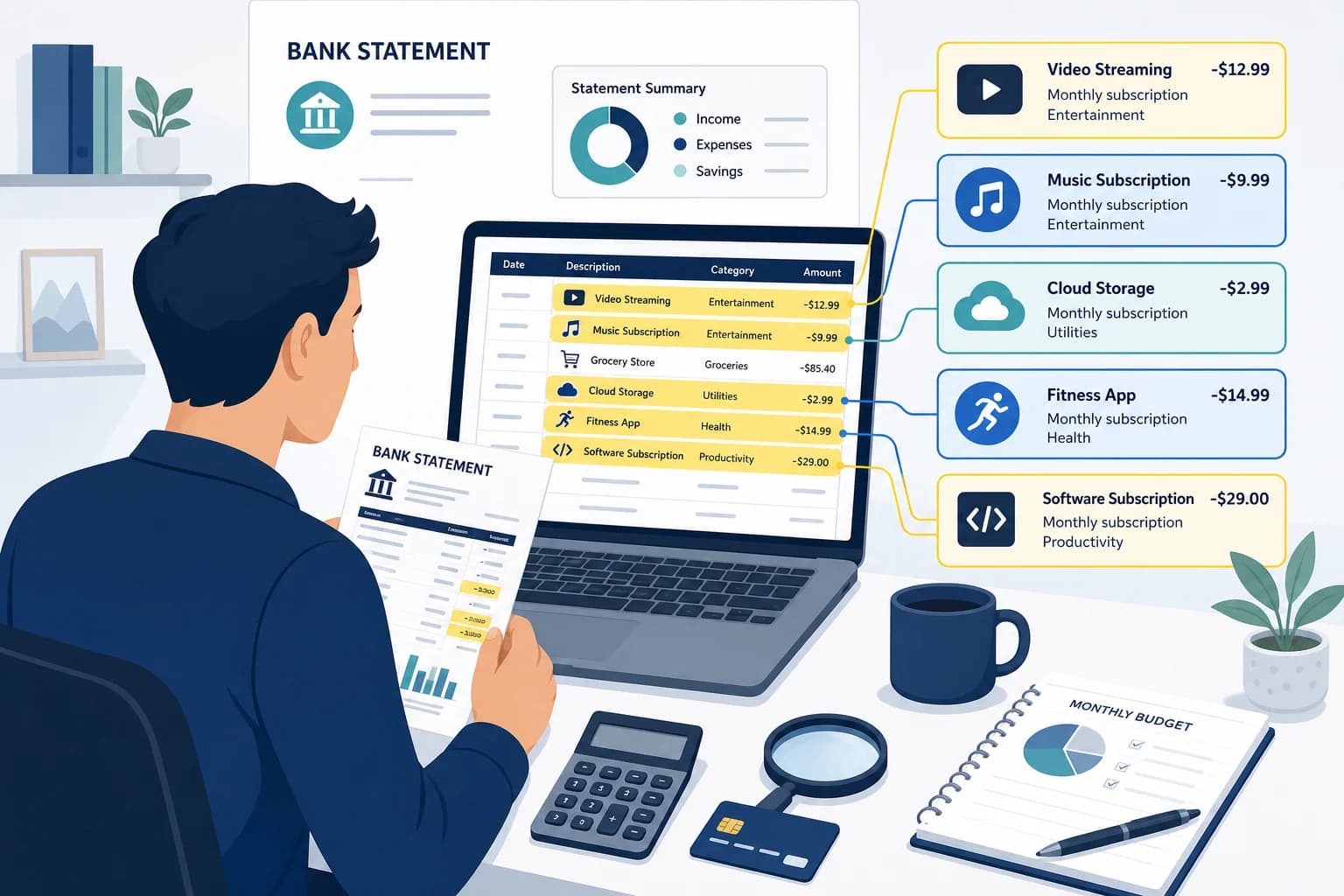
Your bank statement has a secret. Buried between the coffee runs and grocery trips are dozens of small charges — $9.99 here, $14.99 there, $29.99 for something you cannot even remember signing up for. Individually, they feel invisible. Together, they might be $200, $300, or even $500 per month. This is subscription creep. And it is happening to almost everyone. The good news? Fixing it does not require quitting Netflix, canceling your gym membership, or living an ascetic life. It just requires one afternoon and a systematic approach.
The Quick Math: How Much Are You Really Spending on Subscriptions?
Before you can cut, you need to know the baseline. In 2026, the average American household spends approximately $250–$350 per month on subscriptions. This includes streaming services, software memberships, box subscriptions, app purchases, gym memberships, news outlets, and more. Most people are surprised to learn they are paying for at least 8–12 active subscriptions at any given time.
Here is the uncomfortable part: research suggests that roughly 40% of those charges are for services people barely use. That is $100–$140 per month going to subscriptions that deliver little to no value. Over a year, that is $1,200–$1,680 wasted. Enough to fund a modest vacation, build a meaningful emergency fund buffer, or pay down high-interest debt.
The goal of a subscription audit is not to strip away every paid service from your life. It is to make sure every dollar is intentional. If you love your streaming services and actually use them, keep them. If you signed up for a productivity app during a free trial two years ago and have not opened it since, that is the kind of waste a systematic audit can eliminate.
What Is Subscription Creep? (And Why It Happens to Everyone)
Subscription creep is the gradual, often unconscious accumulation of recurring charges over time. You sign up for a free trial. You forget to cancel. A new streaming service launches and you add it temporarily. Your employer switches project management tools and now you are paying for the premium version personally. Slowly, line items multiply until they become a significant chunk of your monthly budget.
Why does it happen so easily? Part of the answer lies in psychological pricing. When a subscription costs $9.99 per month, your brain categorizes it differently than a $120 annual charge or a $500 one-time purchase. It feels small. It feels manageable. It feels like something you can afford. But 10 subscriptions at $9.99 each quickly becomes $100 per month — and that is before the $14.99 and $29.99 tiers enter the picture.
Another factor is the frictionless cancellation problem. Companies have made signing up incredibly easy — one click, sometimes no credit card required for free trials. Cancelling, however, often requires navigating menus, chatting with retention agents, or sitting through lengthy hold times. This asymmetry keeps people subscribed long past the point of actual use.
Step-by-Step: How to Conduct a Subscription Audit
A thorough subscription audit takes 30–45 minutes. Block that time, grab a coffee, and work through each step systematically. The goal is to end with a complete list of every recurring charge, how much it costs, and whether it deserves to stay.
Step 1: Pull 3 Months of Bank and Credit Card Statements
Log into your online banking or download the past three months of statements. Look for any transaction that repeats monthly, quarterly, or annually. Common categories include streaming services (Netflix, Spotify, Disney+, HBO Max), software subscriptions (Adobe, Microsoft 365, Notion), fitness apps (Peloton, Apple Fitness+, gym memberships processed digitally), cloud storage (iCloud, Google One, Dropbox), and news or publication subscriptions (New York Times, Wall Street Journal, Medium).
Pro tip: Many banks have a recurring payments or subscriptions feature that automatically categorizes these for you. Check your banking app — it may already have done half the work.
Step 2: Check App Stores and Digital Accounts Directly
Bank statements will catch most charges, but not all. Apple users can find every iOS subscription by going to Settings → [Your Name] → Subscriptions. Google users can check Play Store → Profile → Payments & Subscriptions → Subscriptions. Amazon Prime members should check both Prime Video channels and their main Amazon account for autorenewing items. These direct checks often surface forgotten subscriptions that never appear on bank statements because they are billed through the platform rather than as separate transactions.
Step 3: Search Your Email for Subscription Confirmations
Search your inbox for terms like subscription confirmed, welcome to, recurring payment, and free trial. Email receipts and welcome messages often reveal subscriptions signed up for during one-time promotions that have since converted to paid plans. Many people discover three to five additional subscriptions this way that neither bank statements nor app stores easily surface.
Step 4: Compile Your Full List
Create a simple spreadsheet or use a note-taking app. For each subscription, record the name, billing amount, billing frequency (monthly, quarterly, annual), the date you signed up, and the primary user if it is a shared or family account. This list becomes your working document for the evaluation phase.
The Keep/Cancel/Negotiate Framework
Once you have your full list, sort every subscription into one of three buckets: Keep, Cancel, or Negotiate. Use these criteria to make the call.
The Keep Test
A subscription earns a spot in the Keep pile if it meets at least two of these three criteria: you use it at least three times per week, the cost is genuinely affordable within your budget, and there is no comparable free or lower-cost alternative that would serve the same purpose. If a subscription passes the Keep Test, it is working for you. Keep it and stop feeling guilty.
The Cancel Test
A subscription belongs in the Cancel pile if it fails at least two of these three criteria: you have not used it in the past 30 days, the cumulative cost is material to your budget (even $15 per month adds up), and you could replicate its core function with something you already use or a free alternative. If you signed up for a free trial and never cancelled, that counts as an automatic Cancel. Those hidden free trials are one of the biggest sources of subscription waste.
The Negotiate Test
Some subscriptions fall into a gray area. You use them occasionally and see value, but the cost feels steep. These are your negotiation candidates. Companies — particularly telecom providers, streaming services, gym chains, and software companies — frequently have unadvertised discounts, loyalty rates, or retention offers. Before cancelling, try negotiating first. You might be surprised what a single phone call or chat message can accomplish.
Negotiation Scripts That Actually Work
When you decide to negotiate rather than cancel, approach the conversation with a specific goal. Here are scripts you can adapt to different scenarios:
For streaming or software subscriptions: I have been a loyal customer for X months/years and I am considering cancelling because the current rate is no longer fitting my budget. Are there any loyalty discounts or promotional rates available that could help me stay?
For gym memberships: My financial situation has changed and I need to either reduce my monthly payment or cancel my membership. Before I cancel, is there a lower-tier plan or a pause option that would work better for my current situation?
For telecom or internet service: I noticed competitors are offering specific deal for new customers. As a long-standing customer, I wanted to ask if there is any way to get a comparable rate on my current plan.
The key is being willing to follow through. If the representative cannot offer a meaningful discount, politely cancel and then check back in 30 days — many companies offer better rates to former customers who express interest in returning than they do to existing customers who complain.
Hidden Subscriptions: Where to Look
Beyond the obvious streaming and software subscriptions, there are several categories that frequently escape notice during casual budget reviews.
- App Store subscriptions on iOS and Android — these include games, meditation apps, dating apps with premium tiers, and utilities. Check both platforms directly.
- Amazon Prime channels — add-on subscriptions like HBO, Showtime, or Starz that bill through your Amazon account separately from the main Prime membership.
- Annual software subscriptions that auto-renew — many apps charge annual rates that seem small monthly but bill $100–$300 upfront. These are easy to forget between renewal notices.
- Rental or lease add-ons — some apartment complexes bundle streaming services or fitness app memberships with rent. Verify you are using what you are paying for.
- Insurance add-ons — mobile phone insurance, travel insurance bundled with bookings, and warranty extensions are recurring charges that feel like one-time purchases.
- ISP-provided streaming bundles — some internet providers now include streaming platform subscriptions as part of service packages. If you already pay for Netflix separately, you may be paying twice.
Subscription Cancellation Services: Worth It or DIY?
Services like Rocket Money (formerly Truebill), PocketGuard, and Trim have built businesses around subscription management. They connect to your bank account, identify recurring charges, and offer to cancel subscriptions on your behalf. Some even negotiate bills for you. Here is an honest assessment:
These services are worth considering if you have a large number of subscriptions (20+), have tried and failed to cancel manually multiple times, or struggle with the psychological friction of cancellation processes. The negotiation services can sometimes secure refunds or rate reductions that exceed the service fee.
However, DIY is equally effective for most people. If you are organized, have 30–45 minutes available, and can handle a few phone calls or chat sessions, you can accomplish everything these services do without the added cost or the security trade-off of sharing your banking credentials. The subscription audit process described above is essentially what these services automate — you can do it yourself for free.
How to Prevent Subscription Creep From Coming Back
Completing a subscription audit is a victory. Preventing the creep from returning requires a different mindset and a few simple systems.
The 24-Hour Rule for New Subscriptions
Before signing up for any new subscription — free trial or paid — add it to a running list and wait 24 hours. This buffer prevents impulse sign-ups during promotional periods. After 24 hours, ask yourself whether you would sign up at full price. If the answer is no, do not sign up at the promotional rate either.
Calendar Reminders for Free Trials
Set a calendar reminder 3 days before any free trial expires. This gives you enough time to evaluate whether the service is worth keeping and cancel without losing access immediately if you decide it is not. Many people find that scheduling the cancellation date as a calendar event is more effective than relying on memory alone.
Annual Budget Reviews
Schedule a recurring quarterly or semi-annual subscription review. Treat it like a financial physical — look at every charge, ask the Keep/Cancel/Negotiate question, and make changes. For most people, this habit alone prevents significant creep because awareness is the antidote to the invisibility problem that makes subscriptions so costly.
Household Coordination
If you share finances with a partner or family members, create a shared subscription tracker. Many households have duplicate subscriptions — two Netflix accounts, two Spotify Premium accounts, two separate software licenses — when a family or duo plan would serve the same needs at a lower total cost. Consolidating duplicate subscriptions is one of the easiest ways to cut costs without losing access to the services you actually use.
FAQ: Subscription Audit
- How do I find all my active subscriptions?
- Review 3 months of bank and credit card statements for recurring charges. Check directly in your Apple ID settings (Settings → [Your Name] → Subscriptions), Google Play store subscriptions, Amazon account for autorenewing items, and search your email for subscription confirmation messages. Cross-referencing these sources typically surfaces every active subscription.
- How much money can I save by canceling subscriptions?
- The average household spends $250–$350 per month on subscriptions, with roughly 40% representing underused or forgotten services. A thorough audit and cancellation of genuinely unused subscriptions typically saves $100–$200 per month, or $1,200–$2,400 per year. Individual results vary based on current subscription volume and usage patterns.
- What is the average number of subscriptions per person?
- Most individuals maintain 8–12 active subscriptions across streaming, software, fitness, and digital services. Households with multiple people often carry 15–25 individual subscriptions, many of which overlap in function or go unused.
- Should I pay for a subscription cancellation service?
- Subscription cancellation services can be worth the cost if you have a large number of subscriptions and struggle with the friction of cancellation processes. However, most people can accomplish the same results through a DIY audit using the step-by-step process described in this article, without sharing banking credentials or paying a service fee.
- How do I stop free trials from charging me?
- The most reliable method is to set a calendar reminder 3 days before the trial expires, then cancel during the reminder window. Alternatively, use a dedicated email address for free trial sign-ups so trial expiration notices stand out clearly. Some people use virtual card services or prepaid cards for trials to prevent accidental charges entirely.
- What subscriptions are worth keeping?
- Subscriptions worth keeping serve a need you use frequently, cost less than comparable alternatives, and fit comfortably within your overall budget. The evaluation is personal — a streaming service you watch daily is worth far more than one you check monthly, regardless of price. Apply the Keep Test outlined above to make the call objectively.
- How often should I do a subscription audit?
- At minimum, conduct a full subscription audit every 6 months. Quarterly reviews are better if you frequently sign up for free trials or tend to accumulate subscriptions quickly. Regular reviews prevent small recurring charges from compounding into meaningful budget drain without your awareness.
- Can I negotiate my subscription prices?
- Yes. Many subscription services — particularly telecom, streaming, gym, and software companies — have unadvertised loyalty discounts or retention offers. Contact customer service directly, express your intention to cancel, and ask about available discounts. This approach is most effective with customer service chat or phone calls where you can speak with a representative who has authority to offer rates not shown on public pricing pages.
A subscription audit is not about deprivation. It is about awareness. The average household loses $100–$200 per month to subscriptions that deliver little to no value — not because they are reckless, but because subscription creep is designed to be invisible. One systematic afternoon of reviewing, evaluating, and deciding is all it takes to reclaim that money and redirect it toward goals that actually matter to you.
If you found this guide helpful and want to build more awareness around your overall spending patterns, learn how to track expenses with a simple step-by-step system. And if you are ready to take the next step beyond cutting costs, explore the best AI budgeting apps that can help you manage recurring payments automatically going forward.
The money you save from a single subscription audit could fund an emergency fund buffer, accelerate debt payoff, or simply give you breathing room in a budget that feels tight. That is not a small thing. It is a real, tangible win — and you do not have to give up anything you actually value to get there.
Take control of your money today
Start free with Spendmate — track expenses, plan budgets, and reach your financial goals.
Start free with Spendmate