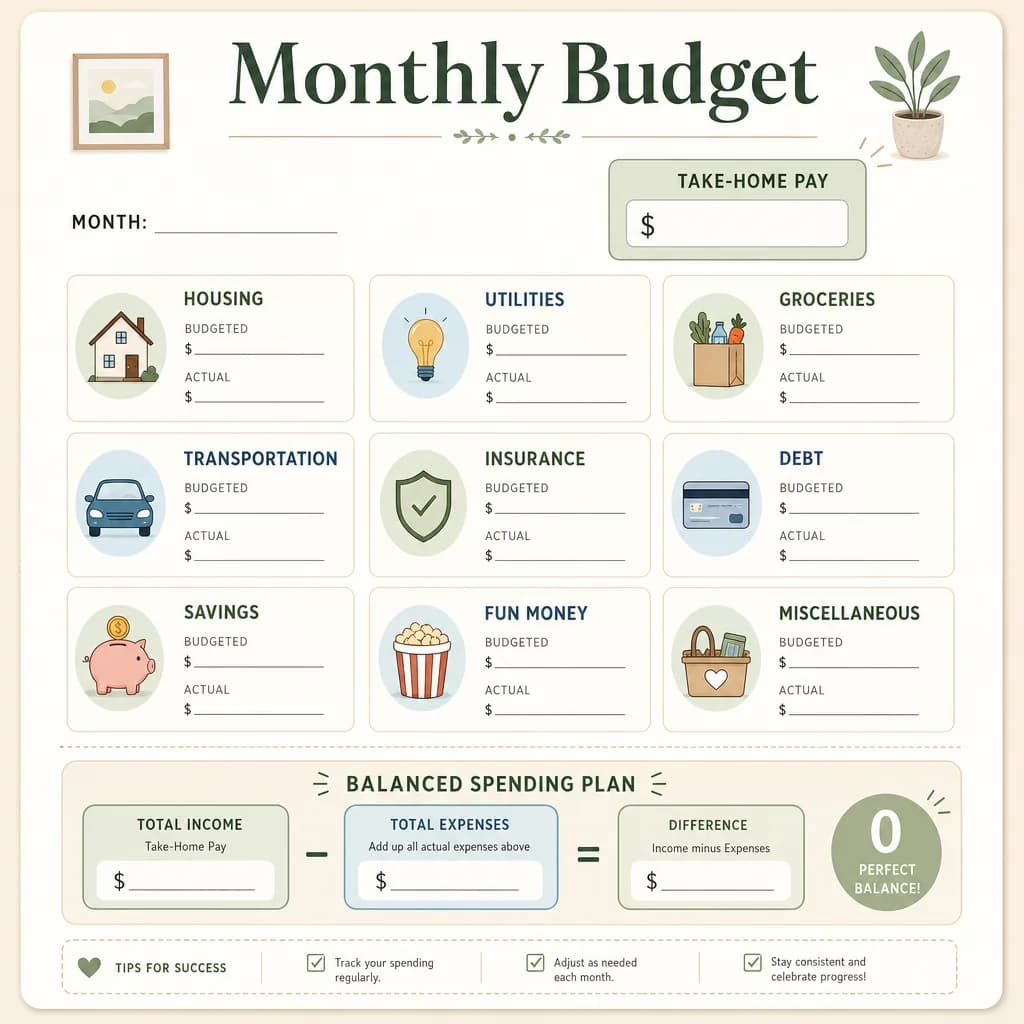
If you want to know how to make a monthly budget, start with a simple idea: give every dollar of take-home pay a job before the month begins. A monthly budget is not a punishment or a finance exam. It is a spending plan that helps you cover bills, handle everyday life, and make progress on savings and debt without guessing.
For beginners, the biggest mistake is trying to build a perfect budget on day one. A better goal is to build a workable first version using real take-home pay, real bills, and a short list of categories you can actually maintain. Once the system works, you can fine-tune it each month.
This guide walks through the full process, including fixed expenses, variable spending, annual bills, a worked monthly budget example, and what to do if your numbers do not balance the first time.
What a monthly budget is
A monthly budget is a plan for how you will use this month’s income. In plain English, it tells your money where to go before it disappears on autopilot. A good monthly budget covers needs first, leaves room for normal life, and connects everyday spending to larger goals like emergency savings or debt payoff.
You do not need dozens of budget categories. Most beginners only need a few: housing, utilities, food, transportation, debt, savings, and personal spending. The goal is clarity, not complexity.
Start with your take-home pay
The first step in how to create a budget is using take-home pay, not gross pay. Gross pay is what you earn before taxes, insurance, retirement deductions, or other withholdings. Take-home pay is what actually lands in your bank account. That is the number your monthly budget should be built around.
If you are paid twice a month, add both paychecks. If you are paid biweekly, remember that some months will have an extra paycheck. If your income changes, use a conservative average month or your lowest reliable month so your plan stays realistic.
- Use net or take-home pay as your starting number
- Include regular side income only if it is consistent
- If income varies, budget from the lowest reliable month
- Treat windfalls as extras, not part of the base plan
List your fixed expenses
Fixed expenses are the bills that stay mostly the same each month. These are usually the easiest numbers to gather because they repeat. Start here because fixed bills shape the rest of your budget.
Fixed vs variable expenses
Fixed expenses include things like rent, mortgage, car payments, insurance, subscriptions, and minimum debt payments. Variable expenses change from month to month, such as groceries, gas, dining out, household items, or entertainment. Both matter, but fixed costs are the foundation.
- Housing: rent or mortgage
- Utilities and phone
- Insurance premiums
- Minimum debt payments
- Subscriptions you plan to keep
- Childcare or tuition if applicable
Add variable and non-monthly expenses
Once fixed bills are listed, add the expenses that move around. Groceries, gas, personal care, pets, and fun money often change every month. Use your recent bank statements to estimate a realistic amount instead of guessing what you wish you spent.
How to include annual bills
A monthly budget also needs room for non-monthly expenses. Annual insurance, car registration, holiday spending, school costs, and home maintenance can wreck a budget when they are ignored. The easy fix is to divide the total by 12 and save a little each month. That turns irregular bills into a manageable monthly line item.
This is where many beginners get stuck. They think the budget failed, when really the plan was incomplete. If the expense is predictable, it belongs in the budget.
Choose a budget method that fits your life
A budget method is just a structure. It should help you make decisions, not make life feel rigid. Two of the most common systems are the 50/30/20 rule and zero-based budgeting.
50/30/20 vs zero-based budgeting
- 50/30/20 budgeting splits income into needs, wants, and savings or debt payoff. It is simple and good for people who want broad guardrails.
- Zero-based budgeting assigns every dollar a job so income minus expenses equals zero. It takes more setup, but it gives tighter control.
- If you are overwhelmed, start with simple categories first and borrow ideas from either method.
- If money is tight, zero-based budgeting is often more helpful because it forces tradeoffs clearly.
A spreadsheet, budget worksheet, or app can all work. Pick the tool you will update. Many people do well with a basic monthly budget template for the first few months because it makes the process feel repeatable.
Spreadsheet vs app
Use a spreadsheet if you want full control and simple customization. Use an app if automation helps you stay consistent. Neither one is morally better. The best tool is the one you will check more than once.
Build your first budget with a simple example
Here is a monthly budget example for beginners using real numbers. Imagine your take-home pay is 3,200 dollars.
- Rent: 1,100 dollars
- Utilities and phone: 220 dollars
- Groceries: 400 dollars
- Transportation: 250 dollars
- Insurance: 130 dollars
- Minimum debt payments: 200 dollars
- Savings: 250 dollars
- Annual bills sinking fund: 150 dollars
- Personal and fun spending: 300 dollars
- Miscellaneous buffer: 200 dollars
That plan totals 3,200 dollars, which means the budget balances. It also covers fixed bills, variable spending, savings goals, and non-monthly expenses. That is what makes a monthly budget actually usable. It reflects real life instead of pretending every month is clean and predictable.
What to do if your budget is negative
If your expenses are higher than your take-home pay, do not panic. A negative budget is information, not failure. Start by cutting or pausing lower-priority categories, reducing subscriptions, shrinking discretionary spending, and checking whether your estimates are inflated. If the budget is still negative, look at bigger fixed costs or income options. You cannot solve a math problem with wishful thinking, so it is better to see the gap clearly.
How to budget if income changes
If you are paid weekly, biweekly, freelance, or on commission, build the budget around your lowest reliable month. Cover essentials first, then add variable spending, savings, and extras only after the basics are funded. When income is higher, use the difference for catch-up goals, savings, or debt instead of expanding every category automatically.
Review your budget every month
A monthly budget is not something you make once and forget. Review it before the month starts, check it during the month, and adjust after the month ends. This is how the plan becomes realistic.
A simple review routine works well: compare what you planned with what you spent, note the categories that ran high or low, update your next month, and keep going. CFPB and FDIC budgeting resources both push this kind of practical review habit because consistency matters more than perfection.
- Check spending once a week or at least mid-month
- Adjust categories when prices or routines change
- Keep savings and debt goals visible in the budget
- Use each month to improve the next month, not to shame yourself
Common budgeting mistakes to avoid
- Using gross pay instead of take-home pay
- Forgetting annual or irregular bills
- Creating too many categories too fast
- Making the plan too strict to survive real life
- Ignoring a negative budget and hoping it fixes itself
- Never reviewing the budget after month one
The best monthly budget is one you trust. That usually means keeping it simple, adjusting it often, and letting it reflect your actual life instead of an ideal version of it.
FAQ
What is the easiest way to make a monthly budget?
Start with take-home pay, list fixed bills, estimate variable spending, add savings and annual expenses, and make sure the total matches your income. A simple worksheet or template is usually enough to begin.
Should I budget with gross pay or take-home pay?
Use take-home pay. Gross pay looks bigger, but your budget has to be based on the money that actually reaches your bank account.
How many budget categories should I use?
Use only enough categories to stay clear. Most beginners can start with a short list such as housing, bills, food, transportation, debt, savings, and personal spending.
What if I overspend in one category?
Adjust another flexible category, reduce next month’s spending, and look for the reason behind the overage. Overspending once does not mean the whole budget failed.
Do I need a budget app?
No. A spreadsheet, paper worksheet, or app can all work. Use the tool that makes it easiest for you to check and update your budget consistently.
Open a simple budget worksheet today, plug in your real take-home pay and bills, and build your first monthly budget before the next paycheck arrives.
Take control of your money today
Start free with Spendmate — track expenses, plan budgets, and reach your financial goals.
Start free with Spendmate