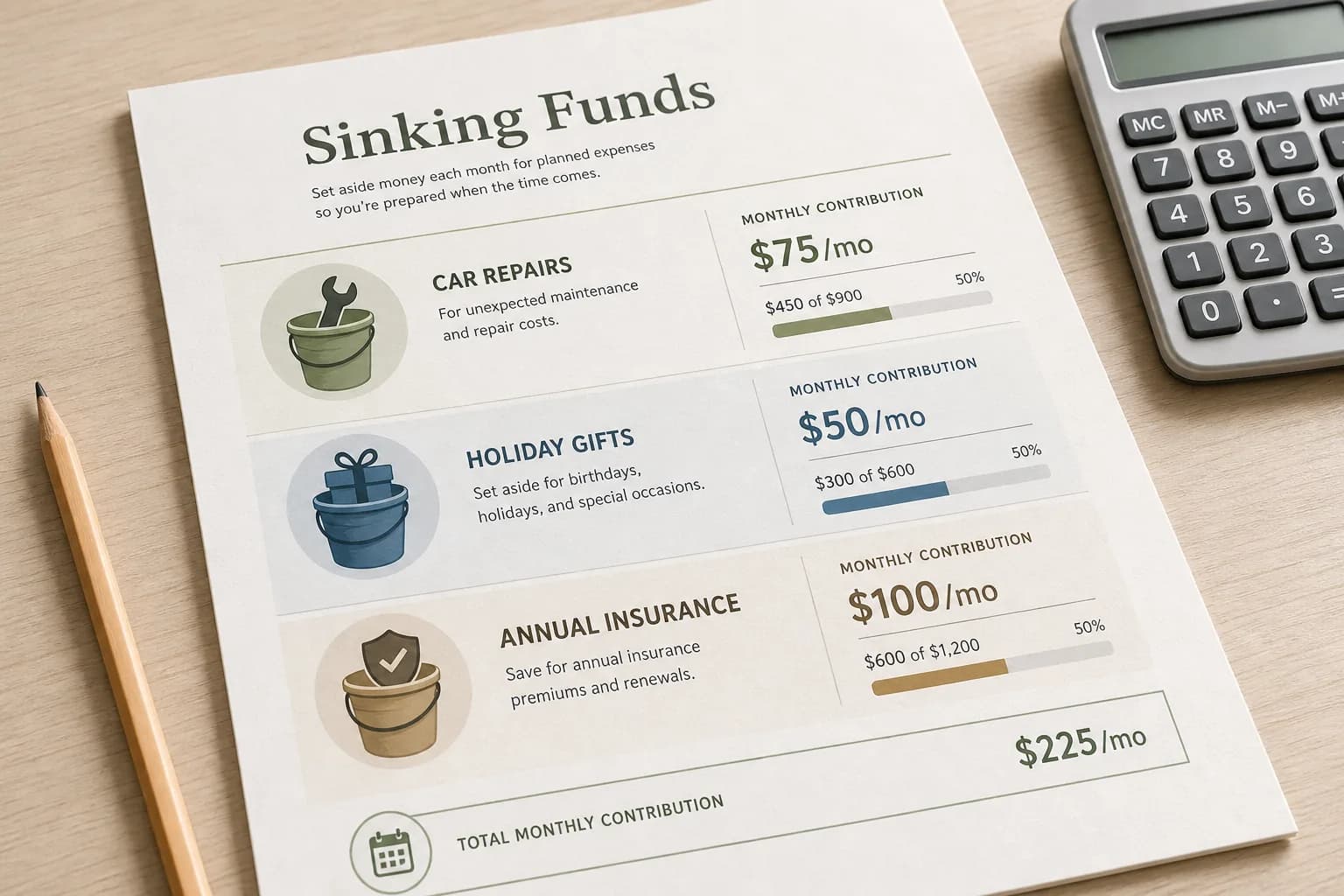
If you have ever asked what is a sinking fund, the easiest answer is this: it is money you save a little at a time for a future expense you already know is coming. Instead of letting a big bill surprise you, you prepare for it in advance.
A sinking fund is useful for car repairs, holiday gifts, travel, annual insurance, school supplies, pet care, and home maintenance. These costs are not true emergencies because they are predictable. They are also not part of your normal monthly bills. That is why they need their own plan.
For beginners, sinking funds make a budget feel steadier. You are less likely to lean on a credit card for a bill you could see coming, and those awkward lump-sum costs start to look more manageable when you break them into monthly saves.
What a sinking fund is
A sinking fund is a savings bucket for a planned expense. You pick a goal, set a deadline, and save toward it gradually. When the bill arrives, the money is waiting.
Think of it as future-you protection. Instead of hoping you will find the money later, you build it on purpose now.
How a sinking fund works
The process is simple. First, choose one upcoming expense. Next, decide how much you will need and when you will need it. Then divide that amount by the number of months left before the expense happens. The result is your monthly sinking fund contribution.
For example, let us say your car insurance renews in 6 months and the bill will be 600 dollars. Divide 600 by 6, and you get 100 dollars per month. If you save 100 dollars each month, the full amount is ready when the renewal arrives.
Sinking fund vs emergency fund
This is where many people get confused. A sinking fund is for expected costs. An emergency fund is for unexpected costs. They solve different problems.
- Use a sinking fund for vacations, holiday gifts, annual insurance, home maintenance, school supplies, and car repairs you know will come eventually.
- Use an emergency fund for job loss, urgent medical bills, emergency travel, or a repair you could not reasonably predict.
- A sinking fund is planned. An emergency fund is protective.
- Sinking funds reduce day-to-day budgeting stress. Emergency funds protect your life when something goes wrong.
If a cost is likely, repeatable, or tied to a known date, it usually belongs in a sinking fund. If it is sudden, urgent, and truly unplanned, it belongs in an emergency fund.
Best expenses to use sinking funds for
You do not need ten sinking funds on day one. Start with the expenses that hit your budget hardest or most often.
- Holiday gifts and seasonal spending
- Car repair and maintenance
- Annual insurance premiums or HOA fees
- Vacation or travel
- Home maintenance and appliance replacement
- Back-to-school costs
- Pet care and vet visits
- Taxes for freelancers or side-income earners
For many beginners, annual bills and car costs are the best first sinking fund categories because they are easy to predict and expensive enough to cause stress if ignored.
Step 1: List your predictable non-monthly expenses
Look at the next 6 to 12 months. Write down expenses that are not monthly but are very likely to happen. Check your bank statements, calendar, old receipts, and renewal dates. This helps you stop treating predictable expenses like surprises.
- Annual subscriptions and memberships
- Insurance renewals
- Holiday spending
- Birthdays and special events
- Car registration and maintenance
- Home repairs and seasonal upkeep
Step 2: Set a target amount and deadline
Estimate how much each expense will cost and when you will need the money. Use last year’s numbers if you have them. If you are unsure, choose a realistic round number and adjust later. It is better to start with a useful estimate than to wait for a perfect one.
Step 3: Break the goal into monthly contributions
Use a simple formula: target amount divided by months left equals monthly contribution. If you need 1,200 dollars for holiday spending in 12 months, save 100 dollars per month. If you need 480 dollars for home maintenance in 8 months, save 60 dollars per month.
This is why sinking funds work so well. A big, stressful bill becomes a small, regular line in your budget.
Step 4: Keep sinking funds organized
You can manage sinking funds in one savings account, separate savings buckets, a spreadsheet, or a simple budgeting app. Use the setup you will actually keep updated. What matters most is knowing exactly how much belongs to each category.
- One savings account plus a tracking spreadsheet
- A budgeting app with category balances
- Separate savings buckets inside one bank account
- Cash envelopes for short-term categories
Most beginners do best with one or two categories first. If money is tight, choose the expense most likely to push you into debt and start there.
One sinking fund vs multiple buckets
If you feel overwhelmed, begin with one general sinking fund for planned expenses. Once the habit feels easy, split it into separate buckets like car, holidays, and home. Starting simple is better than building a perfect system you never use.
Step 5: Review and adjust each month
Life changes, and your sinking funds should change with it. Review your categories once a month. If an expense becomes more urgent, increase its contribution. If a goal is complete, redirect that money to the next planned cost.
A quick monthly check-in keeps your budget realistic and helps the habit stick without turning it into a chore.
A simple example with real numbers
Imagine you want to prepare for three common expenses: 600 dollars for car maintenance in 6 months, 900 dollars for holiday gifts in 9 months, and 360 dollars for annual insurance in 12 months. Your monthly contributions would be 100 dollars, 100 dollars, and 30 dollars. That means you would save 230 dollars per month total. That is much easier to absorb than getting hit with 1,860 dollars at random times.
Common mistakes to avoid
- Confusing sinking funds with emergency savings
- Starting too many categories at once
- Guessing without checking likely costs
- Forgetting annual or seasonal bills
- Skipping monthly reviews
- Using sinking fund money for unrelated spending
The goal is not to create more complexity. The goal is to make predictable spending feel controlled instead of chaotic.
Where should you keep sinking funds?
For most people, a separate savings account or savings bucket system works well. The money stays safe, easy to access, and less tempting to spend. If you are saving for a short-term goal, keep it in cash or savings, not in investments that could drop in value when you need the money.
FAQ
What is the difference between a sinking fund and an emergency fund?
A sinking fund is for expected expenses you can plan for, like holidays, insurance, or car maintenance. An emergency fund is for urgent and unexpected costs, like job loss or a medical bill.
How many sinking funds should I have?
Start with one to three categories. Pick the planned expenses most likely to stress your budget, then add more only after the habit feels easy to maintain.
Should sinking funds be in a separate savings account?
They can be, but they do not have to be. One savings account with clear tracking works fine. Separate buckets can help if you like visual organization.
How do I calculate monthly sinking fund contributions?
Divide the target amount by the number of months left before the expense is due. That gives you the amount to save each month.
What are the best sinking fund categories for beginners?
Car repairs, annual insurance, holiday gifts, and home maintenance are strong starting points because they are common, predictable, and expensive enough to disrupt a monthly budget.
Pick one planned expense today, set a target amount and deadline, and start your first sinking fund with a small monthly transfer.
Start Your First Sinking Fund
Take control of your money today
Start free with Spendmate — track expenses, plan budgets, and reach your financial goals.
Start free with Spendmate