
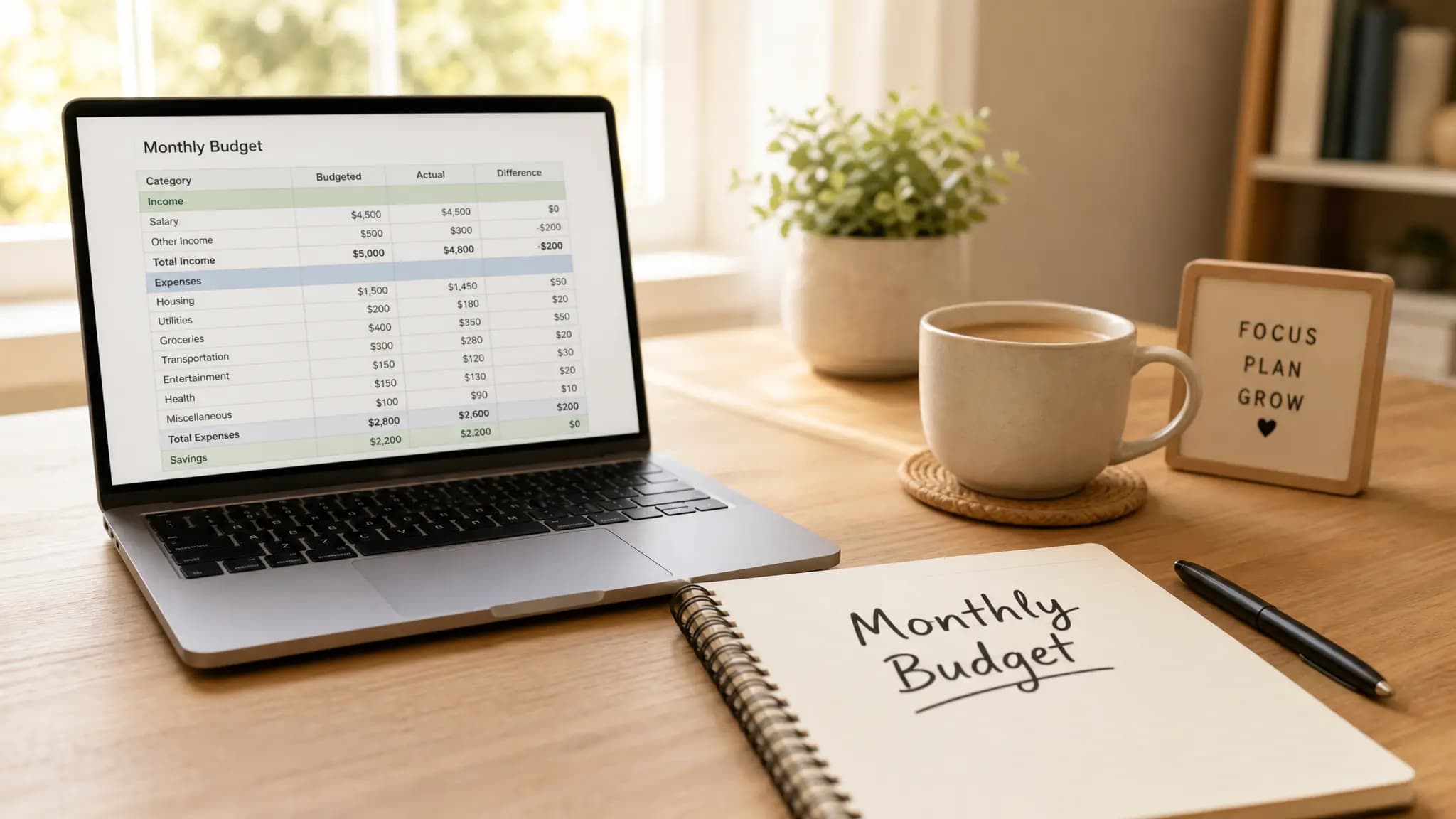
If you've never budgeted before—or you've tried and failed—this guide is for you. You don't need a perfect budget. You need a starting point. And you can set it up in 5 minutes. Yes, really.
Maybe you've downloaded budgeting apps, started elaborate spreadsheets, or made detailed plans that you abandoned by week two. That's not your fault. Most budget advice is overcomplicated, restrictive, and designed for people who love tracking every penny. This is different. This is budgeting for beginners step by step—no shame, no judgment, no perfection required.
Let's build your 5-minute budget.
Here's the entire system in one sentence: Know what comes in, know what goes out, and make a simple plan for the difference. That's it. No 20 categories, no color-coded spreadsheets, no guilt.
Open your bank app or last month's statement. Write down three numbers:
- Income: How much money hits your account each month (after taxes).
- Must-haves: Rent, groceries, utilities, minimum debt payments—the stuff you can't skip.
- Leftover: Income minus must-haves. This is what you have for fun, savings, and everything else.
Done. That took 5 minutes. You now have more clarity than 90% of people.
Choose one of these two frameworks. Don't overthink it—just pick:
Option A: The 50/30/20 Rule (Explained Simple)
- 50% → Needs (rent, groceries, utilities)
- 30% → Wants (fun, hobbies, dining out)
- 20% → Savings or debt payoff
The 50/30/20 rule explained simple: half for needs, 30% for fun, 20% for future-you. That's the whole system.
Option B: Pay Yourself First
- Automatically move 10-20% to savings on payday.
- Pay your bills.
- Spend the rest without guilt.
Pick one. Try it for a month. Adjust later.
Budget apps vs spreadsheet? Here's the real breakdown:
- Spreadsheet: Best if you like seeing everything at once. Free. Simple.
- Budgeting app: Best if you want automation. YNAB, EveryDollar, or your bank's built-in tracker—pick one and stick with it.
- Notes app: Best if you want zero friction. Just type it in.
- Pen and paper: Best if screens stress you out. Old school works.
Don't let tool hunting become procrastination. Confidence comes from using something consistently, not finding the perfect app. The best tool is the one you'll actually use.
Here's the truth: your past budget didn't fail because you're bad with money. It failed because it was too complicated, too restrictive, or both.
- Too many categories: You don't need 47 spending buckets. Start with 3: needs, wants, savings.
- Too much tracking: You don't need to log every coffee. Check in once a week for 5 minutes.
- Too much guilt: One overspent month doesn't erase progress. Just restart next month.
This budget is designed to stick because it's simple, forgiving, and realistic. If you mess up? Adjust and keep going. That's not failure—that's data.
Your First-Month Survival Plan:
- Day 1: Set up your budget (5 min).
- Week 1-4: Check in once a week (5 min).
- Day 30: Review what worked, adjust what didn't (15 min).
- Month 2: Repeat, slightly improved.
That's the whole system. No overwhelm, no perfection, no shame.
Common Mistakes (And How to Avoid Them):
- Being too restrictive: Budget for fun. If you don't, you'll quit.
- Forgetting irregular expenses: Car registration, holiday gifts, annual subscriptions—save a little each month.
- Giving up after one bad month: You will overspend sometimes. That's normal. Restart next month.
- Comparing your budget to others: Your budget is yours alone. Ignore what works for someone else.
You don't need a perfect budget. You need a starting point. And you can build that starting point in 5 minutes.
Your first budget won't be perfect. It doesn't need to be. It just needs to exist. Start simple, check in weekly, and adjust as you learn. If you've failed before, this time is different—not because you're different, but because this system is actually designed to stick.
You've got this. Ready for more? Once you've mastered the 5-minute budget, check out our guides on building an emergency fund, tackling debt strategically, and setting financial goals that actually stick.
Take control of your money today
Start free with Spendmate — track expenses, plan budgets, and reach your financial goals.
Start free with Spendmate