
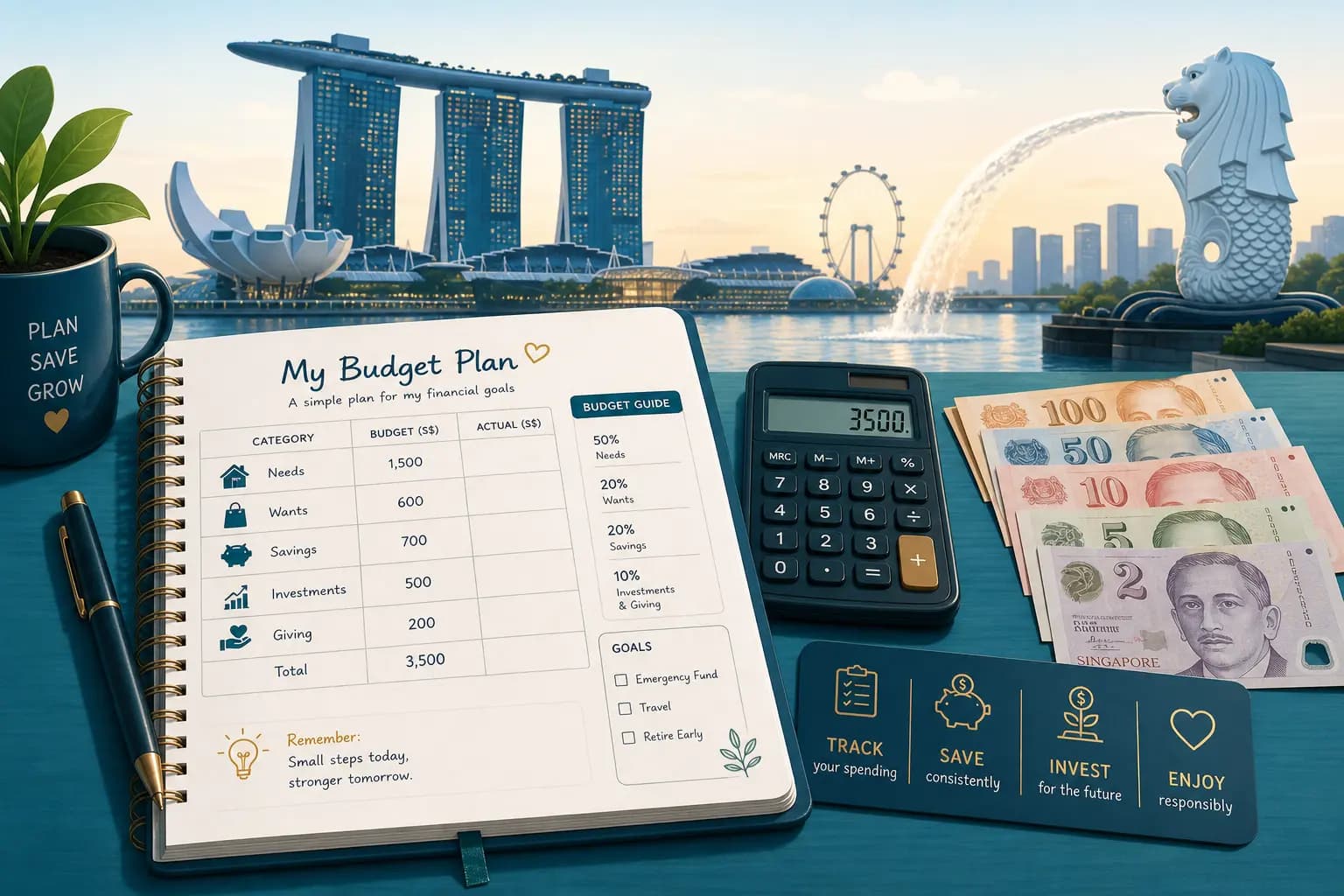
You just got your first payslip. After CPF and SDL deductions, the number in your bank account is smaller than you expected. And somehow, by the end of the month, it is gone. If this sounds familiar, you are not alone — most young Singaporeans enter the workforce without any formal financial education. This guide is not about deprivation. It is a practical 5-step system built around Singapore wages, Singapore costs, and Singapore tools. By the end, you will have a working budget you can actually stick to.
<2>Why Budgeting Feels Different in SingaporeSingapore ranks fourth globally in the 2026 worldwide cost of living index, according to the Monetary Authority of Singapore (MAS) economic report. That ranking is not just a number — it shows up every time you buy groceries, take the MRT during peak hours, or check your Grab fare. The median starting salary for fresh graduates is $3,500 per month according to the NUS Graduate Employment Survey 2025. But after CPF (20%) and SDL (0.25%), your take-home pay is approximately $2,791.25. That $708.75 is not gone — it goes into your CPF accounts where it earns risk-free interest. Understanding this upfront is the difference between feeling broke and actually building wealth.
<2>Understanding Your Payslip: CPF, SDL, and What You Actually Take Home <3>The Typical Singapore Payslip BreakdownBefore you can budget, you need to know what you actually earn. Here is the payslip breakdown for someone earning $3,500 per month:
- Gross Salary: $3,500.00
- CPF Employee Contribution (20%): -$700.00
- SDL (Skill Development Levy, 0.25%): -$8.75
- Total Deductions: -$708.75
- Net Take-Home Pay: $2,791.25
Your employer also contributes 17% of your salary to your CPF — this is part of your total compensation. The $700 per month going into your CPF splits across three accounts: Ordinary Account (OA) for housing and education, Special Account (SA) for retirement earning approximately 4% interest per year, and Medisave Account (MA) for medical expenses and insurance. For official CPF rates and projections, visit the CPF Board website at cpf.gov.sg.
<2>Step 1: Calculate Your Total Monthly IncomeThis sounds obvious, but it is where most beginners stumble. You budget your net take-home pay — not your gross salary. If your net is $2,791 per month, that is your baseline. If you have variable income from freelance work, commissions, or part-time jobs, use the low end of your 3-month average. Budget conservatively and save any excess at the end of the month.
<2>Step 2: Track Your Expenses — Singapore EditionSingapore has expense categories that do not appear in Western budgeting guides. Here is what actually matters for a young Singaporean:
- Housing: $0 with parents to $1,500–$2,500 if renting. This is your biggest variable expense.
- Transport: $100–$200 per month. MRT/LRT typically $80–$120, plus occasional Grab, ERP charges, and parking if applicable.
- Food: $300–$600 per month. Hawker centres are your best friend at $3–$6 per meal. Cooking at home one day a week saves approximately $30–$50 monthly.
- Utilities: $80–$150 per month for HDB flats. Condo residents typically pay $150–$250.
- Telecom: $20–$40 per month with SIM-only plans from Circles.Life, GOMO, or Singtel.
- Insurance: $100–$200 per month for term life, critical illness, and hospital plans. Avoid endowment or investment-linked plans early in your career.
- Healthcare: $30–$60 per month for GP visits, dental, and gym membership.
- Entertainment: $100–$200 per month for movies, games, hobbies, and social outings.
- Shopping: $50–$150 per month for clothing, personal care, and household items.
- Subscriptions: $30–$60 per month for streaming services and apps.
- Savings and Investments: $200–$700 per month. Pay yourself first.
- Parents and Family: $100–$300 per month if you are contributing to household expenses or giving parents an allowance.
The popular 50/30/20 rule from the US breaks down in Singapore because housing costs are disproportionately high. Here is a framework adjusted for Singapore realities:
<3>Budget Allocations by Living Situation- Housing: 0% with parents, 35–45% renting a room, 45–55% renting an apartment
- Transport: 5–8% regardless of living situation
- Food: 15–20% with parents, 10–15% renting
- Utilities and Telecom: 3–5%
- Insurance: 3–5%
- Entertainment and Shopping: 5–10%
- Savings and Investments: 15–25% with parents, 5–15% renting
- Family and Contingency: 5–10%
The US-style 50/30/20 framework allocates 50% to needs, 30% to wants, and 20% to savings. In Singapore, housing can consume 30–55% of take-home pay alone, making the original model impractical. A Singapore-adjusted framework looks like this:
- 50/30/20 (US model): Needs 50%, Wants 30%, Savings 20% — savings portion works in Singapore only if you live with parents
- Singapore-with-parents: Needs (housing, food, transport, utilities) 45–55%, Wants (entertainment, shopping) 10–15%, Savings 20–25%
- Singapore-renting: Needs 65–75%, Wants 10%, Savings 5–15% — higher housing costs leave less room for savings
- Singapore-optimised (aggressive): Needs 50–55%, Wants 10%, Savings 25–35% — achievable with parents or flat-sharing
Take-home pay: $2,791. Here is how this breaks down for someone living with parents:
- Housing (family contribution): $0–$300
- Transport: $150 (MRT plus occasional Grab)
- Food: $500 (Hawker meals plus cooking at home)
- Utilities and Telecom: $60 ($20 SIM plan plus $40 utilities)
- Insurance: $150 (basic term life and hospital plan)
- Entertainment and Shopping: $200
- Savings (Emergency Fund): $500
- Investments (ETFs via Endowus or Syfe): $200
- Parents and Contingency: $231
- Total: $2,791
This gives a savings rate of approximately 25% of take-home pay — $700 per month going toward emergency funds and investments. If you are looking for more ways to stretch your budget during times of rising costs, this Singapore inflation survival guide has practical tips for cutting $400–$800 per month without downsizing your lifestyle. For those already struggling with month-to-month cash flow, this 30-day plan to stop living paycheck to paycheck offers a structured approach to regaining control.
<2>Step 4: Automate and SystemizeThe best budget is one you do not have to think about. Set up automation so your money moves the moment you get paid:
- On pay day: CPF contribution is handled automatically by your employer
- On pay day: Transfer your savings amount to a dedicated savings account immediately
- On pay day: Set up auto-debit for your investment account via Syfe, Endowus, or StashAway
- On pay day: Transfer family contribution if applicable
- Whatever remains is your discretionary spending money — no guilt, no tracking required
- DBS Multiplier Account: Your primary salary account. Auto-saves when you spend and invest simultaneously.
- OCBC 360 Account: Savings accelerator with up to 3.45% per annum interest with qualifying activities.
- UOB One Account: Cash back card plus savings with up to 3.85% per annum with activity requirements.
- Revolut or Wise: Multi-currency accounts for overseas spending and travel money.
- DBS PayLah!: For splitting hawker bills and person-to-person payments easily.
- Seedly or Stockbart: For expense tracking across multiple accounts.
Budgeting without goals is just tracking numbers. Give your savings purpose with this priority order:
- Emergency Fund: 3 months of expenses ($5,000–$10,000 in accessible cash). This is your financial safety net.
- CPF OA Housing Down Payment: If you are planning to buy a BTO or resale flat, you need a minimum 10% down payment for HDB.
- Invest in Yourself: Skills and certifications often have a higher ROI than most investments in your early career.
- Start Investing: ETFs via CDP, SRS, or a brokerage account. Compound growth is powerful when you start early.
- Life Insurance: Term plan, critical illness coverage, and hospital plan for protection.
- Other Goals: Wedding, travel, car, graduate studies — whatever matters to you personally.
- Month 1: Track all expenses for 30 days using your bank's app or a spreadsheet
- Month 2: Set up your first budget plus automatic savings transfer
- Month 3: Build a 1-month emergency fund ($1,500–$2,500 depending on expenses)
- Month 6: Build a full 3-month emergency fund
- Month 9: Start your first investment via ETFs through Endowus, Syfe, or CDP
- Month 12: Review and optimise — increase your savings rate as your salary grows
Many young professionals make these same mistakes. Learning from them early saves thousands:
- Budgeting your gross salary instead of net: Always work from your take-home pay after CPF and SDL.
- Ignoring CPF: It is 20% of your salary. Plan around it, not against it. Refer to cpf.gov.sg for official rates.
- Not tracking Hawker spending: Small daily purchases at $4–$6 per meal add up to $300–$500 per month.
- Copying US budgeting templates: Singapore is cash-light, high-cost, and CPF-based. Generic advice does not apply.
- Skipping the emergency fund: One medical emergency or job loss without savings means debt.
- Underestimating rent costs: Factor in stamp duty, deposit, and agent fees if you are renting.
- Not automating savings: If it is not automatic, it will not happen consistently.
- Trying to wing it: A budget does not need to be perfect. It just needs to exist.
For more on protecting your budget from rising costs, read our Singapore inflation survival guide. If your paychecks seem to disappear before they arrive, our 30-day plan to stop living paycheck to paycheck can help you break the cycle. And if you want to learn about the biggest financial mistakes young professionals make, check out our guide on 9 common money mistakes young professionals make in their 20s.
<2>FAQ: Budgeting for Beginners SingaporeBuilding good financial habits early sets you up for long-term success. For more beginner-friendly financial guides, check out our article on 9 common money mistakes young professionals make in their 20s, and our comparison of the best high-yield savings accounts for your emergency fund.
- How much should a fresh graduate save in Singapore?
- Aim for 15–25% of your take-home pay. On a $3,500 per month salary ($2,791 take-home), that is $420–$700 per month. Start with 10% if 15% feels steep — the key is building the habit. Increase by 1–2% every 6 months as your salary grows.
- What is a realistic budget for a Singapore fresh graduate?
- With parents: Housing $0–$300, Transport $150, Food $400–$500, Utilities $50–$80, Insurance $150, Entertainment $150, Savings $500+. Without parents (renting): Housing $900–$1,500, leaving significantly less for savings. Living with parents is the single biggest financial advantage early in your career.
- How do I budget if I earn a low salary in Singapore?
- The same framework applies, but with less flexibility. Track every dollar, cut optional subscriptions, use Hawker food over restaurants, and look for upskilling opportunities to increase your earning power. The budget does not change — your income potential does.
- Should I use the 50/30/20 rule in Singapore?
- The 50/30/20 rule does not work well in Singapore due to high housing costs. Use the Singapore-adjusted framework instead: Housing (0–55%), Transport (5–8%), Food (10–20%), Savings (5–25%), and remaining categories as listed above.
- How do I budget around CPF contributions?
- You do not budget CPF — it is automatic. But you need to understand it: 20% of your gross goes to CPF, and your employer adds 17%. Your CPF OA earns approximately 2.5–4% interest. When budgeting, use your net (take-home) pay, not gross. The CPF is your future money — do not think of it as gone. For official information, visit cpf.gov.sg.
- What budgeting app should I use in Singapore?
- DBS and POSB digibank have built-in expense tracking. Syfe, Endowus, and StashAway are good for investments. Seedly or Stockbart track expenses across multiple accounts. There is no single best app — use your bank's built-in tools combined with a simple spreadsheet for your budget. The best app is the one you will actually use consistently.
- How do I save money eating in Singapore?
- Hawker centres are the key. Budget $4–$6 per meal at Hawker centres ($330–$480 per month for 3 meals, 6 days a week). Cook at home 1–2 days per week to save approximately $50 per month. Avoid bubble tea and cafe culture if you are saving aggressively — each treat adds $30–$100 per month.
- How much should I allocate to entertainment in Singapore?
- 5–10% of take-home. On $2,791 take-home, that is $140–$279 per month. This covers Netflix, dining out, movies, and hobbies. If you want to save more, cut this category first — it is the most adjustable.
- When should I start investing versus saving in Singapore?
- Priority order: First, build a 3-month emergency fund. Then, start investing. CPF SA top-ups should only come after you have maxed your OA housing limit. Starting early with ETFs via CDP or SRS is powerful due to compound growth, but not before you have cash savings.
- How do I budget for irregular expenses in Singapore?
- Create sinking funds for known irregular costs: car COE renewal ($20,000+ every 10 years), property tax, insurance renewals, holiday travel, and Chinese New Year ang bao. Divide the annual cost by 12 and save that amount monthly in a separate account.
Take control of your money today
Start free with Spendmate — track expenses, plan budgets, and reach your financial goals.
Start free with Spendmate