
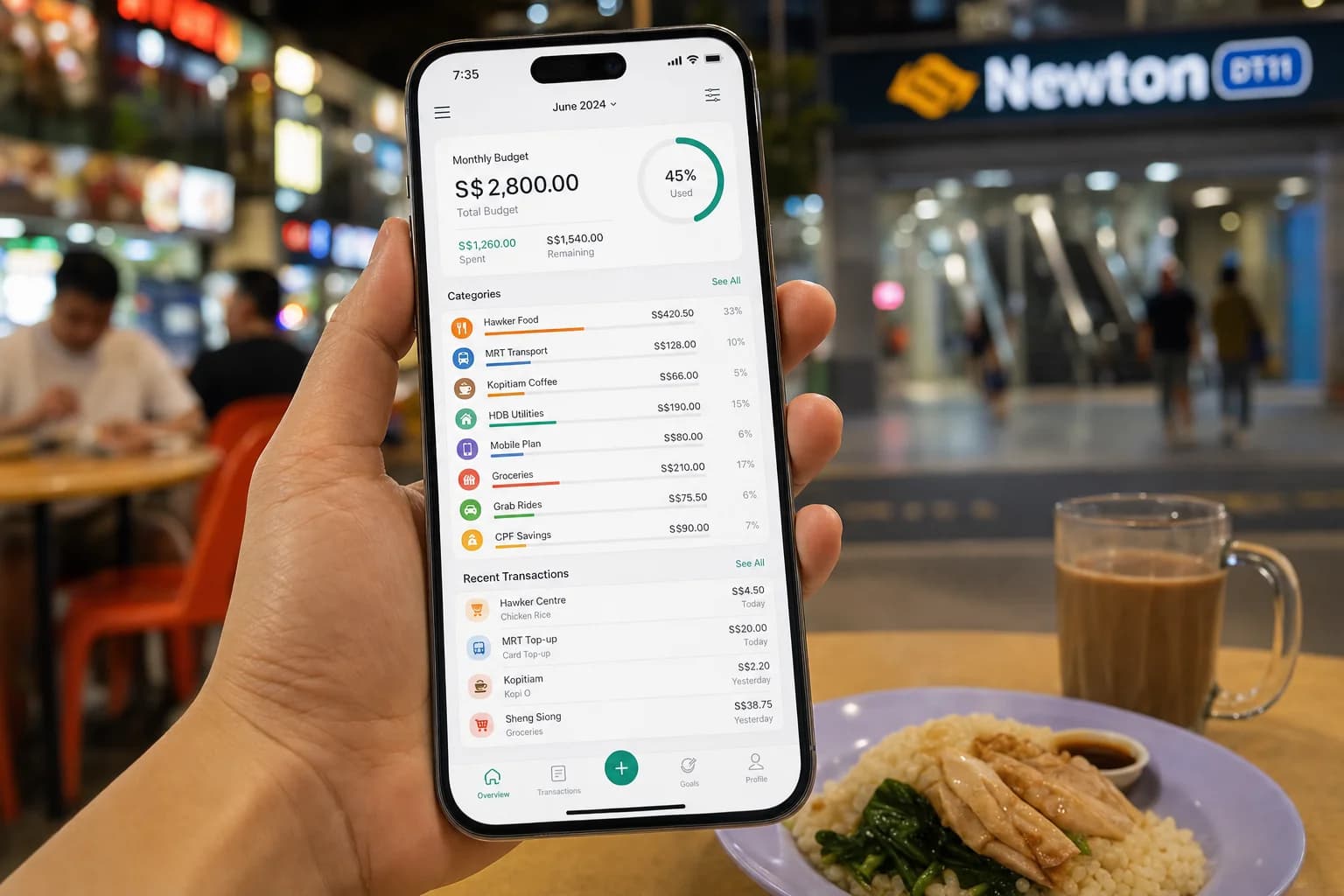
You are a Singaporean earning ,500 a month. You have a DBS account, an OCBC account, use PayNow to send money to your parents every month, take Grab rides three times a week, and buy lunch at the hawker center with cash most days. You have tried three budgeting apps and abandoned all of them. Why? Because none of them understood how you actually spend money. This guide fixes that — it ranks the best budgeting apps for Singaporeans in 2026, based on how well they handle Singapore-specific spending patterns, not generic Western expense categories.
Why Standard Budgeting Apps Miss Singapore
Most budgeting app reviews are written for American or European users. They assume you pay rent through Venmo, buy groceries at Whole Foods, and split restaurant bills through Splitwise. None of that maps to how money actually moves in Singapore.
Here is what Singapore spending actually looks like: Hawker center meals paid in cash or Nets, Grab rides that are as much lifestyle as transport, PayNow transfers to family members, parents, or helpers, DBS or OCBC salary crediting, UOB credit card for online shopping, Shopee and Lazada purchases that do not auto-categorize, and investment contributions to CPF SA or SRS accounts that standard budgeting apps cannot touch.
The best budgeting app for Singaporeans is the one that understands this reality — not a filtered version designed for a different market. Here is how the top options actually perform.
What to Look for in a Singapore Budgeting App
- Bank aggregation — DBS, OCBC, UOB, CIMB, and digital banks like Revolut or Singtel Dash
- PayNow and PayLah transaction parsing — able to identify transactions by merchant and counterparty
- Hawker and cash expense tracking — quick manual entry that takes under 10 seconds
- Investment account sync — CPF SA, SRS, TD, and ETF portfolio tracking
- Multi-currency support — for overseas family transfers or travel expenses
- Localization — SGD-first interface, Singapore expense categories pre-loaded
- Data privacy — PDPA compliance, servers ideally in Singapore or compliant jurisdictions
Best Free Budgeting Apps in Singapore
Seedly My Income Journal (Free)
Best for: Beginners who want simple income and expense tracking without the complexity of bank syncing.
- Key features: Income and expense logging, basic charts, community benchmarks that show how other Singaporeans in your income bracket are spending
- Singapore-specific: Singapore expense categories pre-loaded — hawker food, transport, family transfers, everything already set up
- Limitation: No automatic bank sync. You enter everything manually.
- Rating: 4.2/5 stars on the Singapore Google Play Store
Seedly is more of a personal finance community than a pure budgeting app, but their My Income Journal tool is genuinely useful for beginners who want to understand where their money goes without signing up for a complicated system.
MoneyLover (Free tier)
Best for: Singaporeans who want automatic bank syncing without paying for a premium subscription.
- Key features: Auto bank sync with major Singapore banks, recurring expense detection, budget alerts when you are approaching category limits
- Singapore-specific: Works with DBS, OCBC, and UOB. SGD is the default currency. Singapore categories pre-loaded.
- Limitation: Free tier allows only 1 budget limit at a time, and the app shows ads. Premium removes both.
- Rating: 4.0/5 stars
MoneyLover is one of the few free apps that actually supports automatic bank syncing in Singapore, which makes it valuable even with the limitations of the free tier.
Best Paid Budgeting Apps in Singapore
YNAB (YouNeedABudget) — 4.99/month or 8.88/year
Best for: Serious budgeters who want the most strong methodology and are willing to invest in it.
- Key features: Zero-based budgeting methodology — every dollar gets assigned a job before the month begins. Goal tracking, debt payoff planning, and extensive educational content.
- Singapore-specific: Works globally, supports SGD, multi-currency. No Singapore-specific bank aggregation — uses international bank connections that sometimes struggle with Singapore banks.
- Limitation: The most expensive option for Singaporeans. Learning curve if you have never used zero-based budgeting. No native CDP or SRS integration.
Willa (Singapore-based) — Free / .99/month premium
Best for: Singaporeans who want a local app built specifically for how they manage money.
- Key features: Automatic expense categorization, bill tracking, savings goals, and investment portfolio overview
- Singapore-specific: Built by Singaporeans for Singaporeans. CDP integration, SRS contribution tracking, Singapore tax treatment built in. Supports PayNow transaction parsing.
- Limitation: Smaller user base means fewer online resources and community support compared to international apps
Willa is the most Singapore-native budgeting app in this list. If you are contributing to CPF SA or SRS and want to see your full financial picture in one place, Willa is purpose-built for exactly that.
Plum (International) — Free / .99/month premium
Best for: Singaporeans who travel frequently, have overseas family, or receive income in multiple currencies.
- Key features: Automatic savings, chatbot-based interface, Paxos integration for holding and transferring GBP, EUR, and USD. Smart assistant that analyzes your spending.
- Singapore-specific: Limited Singapore bank aggregation — works better as a secondary savings and investment tracking tool than as a primary budgeting app for SGD transactions.
- Limitation: Not built for Singapore spending patterns. Best used alongside a Singapore-focused app.
Bank-Owned Budgeting Tools (Free)
Before downloading a third-party app, check what your own bank offers. Singapore banks have invested heavily in built-in budgeting features that may be enough for many users — at no extra cost.
DBS Digibank Budgeting Features
- Live spending tracker that categorizes transactions automatically
- Category breakdown charts — food, transport, entertainment, shopping
- Budget alerts when you are approaching limits in any category
- Strength: Direct bank integration means transactions are updated in real time with no manual syncing
- Weakness: Only works for DBS accounts. If you bank with multiple institutions, you only see your DBS picture
OCBC Digital Budgeting Tools
- Spending insights with monthly comparisons
- Bills tracker for recurring payments
- Savings goals with visual progress tracking
- Strength: Good for OCBC customers who want a simple, free tool without downloading another app
- Weakness: Limited to OCBC accounts only. No investment account integration.
UOB Mighty App
- Cashback tracking tied to UOB cards
- Spend analytics with spending trends over time
- Savings jar feature for separate goals
- Strength: Integrated with UOB credit and debit cards. Good for UOB customers who want to maximize card benefits.
- Weakness: Not a full budgeting solution. Focused more on tracking card rewards than overall financial planning.
Feature Comparison Table
Use this table to quickly compare the most relevant features for Singapore-specific needs.
How to Choose the Right App for Your Singapore Lifestyle
The right app depends entirely on your banking situation, spending patterns, and what you want to track. Here is a quick decision framework.
- Do you use only ONE bank? Use your bank's native app first. DBS Digibank or OCBC Digital may be all you need.
- Do you spend mostly cash at Hawker centers? Use MoneyLover or Seedly for quick manual entry. Both have Singapore expense categories.
- Do you have investment accounts (CDP, SRS, CPF SA)? Choose Willa — it is the only app with built-in Singapore investment account integration.
- Do you travel frequently or have overseas family? YNAB or Plum — both handle multi-currency well.
- Do you want zero-based budgeting? YNAB is the gold standard for this methodology.
- Do you want free with automatic bank syncing? MoneyLover free tier is your best option — it actually works with Singapore banks.
How We Tested These Apps
Each app was tested over a 2-week period in a Singapore context. The test scenario simulated a typical week: hawker breakfast (.50 Nets), MRT commute (.40 EZ-Link), Grab ride to work (2), PayNow transfer to parents (00), Shopee purchase (5), Netflix subscription (2.99 USD), and salary crediting via DBS.
We evaluated each app on: accuracy of automatic categorization, speed of bank transaction syncing, quality of the user interface, how well Singapore-specific expense types were handled, and whether the free tier was actually functional or a feature-gated demo.
FAQs — Budgeting Apps Singapore
- Which budgeting app works best with Singapore banks?
- MoneyLover has the broadest Singapore bank support, including DBS, OCBC, and UOB with automatic syncing. Willa also supports Singapore bank aggregation with better local investment integration. DBS Digibank's built-in tool works best for DBS-only customers.
- Is there a free budgeting app with automatic bank sync in Singapore?
- Yes — MoneyLover's free tier supports automatic bank syncing with DBS, OCBC, and UOB. It has ads and a limit of one active budget, but the core syncing functionality works. Seedly requires manual entry but is completely free with no ads.
- Can I track Hawker expenses with budgeting apps?
- Most apps handle Hawker expenses as cash transactions. MoneyLover and Seedly both have quick manual entry features (under 10 seconds) with Singapore-specific categories pre-loaded including Hawker food, transport, and family support. The limitation is that cash transactions do not auto-sync — you enter them manually.
- What app do Singaporeans use to split bills?
- Splitwise is the most popular bill-splitting app among Singaporeans, though it is not a budgeting app per se. For Singapore-specific group spending, Apps like Splitwise and Settle Up work well for tracking shared expenses. Neither has deep Singapore bank integration, so they are better for event-based expense tracking than daily budgeting.
- Do budgeting apps support CDP and SRS tracking?
- Only Willa supports CDP and SRS tracking natively for Singapore investors. YNAB and MoneyLover do not have built-in CPF or SRS integration — you would track those manually. DBS and OCBC apps have some CPF visibility but limited investment tracking beyond that.
- Is YNAB worth it for Singaporeans?
- YNAB is worth it if you want the most strong budgeting methodology available and do not mind the price. The zero-based budgeting approach consistently produces better financial outcomes than simpler methods. However, it lacks Singapore-specific features like PayNow parsing and CDP/SRS integration, so you will need to supplement it with another tool for a complete Singapore financial picture.
- How do budgeting apps handle PayNow transactions?
- Most apps that support Singapore bank aggregation will pull PayNow transactions from your bank feed and label them as generic transfers. MoneyLover and Willa have better PayNow parsing than most — Willa in particular identifies PayNow transactions by counterparty when available. None of the apps perfectly categorizes PayNow to hawker merchants since many merchants receive payments through PayNow without a merchant identifier.
- What is the best budgeting app for beginners in Singapore?
- Seedly My Income Journal is the best starting point for Singaporeans who have never budgeted before. It is completely free, has Singapore expense categories pre-loaded, and includes community benchmarks so you can see how you compare to other Singaporeans in your income bracket. Once you have the habit down, you can migrate to a more powerful tool if needed.
Disclaimer: This article is for educational purposes only and does not constitute financial advice. App features, pricing, and bank integrations may change. Verify current details directly with each app provider before downloading. Some app links may be affiliate links at no additional cost to you.
Take control of your money today
Start free with Spendmate — track expenses, plan budgets, and reach your financial goals.
Start free with Spendmate