
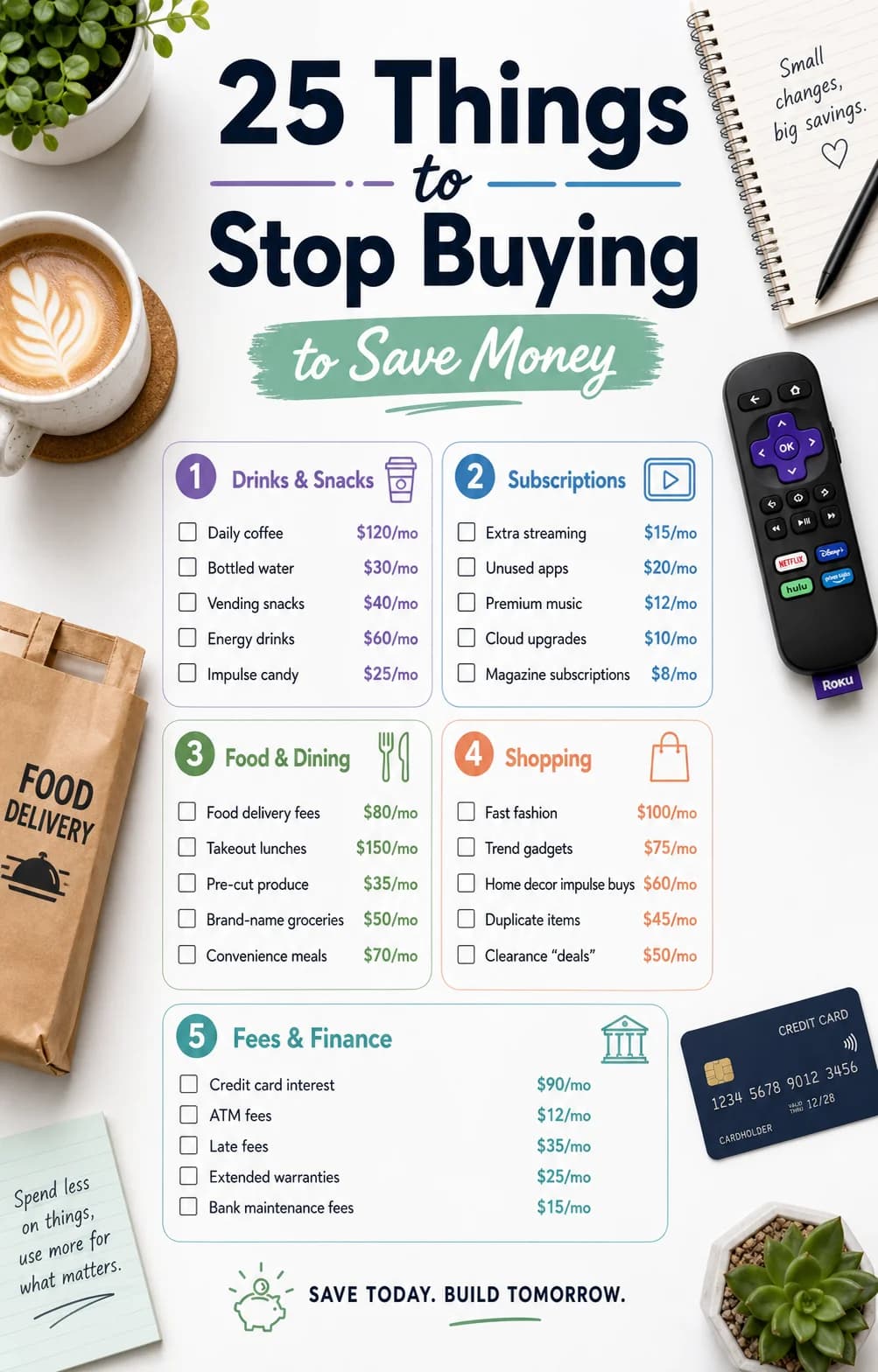
I used to spend $450 a month on things I didn't even realize I was buying. Daily coffee runs, subscription services I forgot I had, brand-name groceries, and random 'treat yourself' purchases that seemed small but added up to thousands every year. One spending audit later, I had a list of 25 things I stopped buying — and exactly how much each one saved me. The total: $510 per month, or $6,120 per year. Here's the complete breakdown.
Why I Started Cutting — The Wake-Up Call
It started with a simple question: 'Where did all my money go?' I had a decent salary, no debt, and yet every month I was living paycheck to paycheck. Then I did a 30-day spending audit and the answer became painfully clear. My biggest money drains weren't the big purchases — they were the small ones I made on autopilot.
Here's what got me: $450 a month invested at 5% interest for 30 years becomes approximately $376,000. That daily coffee, that unused gym membership, that streaming service I forgot I had — they weren't just expenses. They were compound growth I was leaving on the table.
Food and Dining — Saved $180 Per Month
Food is typically the #1 category where money silently disappears. Here's what I cut:
- Daily Coffee Shop Runs ($106/month saved): A $5.50 coffee every workday adds up to $121 per month. Switching to home-brewed coffee with a quality thermos brought that down to $15 per month.
- Lunch Delivery and Eating Out Every Workday ($220/month saved): Spending $14 per meal at work restaurants cost $308 per month. Meal-prepped lunches brought that to $88 per month.
- Bottled Water and Single-Use Drinks ($75/month saved): Buying bottled water at $2.50 per bottle totaled $75 per month. A reusable bottle and tap water cost $0.
- Premium and Brand-Name Groceries ($200/month saved): Switching from Whole Foods to Aldi and store brands reduced a $650 monthly grocery bill to $450.
- Impulse Snack Purchases ($65-125/month saved): Convenience store and vending machine snacks cost $90-150 per month. Buying in bulk and portioning at home brought that to $25 per month.
Subscriptions and Memberships — Saved $95 Per Month
Subscription creep is real. The average American now spends $219 per month on subscriptions — most of which they barely use.
- Streaming Services I Never Watched ($49.46/month saved): Six streaming services totaled $76.44 per month. Rotating between just Spotify and one video service brought that to $26.98.
- Gym Membership I Did not Use ($49/month saved): A $49 per month gym membership went unused. Bodyweight workouts and outdoor running cost nothing.
- Subscription Boxes ($35-60/month saved): Beauty, snack, and apparel subscription boxes totaled $35-60 per month. Buying only what I need, when I need it, eliminated this entirely.
- Cloud Storage I Was Paying For Unnecessarily ($11.98/month saved): Three cloud storage services cost $14.97 per month. Consolidating to one and cleaning up files reduced it to $2.99.
- Magazine and News Subscriptions I Never Read ($5-15/month saved): Paid publications totaled $5-15 per month. Library apps and free news sources replaced them entirely.
Lifestyle and Convenience — Saved $130 Per Month
Convenience culture has a hidden cost. When you factor in delivery fees, ride-share costs, and fast fashion impulse buys, lifestyle spending can silently drain your budget.
- Ride-Share Services Like Uber and Lyft ($66-150/month saved): 8-10 monthly rides at $12-18 each totaled $96-180 per month. Public transit and walking brought transport costs down to $30 per month.
- Food Delivery Fees ($40-70/month saved): Four delivery orders per month incurred $40-70 in fees alone. Picking up food or cooking at home eliminated these fees entirely.
- Convenience Fees Like ATM and Late Fees ($5-15/month saved): Various convenience fees totaled $5-15 per month. Using in-network ATMs and setting up autopay brought this to $0.
- Fast Fashion and Impulse Clothing Purchases ($50-120/month saved): Buying clothes I wore once or never cost $80-150 per month. A capsule wardrobe and the 30-day rule reduced this to $30 per month.
- Beauty Services Like Nails, Hair, and Lashes ($55-175/month saved): Regular manicures, brow waxes, and haircuts totaled $80-200 per month. DIY nail care and less frequent salon visits brought this to $25 per month.
- Home Decor and Just Because Purchases ($40-90/month saved): Random Target and Amazon purchases totaled $50-100 per month. An exchange program for new purchases reduced this to $10 per month.
Financial Waste — Saved $45 Per Month
Some expenses exist purely because of poor systems. These costs are completely avoidable with better financial habits.
- Credit Card Interest and Late Fees ($25-50/month saved): Poor payment habits resulted in $25-50 monthly in interest and fees. Paying off balances and setting autopay brought this to $0.
- Unused Gift Cards ($100-200 recovered once): Forgotten gift cards totaling $100-200 were found and used. Tracking new gift cards prevents future waste.
- Extended Warranties and Insurance Add-Ons ($10-30/month saved): Small warranties on low-value items totaled $10-30 per month. Self-insuring for small purchases eliminated these costs.
- Bank Fees Including Monthly Maintenance and Overdraft ($12-15/month saved): Traditional bank fees totaled $12-15 monthly. Switching to no-fee online banks eliminated them entirely.
Mindful Spending — Saved $60 Per Month
'Treat yourself' culture is one of the sneakiest budget killers. Small daily purchases feel harmless in isolation but create a massive drain over time.
- Treat Yourself Daily and Weekly Small Purchases ($110-260/month saved): Daily 'small treats' like boba tea, bakery items, and app purchases totaled $150-300 per month. Limiting to one intentional treat per week at $10 brought this to $40.
- Alcohol and Bar Spending ($40-130/month saved): Going out 4-6 times per month at $15-25 per outing totaled $60-150. Hosting at home and choosing mocktails brought this to $20 per month.
- Lottery Tickets and Gambling ($10-20/month saved): Monthly scratch-offs and lottery tickets cost $10-20. Eliminating this negative-expected-value habit saved $10-20 per month.
- Premium Versions of Free Apps and Services ($10-20/month saved): Paying for premium app features, ad-free games, and extra functionality totaled $10-20 per month. Using free versions instead saved this entire amount.
- Holiday and Seasonal Decor and Gifts ($25-75/month saved across holidays): Overspending on holiday decorations, wrapping paper, and gifts averaged $200-500 per season. Reusing decor and setting hard gift budgets reduced this to $100-200 per season.
Total Savings Breakdown
Here's the complete picture of what cutting these 25 expenses saved:
$6,120 per year is a fully funded emergency fund. It's a down payment on a car. It's 15 months of student loan payments. It's not chump change — it's life-changing money that was going to things that weren't making your life better.
The Replacement Mindset — What to Do Instead
Cutting expenses without a replacement strategy leads to deprivation and eventual relapse. Here's how to redirect instead of restrict:
- The Joy Check: Before any non-essential purchase over $20, ask: 'Will this bring me more joy than the money it costs?' Most of the time, the honest answer is no.
- The 24-Hour Rule: Wait 24 hours before any non-essential purchase over $20. Often, the urge passes.
- The Cost Per Use Calculation: A $50 dress worn once costs $50 per use. A $50 dress worn 50 times costs $1 per use. Quality over quantity.
- The Time Cost Calculation: How many hours did you work to afford this purchase? At $20 per hour after tax, a $100 purchase costs 5 hours of your life.
- The Treat Fund: Set aside $40 per month for one intentional, meaningful treat. This satisfies the 'treat yourself' urge without the daily drip of small purchases.
How to Do Your Own Spending Audit
You can replicate this process in under an hour. Here's how:
- Pull your last 3 months of bank and credit card statements
- Categorize every transaction into the five categories above
- Identify your 'surprise' categories — where is money leaking that you did not realize?
- Pick 5 to 10 things to stop buying this month — start small to build momentum
- Calculate your projected monthly savings
- Automate the savings — set up an auto-transfer to your savings account the day you get paid
- Review monthly and adjust — what worked? What was harder than expected?
The 30-Day No-Spend Challenge
Want to accelerate your savings? Try a 30-day no-spend challenge. The rules are simple: only spend on essentials — rent, utilities, groceries, transport, and minimum debt payments. Everything else is off-limits. Expected savings: $300 to $800 in 30 days, depending on your baseline spending. What to do with the money: build your emergency fund, pay down debt, or start investing.
For more strategies on building wealth through smart spending habits, check out our guide on how to stop lifestyle inflation. If you are looking for a systematic approach to eliminating monthly expenses, our subscription audit guide can help you cut $100 or more per month without sacrificing the services you actually use.
FAQ — Things to Stop Buying to Save Money
- What is the #1 thing people waste money on?
- Food — specifically daily coffee shop runs, workday lunch delivery, and convenience snacks. The average American spends $300 to $500 per month on food away from home. Cutting this in half saves $150 to $250 per month.
- What are the easiest subscriptions to cancel?
- Streaming services you don't use, gym memberships you never visit, and subscription boxes collecting dust. Do a subscription audit and you'll find at least $30-80 in monthly waste. Most people are surprised what they find.
- How much does the average person spend on impulse purchases?
- Studies suggest $150-400 per month, though it varies widely. The 'small treat' culture — that $5 coffee, $8 boba tea, $15 vending machine snack — adds up faster than people realize. Audit your own spending and you will likely find your number.
- Is it better to cut expenses or increase income?
- Both matter, but cutting expenses has advantages: it's immediate, guaranteed, and compounds over time. A $200/month expense cut saved and invested for 30 years at 5% becomes roughly $170,000. That's a head start versus a raise you might not get.
- How do I stop lifestyle inflation?
- Lifestyle inflation is the tendency to spend more as you earn more. The fix: separate lifestyle increases from true needs. When you get a raise, direct 50% of it to savings or investments before you even see it in your spending account.
- What percentage of income should go to necessities vs. discretionary?
- A common framework: 50% needs (housing, utilities, groceries, insurance), 30% wants (dining out, entertainment, subscriptions), 20% savings and debt payoff. If your needs exceed 50%, look for housing cost reductions or grocery swaps first — those are usually the biggest levers.
Take control of your money today
Start free with Spendmate — track expenses, plan budgets, and reach your financial goals.
Start free with Spendmate