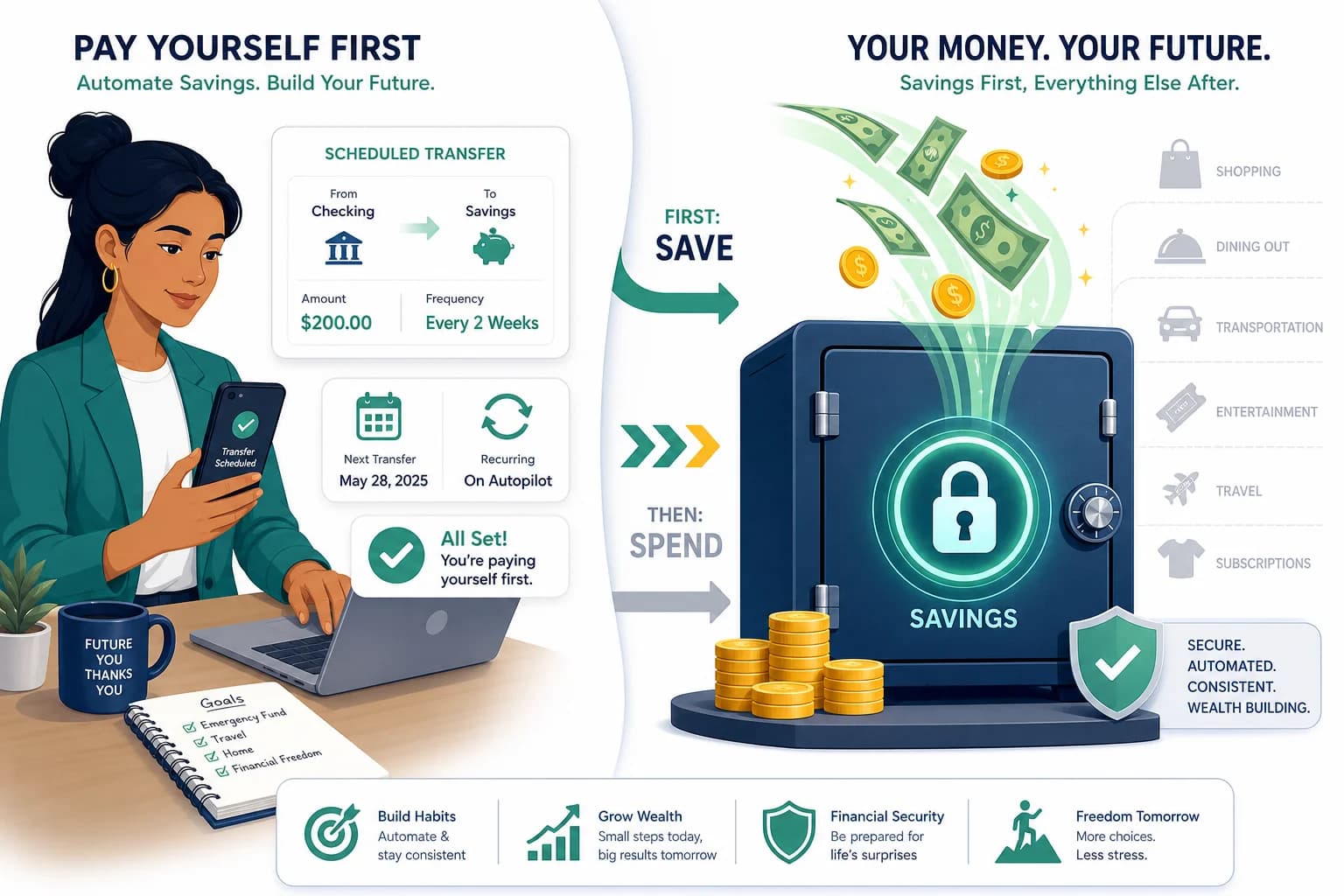
Executive Summary: Reverse budgeting — also called "pay yourself first" — is a savings strategy that automates your savings before you pay any bills or spend on discretionary items. Instead of tracking every expense and hoping something's left at month-end, you set your savings goals first, automate transfers on payday, and spend the rest guilt-free. With US personal savings rates at 3.4% and 64% of Americans living paycheck to paycheck, this method addresses the core failure of traditional budgeting: it relies on daily willpower instead of automatic systems. Behavioral economists favor reverse budgeting because it leverages loss aversion, the default effect, and reduced decision fatigue — making it significantly more sustainable for people who've struggled with traditional budgeting methods.
What Is Reverse Budgeting? (And Why It's Different)
You've tried budgeting. You downloaded the app, categorized every coffee, and felt good for about two weeks. Then life got busy, you missed a few entries, and suddenly you were back to square one — spending without tracking, hoping for the best. Here's the truth: Most budgets fail not because you lack discipline, but because they demand too much daily effort. Reverse budgeting flips the entire approach.
The Core Concept
Traditional budgeting follows a reactive model: track expenses → allocate spending categories → save what's left (often nothing). Reverse budgeting follows a proactive model: set savings goals first → automate savings transfers → spend whatever remains. The key difference is what happens psychologically when savings is automatic versus when it's aspirational.
When you save first, the money never enters your checking account as "available spending" — so you never develop the mental urge to spend it. When you save last, the money already feels like yours, making the psychological friction of "not spending" much harder. This is the behavioral economics insight that makes reverse budgeting work for people who've failed at every other method.
Why Behavioral Economists Love It
Three psychological principles explain why reverse budgeting outperforms traditional methods for most people:
- Loss aversion automation: When savings transfers happen automatically, the "loss" of that money becomes invisible — it never registers as money you had to give up. You're not denying yourself; you're just directing money to the right place before it reaches your spending account.
- Decision fatigue elimination: Traditional budgets require dozens of daily micro-decisions: "Do I buy this? Does it fit the category? Should I wait?" Reverse budgeting eliminates those decisions entirely — savings happens by default, and the remaining balance is yours to spend without judgment.
- Default effect leverage: Humans are creatures of inertia. When savings is the default (automatic), that becomes your baseline behavior. When spending is the default (money sits in checking), saving requires active willpower — which depletes daily. By making saving automatic, you fight human nature at its root.
The mental shift is equally important: from a scarcity mindset ("I have to restrict my spending to save") to an abundance mindset ("I've already saved, so whatever is in my checking account is mine to spend freely"). This framing change is why people on reverse budgeting report less guilt and less anxiety about spending decisions.
Reverse Budgeting vs Other Methods
Not sure which budgeting method fits your life? Here's how reverse budgeting compares to the most common alternatives:
- Reverse Budgeting: Effort level is low (set it up once). Best for people who hate tracking expenses and want a sustainable, automatic system. Not ideal for those who need detailed spending control.
- 50/30/20 Rule: Effort level is low to medium. You allocate 50% to needs, 30% to wants, and 20% to savings. Works well as a general guideline but still requires ongoing categorization of spending. Better for people who want guardrails but don't mind some tracking.
- Zero-Based Budgeting: Effort level is high — every dollar must be assigned a job before the month begins. Best for detail-oriented planners who want complete control. Worst for people who find budgeting overwhelming or unsustainable.
- Envelope System: Effort level is medium. You allocate cash into physical envelopes for each spending category. Works well for cash-based households but difficult for digital-first finances. Good for people who respond to visual, tangible budgeting cues.
- 80/20 Rule (Before-Budgeting): Effort level is low. Save 20% before anything else, spend the remaining 80% freely. Simplest of all methods — essentially a bare-bones version of reverse budgeting. Best for minimalist approaches but provides no structure for people who need spending boundaries.
How Reverse Budgeting Works (The 3-Step System)
Reverse budgeting is deliberately simple. You only need to complete three steps to set up a system that runs itself month after month.
Step 1 — Define Your Savings Goals
Before you can automate savings, you need to know what you're saving for. Most people have three tiers of savings goals:
- Emergency fund: 3–6 months of essential expenses. For the average US household, this means $15,000–$30,000 in a high-yield savings account. This is your financial safety net — it prevents future debt when unexpected expenses arise.
- Retirement: 15% minimum of gross income (including any employer 401(k) match). For a $75,000 salary, that's $11,250 per year going toward retirement. The earlier you start, the more compounding works in your favor — someone starting at 25 vs 35 loses roughly 50% of potential retirement wealth to the time-value of money.
- Short-term goals: Vacation, car down payment, home down payment, wedding fund, hobby equipment — anything you want to save for within 1–5 years. These don't go in retirement accounts; they go in a high-yield savings account or CD ladder.
A practical rule of thumb: Total savings rate should be 20% minimum when you include employer 401(k) match. If you're starting from zero savings, even 10% is a significant improvement from the national average.
Step 2 — Set Your Savings Percentage
The exact percentage depends on your income, expenses, and goals, but here's a practical framework:
- Minimum (10% of gross): Start here if you're rebuilding from zero. This covers basic emergency fund contributions and 401(k) match. For a $50,000 salary, that's $5,000/year or $417/month.
- Recommended (20% of gross): Includes full employer 401(k) match, meaningful emergency fund progress, and Roth IRA contributions. For a $75,000 salary, that's $15,000/year or $1,250/month.
- Aggressive (30–50% of gross): For FIRE path builders, high earners, or catch-up savings after a financial setback. For a $150,000 salary, 35% is $52,500/year or $4,375/month.
The right number for you depends on your income-to-expenses ratio. If your essential expenses consume 80% of your income, you may need to address those before you can hit the recommended 20%. If your essentials are 50% of income, 20% savings is very achievable.
Step 3 — Automate Everything
This is the most critical step — and the one that makes or breaks the system. Automation removes the daily willpower battle entirely. Here's what to automate:
- 401(k) contributions: Set these through your employer's payroll portal. Contribute at least enough to capture the full employer match — that's literally free money with a 100% immediate return.
- Roth IRA or traditional IRA: Set up automatic monthly contributions through Vanguard, Fidelity, or Schwab. Even $200/month compounds significantly over 20 years.
- Emergency fund transfers: Set up an automatic transfer from checking to your high-yield savings account on the same day as your paycheck. The money never sits in checking long enough to feel "available."
- Goal-specific savings: If you're saving for a vacation or car, set up separate savings sub-accounts with automatic transfers. Many banks (Ally, Marcus) let you create multiple savings buckets for free.
Pro tip: Schedule all transfers for the day after payday, not the same day. This gives your direct deposit time to clear and prevents the awkward situation where a transfer bounces because funds haven't arrived yet.
Where to Park Your "Save First" Money
Automating savings is only half the equation — you also need to put that money in the right accounts. The order matters because some accounts offer tax advantages, higher returns, or protection that others don't.
Savings Priority Order
Follow this priority order when deciding where to direct your savings:
- Priority 1 — 401(k) to employer match: If your employer matches 3–6% of your salary, this is a guaranteed 100% immediate return. Always capture this first before investing anywhere else.
- Priority 2 — Emergency fund in a high-yield savings account (HYSA): Park 3–6 months of essential expenses in a HYSA earning 4.0–4.5% APY in 2026. This is liquid, FDIC-insured, and accessible within 1–2 business days.
- Priority 3 — Roth IRA: Contribute up to $7,000/year ($8,000 if age 50+). Roth IRAs grow tax-free and contributions (not earnings) can be withdrawn anytime without penalty. Ideal for flexibility and retirement.
- Priority 4 — 401(k) beyond the match: Continue contributing beyond the match, up to the annual limit ($23,500 in 2026, $31,000 if 50+). Pre-tax contributions reduce your taxable income now.
- Priority 5 — HSA (if you have a high-deductible health plan): The HSA is the only triple tax-advantaged account — contributions are tax-deductible, growth is tax-free, and withdrawals for medical expenses are tax-free. In 2026: $4,300 individual / $8,550 family.
- Priority 6 — Taxable brokerage: After maxing retirement accounts, a taxable brokerage account at Vanguard, Fidelity, or Schwab offers unlimited contributions and access to index funds with low expense ratios.
- Priority 7 — Goal-specific savings: Vacation, car, home down payment — these short-term goals belong in a HYSA or CD ladder, not in volatile investments.
Best Accounts for Reverse Budgeting
- High-Yield Savings Account (HYSA): 4.0–4.5% APY in 2026, FDIC insured, fully liquid. Best for emergency funds and short-term goals. Top picks: Ally Bank, Marcus by Goldman Sachs, CIT Bank.
- Money Market Account: Slightly higher rates than HYSA at some institutions, with limited check-writing or debit card access. Good for your "spending remainder" buffer if you want immediate access.
- CD Ladder: For money you won't need for 6–24 months, CD rates are often 0.5–1% higher than HYSA. Build a ladder with maturing dates every 3–6 months to maintain liquidity while earning more.
- Roth IRA at Vanguard/Fidelity/Schwab: $0 commissions on index funds, no minimums at Fidelity and Schwab. Set up automatic investments into a three-fund portfolio (US total market, international, bonds) and forget it for 30 years.
If you haven't started building an emergency fund yet, our emergency fund guide walks you through the exact steps — starting with just $1,000 and building from there.
Real-World Examples: Reverse Budgeting in Action
Example 1 — Recent Grad ($45,000/year)
Monthly take-home: ~$2,925 (after federal/state taxes). With a 20% savings target, that's $585/month to save before spending a single dollar.
- $200 to Roth IRA (Vanguard Total Market Index Fund)
- $200 to emergency fund (Ally HYSA)
- $100 to travel fund (separate Ally savings bucket)
- $85 to employer 401(k) — enough to capture employer match
Remaining for expenses: $2,340/month. Typical breakdown: $1,000 rent (roommate situation), $150 utilities and internet, $400 groceries and dining out, $200 transportation, $590 discretionary ( subscriptions, entertainment, gym, clothes). The $590/month discretionary budget sounds tight but it's entirely guilt-free spending — you've already handled your future, so this is yours to enjoy without tracking.
Example 2 — Mid-Career Couple ($120,000 combined)
Monthly take-home: ~$7,800 (after taxes, both incomes combined). With a 25% savings rate, that's $1,950/month saved before touching any of it.
- $1,000 to 401(k)s (combined, including full employer match on both)
- $500 to joint HYSA (emergency fund top-up)
- $300 to Roth IRAs (both partners, $150 each)
- $150 to vacation fund (separate savings bucket)
Remaining for expenses: $5,850/month. Typical breakdown: $2,000 mortgage, $350 utilities, $800 groceries and dining, $500 transportation (two cars, insurance, gas), $1,200 childcare, $1,000 discretionary. Result: $1,950/month building wealth automatically, $1,000/month guilt-free discretionary. This couple will have a fully-funded emergency fund within 14 months.
Example 3 — High Earner ($150,000/year)
Monthly take-home: ~$9,000 (after taxes). With a 35% savings rate, that's $3,150/month going to savings before any discretionary spending.
- $1,500 to 401(k) — maxing the 2026 contribution limit
- $500 to backdoor Roth IRA
- $500 to HSA (family plan, maxing the $8,550 family limit)
- $400 to taxable brokerage (Vanguard total market index)
- $250 to vacation fund
Remaining for expenses: $5,850/month. Typical breakdown: $2,500 mortgage, $400 utilities, $1,000 groceries and dining, $600 transportation, $1,350 discretionary. Result: $3,150/month building long-term wealth, $1,350/month guilt-free spending. This earner is on pace to financial independence in approximately 12–15 years.
When Reverse Budgeting Works (And When It Doesn't)
It Works Best When:
- You have stable, predictable income (salary with biweekly or monthly paychecks)
- Your essential expenses are manageable — not in financial crisis mode
- You've tried traditional budgeting and found it tedious or unsustainable
- You want to build savings without making daily spending decisions
- You're motivated by automation and "set it and forget it" financial systems
It Can Fail When:
- Your income is irregular (freelancers, gig workers, commission-based earners) — the same amount each month can't be assumed
- You have high-interest debt (credit cards at 20%+ APR) — the interest cost likely exceeds any investment returns
- Your essential expenses already consume 90%+ of your income after savings — there's nothing left to reverse budget
- You lack self-awareness about whether your spending is actually under control
- You need detailed spending data for financial planning or tax purposes
The Debt Exception
One size doesn't fit all — and reverse budgeting has a critical exception when high-interest debt is involved. Here's the decision framework:
- Credit card debt at 20%+ APR: Pay minimums on any savings goals, throw every extra dollar at the debt. A guaranteed 20% return from paying off a credit card beats any investment return you could earn. The debt snowball or avalanche method applies here — see our debt payoff comparison for the full breakdown.
- Student loans at 4–6% APR: Most investment portfolios return 7–10% annually over long periods. Continue saving first — especially for retirement — while making regular student loan payments. The math favors investing over aggressive debt payoff here.
- Mortgage at 6–7%: Split the difference. Continue maximizing retirement accounts (especially 401(k) for tax benefits), then make extra mortgage payments with remaining surplus. Don't sacrifice retirement match or tax advantages to pay a 6–7% mortgage faster.
- Rule of thumb: If debt interest > expected investment return (7–10%), prioritize debt. If debt interest < expected investment return, save first.
Important caveat: Always capture the full 401(k) employer match before paying extra on any debt. A 50–100% match from your employer is a better return than any debt interest rate.
How to Set Up Reverse Budgeting in 30 Minutes
Step-by-Step Setup
You can have reverse budgeting fully operational in under 30 minutes. Here's the exact sequence:
- Calculate your savings rate: Take your gross monthly income, multiply by 10–20%. This is your target savings amount. If you're starting from zero, begin at 10% and increase by 1% every 3 months.
- Open required accounts: You'll need at minimum a high-yield savings account (Ally, Marcus, or CIT Bank — takes 10 minutes online) and a Roth IRA (Vanguard, Fidelity, or Schwab — takes 15 minutes online).
- Set up 401(k) contributions: Log into your employer's benefits portal. Set contributions to at least the full match percentage. This step alone could add 3–6% to your total savings rate instantly.
- Automate your Roth IRA: Log into your brokerage account. Set up automatic monthly investments on the day after payday. Even $100–200/month compounds significantly over decades.
- Automate HYSA transfers: Log into your bank. Set up an automatic transfer from checking to your HYSA on the day after payday. Set it and forget it — the balance will grow without any ongoing attention.
- Enable round-ups (optional): Apps like Acorns, Digit, or Qapital round your purchases to the nearest dollar and invest/save the difference. This typically adds 0.5–1% to your savings rate passively.
- Review quarterly: Set a calendar reminder every 3 months. Ask: Has my income changed? Are my accounts on track? Should I increase my savings rate? Adjust once, then return to automation.
Tools to Use
- Employer 401(k) portal: Free, immediate access to your most important savings vehicle. Set and forget here first.
- Vanguard / Fidelity / Schwab: Roth IRAs, taxable brokerage accounts. $0 commissions on major index funds. Fidelity and Schwab have no minimums.
- Ally / Marcus / CIT Bank: High-yield savings accounts, 4.0–4.5% APY in 2026, FDIC insured, great for emergency funds.
- Digit: $5/month. Monitors your checking account and automates small savings transfers based on spending patterns. Good for people who want AI-driven micro-savings.
- Qapital: $3–12/month. Allows customizable savings rules — save $X every time you make a purchase, or set flat automatic transfers. Better than Digit for goal-specific savings.
- YNAB (You Need a Budget): $14.99/month. Not pure reverse budgeting, but a hybrid approach that combines automated savings with category-based spending awareness. Ideal if you want both automation and guardrails.
FAQ — Reverse Budgeting Questions
What is reverse budgeting?
Reverse budgeting (also called "pay yourself first") is a savings method where you automate savings and investments BEFORE paying bills or discretionary spending. Unlike traditional budgeting, you don't track every dollar — you just make sure savings happen automatically on payday, then spend the remainder guilt-free. The core shift is behavioral: instead of hoping money is left to save, you've already saved and the remaining money is yours to use without restriction.
How much should I save with reverse budgeting?
Minimum: 10% of gross income (if starting from zero). Recommended: 20% of gross income, including employer 401(k) match. Aggressive: 30–50% for FIRE path builders or catch-up savings. The right percentage depends on your income and essential expenses. A good starting point: calculate your essential expenses, subtract from your take-home pay, and direct 20–50% of the remainder to savings before it enters your checking account.
Is reverse budgeting better than the 50/30/20 rule?
Both work, but reverse budgeting requires far less ongoing effort. The 50/30/20 rule requires you to categorize every expense throughout the month to ensure you're staying within the 30% wants category. Reverse budgeting only requires one upfront setup — after that, savings happen automatically. Choose reverse budgeting if you hate tracking expenses and want a sustainable system. Choose 50/30/20 if you want spending guardrails and don't mind some categorization.
Can I reverse budget with irregular income?
Yes, but it requires more planning. Calculate your minimum guaranteed monthly income (not your average — your worst month). Set your savings as a percentage of that minimum. When you earn more in a given month, save the surplus instead of spending it. Freelancers and gig workers should keep a 6-month expense buffer in their checking account before committing to fixed savings amounts — this prevents the stress of not having enough for bills in lean months.
What if I automate savings and don't have enough for bills?
This means your savings rate is too high relative to your income, or your essential expenses are too high. Reduce your savings rate temporarily — even 5% is better than 0%. Then focus on either increasing income or reducing fixed expenses (negotiate rent, refinance loans, cut subscriptions). The goal is sustainable savings that doesn't cause financial stress. If automating savings causes anxiety, the rate is too high.
Should I pay off debt or save first?
The answer depends on the interest rate. For high-interest debt (credit cards at 20%+ APR): pay minimums on savings and throw everything at the debt. For low-interest debt (student loans at 4–6%, mortgages at 6–7%): save first, especially for retirement. One universal rule: always capture the full 401(k) employer match before paying extra on any debt. A 50–100% match is a better return than any debt interest rate.
How do I know if I'm overspending with reverse budgeting?
Check your checking account balance monthly. If it's consistently dropping toward zero (or negative), you're spending more than your after-savings income. Review your bank statements every quarter. Track one number: your net worth (total assets minus total debts). If your net worth is growing month-over-month, your reverse budget is working. If not, either increase your savings rate or identify one area of discretionary spending to reduce.
Can I combine reverse budgeting with other methods?
Yes. Many people use reverse budgeting for long-term savings (retirement accounts, emergency fund) and a simple spending framework for their remaining income. For example: automate 20% to savings, then use the 50/30/20 framework for the remaining 80% of your take-home pay. This hybrid approach gives you the best of both — automatic wealth-building plus spending guardrails and awareness. Our loud budgeting guide offers another complementary approach for couples or individuals who want more visibility into spending without daily tracking.
What's the best bank account setup for reverse budgeting?
Three accounts is the optimal setup: (1) A checking account for bills and daily spending — keep only 1–2 months of expenses here. (2) A high-yield savings account (HYSA) for your emergency fund and short-term goals — 4.0–4.5% APY, FDIC insured, liquid. (3) An investment account (Roth IRA + taxable brokerage) for long-term wealth building. Set up automatic transfers from checking to both savings and investment accounts on payday. Our HYSA guide covers the best options for emergency funds in 2026.
How often should I review my reverse budget?
Quarterly reviews are sufficient for most people. Set a calendar reminder every 3 months and check: (1) Is my savings rate still appropriate for my current goals? (2) Are my accounts on track to meet my goals (retirement on pace, emergency fund funded)? (3) Has my income or essential expenses changed significantly? (4) Do I need to adjust my automation — new accounts, changed contribution amounts? A 15-minute quarterly review is far more sustainable than daily or weekly budgeting efforts.
Start Your Reverse Budget Today
Reverse budgeting isn't about restriction — it's about making savings the path of least resistance. By automating your savings first, you remove the daily willpower battle, eliminate decision fatigue around spending, and build wealth without thinking about it. The setup takes 30 minutes. The system runs itself for years.
The behavioral shift is powerful: instead of asking "Can I afford this?" before every purchase, you simply check your checking account balance. If there's money there, it's already yours — you've already taken care of your future. That framing change alone reduces financial guilt and anxiety for most people.
The next step is the most important: open a high-yield savings account today if you don't have one. Even $50/month automated to a HYSA earns 4.0–4.5% APY in 2026 — that's significantly better than the 0.01% at most traditional banks. Every day you delay is compounding interest you're leaving on the table.
Kendalikan keuanganmu hari ini
Mulai catat pengeluaranmu gratis dengan Spendmate — lacak pengeluaran, atur anggaran, dan raih tujuan keuanganmu.
Mulai catat pengeluaranmu gratis