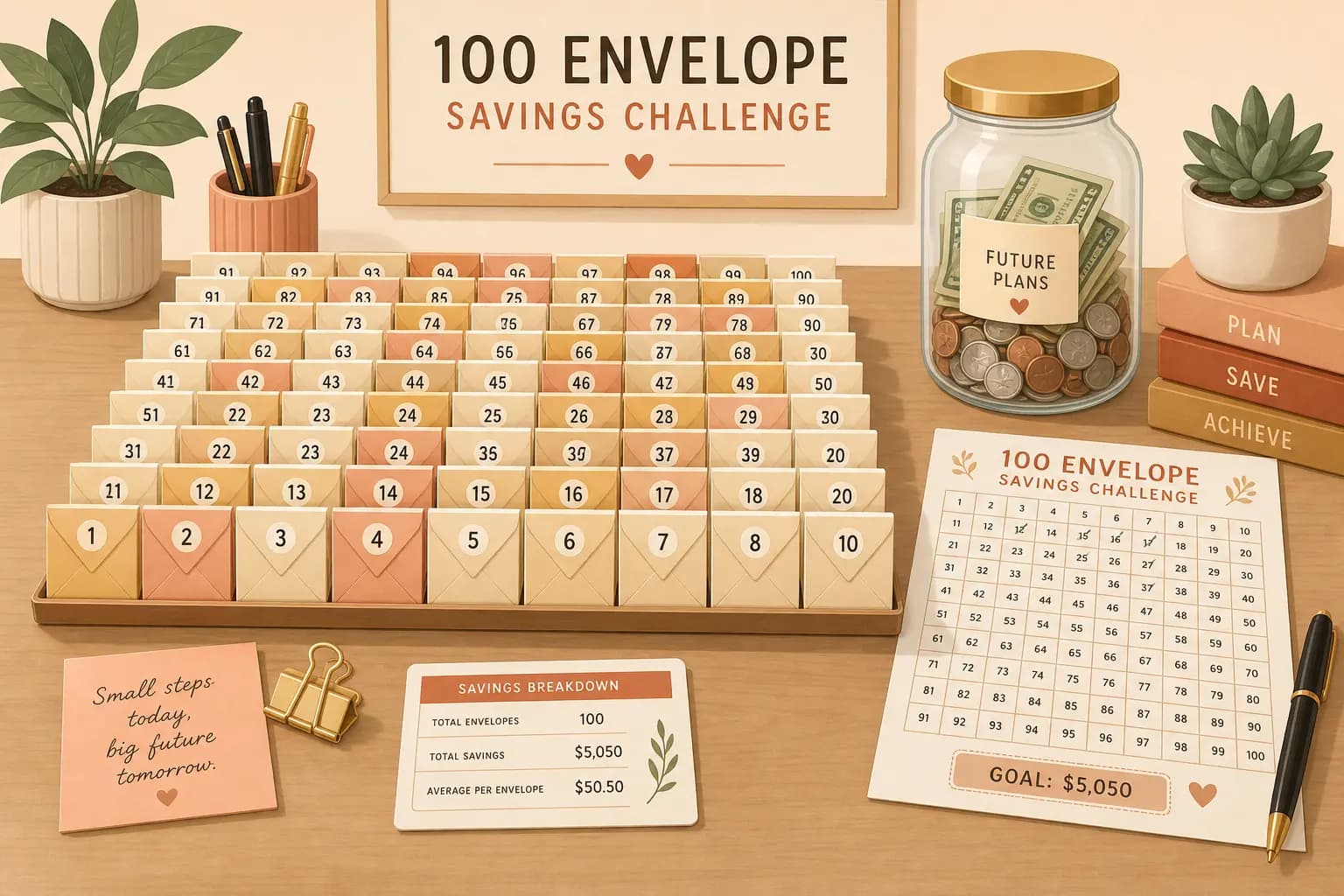
You have seen it on TikTok. A stack of 100 envelopes, neatly labeled $1 to $100. People claiming they saved $5,050 in just over three months. Is it real? Yes. Does it work? For thousands of people, yes. The 100 Envelope Savings Challenge is one of the most popular savings methods on the internet, and for good reason. It turns saving money into a game. Each day, you draw two envelopes and deposit whatever amount is written on them. By day 100, you have $5,050. But here is the truth: the full challenge is not for everyone. Some days you will draw $3 and $47 ($50 total). Other days you will draw $89 and $92 ($181). That is why this guide includes modifications for every budget, free printable templates, and a digital alternative. Whether you save $5,050, $2,525, or $1,262.50, you will have built a savings habit that lasts.
Key Takeaways: The full 100 Envelope Challenge saves $5,050 in 100 days at an average of $50.50 per day. Modifications include the Half Challenge ($2,525) and Quarter Challenge ($1,262.50). The challenge works because it is visual and gamified. A digital version exists if you prefer spreadsheets over physical envelopes. Keep the money in a high-yield savings account (HYSA) earning 4-5% APY in 2026, not a checking account.
What Is the 100 Envelope Savings Challenge?
The 100 Envelope Savings Challenge went viral on TikTok, Instagram, and Pinterest starting in 2022, and it has only grown since. The concept is simple: you label 100 envelopes with amounts from $1 to $100. Every day, you randomly draw two envelopes and deposit that combined amount into your savings account. Over 100 days, roughly three months, the math works out so you save a total of $5,050.
Why does it work so well? Three reasons. First, it gamifies saving. Random draws mean every day is a surprise. Some days are light ($3 and $12), others are heavy ($87 and $94). That unpredictability keeps it interesting. Second, it is visual. You can literally see your envelope stack shrinking as days pass, which provides a psychological pull that a spreadsheet cannot match. Third, the daily commitment is small in theory but large in practice. The average daily draw is $50.50, which can surprise people who are not prepared.
This challenge is best for budgeting beginners who find traditional saving advice boring or intimidating, visual learners who respond to physical progress trackers, anyone who has tried and failed with standard budgeting methods, and people who want a structured, time-bound savings goal with a clear finish line.
How the 100 Envelope Challenge Works (Step by Step)
Step 1 — Gather Your Supplies
Before you start, collect what you need: 100 envelopes (any standard size works; No. 10 business envelopes are a popular choice), a permanent marker or printed adhesive labels, a plan for how you will deposit money (cash at bank, online transfer, or mobile banking app), a box, jar, or binder to store your envelopes, and a printable tracker to mark each completed day.
Tip: Color-code your envelopes by dollar range to add visual structure. Try green for $1-$20, blue for $21-$50, and red for $51-$100. It makes the stack look intentional and adds a design element that makes you more likely to stick with it.
Step 2 — Label Your Envelopes
Using your marker or labels, write the numbers 1 through 100 on each envelope. One envelope per dollar amount. You can write the number directly on the front of the envelope or on a label stuck to the front. The exact design does not matter. What matters is that each envelope has a unique amount from $1 to $100. Once labeled, arrange them in numerical order (1, 2, 3... 100) or shuffle them immediately. Many people prefer to shuffle right away so the challenge stays unpredictable.
Step 3 — Draw Two Envelopes Every Day
Each day, reach into your envelope stack and randomly pull out two envelopes. Write down the amounts on your tracker. Deposit the combined total into your savings account, whether that is a traditional savings account, a high-yield savings account (HYSA), or a credit union account. The key is to move the money out of your spending account so it is no longer available to spend. Once deposited, remove those two envelopes from the stack so they cannot be drawn again. On day 100, the last two envelopes will be drawn and the challenge is complete.
Important: Do not draw ahead. If you draw today and skip to tomorrow's draw, you lose the structure of the 100-day timeline and the challenge loses its momentum.
Step 4 — Track Your Progress
Use your printable tracker to record each day's draw: the date, the two envelope amounts, and the running total saved. Mark each completed day with a checkmark or color it in on your progress grid. Watching your savings grow day by day is a powerful motivator. Celebrate milestones like $500, $1,000, and $2,500 with a small, non-financial reward. A favorite meal at home, a movie night, a coffee from your favorite cafe. Not a shopping spree.
Step 5 — Complete the Challenge
After 100 days, every envelope has been drawn and removed from the stack. You will have deposited a total of $5,050 into your savings account, plus any interest earned along the way. At this point, the decision of what to do with that money becomes critical. If you have not built an emergency fund yet, that should be your first priority. If you already have one, you have several good options, which we cover below.
100 Envelope Challenge Modifications for Every Budget
The standard 100 Envelope Challenge assumes you can comfortably afford to save between $3 and $200 per day, with an average of $50.50 daily. That is a significant commitment. The average American household savings rate sits below 5%, and many families cannot absorb a $150 day without stress. That is where modifications come in. These alternatives let you participate in the challenge regardless of your income, expenses, or financial situation.
The Half Challenge: Save $2,525
Label your envelopes $0.50 to $50 instead of $1 to $100. You still draw two per day, but your daily range is $1 to $100 with an average of $25.25. Over 100 days, you save $2,525. This version works well for tight budgets, part-time workers, students, or anyone supporting a family on a single income. It delivers the psychological benefits of the challenge at a more accessible price point.
The Quarter Challenge: Save $1,262.50
Label envelopes $0.25 to $25. Draw two per day with amounts ranging from $0.50 to $50 and an average of $12.63 per day. Over 100 days, you save $1,262.50. This version is designed for first-time savers, teenagers, or anyone in a genuinely tight financial spot. Saving even $1.50 on a hard day still counts and still builds the habit.
The Biweekly Challenge: $5,050 in 200 Days
Keep the full $1-$100 envelope set, but draw only one envelope per day instead of two. Your daily range is $1 to $100 with an average of $50.50, but you make the draw every other day rather than daily. This extends the challenge to 200 days. It is a better fit for people who find the daily commitment of the standard version too aggressive or who get paid biweekly and want to align their deposits with their pay schedule.
The Reverse Challenge: Start Big, End Small
Do not shuffle your envelopes. Draw them in strict numerical order: $100 and $99 on Day 1, $98 and $97 on Day 2, working down to $3 and $2 on Day 49, and finally $1 on Day 50. This front-loads your savings when motivation is highest. It is psychologically powerful because you see a large balance early, which reinforces the behavior. Best for people who know they lose steam as challenges progress.
The Digital Challenge: No Cash Required
Physical envelopes are not for everyone. Some people handle cash rarely, some live in areas without easy bank access, and some prefer digital records. For the digital version, create a spreadsheet with 100 rows labeled $1 through $100. Each day, use a random number generator or a randomization formula to pick two numbers between 1 and 100. Transfer the combined amount to your savings account and mark those rows as used. Consider automating transfers to a high-yield savings account so the process is as hands-off as possible.
The Team Challenge: Save $5,050 Together
Two people each run the half challenge ($0.50-$50 envelopes). Each person saves $2,525, for a combined total of $5,050. Best for couples, roommates, siblings, or accountability partners who want to compete or collaborate. You can set shared milestones, compare progress weekly, or make it a friendly competition to see who finishes first. Either way, you both win.
Tips to Stay Consistent for 100 Days
One hundred days is roughly three months. That is long enough to build a real habit but long enough to lose momentum. Here is what works:
- Set a daily alarm labeled Envelope Draw and treat it the same way you treat a work meeting: non-negotiable
- Make it a morning routine. Pair the draw with something you already do every day, like your first cup of coffee
- Use a wall-mounted tracker or whiteboard where you can see progress every morning
- Join a community. Subreddits like r/savingmoney and Facebook groups dedicated to the envelope challenge provide accountability and ideas
- Share your progress on social media. Accountability to an audience is a powerful motivator
- Reward milestones with small, non-financial treats. A nice bath, a favorite meal, a new book, not a shopping spree
- If you miss a day, do not quit. Draw four envelopes the next day or extend your timeline by one day. The goal is the habit, not perfection
What to Do with Your $5,050 After the Challenge
Reaching $5,050 is a major achievement. The worst thing you can do is leave it sitting in a regular savings account earning 0.01% APY or, worse, let it sit as cash at home where inflation quietly erodes its value. Here are your best options:
Option 1: Build Your Emergency Fund
Financial advisors recommend 3-6 months of living expenses in an emergency fund. $5,050 is a strong foundation for most working adults. If you do not have an emergency fund yet, this is the highest-impact use of your challenge winnings. If you already have a starter emergency fund, this can push it to a full 3-month safety net. Keep it in a high-yield savings account earning 4-5% APY in 2026. For a deeper comparison of HYSA options, see our guide to the best high-yield savings accounts for emergency funds. If you are not sure how much you need in your emergency fund, our how much emergency fund do I need guide has a simple calculator.
Option 2: Pay Off High-Interest Debt
The average credit card APR in the US exceeds 22% in 2026. Every dollar you carry as credit card debt costs you 22 cents per year in interest. $5,050 applied to a high-balance credit card can eliminate hundreds of dollars in annual interest charges, a better return than virtually any savings account. If you have student loans, auto loans, or personal loans with APRs above 7%, prioritizing those with this windfall is mathematically sound.
Option 3: Invest for the Future
If your near-term financial bases are covered, investing is the right move. Open a Roth IRA and contribute up to the 2026 limit of $7,000 ($8,000 if you are 50 or older). A $5,050 contribution to a low-cost S&P 500 index fund averaging a historical 10% annual return could grow to over $50,000 in 20 years, before inflation. Even if you cannot max out the Roth IRA, any contribution compounds dramatically over time.
Option 4: Save for a Specific Goal
If you have a concrete goal, a down payment on a car, a vacation, holiday gifts, a home improvement project, earmark the $5,050 specifically for that purpose. Open a separate savings account labeled for that goal so the money is tracked separately from your general savings. Visual goal-tracking reinforces the behavior and prevents the money from disappearing into undifferentiated savings.
Option 5: Keep the Challenge Going
Once you finish the 100 Envelope Challenge, you have momentum. Consider starting a second round with modified stakes. Try the 200 Envelope Challenge, which totals $20,100. You can also fold the savings habit into a sinking fund strategy, setting up separate categories for irregular expenses like car repairs, annual insurance premiums, or holiday spending. See our what is a sinking fund guide for the full approach.
100 Envelope Challenge vs Other Savings Methods
How does the 100 Envelope Challenge stack up against other popular savings methods? Here is a direct comparison:
The 100 Envelope Challenge saves the most money in the shortest time but requires a higher daily commitment than most alternatives. If $50.50 per day average feels too aggressive, the 52-Week Money Challenge is a gentler on-ramp with a proven track record. If you want to pair the 100-day structure with other money-saving experiments, try a no-spend challenge for 30 days to accelerate your savings. The two methods are not mutually exclusive. Many savers use both sequentially.
Common Mistakes and How to Avoid Them
The 100 Envelope Challenge has a failure mode that most guides do not discuss honestly. Here are the eight most common reasons people quit and how to avoid each one:
- Starting too big. If $50.50 average daily savings causes financial stress, switch to the half or quarter challenge immediately. Do not white-knuckle through a version that does not fit your budget.
- Using cash when you are not a cash person. If you rarely use cash, do the digital version. Physical envelopes are optional, not mandatory.
- Forgetting to track progress. Print the tracker on day one and put it somewhere visible. A tracker you never see cannot motivate you.
- Quitting after missing a day. Missing one day does not derail the challenge. Extend your timeline and keep going.
- Not having a plan for the money. Before you start, decide what you will do with the $5,050. A vague goal produces vague results.
- Keeping cash at home. Inflation quietly reduces the value of cash at home by 3-4% per year. Deposit everything in a high-yield savings account as soon as possible.
- Telling no one. Accountability works. Share your goal with at least one person who will check in on your progress.
- Treating it as a one-time experiment. Whether you finish the full challenge or a modified version, the habit you build is the real prize.
100 Envelope Challenge FAQ
How much can you save with the 100 envelope challenge?
$5,050 in 100 days. You draw two envelopes daily with amounts from $1 to $100. The average daily savings is $50.50. With modifications, you can save $1,262.50 (quarter challenge) or $2,525 (half challenge).
Is the 100 envelope challenge realistic for low income?
Yes. The quarter challenge ($0.25 to $25 envelopes) saves $1,262.50 in 100 days with an average daily draw of just $12.63. The half challenge saves $2,525 at an average of $25.25 per day. Either version is realistic on a modest income.
Do I have to use cash for the 100 envelope challenge?
No. You can run the entire challenge digitally using a spreadsheet or a random number selector. The key is the structure and daily commitment, not the physical envelopes. Many savers prefer the digital version because it integrates directly with online banking.
What if I cannot afford the envelope I draw?
Skip that envelope and draw another. Or immediately switch to the half or quarter challenge. The challenge should reduce your financial stress, not increase it. Pick amounts that fit your actual budget.
Can I do the 100 envelope challenge more than once?
Yes. Many people complete the challenge and immediately start a second round. Options include increasing the amounts (200 Envelope Challenge, $20,100 total), trying the reverse order, or combining it with a separate savings method.
Where should I keep the money during the challenge?
A high-yield savings account earning 4-5% APY is ideal in 2026. If you are using cash, deposit it weekly or biweekly into your HYSA to earn interest and reduce the risk of keeping large amounts of cash at home.
What happens if I miss a day?
Do not quit. Draw four envelopes the following day, or simply extend your 100-day timeline by one day. The challenge rewards consistency over perfection. Missing one day out of 100 is statistically insignificant.
Is the 100 envelope challenge better than the 52-week challenge?
It depends on your goals. The 100 envelope challenge saves more ($5,050 vs $1,378) in less time (100 days vs 52 weeks) but requires a higher average daily commitment ($50.50 vs $26.50). The 52-week challenge is easier for beginners. The 100 envelope challenge is better for those who want a bigger payoff.
Can couples do the 100 envelope challenge together?
Yes. Each person can run the half challenge ($2,525 each = $5,050 combined). Or one person runs the full challenge while the other runs a modified version. Doing it together adds accountability and a shared goal to the household.
What should I do with the $5,050 after the challenge?
Build an emergency fund, pay off high-interest credit card debt, invest in a Roth IRA, or save for a specific goal. Have this decision made before you start the challenge so the money has a purpose from day one.
The 100 Envelope Savings Challenge works because it transforms saving from a dull monthly resolution into a daily game with a clear finish line. Whether you save $5,050, $2,525, or $1,262.50, you will have built something more valuable than the money itself: a savings habit that outlasts any single challenge. Label your envelopes, pick your version, and start drawing.
Kendalikan keuanganmu hari ini
Mulai catat pengeluaranmu gratis dengan Spendmate — lacak pengeluaran, atur anggaran, dan raih tujuan keuanganmu.
Mulai catat pengeluaranmu gratis