
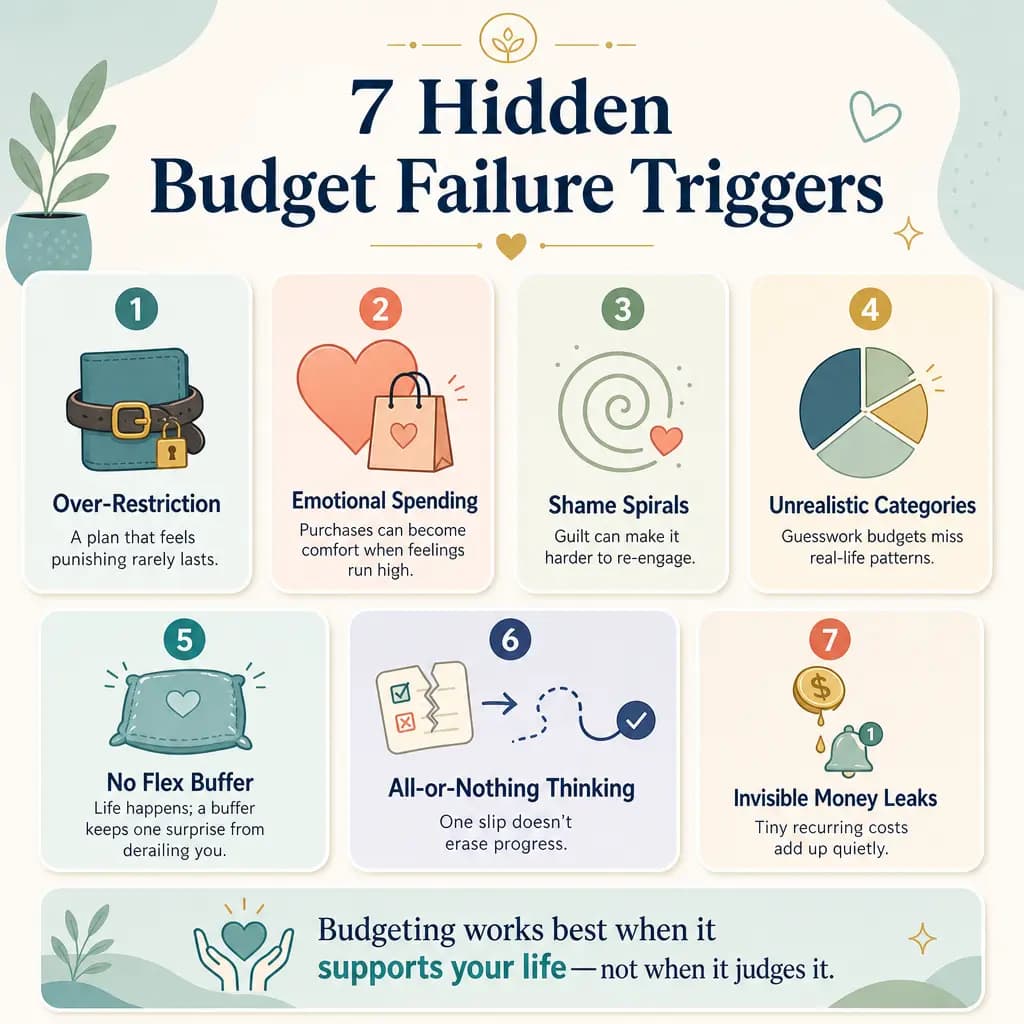
Most people who fail at budgeting don't fail because they lack discipline. They fail because they never identified what's actually sabotaging their plan. Research from Fidelity's May 2026 financial wellness study reveals seven hidden triggers that silently derail even the most committed budgeters — and understanding each one is the first step toward building a system that actually holds. This guide walks through every trigger, explains the psychology behind it, and gives you a concrete fix you can apply immediately.
YouGov data from May 2026 shows 53% of Americans now set a budget — up from 46% the previous year. More people are trying. Yet the failure rate remains staggeringly high. The reason isn't math. It's psychology. Budget failure is fundamentally a behavioral problem, not a numerical one. When you understand the hidden triggers working against you, you can design a budget that anticipates and neutralizes them rather than crumbling under their weight.
Emotional spending is purchasing decisions driven by feelings rather than necessity. You feel stressed, so you buy something to feel better. You feel celebratory, so you treat yourself — regardless of whether the purchase fits your budget. Fidelity's research identifies this as the single most common trigger of budget breakdown, affecting nearly every demographic.
Lifestyle creep happens when your income rises and your spending rises proportionally, leaving you no better off financially. You get a raise, you upgrade your car. You get a bonus, you take a fancier vacation. The extra money never becomes savings because your lifestyle expanded to consume it all.
Social comparison is the tendency to measure your financial situation against others, particularly peers or those in your social feed. Seeing friends upgrade homes, take trips, or dine out constantly creates pressure to keep up appearances — even when doing so contradicts your financial goals.
Many people create budgets that are too restrictive, then abandon them within weeks. They set category limits so tight that any small deviation triggers a sense of failure that spirals into complete abandonment. The budget becomes a self-fulfilling prophecy of failure.
Commitment creep is the gradual accumulation of fixed obligations — subscriptions, memberships, recurring payments — that quietly consume income without active decision-making. Each individual commitment seems small, but together they strangle cash flow and leave little room for intentional saving.
When savings goals are vague — 'save more' or 'build wealth' — motivation fades quickly. Without a concrete target and deadline, there's no tangible reward to work toward. The budget becomes an abstract exercise rather than a path toward something meaningful.
Budgeting alone is significantly harder than budgeting with external accountability. Without someone checking in, it's easy to rationalize overspending, skip tracking, or defer decisions indefinitely. Behavioral research consistently shows that public or social commitment dramatically increases follow-through rates.
Knowing the triggers is helpful, but applying fixes haphazardly doesn't work. The most effective approach is systematic: identify your top three triggers, apply the corresponding fixes, and track results for 30 days before adding more changes. Trying to address all seven simultaneously overwhelms the system and reduces follow-through.
- Week 1: Identify your primary trigger through self-reflection on past budget failures
- Week 2: Implement the corresponding fix for your top trigger only
- Week 3: Add a second trigger fix if the first is showing results
- Week 4: Review and adjust before introducing the third fix
- Month 2: Expand to remaining triggers using the same gradual approach
Answer these five questions to identify which triggers are most likely affecting your budget. Be honest — the goal is accuracy, not comfort.
Sustainable budget success requires building systems that account for human behavior, not just numbers. The triggers above are not character flaws — they're predictable patterns that can be systematically managed. The difference between people who succeed with budgeting and those who fail isn't willpower. It's whether they built a system designed to handle these predictable challenges.
Take control of your money today
Start free with Spendmate — track expenses, plan budgets, and reach your financial goals.
Start free with Spendmate