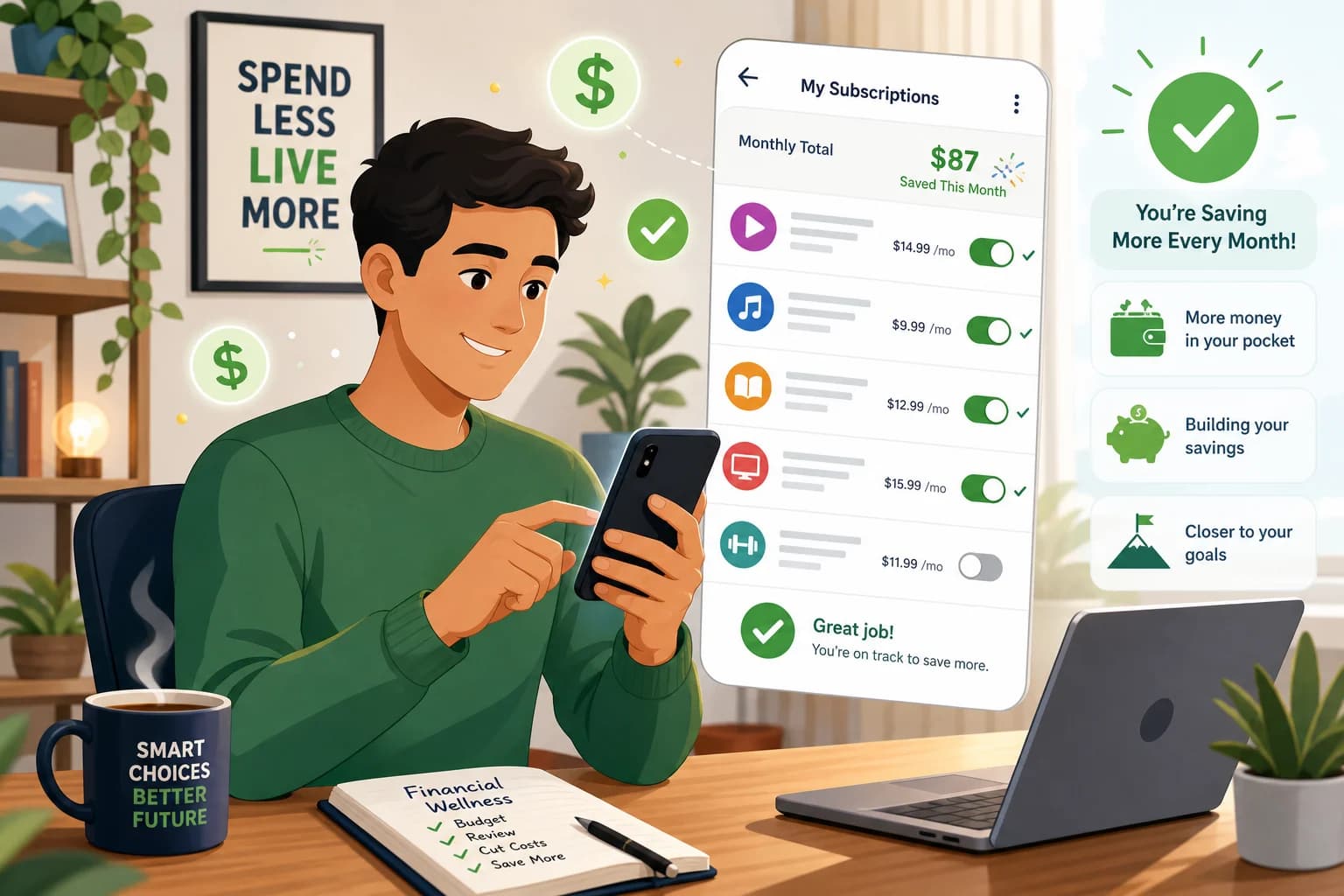
Three months into her new marketing job, Priya noticed she was always broke by the 20th. She earned $4,200 a month, paid her rent on time, and could not figure out where $347 vanished every month. Then she ran a subscription audit. The result: four forgotten subscriptions she had not used in months — a meditation app she signed up for in January, two streaming services she rotated and never cancelled, and a cloud storage plan she upgraded for a project that ended in March. That was $117 a month she had been bleeding without knowing it. This guide walks you through running that same audit in about 90 minutes, finding every recurring charge, and deciding what actually deserves your money.
The Short Answer: How to Audit Your Subscriptions in 5 Minutes
Open your last 3 bank or credit card statements. Search for charges over $5. That quick scan typically surfaces $50–$150 in monthly waste within 15 minutes. The full subscription audit takes 1–2 hours, and most people recover that much every month in their first session. how to budget for car maintenance how to budget as a couple
The 3-Question Test
Before diving into a deep audit, apply this quick filter to every subscription: how to budget as a couple
- Did you use this in the last 30 days? If no, it is a strong cancel candidate.
- Does this add genuine value to your life — entertainment, productivity, health, or connection? If no, cancel.
- Can you comfortably afford this within your current budget? If no, cancel or downgrade.
Most subscriptions fail at least one of these. Those that pass all three are worth keeping. how to budget as a couple
Why Subscription Audits Matter Now More Than Ever
Subscription prices have climbed 28% since 2022 across streaming, software, and subscription box services. Many companies have raised prices 2–3 times without prominent notification — a practice the industry calls silent price hikes. The average household now manages 12 or more active subscriptions, which makes tracking nearly impossible without a deliberate system.
Subscription Creep by the Numbers
- Average US household: 12+ active subscriptions totaling $347/month ($4,164/year)
- Forgotten subscriptions: 4–6 per household on average
- Free trial conversions: 62% of users forget to cancel before charging
- Average waste per household: $1,200+ annually on unused or forgotten services
Why We Lose Track
Automatic billing makes spending invisible. Small amounts feel insignificant — $9.99 here, $14.99 there — until you add them up. Free trials are specifically designed to convert via inertia. App Store and Google Play bundling obscures individual charges. Understanding why this happens helps you build systems that fight back against your own psychology. how to budget for car maintenance how to budget as a couple
Step 1: Find Every Subscription — The Complete Hunt
You cannot audit what you cannot see. Subscriptions hide in places you probably have not checked in months. Here is where to look: how to budget for car maintenance
Check These 7 Sources
- Bank account statements (last 3 months minimum)
- Credit card statements (all cards, last 3 months)
- Apple App Store subscriptions (Settings → Your Name → Subscriptions)
- Google Play Store subscriptions (Play Store → Profile → Payments & subscriptions)
- PayPal recurring payments (Settings → Payments → Manage automatic payments)
- Amazon Prime memberships and channel add-ons
- Email search for receipt, invoice, renewal, or subscription
Commonly Forgotten Subscriptions
- Streaming services rotated on and off (resubscribing for a new season — and never cancelling)
- Fitness apps after New Year resolution periods end
- Meal kit services after promotional periods expire
- Cloud storage upgrades (iCloud, Google One, Dropbox)
- Dating app premium tiers signed up for during a weekend
- News and media subscriptions after free trials ended
- Software tools purchased for one-time projects
- Subscription boxes for hobbies you no longer pursue
- Gym memberships, especially annual contracts
- Domain names, website hosting, and SSL certificates
Subscription Tracker Template
Create a simple spreadsheet to track what you find. Include columns for: Service name, monthly cost, annual cost, last used date, use frequency, and your decision (Keep, Maybe, or Cancel). Reviewing this tracker makes your quarterly audits much faster. If you want a simpler way to track expenses alongside your subscriptions, consider using a budgeting app that consolidates everything in one dashboard. how to budget as a couple
Step 2: Evaluate Each Subscription — The Decision Framework
Now that you have a complete list, it is time to make decisions. This framework removes the guesswork. how to budget as a couple
The 3-Question Test (detailed look)
Question 1 — Did you use this in the last 30 days? If yes, move to question 2. If no, you have a strong cancel candidate unless the subscription is seasonal or expected for occasional use. how to budget for car maintenance
Question 2 — Does this add genuine value to your life? Consider entertainment, productivity, health, and connection. If you signed up impulsively, forgot about it entirely, or never opened the app, the answer is probably no.
Question 3 — Can you comfortably afford this within your budget right now? Tight finances are not a reason for shame, but they are a reason to prioritize. If money is tight, only keep subscriptions that pass questions 1 and 2. how to budget for car maintenance
Tier Your Subscriptions
- Tier 1 — Essential: Services you use weekly and cannot imagine living without (primary streaming, cloud storage for photos, critical software)
- Tier 2 — Valuable: Nice-to-have services you use monthly that add quality of life (secondary streaming, news subscriptions, hobby apps)
- Tier 3 — Waste: Unused, forgotten, or regretted subscriptions. Cancel immediately.
- Tier 4 — Negotiable: Services you want but cost too much. Call to negotiate or find lower-tier alternatives.
Special Cases Worth Examining
Family plans: Are you maximizing shared subscriptions like Spotify Family, Apple One, or Amazon Household? Family plans typically cut per-person costs by 50–70% compared to individual subscriptions.
Annual vs. monthly: Annual billing usually saves 15–20% compared to monthly. If you are certain you will use a service all year, annual is the smarter choice. If you are uncertain, stick with monthly. how to budget for car maintenance
Bundles: Are you paying for overlapping services? Many subscribers pay for Hulu, Disney+, and ESPN+ separately when a bundle deal covers all three for less. how to budget for car maintenance
Student and senior discounts: Many services offer 20–50% discounts for students and seniors. If you qualify, you are leaving money on the table by not asking. how to budget as a couple
Employer benefits: Some employers subsidize subscriptions to gym memberships, software tools, or news services. Check your benefits package before paying out of pocket. how to budget for car maintenance
Step 3: Cancel or Negotiate — The Action Phase
This is where theory becomes reality. Most people cancel subscriptions incorrectly — wasting time on hold, getting guilt-tripped, or accidentally being charged again. Here is how to do it right.
Cancellation Shortcuts for Top Services
Most subscription services make cancellation deliberately difficult. Knowing the direct paths saves hours of frustration: how to budget for car maintenance how to budget as a couple
- Netflix: Account page → Plans → Cancel membership
- Hulu: Account → Subscription → Cancel
- Disney+: Account → Subscription → Manage Plan → Cancel
- Spotify: Premium page → Change Plan → Cancel Premium
- Amazon Prime: Account Settings → Membership → End membership
- Adobe Creative Cloud: Creative Cloud website → Plans → Cancel
- Gym memberships: Check contract for cancellation terms — often requires certified mail
Negotiation Scripts That Actually Work
Before cancelling anything, try negotiating. Companies — especially streaming services, internet providers, and phone plans — frequently have retention discounts they do not advertise. Here are three scripts that work: how to budget for car maintenance
Script 1 — Retention Department
I have been a customer for several years but the recent price increases make this difficult to justify. I am considering cancelling. Are there any loyalty discounts, promotional rates, or retention offers available? Success rate: approximately 40% for streaming services and 60% for internet and phone plans. Typical result: 10–25% discount for 6–12 months. how to budget as a couple
Script 2 — Downgrade Inquiry
I love the service but need to reduce my monthly costs. What is the lowest-tier plan you offer? Are there features I could live without to save money? Typical result: $5–15 per month in savings. how to budget for car maintenance
Script 3 — Competitor use
Similar service is offering comparable features at $X per month. Can you match or beat that price to keep me as a customer? Works best for internet, phone, and streaming bundles.
When to Use Subscription Management Apps
Apps like Rocket Money (formerly Truebill), Bobby, and PocketGuard can find forgotten subscriptions and negotiate on your behalf. They charge 30–60% of your first-year savings as a fee. Worth it if you have 10 or more subscriptions and dislike manual tracking. If you prefer hands-on control or have fewer subscriptions, manual tracking works just fine. how to budget for car maintenance
Tracking Methods: App vs. Spreadsheet vs. Hybrid Compared
There are three main approaches to tracking subscriptions. Each has strengths and trade-offs. The right choice depends on how much control you want and how many subscriptions you manage. how to budget as a couple
- Manual Spreadsheet: Full control, no cost, takes 15–20 minutes per month. Best for disciplined budgeters who want maximum awareness.
- Subscription Tracker App: Automatic detection, reminders, cancellation help. Typical cost: $0–$12/month. Best for people with 6+ subscriptions who want automation.
- Hybrid Approach: Spreadsheet for decisions, app for alerts. Best for couples managing shared subscriptions or anyone wanting both control and convenience.
Step 4: Prevent Subscription Creep — The Maintenance System
Cancelling subscriptions once is easy. Keeping subscription creep from returning is harder. Without a system, most people re-accumulate waste within 3–6 months. Here is how to build lasting habits. how to budget for car maintenance how to budget as a couple
Set Up Alerts
- Bank and credit card transaction alerts for any charge over $5
- Calendar reminders 3 days before free trials end
- Monthly recurring 15-minute subscription review on your calendar
Create Friction for New Subscriptions
- 48-hour rule: Wait 2 days before signing up for any paid subscription
- Virtual credit card numbers (Privacy.com, Capital One Eno) with spend limits
- Unsubscribe from marketing emails that trigger FOMO
- Delete shopping and payment apps from your phone to add friction
The Quarterly Audit Habit
Schedule 30 minutes every 3 months — ideally at the start of each quarter — to review all recurring charges. Ask yourself the same three questions: Did I use this? Do I still love it? Can I afford it? Cancel immediately if the answer is no. Tracking how much you save each quarter reinforces the habit and motivates you to stay vigilant. how to budget for car maintenance how to budget as a couple
Real Savings Scenarios
Concrete examples show what is possible. These are real patterns our readers have reported:
Scenario 1 — The Streaming Stack
Before: Netflix ($23), Hulu ($18), Disney+ ($14), Max ($16), essential+ ($12), Peacock ($12) = $95 per month. After: Rotate 2–3 services quarterly instead of maintaining all six simultaneously, use a digital antenna for local channels = $45 per month. Annual savings: $600. how to budget for car maintenance
Scenario 2 — The Forgotten Trials
Before: 4 forgotten free trials that converted to paid subscriptions ($10–$20 each) = approximately $60 per month in completely wasted charges. After: Cancelled all forgotten subscriptions and set calendar reminders for future free trials. Annual savings: $720. how to budget for car maintenance how to budget as a couple
Scenario 3 — The Fitness Overcommitment
Before: Peloton ($44), Apple Fitness+ ($10), ClassPass ($99), gym membership ($50) = $203 per month on fitness subscriptions you rarely used. After: Kept one gym membership and one app, cancelled the rest = $60 per month. Annual savings: $1,716. how to budget as a couple
Scenario 4 — The Bundle Optimization
Before: Separate Hulu ($18), Disney+ ($14), and ESPN+ ($11) subscriptions = $43 per month. After: Switched to Disney+ bundle (Hulu, Disney+, ESPN+ together) = $30 per month. Annual savings: $156. how to budget for car maintenance how to budget as a couple
Key Terms to Know
- Subscription creep: The gradual accumulation of recurring charges over time, often without conscious awareness.
- Silent price hike: A price increase implemented without prominent notification to existing customers.
- Cost-per-use: The actual cost of a subscription calculated by dividing monthly cost by times used, revealing true value.
- Retention offer: A discount or promotional rate offered to customers who indicate they want to cancel.
FAQ — Subscription Audit Questions Answered
- How many subscriptions does the average person have?
- The average US household has 12 or more active subscriptions, with 4–6 being forgotten or rarely used.
- What is the easiest way to find all my subscriptions?
- Check your last 3 months of bank and credit card statements. Also check Apple App Store and Google Play Store directly.
- Can I negotiate subscription prices?
- Yes. Call the retention department and ask about loyalty or promotional rates. Success rates range from 40–60% depending on the service.
- Are subscription management apps worth it?
- If you have 10 or more subscriptions and hate manual tracking, yes. They charge 30–60% of first-year savings. For fewer subscriptions, manual tracking works fine.
- Should I pay annually or monthly for subscriptions?
- If you are certain you will use the service all year, annual billing typically saves 15–20%. If uncertain, stick with monthly for flexibility.
- How often should I do a subscription audit?
- Minimum once per year. Quarterly (every 3 months) is ideal to catch price increases and usage changes before waste accumulates.
Common Mistakes That Cost People Money
- Not checking all payment sources — subscriptions hide in App Store, Google Play, PayPal, and Amazon
- Assuming small amounts do not matter — $9.99 times 10 subscriptions equals $100 per month ($1,200 per year)
- Forgetting to cancel free trials — set calendar reminders immediately upon signing up
- Not negotiating before cancelling — many companies have retention discounts they do not advertise
- Overlapping services — paying for multiple streaming, music, or cloud services with redundant features
- Annual plans for uncertain usage — locking in without confirming you will actually use the service
- No maintenance system — auditing once and then letting subscription creep return within months
Take control of your money today
Start free with Spendmate — track expenses, plan budgets, and reach your financial goals.
Start free with Spendmate