
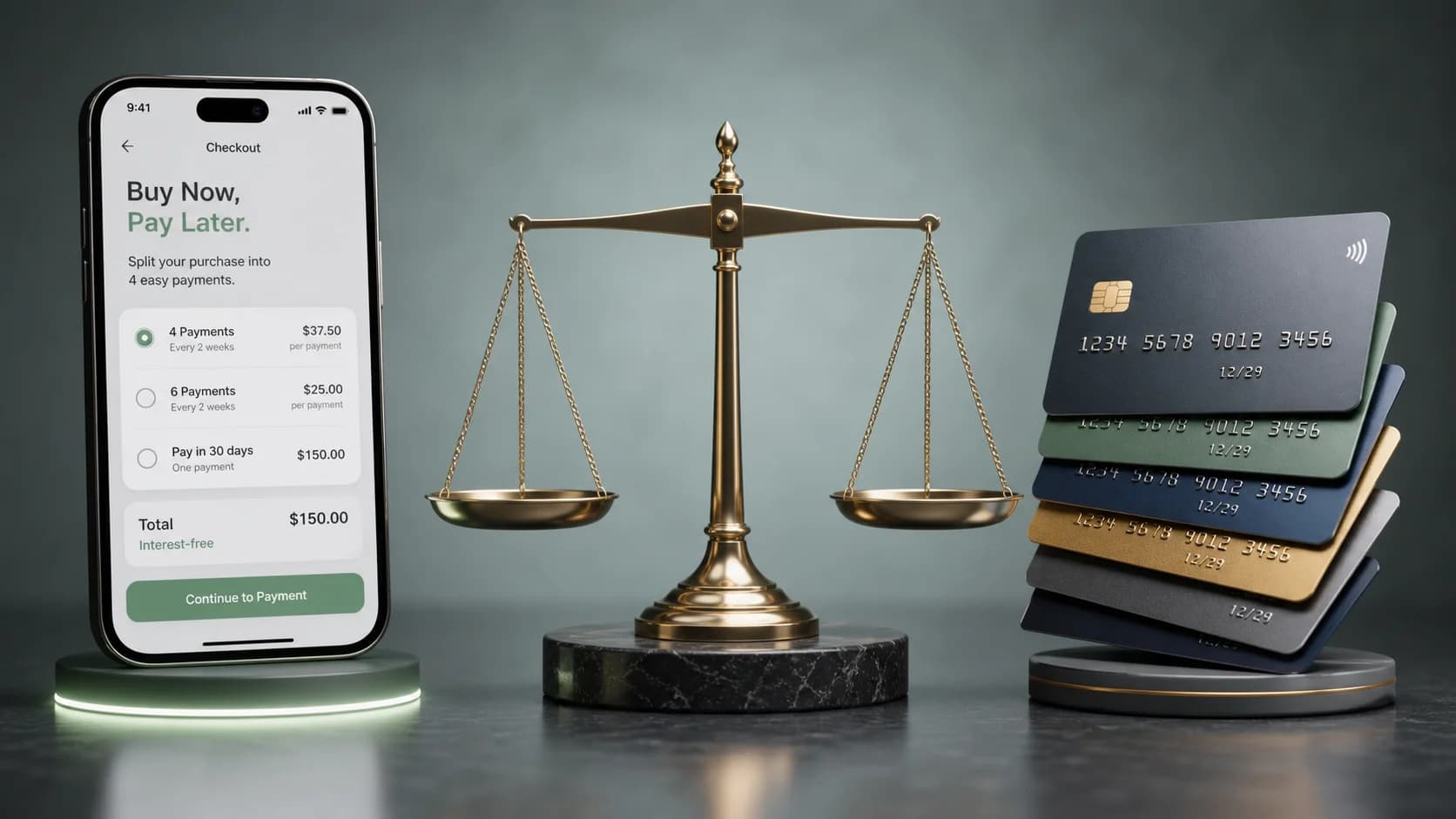
You're checking out online. A pop-up appears: 'Pay in 4 interest-free installments.' No interest. No hard credit check. Just four small payments over six weeks. It sounds like free money. But is it? Buy Now, Pay Later (BNPL) has exploded in the US — Americans used BNPL for over $100 billion in purchases in 2025. Services like Affirm, Klarna, and Afterpay are everywhere. And for good reason: 0% interest, instant approval, and no credit card required. But here is what the BNPL companies do not always tell you upfront: late fees that can exceed credit card penalties, a behavioral trap that makes you spend 20–40% more, and a growing debt problem that regulators are now investigating. This guide gives you the full picture — the good, the bad, and the ugly — so you can decide for yourself: is BNPL worth it?
About the author: Sarah Chen is a personal finance writer and certified financial educator (CFE) with six years covering consumer credit and debt topics. She has tested BNPL products firsthand and reported on the regulatory landscape for major personal finance publications.
What Is Buy Now, Pay Later? A Quick Overview
Buy Now, Pay Later is a short-term installment loan offered at checkout. You pay 25% upfront and the remaining 75% in three biweekly payments — typically over six weeks. Major providers include Affirm, Klarna, Afterpay, PayPal Pay in 4, and Sezzle. Terms are usually 0% interest if paid on time. No interest, no minimum payment confusion, no compounding debt — on the surface, it looks like the perfect financial tool. The US BNPL market surpassed $100 billion in transaction volume in 2025, driven by younger consumers who prefer BNPL over traditional credit.
The Good — When BNPL Makes Sense
0% Interest on Short-Term Purchases
If you pay on time, BNPL costs exactly $0 in interest. Compare that to a credit card: the average credit card APR is 22% in 2026, according to the Federal Reserve's Consumer Credit report. A $200 purchase on a credit card carried for 6 weeks at 22% APR costs roughly $1.42 in interest. BNPL at 0% = $0. If you would carry a credit card balance, BNPL is mathematically cheaper — but only if you actually pay on time.
No Hard Credit Pull (Most Providers)
Affirm, Klarna, and Afterpay typically perform only soft pulls for Pay in 4 applications — no impact on your credit score from applying. Exception: Affirm's longer-term loans (6–12 months) may include hard inquiries. For people with thin credit files who want to avoid hard inquiries, BNPL offers a path to short-term financing without the credit score hit.
Budgeting and Predictability
BNPL gives you a fixed payment schedule — you know exactly what you owe and when you owe it. No minimum payment confusion. No compounding interest. No credit card statement math. For planned purchases you can genuinely afford within 6 weeks, the predictability is genuinely useful.
Building Credit (Select Providers)
Affirm reports positive payment history to Experian for select loans. Klarna started reporting Pay in 4 positive payments to Experian in 2025. Afterpay does NOT report positive payments — only defaults. PayPal Pay in 4 and Sezzle do not report to credit bureaus at all. If credit building is your goal, choose your provider carefully.
The Bad — When BNPL Is Dangerous
Late Fees Can Add Up Fast
BNPL late fees look small — $7 to $10 per missed payment — but they stack faster than you think. Affirm charges up to $10 per missed payment or 25% of the loan amount. Klarna charges up to $7 per missed payment, capped at 25% of the order. Afterpay charges up to $8 per missed payment, with an additional $8 if still unpaid after 7 days. PayPal Pay in 4 charges up to $8 per missed payment. Real example: a $300 purchase where you miss 2 payments costs $14–$20 in late fees — an effective interest rate of 4.7–6.7% on a 6-week loan. That wipes out the '0% interest' benefit entirely.
The Overspending Problem (Behavioral)
BNPL separates the pleasure of purchase from the pain of payment — a phenomenon called decoupling. Studies show consumers spend 20–40% more when using BNPL. The average BNPL user has 3–5 active plans simultaneously, making it easy to lose track of total obligations. In the US consumer debt context, BNPL users are 2x more likely to carry credit card debt, per the Consumer Financial Protection Bureau (CFPB) research on BNPL products. The service that was supposed to help you budget can do the exact opposite.
Credit Score Impact (The Hidden Risk)
Missed BNPL payments can be reported to credit bureaus. Afterpay reports defaults to Experian. Affirm reports late payments to Experian. Klarna reports late payments to Experian. Multiple active BNPL plans can increase perceived credit utilization. Some longer-term BNPL options (6–12 months) include hard credit inquiries. The danger is invisible until it shows up on your credit report.
No Grace Period, No Rewards
Credit cards offer a 21–25 day grace period between purchase and payment — BNPL starts paying immediately. Credit cards offer cashback, points, or miles (1.5–5% back on every purchase). BNPL offers nothing. Credit cards offer purchase protection, extended warranties, and $0 liability on fraud. BNPL offers limited consumer protections. If you pay your card in full each month, BNPL is genuinely costing you value. If you are trying to decide between BNPL and a credit card for a major purchase, here is a direct comparison of the two.
BNPL vs Credit Card vs Cash — Real Cost Comparison
Here is the honest math. BNPL only beats a credit card if you would carry a balance AND you pay on time. If you pay your card in full, the credit card wins — rewards, purchase protection, and grace period included.
BNPL Provider Comparison (2026)
Not all BNPL services are the same. Here is how the five major providers stack up across the features that actually matter.
The BNPL Decision Framework — Should You Use It?
Before you click 'Pay in 4' at checkout, run through this quick framework. I have seen people get into real trouble with BNPL not because they were irresponsible, but because they did not stop to ask these questions before check out.
Use BNPL If All of These Apply:
- You have the cash right now but want to spread payments for cash flow management
- The purchase is planned — not an impulse buy at checkout
- You have reliable income and can make all four payments on time
- You're using a provider that reports to credit bureaus (Affirm or Klarna for credit building)
- The purchase is under $500 — manageable risk if something goes wrong
- You have no high-interest credit card debt you are paying down
- You have set up automatic payments to eliminate the risk of forgetting a due date
Do NOT Use BNPL If Any of These Apply:
- You are buying something you would not buy with cash today
- You already have 3 or more active BNPL plans running simultaneously
- You have a history of late payments on any financial obligation
- You carry credit card debt from month to month
- The purchase is for a depreciating asset (fashion, electronics you will upgrade in 12 months)
- You are using BNPL to fund a lifestyle beyond your current income
- You have not read the terms — particularly the late fee schedule and credit reporting policy
The 5 BNPL Rules (Quick Reference)
- The Cash Test: If you would not buy it with cash, do not BNPL it
- The 3-Plan Limit: Never have more than 3 active BNPL plans at the same time
- The Auto-Pay Rule: Always set up automatic payments on the due dates — never rely on memory
- The Total Check: Know your total BNPL obligation across all providers before taking on a new plan
- The Emergency Fund Rule: Only use BNPL if you have a funded emergency fund — BNPL is not your safety net
What the Experts Say (2026 Data)
BNPL has drawn increasing scrutiny from regulators and researchers. Here is what the data actually shows — and where to find the source if you want to go deeper:
- CFPB (consumerfinance.gov): BNPL users are more likely to be overdrawn, carry credit card debt, and use high-cost financial services
- Federal Reserve (federalreserve.gov): BNPL usage is highest among 18–34 year olds — 40% have used it at least once
- Consumer Reports: 1 in 5 BNPL users have been charged a late fee
- Credit Karma: BNPL users have average credit scores 30–50 points lower than non-users — though causality is unclear
- NY Fed (newyorkfed.org): BNPL debt is significantly underreported — estimated $20–$30 billion in outstanding obligations not captured in traditional credit metrics
FAQ — BNPL Questions Answered
Is buy now pay later a good idea?
It depends entirely on your financial situation and discipline. BNPL is a good idea for planned purchases you can genuinely afford within 6 weeks, especially if you would otherwise carry a credit card balance. It is a bad idea for impulse purchases, when you already have multiple active plans, or when you are using it to spend beyond your means.
Does buy now pay later affect your credit score?
Most BNPL applications use soft pulls with no credit score impact. However, missed payments can be reported to credit bureaus (Experian) and damage your score. Affirm and Klarna report positive payment history for select products — which means the right provider can actually help you build credit.
What happens if you miss a BNPL payment?
You will be charged a late fee of $7–$10 per missed payment, capped at 25% of the loan amount. After multiple missed payments, the provider may report the default to credit bureaus. In extreme cases, the debt may be sent to collections.
Is BNPL better than a credit card?
Only if you would carry a credit card balance. If you pay your card in full each month, the credit card is objectively better — rewards, purchase protection, and a grace period all favor the card. BNPL's only real advantage is short-term, interest-free financing with no credit score impact from application.
How does buy now pay later make money?
BNPL providers charge merchants 2–8% per transaction — significantly higher than the 1.5–3.5% charged by credit card networks. They also collect late fees from consumers and earn interest on longer-term loans (6–12 months). This means you — the consumer — are likely subsidizing BNPL through higher prices at participating merchants.
Can you use BNPL for anything?
No. BNPL is only available at participating merchants. Most major retailers (Amazon, Walmart, Target) offer BNPL at checkout. You can also use BNPL provider apps to shop at any merchant that accepts that specific provider.
How many BNPL plans is too many?
More than 3 active plans is a red flag. Track your total BNPL obligation — if it exceeds 10% of your monthly income, you are overextended. The average BNPL user has 3–5 active plans, which research shows correlates strongly with financial stress.
Does BNPL charge interest?
Most BNPL plans (Pay in 4) charge 0% interest if paid on time. However, some providers offer longer-term loans (6–12 months) with interest rates of 10–30% APR. Always read the terms carefully — '0%' does not mean 'free' if you miss a payment or take out a longer-term option.
Can you pay off BNPL early?
Yes, most BNPL providers allow early payoff with no penalty. Paying early reduces your risk of missed payments and late fees, and eliminates the cognitive load of tracking multiple due dates.
What is the future of BNPL in 2026?
The CFPB is proposing new regulations that would require BNPL providers to offer the same consumer protections as credit cards — dispute rights, refund handling, and billing error resolution. More providers are starting to report to credit bureaus. The market is consolidating, with traditional financial institutions (Apple, Chase) entering the space with integrated products.
The Bottom Line on BNPL
BNPL is not free money. It is a financial tool — useful in specific circumstances, dangerous in others. The providers market it as simple and frictionless because they make money on every transaction, win or lose. Your job is to be more strategic than their marketing. Before you click 'Pay in 4' at checkout, ask yourself: Would I buy this with cash? Can I afford all four payments without stress? Am I using BNPL to spend more than I normally would? If the answer to any of those questions is uncertain, the answer is no. For a deeper look at how BNPL stacks up against credit cards with real numbers, compare your options before you commit.
Take control of your money today
Start free with Spendmate — track expenses, plan budgets, and reach your financial goals.
Start free with Spendmate