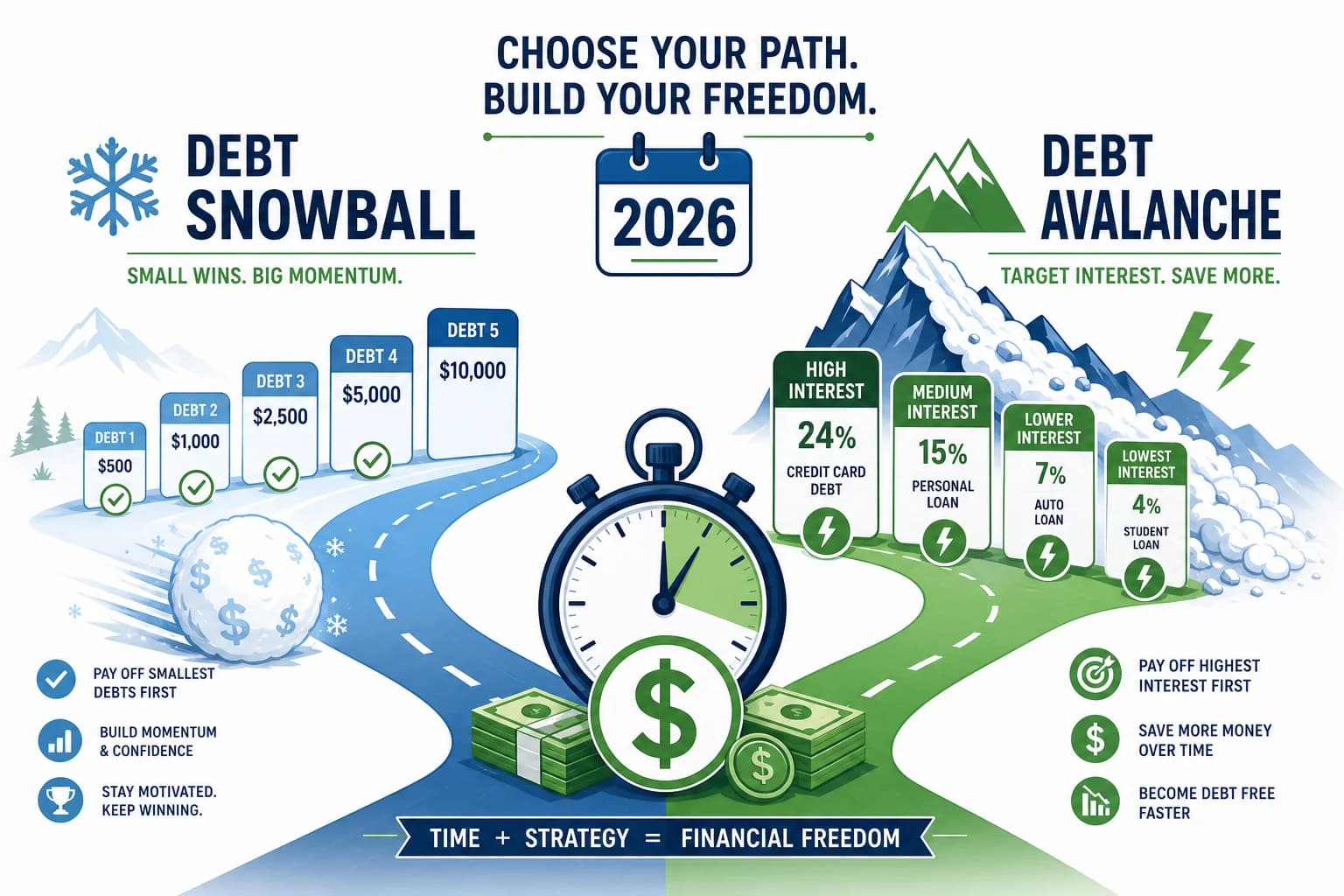
You've decided to pay off your debt. Congratulations—that is the hardest step. Now comes the next question: Should you use the debt snowball method (smallest balances first) or the debt avalanche method (highest interest rates first)? Here's the uncomfortable truth: both methods work. The real question is not which method is mathematically superior. It's which method will you stick with for the next 12 to 36 months. This guide compares the math, the psychology, and the real-world success rates of each method—with 2026 interest rates and a decision quiz to help you choose.
The Short Answer (For Skimmers)
Debt Snowball: Pay smallest balances first regardless of interest rate. Builds momentum through quick wins. Best for people who need motivation and have struggled to stick with financial goals. Debt Avalanche: Pay highest interest rates first regardless of balance. Saves more money over time. Best for people motivated by efficiency and long-term optimization.
The Math: Avalanche typically saves 5–15% more in interest over the payoff period. The Reality: The best method is the one you will actually stick with for 12–36 months. Our Recommendation: If you've quit debt payoff attempts before → Snowball. If you're disciplined and motivated by efficiency → Avalanche. Unsure? Try our decision quiz below.
What Is the Debt Snowball Method?
How It Works (Step-by-Step)
- List all debts from smallest balance to largest balance (ignore interest rates)
- Pay minimum payments on all debts except the smallest
- Throw every extra dollar at the smallest debt until paid off
- Move to the next smallest debt (now you have two payments worth attacking it)
- Repeat until all debts are paid
Example Scenario (2026 Numbers)
Debt A: $800 credit card @ 24% APR, min $25
Debt B: $3,500 credit card @ 21% APR, min $100
Debt C: $12,000 student loan @ 5.5% APR, min $150
Extra monthly payment: $300
Snowball order: A → B → C (smallest to largest)
Timeline: Debt A paid in 3 months, Debt B in 12 months, Debt C in 36 months total
Why It Works (Psychology)
- Quick wins build confidence (behavioral momentum)
- Visible progress reduces overwhelm
- Fewer accounts quickly = simplified finances
- Celebrating milestones reinforces commitment
The Downside
- May pay more interest overall (mathematically suboptimal)
- Can feel frustrating if large high-interest debt lingers
- Requires discipline to not celebrate by spending
What Is the Debt Avalanche Method?
How It Works (Step-by-Step)
- List all debts from highest interest rate to lowest interest rate (ignore balances)
- Pay minimum payments on all debts except the highest rate
- Throw every extra dollar at the highest-rate debt until paid off
- Move to the next highest rate (now you have two payments worth attacking it)
- Repeat until all debts are paid
Example Scenario (Same 2026 Numbers)
Same debts as above:
Avalanche order: A (24%) → B (21%) → C (5.5%) (highest to lowest rate)
Timeline: Debt A paid in 3 months, Debt B in 11 months, Debt C in 35 months total
Interest saved vs. Snowball: Approximately $180–$250 over the payoff period
Why It Works (Math)
- Minimizes total interest paid (mathematically optimal)
- Faster overall debt elimination (typically 2–6 months sooner)
- Appeals to logical, efficiency-minded people
- No regret about leaving money on the table
The Downside
- Slow visible progress if high-rate debts have large balances
- Requires longer commitment before first win
- Higher abandonment rate for motivation-dependent people
Head-to-Head Comparison (2026 Data)
The Real Question — Which Method Will YOU Stick With?
Take the 5-Question Decision Quiz
Q1: Have you successfully stuck with a financial goal for 12+ months before?
Yes, multiple times → Lean Avalanche
Yes, once or twice → Neutral
No, I tend to lose motivation → Lean Snowball
Q2: What motivates you more?
Seeing quick progress and checking things off → Lean Snowball
Knowing I am improving and saving maximum money → Lean Avalanche
Q3: How do you handle delayed gratification?
I struggle; I need visible results soon → Lean Snowball
I am fine waiting if the outcome is better → Lean Avalanche
Q4: What does your debt portfolio look like?
Many small balances ($500–$3,000 range) → Lean Snowball
Few large balances with high rates ($10K+ at 20%+) → Lean Avalanche
Mixed → Neutral (use other answers to decide)
Q5: Why do you want to pay off debt?
To feel accomplished and reduce stress → Lean Snowball
To save money and optimize finances → Lean Avalanche
Scoring:
Mostly Snowball: You will likely succeed with Snowball. The quick wins will keep you motivated.
Mostly Avalanche: You've the discipline for Avalanche. The math optimization will satisfy you.
Mixed/Neutral: Either method can work. Consider the Hybrid Approach below.
The Hybrid Approach — Best of Both Worlds
When Hybrid Makes Sense
- You want mathematical efficiency BUT need early wins
- You have one very small debt AND one very high-rate debt
- You are unsure which method fits your personality
How Hybrid Works
Phase 1 (Months 1–3): Use Snowball to eliminate 1–2 smallest debts (build momentum)
Phase 2 (Rest of Journey): Switch to Avalanche for remaining debts (optimize interest)
OR: Use Snowball for debts under $2,000, then Avalanche for larger debts
Example Hybrid Scenario
Start with Snowball: Knock out $800 and $1,500 debts in first 4 months. Celebrate wins, build confidence. Switch to Avalanche: Attack 24% and 21% APR debts aggressively. Result: Momentum + optimization combined.
Pros of Hybrid
- Early wins build commitment
- Long-term math still optimized
- Flexibility to adapt to your needs
Cons of Hybrid
- Slightly more complex to track
- Must resist temptation to switch methods repeatedly
- Requires honest self-assessment of motivation levels
Real 2026 Math Examples
Example 1: Credit Card Heavy Portfolio
Debt A: $1,200 @ 24% APR, min $35
Debt B: $4,800 @ 22% APR, min $120
Debt C: $6,500 @ 21% APR, min $150
Total: $12,500 debt
Extra monthly payment: $400
Method comparison:
Snowball: 20 months, $2,180 total interest
Avalanche: 18 months, $1,940 total interest (Save $240, 2 months faster)
Verdict: Avalanche wins on math, but Snowball provides quicker first win (Debt A gone in 3 months either way since it's both smallest AND highest rate).
Example 2: Mixed Debt Portfolio
Debt A: $900 credit card @ 24% APR, min $25
Debt B: $8,000 student loan @ 5.5% APR, min $100
Debt C: $15,000 student loan @ 6.8% APR, min $200
Total: $23,900 debt
Extra monthly payment: $500
Method comparison:
Snowball: 42 months, $4,850 total interest
Avalanche: 38 months, $4,220 total interest (Save $630, 4 months faster)
Verdict: Avalanche saves significant money because high-rate credit card is also smallest balance (wins both ways). But Snowball still eliminates Debt A quickly for psychological win.
Example 3: Snowball-Favorable Scenario
Debt A: $600 medical bill @ 0% APR, min $20
Debt B: $2,200 credit card @ 21% APR, min $65
Debt C: $18,000 student loan @ 6.5% APR, min $250
Total: $20,800 debt
Extra monthly payment: $450
Method comparison:
Snowball: 46 months, $5,420 total interest
Avalanche: 44 months, $5,180 total interest (Save $240, 2 months faster)
Verdict: Avalanche still saves money, but difference is minimal ($240 over 4 years). Snowball provides three quick wins (Debts A, B gone in first 8 months) vs. Avalanche where Debt C drags for years. For motivation-dependent person, Snowball may be better despite slightly higher cost.
Step-by-Step Implementation Guide
Before You Start — Prerequisites
- Minimum $500–$1,000 starter emergency fund (prevents new debt during payoff)
- Budget created with identified extra payment amount
- All debts listed with current balances, interest rates, minimum payments
- Automatic minimum payments set up (avoid late fees)
- Mindset committed (this is a 12–36 month journey)
Week 1: Setup
- Choose your method (use quiz above if unsure)
- Create debt payoff list in correct order (balance or rate)
- Set up spreadsheet or app tracker (see tools below)
- Calculate your debt-free date (use online calculator)
- Tell someone your plan (accountability partner)
Month 1: First Actions
- Make minimum payments on all debts (auto-pay recommended)
- Send extra payment to target debt (first on your list)
- Track progress visually (chart, app, thermometer graphic)
- Celebrate first milestone (even if small)
- Review budget end-of-month (adjust if needed)
Ongoing: Monthly Rhythm
- Auto-pay minimums (never late)
- Manual extra payment to target debt (beginning of month ideal)
- Update tracker after each payment
- Review progress monthly (stay motivated)
- Adjust budget quarterly (income changes, expense shifts)
When You Pay Off a Debt
- Celebrate! (Low-cost reward: home dinner, movie night, hike)
- Do NOT increase lifestyle spending (critical mistake)
- Roll entire payment amount (minimum + extra) to next debt
- Update tracker (cross off debt, recalculate timeline)
- Share win with accountability partner
Common Mistakes to Avoid
- Not having emergency fund (one emergency = new debt)
- Celebrating by spending (defeats the purpose)
- Switching methods repeatedly (confusion kills momentum)
- Not tracking progress (cannot see how far you have come)
- Ignoring budget adjustments (life changes, plan should too)
- Taking on new debt during payoff (digging hole while climbing out)
- Comparing your journey to others (your debt is unique)
Tools & Trackers
Free Tools
- Undebt.it (free tier available, supports both methods)
- Google Sheets templates (search debt snowball tracker)
- Vertex42 debt reduction calculators (Excel/Google Sheets)
- Mint or YNAB (budget apps with debt tracking features)
Paid Tools Worth Considering
- YNAB ($14.99/month) — excellent for budget + debt combo
- Undebt.it Pro ($5/month) — advanced debt payoff planning
- Tally app (free) — auto-pays credit cards strategically
DIY Tracker Template Elements
- Debt name, balance, interest rate, minimum payment
- Payment order (1, 2, 3…)
- Monthly payment amount
- Progress bar or thermometer visual
- Debt-free date projection
- Milestone celebration ideas
FAQ — Debt Snowball vs Avalanche
Which method is scientifically proven to work better?
Both methods have merit. Behavioral economics studies show Snowball has ~20% higher completion rates because quick wins reinforce commitment. However, Avalanche saves 5–15% more in interest mathematically. The best method is the one you will actually complete.
Can I switch from snowball to avalanche (or vice versa)?
Yes, absolutely. Many people start with Snowball for motivation then switch to Avalanche once they have momentum. Just ensure you have paid off at least one debt first so you have a success to build on.
What if I get a windfall (tax refund, bonus)?
Apply 100% of windfalls to your target debt (whichever method you chose). This accelerates payoff significantly. Do not split windfalls across debts—it dilutes the snowball/avalanche effect.
Should I pay off debt or invest during inflation?
For most people, paying off high-interest debt (anything above 7–10% APR) takes priority over investing. The guaranteed return from eliminating 21–24% credit card interest exceeds typical investment returns after inflation.
What happens if I accumulate new debt during payoff?
This is the most common derailment. Prevention: Build your emergency fund first (even $500 helps). If it happens: Pause aggressive payoff, return to minimum payments only, rebuild emergency fund, then resume extra payments.
Do I include my mortgage in debt snowball/avalanche?
Most advisors recommend excluding mortgage from your debt payoff strategy because mortgage rates are typically lower (6–8% in 2026) and mortgage interest may be tax-deductible. Focus on consumer debt first.
How do I stay motivated when progress feels slow?
Track every payment visually. Celebrate milestones (small wins). Join online communities for accountability. Consider the Hybrid approach if you need more frequent wins. Remember: every payment brings you closer to freedom.
What if my spouse prefers a different method?
Discuss openly. Run the numbers together and see which method saves more interest. Usually the math will favor Avalanche, but if your spouse is the more motivation-driven partner, Snowball may be the smarter choice for your household.
Should I use debt consolidation with snowball/avalanche?
Debt consolidation can help IF you get a lower overall interest rate and do not increase spending afterward. A balance transfer card (0% intro APR for 12–21 months) can accelerate either method significantly. Just watch for transfer fees (typically 3–5%).
Is it okay to pause debt payoff for emergencies?
Yes, but only true emergencies. A job loss, medical crisis, or essential home repair qualifies. A sale, vacation, or non-essential purchase does not. If you pause, return to aggressive payoff within 30–60 days once the emergency resolves.
When Debt Payoff Methods Are NOT Enough
Signs You Need Additional Help
- Minimum payments exceed 40% of take-home income
- Using credit cards to pay for basics (groceries, utilities)
- Borrowing from retirement accounts to make payments
- Considering bankruptcy or debt settlement
- Debt growing despite making payments (interest outpacing principal)
Options Beyond Snowball/Avalanche
- Debt Consolidation Loan: Combine multiple debts into one lower-rate loan (good credit required)
- Balance Transfer Credit Card: 0% intro APR for 12–21 months (requires good credit, transfer fees apply)
- Debt Management Plan (DMP): Nonprofit credit counseling negotiates lower rates (small fee, 3–5 year program)
- Debt Settlement: Negotiate to pay less than owed (damages credit, tax implications, risky)
- Bankruptcy: Last resort legal protection (major credit impact, 7–10 years on report)
When to Seek Professional Help
Consider nonprofit credit counselors (NFCC.org for certified counselors), fee-only financial planners (NAPFA.org), or legal aid if facing collections or lawsuits. These resources can provide objective guidance when your debt situation feels unmanageable.
Need to build an emergency fund before starting? Learn how to build an emergency fund from scratch to prevent new debt during your payoff journey. And if you're living paycheck to paycheck, our 30-day escape plan can help you free up cash for debt payments. For couples tackling debt together, the step-by-step budgeting system for shared money ensures you're both aligned on the same debt payoff strategy.
Take control of your money today
Start free with Spendmate — track expenses, plan budgets, and reach your financial goals.
Start free with Spendmate