
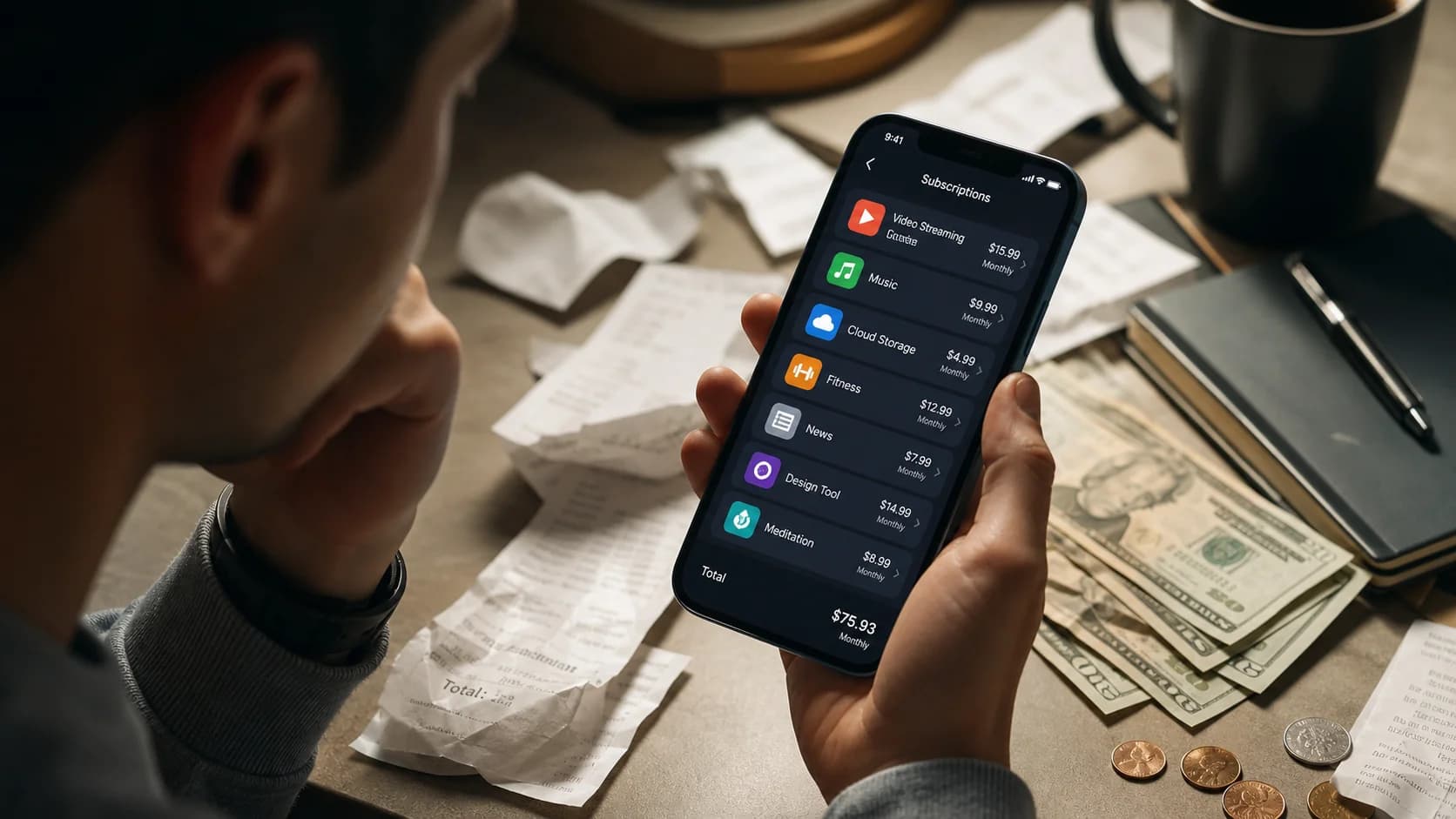
Here is an uncomfortable math problem: the average American household pays for 12–15 subscriptions monthly, spends $250–$400/month, and forgets about 30–40% of what they pay for. That is $1,500–$2,000 per year—vanished into autopilot charges for services you do not remember signing up for. The good news: in 90 minutes, you can audit every subscription, cancel the waste, negotiate better rates on keepers, and reclaim $100–$200/month without giving up anything you actually use. No shame. No judgment. Just a systematic process that works.
The Uncomfortable Truth About Your Subscriptions
Subscription fatigue is real. In 2026, the average US household manages more recurring charges than ever—streaming bundles, fitness apps, cloud storage, news subscriptions, meal kits, and more. Each individual charge feels harmless at $9.99 or $14.99, but together they create a silent drain on your budget that most people never notice until they actually look.
Average American Household Subscription Stats (2026)
- 12–15 active subscriptions per household on average
- $250–$400 spent monthly on subscription services
- 30–40% of subscriptions are forgotten or rarely used
- $1,500–$2,000 wasted annually on autopilot charges
- Most households have at least 2–3 duplicate streaming services
Why Subscription Creep Happens
Subscription creep is the gradual, often unnoticed accumulation of recurring charges over time. It happens because each charge arrives silently, auto-renews without friction, and hides within a larger bill picture where it feels too small to question. A $9.99/month charge feels trivial—but 12 of them add up to $143/month or $1,716/year. This is what financial wellness researchers call budget leakage, and it is one of the easiest sources of waste to eliminate once you know it exists. Understanding the mechanics behind subscription creep is the first step toward building a system that prevents it from returning.
Step-by-Step: How to Conduct a Subscription Audit in 90 Minutes — cancel subscriptions
This is not about deprivation. It is about intentionality. You can keep every subscription that genuinely adds value to your life—and cancel the ones that do not. Here is the exact three-phase process to get there in 90 minutes.
Phase 1: Discovery (30 Minutes)
Before you can cut anything, you need to see everything. Most people dramatically underestimate how many active subscriptions they have because charges arrive on different dates and from different merchant names on your statement.
- Pull your last 3 months of bank and credit card statements—look specifically for recurring charges
- Search your email inbox for terms like 'receipt,' 'subscription,' 'renewal,' and 'recurring' to find billing notices
- Check your phone app store accounts (iOS App Store, Google Play) for active subscriptions
- List every subscription you find in one place: name, monthly cost, billing date, and renewal term
- Note the cancellation terms for each—look for minimum contract periods, cancellation fees, or required notice periods
Phase 2: Evaluation (20 Minutes)
Now that you have your full list, rate each subscription honestly. This is where most people discover the waste.
- Rate each subscription 1–5 on actual usage (5 = daily use, 1 = not used in 60+ days)
- Identify duplicates: two music streaming services, three video streaming platforms, multiple cloud storage accounts
- Flag free trials that are about to convert to paid—these need immediate action
- Note which subscriptions are shared (family plan members) and which you pay for alone
- Separate essential subscriptions (work tools, healthcare) from nice-to-have subscriptions
Phase 3: Action (40 Minutes)
- Cancel everything rated 1–2 on usage immediately—do not wait
- Call or chat with retention teams for expensive subscriptions you want to keep—ask about discounts or downgraded tiers
- Downgrade premium tiers where you are paying for features you never use
- Set calendar reminders 7 days before any free trial converts to paid
- Move annual billing to monthly if you need flexibility—or move monthly to annual if you want a discount
Subscription Audit Template — What to Track
Use this template to organize your findings. The act of writing it down makes the waste visible in a way that casual awareness never does.
For a broader expense tracking system that captures all your spending—not just subscriptions—consider reading our guide on how to track expenses. Understanding your full financial picture makes individual subscription decisions easier.
Which Subscriptions Should You Cancel First?
Not all subscriptions are equal. Use this priority framework to decide where to start.
Priority 1: Cancel Immediately
- Not used in 60+ days with no planned near-term use
- Free trial converting to paid within 7 days that you did not intentionally keep
- Duplicate service (two music streaming apps, three video streaming platforms)
- Impulse sign-up regret—you signed up during a sale and never used it
Priority 2: Negotiate or Downgrade
- Used occasionally but expensive relative to usage
- Premium tier with features you never access
- Services known to offer retention discounts (cable, internet, gym, software)
- Annual plan you could switch to monthly for lower commitment
Priority 3: Keep (For Now)
- Used multiple times per week with clear value
- Essential for income generation (work software, tools)
- No good lower-cost alternative available
- Family-shared plan with high per-person value
Common Subscriptions — Worth It or Waste?
Streaming Services
Music Streaming
Fitness & Wellness
Software & Productivity
How to Negotiate Better Rates Before Canceling
Most subscriptions offer retention discounts—you just have to ask. Companies would rather keep you at a reduced margin than lose you entirely. Use these scripts.
Script 1: Gym Membership Retention
"Hi, I have been a member for [X years] and I enjoy the facility, but I am reviewing my monthly expenses and need to reduce costs. Are there any retention offers, seasonal promotions, or downgraded membership tiers available that could help me stay?"
Expected outcome: 10–30% discount, freeze option for 1–3 months, or conversion to month-to-month pricing.
Script 2: Internet / Cable Provider
"I am reviewing my monthly expenses and I have seen competitor promotional rates that are lower than what I am currently paying. Can you help me understand what options are available to keep my account with you?"
Expected outcome: Promo rate match, equipment fee waiver, or bundle discount. Do not bluff—have the competitor rate ready.
Script 3: Streaming Services
"I love this service but I am working to simplify my budget. Are there any loyalty discounts, annual payment options, or bundled deals available that could help me keep the subscription?"
Expected outcome: Annual plan discount (10–20% off), bundle with sister services (e.g., Disney+ and Hulu discounts).
Script 4: Software Subscriptions
"I am a [student / teacher / hobbyist / nonprofit volunteer] and I use this software for [personal projects / educational purposes]. Are there any community or educational pricing options available for this product?"
Expected outcome: 30–50% educational discount from Adobe, Microsoft, and many other software providers.
Tools & Apps That Help Track Subscriptions
Start with a free spreadsheet or calendar reminders. If you have 10 or more subscriptions and want hands-off cancellation support, Rocket Money is worth the subscription cost for its auto-discovery feature alone. For those building a broader money management system, combining subscription tracking with a comprehensive budgeting approach gives you the full financial picture you need to make confident decisions.
Preventing Subscription Creep — The Maintenance System
Auditing once is not enough. Without a maintenance system, subscriptions quietly accumulate again within 3–6 months. Here is the system that prevents that.
Monthly Check (5 Minutes)
- Review bank and credit card statements for any new recurring charges
- Check email for renewal notices that arrived that month
- Verify that free trials you intended to cancel did not convert to paid
Quarterly Review (15 Minutes)
- Re-rate each active subscription on actual usage
- Rotate streaming services based on current content releases
- Check for annual price increases—many services raise rates without notice
- Calculate your quarterly subscription spend and compare to the previous quarter
Annual Audit (30 Minutes)
- Repeat the full 90-minute audit process from scratch
- Call retention teams for all subscriptions you want to keep
- Calculate total annual subscription spend—shock value is motivating
- Set next year's subscription budget based on actual need
Household Rules to Prevent Creep
- No new subscription without a 48-hour cooling-off period
- All new subscriptions require partner approval if shared finances
- Free trials must have a calendar reminder set BEFORE signing up
- One-in, one-out rule: adding a new subscription means canceling an existing one
FAQ — Subscription Audit
- How many subscriptions does the average person have?
- The average American household has 12–15 active subscriptions, spending $250–$400 per month. Most people are unaware of at least 3–4 subscriptions they are paying for but rarely use.
- How much money can I save by auditing subscriptions?
- Most households discover $100–$200 per month in waste. That is $1,200–$2,400 per year—enough to fully fund an emergency fund, pay off high-interest debt, or make a significant contribution to retirement savings.
- What is the easiest way to find all my subscriptions?
- Pull your last 3 months of bank and credit card statements, search for recurring charges, and check your phone's app store subscriptions. Services like Rocket Money can also auto-discover subscriptions by connecting your accounts.
- Are subscription cancellation services worth it?
- For people with 10+ subscriptions who struggle with the process, services like Rocket Money are worth the cost. They handle negotiations and cancellations for you and take a percentage of savings as their fee. For most people, doing it yourself with our scripts takes 90 minutes and costs nothing.
- How do I stop a company from charging my card?
- Contact the company directly to cancel—most require written notice via chat, email, or a cancellation form on their website. If a charge appears after cancellation, contact your bank to dispute it as an unauthorized charge.
- Can I get a refund for a forgotten subscription?
- It depends on the company's policy. Some will issue partial refunds for recently charged periods if you contact them and explain the situation, especially for annual plans you forgot to cancel. It never hurts to ask.
- What if I cancel but want to resubscribe later?
- Most services allow you to resubscribe at any time, sometimes at the same promotional rate you had before. Streaming services especially run promotions frequently. Cancel with confidence and resubscribe strategically when you actually want the content.
- Should I cancel or pause my subscription?
- If a service offers a freeze or pause option (gyms often do), use it. For streaming services, canceling and resubscribing later is usually seamless. Choose whichever option saves you more money and keeps you most accountable.
- How do I handle shared subscriptions with family?
- Identify which family members are actually using shared subscriptions. If someone in your household has their own account for the same service, consolidate to a family plan. If someone is not using a shared subscription at all, remove them from the plan or cancel.
**Bottom Line:** Start with the 4-test framework, cancel what fails at least 2 tests, and negotiate or downgrade what you舍不得 cancel. Even one audit session can save $200-500/month.
- What subscriptions are actually worth keeping?
- Subscriptions worth keeping: ones you use multiple times per week, essential work tools you cannot replace with a free alternative, and services where the cost-per-use is genuinely low. The test is simple: would you sign up for this today at today's price? If not, cancel it.
Put Your Savings to Work
Reclaiming $100–$200 per month from your subscriptions is only the beginning. That freed-up cash flow is a powerful tool when directed intentionally. Building an emergency fund with even a portion of your subscription savings creates a financial safety net that prevents future budget crises—and the peace of mind that comes with it is worth more than any streaming service.
Take control of your money today
Start free with Spendmate — track expenses, plan budgets, and reach your financial goals.
Start free with Spendmate