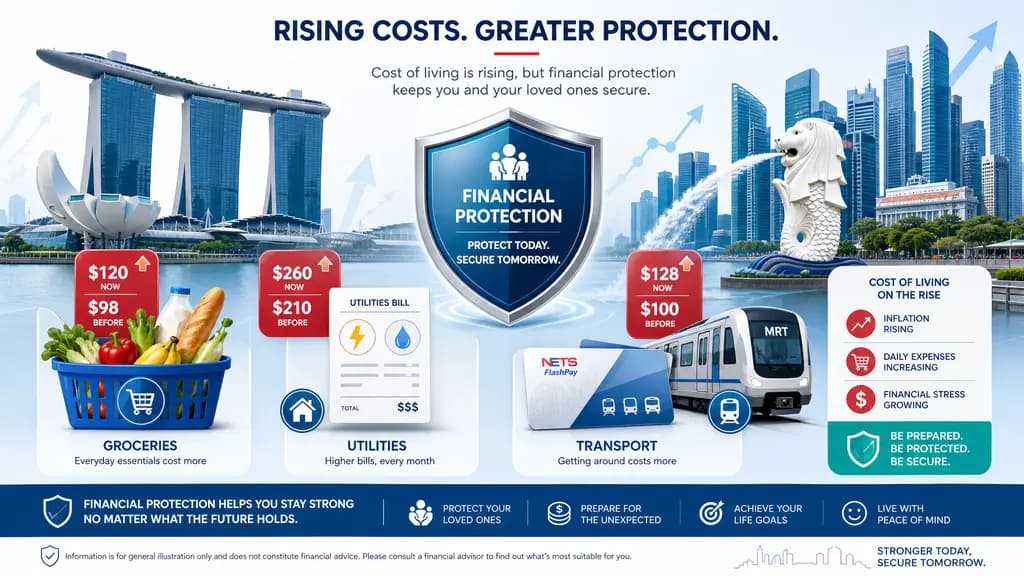
If you have noticed your hawker meal costs more, your electricity bill keeps climbing, and your bus fare went up again — you are not imagining it. Singapore's inflation rate has been running at elevated levels through 2026, and for the average household, that translates to an extra $150–$400 in monthly spending pressure. This guide gives you 8 specific, Singapore-focused tactics to fight back without drastically changing your lifestyle. No lecture. No guilt. Just things you can actually do.
<2>How Bad Is Inflation in Singapore Right Now? (2026 Reality Check)Singapore's inflation story in 2026 is a mix of global and local pressures. Food inflation has been running at 3–5% year-on-year, driven by supply chain costs and manpower constraints in the food service sector. Electricity costs have surged 5–8% as global energy markets remain volatile — though Singapore's electricity liberalization means you can actually do something about this. Public transport fares adjusted under the PETR formula, adding 2–4% to monthly commuting costs. Overall, Singapore's CPI inflation is tracking at roughly 3–4% in 2026 according to MAS data — not catastrophic, but persistent enough to erode purchasing power meaningfully over time.
<2>The 8 Inflation-Fighting Tactics That Actually Work in Singapore <3>Tactic 1: Lock In Your Electricity Rate Before the Next HikeSingapore's electricity market has been liberalized since 2018, but many households still have not switched — and they are paying for it. As of 2026, households in the national tariff category can choose from over 10 licensed retailers offering fixed-price plans that are typically 10–20% below the regulated tariff. The average household can save $15–$60 per month by switching. The process takes 10 minutes online, requires no change to physical infrastructure, and your supply is never interrupted. Lock in a fixed-rate plan now — most promotional rates are valid for 6–12 months. Set a calendar reminder for your lock-in expiry date so you do not roll onto a higher rate automatically.
<3>Tactic 2: Use Every CDC Voucher TwiceCDC vouchers — Community Development Council vouchers — are one of the most tangible inflation-offsetting tools the Singapore government provides. Eligible households receive vouchers in specific denominations that can be used at participating hawkers, wet markets, and heartland shops. The key tactical move: treat CDC vouchers as budget neutralizers for essential price increases, not as 'free money' to spend on extras. Check your voucher balance and expiry date at the CDC Voucher portal. Combine CDC voucher usage with ongoing promotions at participating outlets to effectively double their value on essential purchases.
<3>Tactic 3: Fix Your Transport Costs Before the Next Fare AdjustmentSingapore's public transport fare formula (PETR) adjusts annually based on inflation, energy costs, and wage movements — and those adjustments have been upward. Strategies that actually work: consider a monthly concession pass if you commute regularly — the Adult Monthly Travel Pass costs $128 and covers unlimited bus and MRT rides. If you are not eligible for concession pricing, load your EZ-Link or NETS FlashPay card with stored value and plan your trips to minimize unnecessary journeys. For ERP-sensitive routes, consider time-shifting your travel outside peak ERP windows where possible.
<3>Tactic 4: Shop at Wet Markets and NTUC FairPrice StrategicallyThe humble wet market is still cheaper than the supermarket for most fresh produce — typically 10–20% savings on vegetables, poultry, and fish compared to NTUC FairPrice or Cold Storage. Budget your hawker meals more deliberately: average hawker meal prices in 2026 range from $4.50–$7.00 for a chicken rice or economy rice plate in the city area, to $3.50–$5.50 in heartland hawker centres. Use FairPrice's 2-for-1 promotions and price cycles strategically — buy non-perishables in bulk during promotions. NTUC's Eco and housebrand range can save 15–25% on equivalent products.
<3>Tactic 5: Review Your Insurance — Are You Paying for Coverage You Do Not Need?Singapore has one of the highest insurance penetration rates in Asia, and much of it is unnecessarily expensive. Critical illness policies with payout amounts that made sense 10 years ago may now be inadequate — or worse, you may be paying for double coverage you do not need. If you are paying premiums for investment-linked policies (ILPs) with high management fees (1.5–2% annually), consider whether term life insurance plus a low-cost index fund would serve you better. Redirect any freed-up premium to CPF SA top-ups (4% interest, tax-free, guaranteed) or SRS contributions for tax relief.
<3>Tactic 6: Maximise Government Assistance You Are Already Eligible ForThe GST Voucher (GSTV) provides cash and U-Save rebates to eligible households — disbursements are automatic if you qualify based on annual income. U-Save rebates are credited directly to your SP Services account to offset electricity and gas bills. S&CC rebates apply to eligible HDB households. ComCare assistance is available for lower-income households through a self-assessment tool at go.gov.sg/comcare. Quick eligibility check: (1) Is your annual household income below $100,000? (2) Do you live in an HDB flat? (3) Are you a Singapore citizen? If yes to any two, check your specific scheme eligibility.
<3>Tactic 7: Stop Paying Full Price for These 5 ThingsMobile plans: Singapore has some of the highest telco costs in the world. Switching from a flagship plan ($50–$80/month) to a budget MVNO or promotional plan ($15–$25/month) saves $25–$55/month — $300–$660/year. Internet: promotional bundles from a different provider can save $10–$20/month. Gym memberships: the average gym membership in Singapore costs $60–$120/month. If you have not been in 3 months, downgrade or cancel. Streaming bundles: audit which ones you actually watch and consolidate. Credit card annual fees: if you are paying $200+ in annual fees and not using the benefits, call your bank and request a fee waiver or product downgrade.
<3>Tactic 8: Protect Your Long-Term Purchasing PowerHere is the counter-intuitive truth: cutting your savings to fight inflation is a mistake. Inflation erodes cash purchasing power at roughly 3–4% annually in 2026. If your savings are earning less than 3%, you are losing real purchasing power by holding cash. CPF Special Account (SA) earns 4% interest — guaranteed, tax-free, and inflation-beating for most households. SRS (Supplementary Retirement Scheme) contributions give you tax relief at your marginal rate — a 22% taxpayer saving $1,000 in SRS gets $220 back in taxes. The risk of not investing at all is real: holding all your wealth in cash guarantees you will lose purchasing power over a 10-year horizon.
<2>Where Singapore Inflation Is Hitting Hardest (Category Breakdown)Not all categories are equal when it comes to inflation pain. Here is where to focus your mitigation efforts.
- Hawker/food: +3–5% YoY. Best response: CDC vouchers + cook more + wet market shopping. Estimated monthly savings vs 2024: $40–$120
- Public transport: +2–4% YoY. Best response: monthly pass, off-peak travel, route optimization. Estimated monthly savings: $10–$30
- Electricity: +5–8% YoY. Best response: switch retailer, lock in fixed rate. Estimated monthly savings: $15–$60
- Household goods: +2–4% YoY. Best response: generic brands, bulk buying, FairPrice promotions. Estimated monthly savings: $20–$50
- Petrol/COE: volatile. Best response: use public transport more, consider e-scooter for short distances
- Entertainment/dining out: +4–6% YoY. Best response: set a monthly entertainment cap, use credit card dining promotions
- Insurance/premiums: +3–5% YoY. Best response: policy review, term life vs whole life audit. Estimated annual savings: $500–$2,000
The MAS official forecast as of mid-2026 suggests inflation may moderate to 2.5–3.5% by late 2026 as global supply chain pressures continue to ease. Food and energy inflation is expected to remain elevated relative to pre-2020 averages. The bottom line: inflation may moderate but costs are not going back down. Adaptation — not waiting for prices to fall — is the only reliable strategy. The households that will fare best are the ones that build systematic spending efficiency rather than trying to out-save inflation through willpower alone.
<2>FAQ — Singapore Inflation Questions Answered- How much does the average Singapore household spend on essentials monthly in 2026?
- A typical 4-person household in Singapore spends approximately $4,500–$6,500 per month on essentials — housing, food, transport, utilities, healthcare, and insurance. Inflation adds $150–$400 per month in pressure compared to 2024 levels, depending on spending patterns and household size.
- Are Singapore salaries keeping up with inflation?
- Wages in Singapore have been rising, with median monthly income for full-time employees at approximately $3,600–$4,200 based on 2025 data. Real wage growth has been positive in some sectors but uneven. Public sector adjustments and progressive wage model increases have helped lower-income workers more than middle-income earners.
- Is it worth switching electricity retailers in Singapore?
- Yes, for most households. The savings range from $10–$80 per month depending on your current plan, usage, and which retailer you choose. The process takes 10 minutes online, requires no change to physical infrastructure or supply reliability, and you can always switch back to the regulated tariff if needed.
- Should I stop saving to cope with inflation?
- No. Stopping savings entirely is counterproductive. While cutting discretionary spending makes sense, inflation erodes cash purchasing power — you want at least some of your money in interest-bearing accounts. CPF SA at 4% effectively beats 2026 inflation. A high-yield savings account at 3.5–4% in Singapore preserves real purchasing power. The key is to cut waste, not savings.
- How do CDC vouchers help with inflation?
- CDC vouchers are government subsidies usable at participating hawkers, wet markets, and heartland shops. The tactical approach: use CDC vouchers to cover price increases on essentials, effectively neutralizing a portion of your grocery and hawker meal inflation. Unused vouchers are still purchasing power wasted.
- Is now a good time to invest in Singapore?
- Equities have historically outpaced inflation over 10+ year periods. Priority order for Singapore residents: (1) Employer CPF contribution matching (if applicable), (2) CPF SA top-ups (4% guaranteed), (3) Emergency fund of 3–6 months expenses, (4) Low-cost index fund. Do not let inflation urgency push you into investment products with high fees that erode your returns.
- What Singapore government schemes help with rising costs?
- Key 2026 schemes include: GST Voucher (cash and U-Save components), CDC vouchers, S&CC rebates for HDB residents, ComCare assistance for lower-income households, and the Utilities-Saving Rebate for eligible households. Most are automatically disbursed if you are eligible.
- How much should I budget for groceries in Singapore?
- A single adult spending primarily at supermarkets: $300–$500 per month. A family of 4: $900–$1,400 per month. Going fully to wet markets can reduce this by 10–20% on fresh produce. Strategic shopping using FairPrice promotions and switching to housebrand products can reduce grocery spend by an additional 15–25% without changing your diet.
Singapore inflation in 2026 is real, persistent, and not going away on its own. The households navigating this best are not the ones panicking or cutting everything — they are the ones systematically applying small, practical tactics across the categories that matter most. Electricity switching alone saves $180–$720 per year. A wet market shop instead of a supermarket run saves $40–$120 per month. A mobile plan switch saves $300–$660 per year. These are not sacrifices — they are just better decisions. Start with the one that takes least effort and build from there.
Take control of your money today
Start free with Spendmate — track expenses, plan budgets, and reach your financial goals.
Start free with Spendmate