
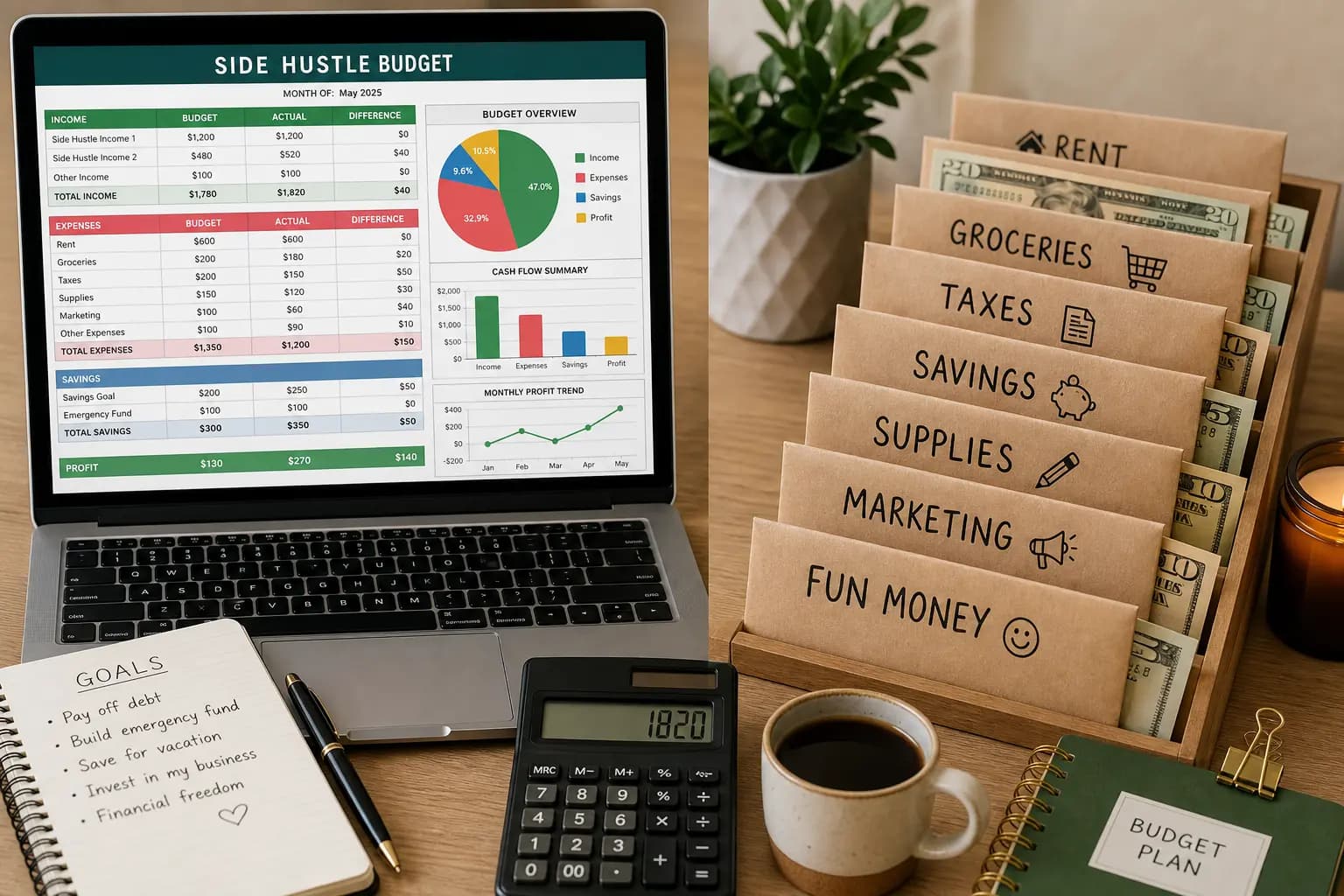
Executive Summary: Side hustle income offers real financial upside, but irregular cash flow makes traditional budgeting feel impossible. Most side hustlers earn an extra $500 to $3,000 per month yet still live paycheck to paycheck because they apply the same rules designed for salaried workers. This guide breaks down a step-by-step allocation system built specifically for side income: how to track unpredictable deposits, set aside the right percentage for taxes, build a buffer for slow months, and direct every extra dollar toward a specific goal. Follow this system and your side hustle becomes a predictable wealth-building engine instead of a source of constant financial anxiety.
Why Side Hustle Income Breaks Traditional Budgeting Rules
A regular paycheck follows a rhythm your brain can anticipate. You know roughly when money arrives, how much to expect, and can plan around fixed numbers. Side hustle income throws that predictability out the window. Some months you earn $800. Others you earn $2,400. And the month after that, a client delays payment and your deposit looks nothing like the previous one.
When you try to force a traditional budget onto irregular income, two things happen. First, you underestimate what you actually earned, so you spend more than you should. Second, you fail to capture the money that could be working for you, because it disappears into your checking account and blends in with your day-job income. The solution is not to budget differently in slow months. It is to build a system that absorbs every size deposit, predictable or not, and automatically directs it somewhere useful.
Step 1: Separate Your Side Hustle Income From Your Primary Paycheck
Before you can budget side hustle money, you need to see it clearly. Mixing it with your regular paycheck in a single account makes it impossible to track. Open a separate checking account specifically for side hustle deposits. When money arrives from a gig platform, freelance client, or product sale, it goes here first. Your day-job income stays in its own account and covers your fixed bills, rent, groceries, and regular lifestyle spending.
This separation does two things. It gives you a clean number to work with every time you open your side hustle account, and it creates an automatic pause between earning and spending. That pause is where all the smart decisions happen. When you log into your side hustle account and see $1,200 sitting there, you can consciously choose what to do with it instead of watching it disappear into a general fund.
- Open a free online checking account for side income only
- Redirect all gig platform payouts, freelance deposits, and product revenue to this account
- Label every incoming deposit with the source and date in your notes
- Transfer your fixed personal expenses to your primary account before touching side income
Step 2: Track Every Deposit With a Simple Income Log
You cannot budget what you do not measure. Build a basic income log using a spreadsheet or any budgeting app. Each row records the date, source, gross amount, and net amount of every side hustle deposit. Over time, this log tells you your average monthly side income, your highest and lowest months, and whether your side hustle is growing or shrinking.
If you have been freelancing for more than six months, look at your actual numbers before setting a budget. Calculate your average monthly side income over the last three months. Then set your budget using that average as your baseline, not your best month. Budgeting based on a $2,400 month when your average is $1,100 is how people end up overspending and feeling frustrated.
Step 3: Apply the 50/30/20 Rule for Irregular Income
The standard 50/30/20 rule allocates 50% of income to needs, 30% to wants, and 20% to savings. That framework still works for side hustle income, but the numbers shift when income is unpredictable. For side hustlers earning $500 to $3,000 per month on top of a salary, a more practical split looks like this: 10% goes straight to taxes, 15% builds your side hustle emergency buffer, 30% accelerates a specific financial goal like debt payoff or investing, and the remaining 45% returns to your general budget or lifestyle.
The key is automating these allocations the moment a deposit hits your side hustle account. Set up instant transfers to separate savings or investment accounts for each category. When the money moves automatically, you remove the temptation to spend it casually. You also remove the guilt of having it sit idle when it could be working harder.
- 10% of each deposit to tax savings account
- 15% of each deposit to side hustle emergency buffer fund
- 30% of each deposit to debt payoff, investing, or a specific savings goal
- 45% of each deposit to general budget or lifestyle upgrade
Step 4: Set Aside the Right Percentage for Taxes
One of the biggest financial surprises for side hustlers is a tax bill they were not prepared for. Unlike W-2 employees who have taxes withheld automatically, freelancers and gig workers are responsible for setting aside their own tax money. The IRS recommends freelancers save 25 to 30 percent of their freelance income for taxes.
The 10 percent allocation in the split above is a starting point. If you earn $1,000 in side income in a month, that is $100 set aside for taxes. If your total annual side hustle earnings push you into a higher tax bracket, or if you are in a state with income tax, you may need to increase that percentage. Use a simple tax calculator at the start of the year to estimate your actual liability based on projected side income and adjust accordingly.
Set up a separate high-yield savings account labeled Tax Buffer. Every time you receive a deposit, transfer your tax percentage there immediately. When quarterly estimated tax payments are due, you have the money ready instead of scrambling to find it. The IRS charges penalties for underpayment if you owe more than $1,000 at tax time and did not withhold enough throughout the year.
Step 5: Build a Side Hustle Emergency Buffer
Traditional financial advice suggests three to six months of expenses in an emergency fund. For side hustlers, that number needs to be higher, because your income is less stable. Your side hustle emergency buffer should cover at least three months of average side income, not three months of expenses. If you earn $1,200 per month on average from side work, aim for a buffer of $3,600 before you start directing extra money toward investments or big purchases.
This buffer serves two purposes. It replaces income during slow months when client work dries up, and it covers unexpected business expenses like equipment replacements, software subscriptions, or platform fees without disrupting your personal budget. Keep this money in a separate savings account that is not tied to your daily spending. It should feel slightly inconvenient to access, which keeps it protected from casual impulse decisions.
- Target: 3 months of average side hustle income in a dedicated savings account
- Contribute 15% of every deposit until the buffer is fully funded
- Do not touch it for personal expenses, only for side hustle income gaps or business emergencies
- Once funded, redirect the 15% allocation to your next financial goal
Step 6: Direct Extra Income Toward One Goal at a Time
The 30 percent allocated to a financial goal in the side hustle split should go to one target at a time. Trying to pay off debt, invest for retirement, and save for a home down payment simultaneously dilutes your focus and slows your progress on every front. Pick the goal that will have the biggest impact on your financial picture and attack it aggressively with your side income.
If you carry high-interest credit card debt, that is usually the best first target. Every dollar you put toward a 20 percent APR balance gives you a guaranteed 20 percent return, which is better than almost any investment you could make. Once that debt is gone, redirect those payments to the next goal. Snowballing in this way creates momentum that keeps you motivated as you watch debts disappear and goals get crossed off.
Frequently Asked Questions
- How do I budget when my side hustle income varies every month?
- Use your three-month rolling average as your baseline number. Do not budget based on your best month. Instead, cover your fixed expenses from your primary income and use your side hustle money exclusively for goals, taxes, and buffer contributions. In high-earning months, your buffer grows faster. In slow months, you do not feel pressure because your fixed costs are already covered.
- How much should I save for taxes as a freelancer or gig worker?
- Set aside 25 to 30 percent of every freelance payment. This covers federal income tax, self-employment tax, and state income tax if applicable. Put this money in a separate high-yield savings account and do not touch it until quarterly estimated tax payments are due. If you are in a higher income bracket or a state with significant income tax, increase that percentage to avoid a surprise bill at tax time.
- Should I treat my side hustle like a business for tax purposes?
- Yes. Keep detailed records of all income and expenses related to your side work. You can deduct legitimate business expenses like equipment, software subscriptions, platform fees, home office costs, and professional development. Track these in a separate business account and save receipts. This reduces your taxable income and makes tax time much less painful. Consider working with a tax professional in your first year to understand which deductions apply to your specific situation.
- How do I build an emergency fund for side hustle income gaps?
- Calculate three months of your average side hustle income. Save 15 percent of every deposit toward this goal until it is fully funded. Keep the money in a separate savings account that is not linked to your daily spending. This fund replaces income during slow months so you are never caught short when a client delays payment or a gig platform slows down.
- What is income smoothing and why does it matter for freelancers?
- Income smoothing is the practice of setting aside a portion of earnings during high-income periods to cover expenses during low-income periods. It keeps your spending consistent even when your income fluctuates month to month. The simplest way to smooth is to maintain a buffer fund and never let your monthly spending exceed your lowest realistic income month.
Side hustle income budgeting is not about restricting yourself. It is about building a system that makes every deposit feel productive instead of anxiety-inducing. Separate your accounts, track your numbers, automate your allocations, and watch your side hustle go from a unpredictable cash flow to a reliable wealth-building tool you can count on.
Take control of your money today
Start free with Spendmate — track expenses, plan budgets, and reach your financial goals.
Start free with Spendmate