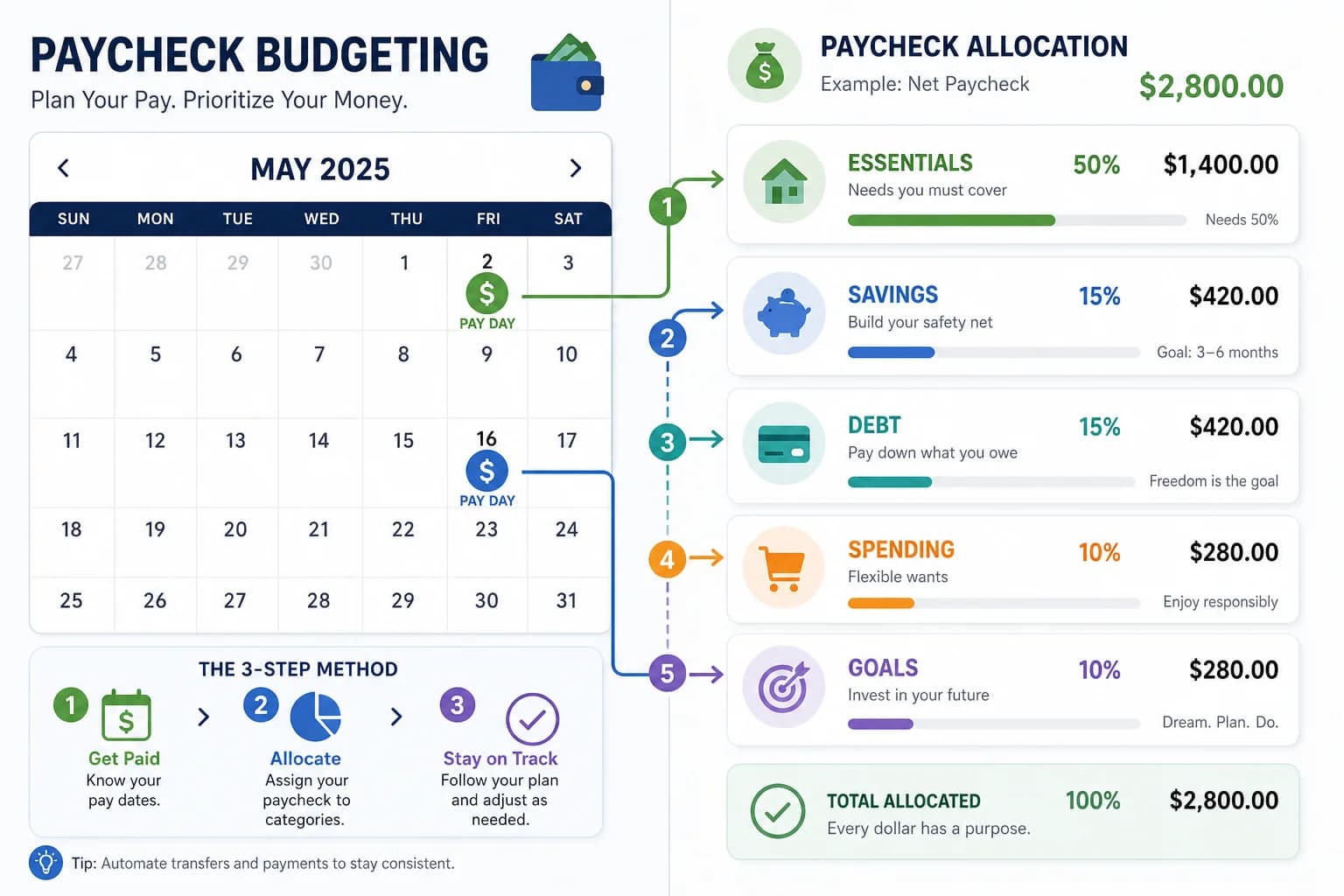
Monthly budgets assume you can predict an entire month of expenses. But life does not work that way. Your rent is due on the 1st. Your car insurance hits on the 15th. Your credit card payment lands somewhere in between. And your paycheck? It arrives every two weeks — not on a neat monthly schedule. This is why 63% of Americans live paycheck to paycheck, and why traditional monthly budgeting fails for most people. The paycheck budgeting method solves this. Instead of forecasting 30 days of spending, you budget what you have — right now, this paycheck — and allocate every dollar before the next one arrives. It is simpler, more realistic, and it works with your actual cash flow. This guide walks you through exactly how to implement the paycheck budgeting method for your specific pay schedule, whether you are paid weekly, bi-weekly, semi-monthly, or irregularly.
What Is the Paycheck Budgeting Method?
The Core Philosophy
The paycheck budgeting method flips the traditional budgeting model on its head. Instead of trying to predict an entire month of expenses — a task that requires predicting the unpredictable — you build your budget around each individual paycheck as it arrives. Every dollar gets a specific job before the next paycheck hits your account. No guessing. No forecasting. Just allocation based on real money you already have.
This works because it matches your spending system to your actual cash flow. If you are paid bi-weekly, your budget thinks in two-week cycles instead of 30-day blocks. If you are paid weekly, you budget in one-week windows. The method scales to any pay schedule — including irregular income from freelance or gig work — because you are always working with money you already have, not money you hope to have.
- Budget what you have, when you get it — not what you expect to have
- Align spending with actual cash flow instead of calendar months
- Treat each paycheck as its own mini-budget period
- No forecasting required — only allocating money that exists
- Works for weekly, bi-weekly, semi-monthly, and irregular pay schedules
How It Differs from Monthly Budgeting
Monthly budgeting forces you to predict expenses 30 days in advance. The paycheck budgeting method eliminates that pressure entirely. Instead of asking 'what will I spend this month?' you ask 'what does this paycheck need to cover before the next one arrives?' This reframe changes everything about how you allocate money.
Monthly budgets also tend to treat all income as fungible — the same dollar can pay rent one week and fund a savings goal the next. The paycheck method creates clearer boundaries: this paycheck pays these bills, that paycheck covers those expenses. For people who have tried monthly budgeting and felt constantly off-track, the paycheck method often feels like finally having a system that makes sense.
Take control of your money today
Start free with Spendmate — track expenses, plan budgets, and reach your financial goals.
Start free with Spendmate