
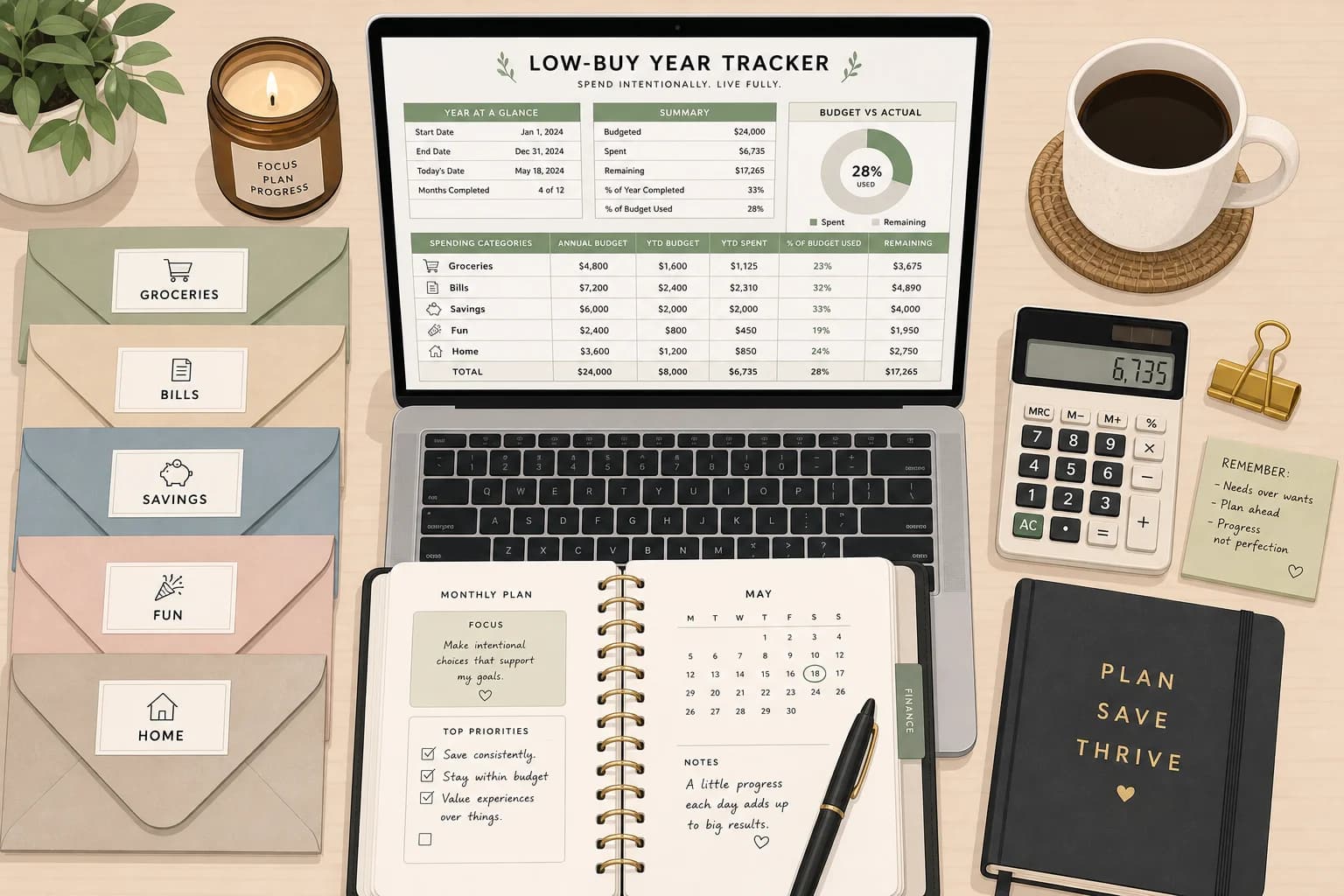
Imagine waking up a year from now with $6,000 more in your savings account, $0 in new credit card debt, and a completely different relationship with money. That is what a low-buy year can do. The low-buy year challenge is the fastest-growing budgeting trend in America—and for good reason. It is not about deprivation. It is about reclaiming control. In 2026, with inflation still squeezing household budgets and the average American spending $1,800/year on impulse purchases, the low-buy challenge offers a structured, sustainable way to cut spending without feeling like you are punishing yourself. This guide covers everything: rules, category breakdowns, a ready-to-use tracker template, and honest savings projections.
A low-buy year is a personal challenge where you set intentional limits on non-essential spending for 12 months. Unlike a no-buy year—which bans all non-essential purchases—a low-buy year allows flexibility within clear boundaries. Think of it as a personal spending framework, not a punishing restriction. The philosophy is rooted in anti-consumerism and mindful spending: every dollar you do not waste on things that do not genuinely improve your life is a dollar you can direct toward what actually matters to you.
The low-buy movement has gained massive traction on social media. On TikTok alone, #lowbuyyear has surpassed 800 million views, and #nobuyyear has crossed 1.2 billion views. Instagram, YouTube, and Reddit communities have grown proportionally, driven primarily by Gen Z and Millennials who are pushing back against lifestyle creep and searching for a more intentional relationship with money.
<3>Low-Buy vs No-Buy vs Spending FreezeBefore committing to a challenge, it helps to understand the differences between the three most popular approaches:
A low-buy year is that system — structure, accountability, and community all in one. If a no-buy year feels too extreme and a spending freeze feels too short, the low-buy year is your starting point.
<3>Why 2026 Is the Perfect Year for a Low-Buy ChallengeThe economic environment in 2026 makes the low-buy challenge more relevant than ever. Inflation, while lower than the 2022-2023 peak, still sits at 3.2% as of July 2026—meaning purchasing power is still eroded compared to pre-pandemic norms. Average credit card debt per household has climbed to $7,200, up 12% from 2024. The average American spends $1,800 per year on impulse purchases alone, according to McKinsey research. And 64% of Americans say they want to spend less but struggle to find a system that actually works.
A low-buy year is that system — structure, accountability, and community all in one. It turns vague intentions into specific rules and measurable outcomes.
<2>How to Set Up Your Low-Buy Year <3>Step 1 — Define Your WhyBefore setting a single rule or downloading a single tracker, get crystal clear on why you are doing this. What are you saving toward? A fully funded emergency fund? Paying off high-interest credit card debt using the debt snowball or avalanche method? A down payment on a home? A dream vacation? Travel rewards earned through smart spending? Your why is your anchor when temptation strikes at 10 p.m. on a Saturday. Write it down. Make it specific. Post it somewhere you will see every day.
<3>Step 2 — Audit Your Current SpendingYou cannot set meaningful limits without knowing where your money currently goes. Pull the last three months of bank and credit card statements and categorize every single expense. Separate essentials (rent, utilities, groceries, insurance) from non-essentials (dining out, streaming subscriptions, clothing, impulse Amazon buys, bar tabs).
Most people are shocked to discover their non-essential monthly spend is far higher than they estimated. Identify your biggest spending leaks—these are the categories where the low-buy rules will bite first. You might find that your subscription audit reveals five streaming services you barely use, or that $400/month goes to takeout coffee and lunch. The audit is not about shame; it is about data.
<3>Step 3 — Create Your Rules FrameworkThis is where the low-buy year gets specific. Use the Three-Tier System to categorize every type of spending:
<4>Tier 1: Always Allowed (Essentials)- Rent or mortgage and utilities
- Groceries (within a set monthly budget)
- Transportation (gas, public transit, car maintenance)
- Healthcare (insurance, copays, prescriptions)
- Debt minimum payments
- Insurance premiums
- Basic toiletries and household supplies
- Childcare and education expenses
- Dining out: 1x per week maximum, $30 limit per meal
- Clothing: Replace worn-out items only—no new fashion additions
- Entertainment: Keep a maximum of 2 streaming services; no new subscriptions
- Books: Library first; buy only if unavailable and truly needed
- Hobbies: Use existing supplies; buy new materials only when current stock is exhausted
- Gifts: Set an annual gift budget ($200-$500 total); plan ahead to avoid last-minute overspending
- Travel: 1 trip maximum; use points and miles; budget in advance
- New clothing for fashion purposes (not replacement of worn items)
- Home decor and non-essential furniture
- New tech or gadgets (unless your current device breaks down)
- Takeout coffee and specialty drinks
- Impulse Amazon purchases
- New subscription services
- Beauty treatments (manicures, facials, etc.)
- Alcohol at bars and restaurants
- New hobby equipment beyond replacement of exhausted supplies
- Collectibles and non-essential shopping
These rules are a starting framework—customize them to match your lifestyle, your budget, and your non-negotiables. Some people add a one splurge per quarter exception. Others make the dining-out rule stricter. Make it yours.
<3>Step 4 — Set Category-Specific BudgetsRules without dollar limits are incomplete. Here are example monthly budgets for each major category:
- Groceries: $500-$700 (meal planning is your best tool to stay within this)
- Dining Out: $120 (one outing per week, $30 cap) or $0 if pursuing a strict low-buy
- Gas/Transport: $200 (carpool or public transit to reduce if possible)
- Entertainment: $30 (one streaming service plus library access)
- Clothing: $0 for new fashion; $50 for replacements only
- Gifts: $25 per month (save for holidays and birthdays in advance)
- Personal Care: $50 (basic toiletries only)
- Miscellaneous: $50 (buffer for unexpected small expenses within rules)
These numbers are examples—your actual budget depends on your income, location, and family situation. Adjust accordingly, but be honest with yourself about where your spending leaks are.
<3>Step 5 — Set Up Your Tracking SystemA low-buy year without tracking is like budgeting without checking your account balance. Pick a system that you will actually use consistently:
- Spreadsheet (Recommended): Track date, category, item, amount, whether it was allowed, and notes. Review monthly to spot patterns and identify where you are slipping.
- Budgeting App: Use YNAB, EveryDollar, or Mint with custom low-buy categories. Set spending alerts for restricted categories to catch overspending early.
- Printable Tracker: Keep a physical tracker on your fridge or in your planner. Check off each day you stayed within rules. Visual streaks are highly motivating.
Whatever system you choose, schedule a weekly review and a monthly deep dive. Consistent tracking is what separates a low-buy year that works from one that quietly falls apart by March.
<2>How Much Can You Save? <3>Realistic Savings ProjectionsHere is what three types of spenders typically save over a low-buy year:
- Heavy Spender: $1,200/month in non-essential spending reduced to $300/month. Annual savings: $10,800.
- Moderate Spender: $700/month reduced to $200/month. Annual savings: $6,000.
- Light Spender: $350/month reduced to $100/month. Annual savings: $3,000.
The average person attempting a low-buy year falls somewhere between moderate and heavy spending and can expect to save between $5,000 and $7,000 over 12 months. That is enough to fully fund an emergency fund, make a significant dent in credit card debt, or accelerate progress on any savings goal.
<3>Where That Money Could GoThe real power of a low-buy year is not just the number in your savings account—it is what that money becomes:
- Emergency fund: A heavy spender can fund 72% of a $15,000 emergency fund in one year
- Roth IRA: A moderate spender can max out a $7,000 Roth IRA and still have $1,000 left over
- Credit card debt: A heavy spender can pay off $10,000 in debt in under 11 months
- Home down payment: A heavy spender saves $10,800 toward a $40,000 down payment—27% in year one alone
- Vacation: Even a light spender can fully fund a $3,000 vacation in one year without going into debt
For any non-essential purchase over $50, impose a mandatory 24-hour waiting period. Write it down—item, price, and why you want it. Come back the next day. Most impulse desires fade within 24 hours. If it does not fade, evaluate it against your rules framework. This single habit eliminates the majority of impulse buys that sabotage low-buy years.
<3>The One In, One Out RuleIf you buy something new in an allowed category, you must remove something similar from your life. New pair of running shoes? Donate an old pair. New book for your collection? Return or donate one you have already read. Without this rule, most people's Month 1 turns into a last hurrah — and the rest of the year suffers.
<3>Emergency Exception FrameworkLife happens. The low-buy year is not a contract that voids when something unexpected occurs. Here is how to handle real situations without derailing the challenge:
- Car breakdown: Essential repair is always allowed—use your emergency fund. This is exactly what it exists for.
- Wedding gift: Social obligation is real. Use your gift budget. Plan ahead to avoid last-minute overspending.
- Work conference travel: Professional necessity—allowed. Check if your employer will reimburse.
- Broken phone: Essential replacement—allowed. Consider buying refurbished or a budget model to stay within rules as much as possible.
- Family emergency travel: Life necessity—allowed without guilt.
- Birthday dinner for a friend: Allowed 1x per month with a $50 limit. Social connection matters.
One slip-up—a $40 Amazon impulse buy, a dinner out that was not in the plan—does not mean the challenge is over. Acknowledge it, note what triggered it, and continue. The goal is progress, not perfection. Track your slip days separately and aim to keep them under 5% of the year. If you slip 18 days out of 365, you are still succeeding 95% of the time. Most people who fail a low-buy year do not actually fail—they just stop tracking and give up. Do not be that person. Keep the spreadsheet going even when you make a mistake.
<2>Low-Buy Year Tips for Success- Start with a practice month. Try low-buy for 30 days before committing to a full year. If it feels sustainable, extend it. If it feels impossible, adjust your rules first.
- Tell your friends and family. Accountability dramatically increases success rates. When other people know what you are doing, they are less likely to pressure you to spend.
- Unsubscribe from marketing emails. Remove temptation at the source. A sale notification is an external trigger you do not need.
- Delete shopping apps from your phone. Add friction to impulse buying. If you have to get in your car to buy something, most impulses will pass before you bother.
- Find free alternatives. Library, parks, free community events, home workouts, YouTube instead of streaming—all of these replace paid entertainment without replacing the fun.
- Create a wishlist. Write down things you want but are not buying during the challenge. Review the list after 30 days. Most items will feel less compelling.
- Celebrate milestones. At 30, 90, 180, and 365 days, reward yourself within the rules. A nice dinner, a book you have been wanting to read—within budget, within rules.
- Join a community. Reddit r/nobuy, Facebook groups, and Discord servers are full of people doing the exact same challenge. Their wins and lessons are yours to learn from.
- Track your savings visually. Seeing the number grow is powerful motivation. A spreadsheet with a running total of money saved hits different when it crosses $1,000.
- Revisit your why monthly. Keep your goal front and center. Read your original motivation statement every time you sit down to do your monthly review.
The biggest mistake people make after completing a low-buy year is immediately returning to their pre-challenge spending habits. After 12 months of intentional spending, you have built new neural pathways. Do not undo them in two months. Transition gradually:
- Keep your tracking system. It is now a permanent financial tool, not just a challenge tool.
- Set a maintenance budget at 30-50% of your pre-challenge non-essential spending level.
- Gradually reintroduce one category at a time. Add dining out back in for one month before adding new clothing purchases.
- Notice the difference between I want this and I miss the dopamine hit of buying this. The former is a real desire; the latter is habit.
The biggest gains come from people who treat a low-buy year as a beginning, not a finish line. The long-term benefits of completing a full year are significant:
- Permanent reduction in impulse spending habits
- A clearer understanding of the difference between needs and wants
- A stronger emergency fund and higher savings rate
- Reduced financial anxiety and less money-related stress
- A more intentional, values-driven relationship with money
- The potential for a permanent lifestyle upgrade—not just a temporary restriction
Many people who complete a low-buy year find that they never return to their old spending levels. The awareness they gained about where their money was actually going was enough to change behavior permanently.
<2>Low-Buy Year FAQ- What is the difference between a low-buy year and a no-buy year?
- A low-buy year allows limited spending in specific categories with rules. A no-buy year bans all non-essential purchases for 12 months. Low-buy is more flexible and sustainable for most people; no-buy requires more discipline and suits experienced budgeters.
- How much money can I save with a low-buy year?
- Between $3,000 and $10,800 per year, depending on your habits. Most people save $5,000-$7,000. A heavy spender cutting $900/month in non-essential spending saves roughly $10,800 over 12 months.
- What are good low-buy year rules for beginners?
- Start here: no takeout coffee, no new clothing (replacements only), no impulse Amazon buys, dining out max once per week at $30, no new subscriptions. These four categories cover where most people's money actually goes.
- Can I still travel during a low-buy year?
- Yes—with limits. Set a travel budget upfront, use points and miles to cut costs, and cap yourself to one or two trips. Travel is the most common exception people build into their rules.
- What if I need something on my ban list?
- Use the 24-hour rule. Wait a full day. If it is a genuine replacement for something worn out, Tier 1 rules probably allow it. If it is a new want, try secondhand or borrowing first.
- How do I handle birthdays and holidays during a low-buy year?
- Set an annual gift budget—$200-$500 total—and buy ahead. Handmade gifts and experiences (dinner, concert, shared activity) often carry more meaning than expensive stuff anyway.
- Can I do a low-buy year with a partner or family?
- Yes, and it helps to have support. Align on shared categories like groceries and dining out. Each person keeps flexibility in personal spending. Compromise on the joint budget; stay flexible on your own categories.
- What if I have an emergency expense?
- Emergencies always override the rules. Car breaks down, family emergency, unexpected medical bill—handle it without guilt. That is what your emergency fund is for.
- How do I stay motivated for a full year?
- Track visually, find a community, celebrate milestones, and reread your why every month. One slip does not erase 29 good days. Consistency beats perfection — just keep tracking.
- What is the best way to track a low-buy year?
- A spreadsheet or budgeting app with custom categories matching your rules. Log daily or weekly, review monthly. Seeing your running savings total climb is genuinely motivating — that visual progress is half the reason people stick with it.
The low-buy year is not about perfection—it is about intentionality. Every dollar you choose not to spend is a dollar you are choosing to save, invest, or put toward something that actually matters to you. Whether you make it 30 days or a full 12 months, the skills you build around awareness, planning, and delayed gratification will outlast any single budget number.
Start with 30 days. See how much you save. Then decide if you want to keep going. Most people do.
Written by Saku Finance. This article is for informational purposes only and does not constitute financial advice. Consult a licensed financial advisor for guidance specific to your situation.
Take control of your money today
Start free with Spendmate — track expenses, plan budgets, and reach your financial goals.
Start free with Spendmate