
Do you know where your money goes each month? Most people don't. Small purchases add up fast—that daily coffee, the subscription you forgot about, the quick grocery run for just one thing. They all disappear unless you have a system.
Learning how to track expenses is not about restriction or guilt. It's about clarity. When you can see exactly where your money flows, you gain control. You can spot leaks, plan better, and stop the end-of-month panic of wondering where it all went.
This guide gives you a complete five-step system that beginners can start using today. By the end, you'll have a working expense tracker and a clear picture of your spending habits.
Expense tracking is the practice of recording everything you spend money on. Think of it as creating a map of your financial life. Instead of guessing, you have real data.
- You catch hidden spending. That $12 monthly subscription you forgot about? Over a year, that's $144. Small leaks sink budgets.
- You reduce anxiety. Money stress often comes from uncertainty. Knowing your numbers replaces worry with confidence.
- You build better habits. When you see patterns—like spending $300 monthly on dining out—you can make intentional choices.
- You prepare for budgeting. You cannot budget effectively until you know what you actually spend. Expense tracking is the foundation.
This five-step process takes about 30 minutes to set up and 10 minutes per week to maintain. It combines simplicity with consistency—the key to long-term success.
Start with the past 30 days of transactions. Log into your primary checking account, savings accounts, credit cards, and digital payment apps like PayPal or Venmo. Download statements or screenshots. You need a complete picture—every single transaction.
Pro tip: If you use cash, estimate your weekly cash withdrawals. You won't track individual cash purchases (that's too tedious for beginners), but you will account for the total withdrawn.
Categorize every transaction into two buckets. Fixed expenses stay the same each month: rent, insurance, loan payments, subscriptions, and consistent utilities. Variable expenses fluctuate: groceries, dining out, gas, entertainment, and shopping.
This split matters because you control variable expenses. Fixed expenses are harder to change quickly. When you need to adjust spending, you start with the variable category.
Create 6-10 categories that cover your life. Too many categories overwhelm beginners. Too few hide important patterns.
- Housing: rent, mortgage, utilities, maintenance
- Transportation: car payment, gas, insurance, public transit, rideshares
- Food: groceries, dining out, coffee, delivery apps
- Debt Payments: credit cards, loans (above minimums)
- Savings: emergency fund, retirement, goals
- Personal Spending: clothing, hobbies, subscriptions, entertainment
- Irregular/Annual: gifts, travel, medical, annual bills
You have three options, and the best one depends on your personality and lifestyle.
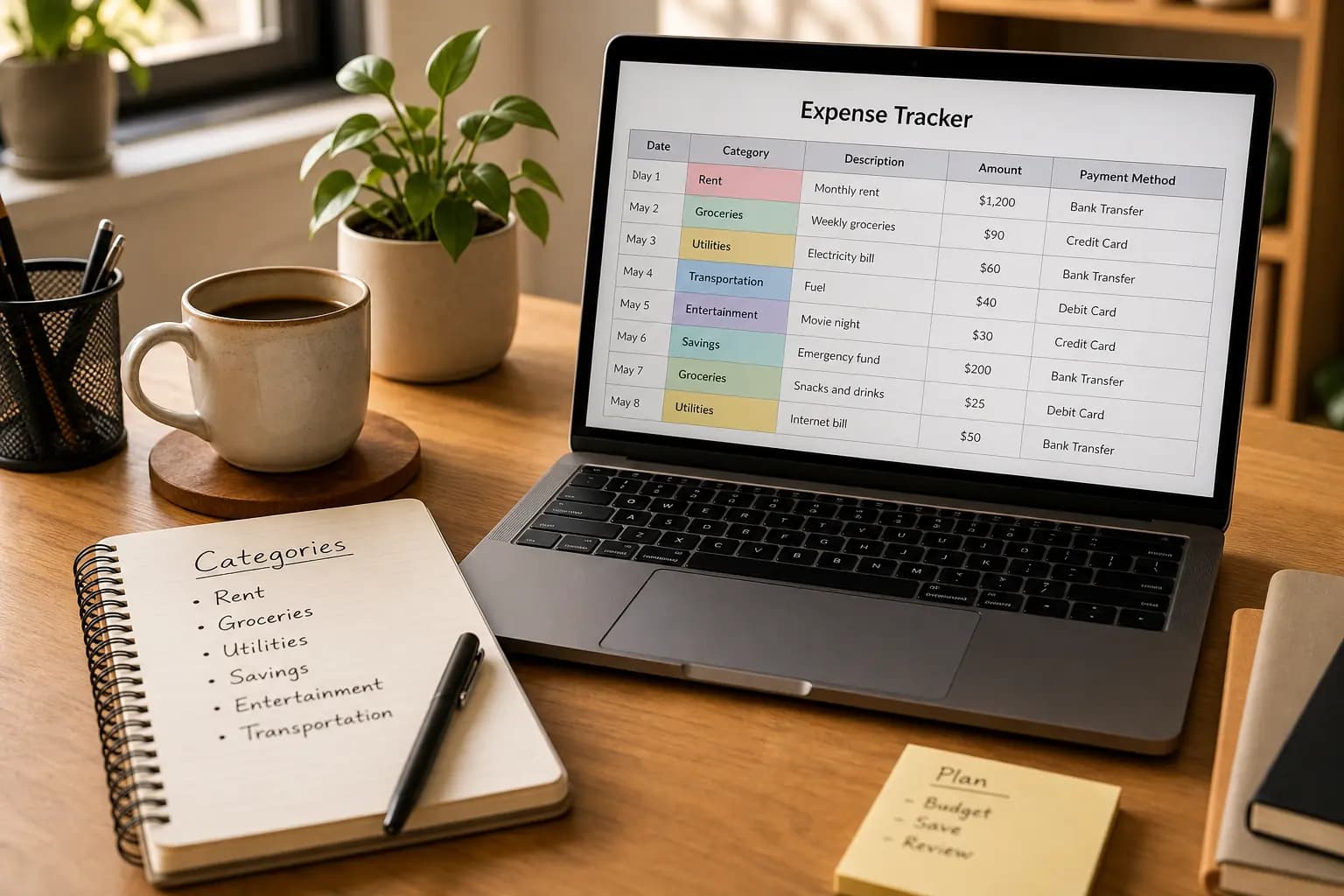
- Spreadsheet (Best for Detail-Oriented Beginners): Create a simple Google Sheet with columns for date, description, category, amount, and payment method. Free, customizable, works offline. Requires manual entry.
- Expense Tracking App (Best for Busy Beginners): Apps like Rocket Money, Monarch Money, or PocketGuard connect to your bank accounts and automatically categorize transactions. Automatic and always current, but may miscategorize.
- Manual Log (Best for Cash Spenders): Use a small notebook or notes app. Write down every purchase immediately. Forces mindfulness but easy to forget entries.
Tracking without reviewing wastes your effort. Build two review habits. Weekly review takes 10 minutes every Sunday: check last week's spending against expectations, note unusual expenses, and adjust the upcoming week. Monthly review takes 30 minutes on the first of the month: calculate totals per category, compare to the previous month, identify one area to improve, and celebrate one win.
- Tracking for one week and quitting: One week shows nothing meaningful. You need at least a month—preferably three—to see real patterns.
- Being too perfectionist: Missing one coffee purchase doesn't ruin your tracking. Estimate and move on. Progress beats perfection.
- Ignoring small purchases: It's just $5 adds up to $150 monthly if you say it 30 times. Track everything.
- Not tracking cash: If you withdraw $200 in cash, mark it as cash spending even if you don't know exactly what you bought.
- Never reviewing the data: Tracking without reviewing is like weighing yourself without looking at the scale. Schedule your weekly and monthly reviews.
- Making it too complicated: Twenty categories and color-coded charts look impressive, but they burn you out. Keep it simple.
Expense tracking and budgeting are different but connected. Tracking shows you where money went (past). Budgeting tells money where to go (future). You cannot budget accurately without tracking first.
- Month 1-2: Track only. Record everything. No judgment. Just data.
- Month 3: Analyze and adjust. Look at your averages. If you spent $450 on dining out, ask: Is this aligned with my values? Set a target.
- Month 4+: Transition to budgeting. Use your tracking data to create realistic budget categories.
A common guideline is the 50/30/20 rule: 50% for needs, 30% for wants, 20% for savings and extra debt payments. Your expense tracking data shows whether you currently hit these percentages.
- Day 1: Gather last month's statements and sort transactions into fixed vs. variable.
- Day 2: Create your categories and assign every transaction from last month.
- Day 3: Choose your tracking method (spreadsheet, app, or manual log) and set it up.
- Day 4: Start tracking today's expenses in real-time. Every single purchase.
- Day 5: Continue tracking. Check that your method works—adjust if needed.
- Day 6: Do a mini-review of the past three days. Any surprises?
- Day 7: Complete your first week. Calculate totals by category. Pat yourself on the back.
After 30 days, you will have enough data to spot patterns and make informed decisions.
Learning how to track expenses transforms your relationship with money. You stop guessing and start knowing. You replace financial anxiety with informed confidence. You build the foundation for budgeting, saving, and achieving your goals.
Remember: start simple, track everything, review weekly, and be patient. Habits take time, but the results last a lifetime.
Your first step? Gather this month's statements and spend 30 minutes categorizing. That's it. One small action today builds the system that changes your financial future.
Take control of your money today
Start free with Spendmate — track expenses, plan budgets, and reach your financial goals.
Start free with Spendmate