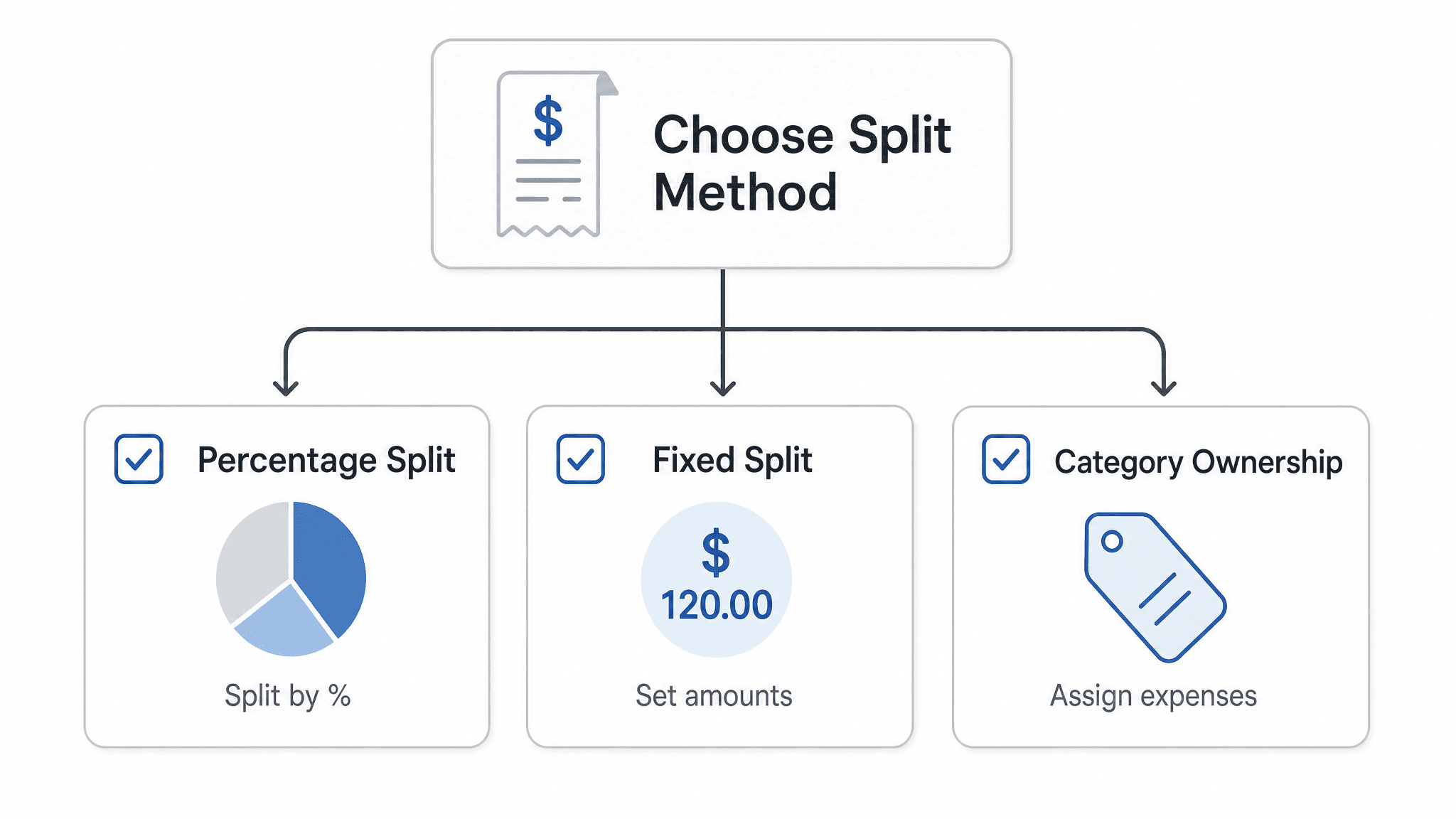
Splitting bills fairly is one of the most common financial challenges couples face. Should you split everything 50/50? Proportional to income? Or keep finances completely separate? There's no one-size-fits-all answer—but there is a decision framework that can help you find what works for your relationship.
This guide walks you through the key factors to consider, the most common bill-splitting methods, and how to choose the approach that feels fair to both of you.
Money isn't just math—it's tied to values, upbringing, and expectations. What feels fair to one partner might feel stressful or unequal to the other. The goal isn't perfect mathematical equality; it's finding a system that both of you can commit to without resentment.
**Key insight:** Fair doesn't always mean equal. The best bill-splitting method accounts for income differences, financial goals, and each partner's comfort level with money management.
Before deciding how to split bills, you need to understand each other's financial situation and priorities. Here's what to discuss:
- **Income:** What does each partner earn? Are there significant disparities?
- **Debt:** Does either partner have student loans, credit card debt, or other obligations?
- **Financial goals:** Are you saving for a house, retirement, travel, or emergency funds?
- **Spending habits:** Is one partner a saver and the other a spender?
- **Financial history:** How did your families handle money? What assumptions are you bringing into the relationship?
This conversation isn't about judgment—it's about understanding. You can't build a fair system without knowing where each of you is starting from.
Here are the four most common approaches couples use, along with when each works best:
Each partner pays exactly half of all shared expenses.
- **Best for:** Couples with similar incomes, no major debt disparities, and a desire for simplicity
- **Pros:** Easy to calculate, feels straightforward, no need to track income ratios
- **Cons:** Can feel unfair if one partner earns significantly less; may create stress for the lower earner
- **Example:** Rent $2,000, utilities $200, groceries $600 = $2,800 total → Each pays $1,400/month
Each partner contributes a percentage based on their share of the total household income.
- **Best for:** Couples with significant income differences who want to share financial burden equitably
- **Pros:** Feels fairer when incomes differ; reduces financial stress on the lower earner
- **Cons:** Requires more calculation; may feel complicated to track
- **Example:** Partner A earns $60k, Partner B earns $40k (total $100k). Partner A pays 60% of bills, Partner B pays 40%.
**How to calculate:**
- Add both partners' incomes: $60,000 + $40,000 = $100,000
- Calculate each partner's percentage: A = 60%, B = 40%
- Apply to total monthly bills: If bills are $3,000, A pays $1,800, B pays $1,200
Split some expenses 50/50, others proportionally, or keep certain bills separate.
- **Best for:** Couples who want flexibility or have different financial priorities
- **Pros:** Customizable; allows autonomy while sharing core expenses
- **Cons:** Requires clear communication about which bills are shared vs. individual
- **Example:** Rent and utilities split 50/50; groceries and entertainment split proportionally; student loans remain individual
All income goes into a joint account, and all bills are paid from there.
- **Best for:** Married couples or long-term partners who view finances as completely shared
- **Pros:** Simplifies bill-paying; eliminates mental math; builds financial unity
- **Cons:** Requires high trust; may feel like loss of autonomy for some
- **Example:** Both partners deposit paychecks into joint account; all household expenses, savings, and personal spending come from the same pool
Not sure which method to choose? Work through these questions:
- **1. What's our income ratio?** If it's close (within 20%), 50/50 might work. If it's wide, consider proportional.
- **2. Do we have major debt disparities?** If one partner has significant debt, a hybrid approach may be fairer.
- **3. What's our relationship stage?** Dating couples often prefer keeping some finances separate; married couples may lean joint.
- **4. What feels sustainable?** The best system is one you can stick with long-term without resentment.
- **5. Can we revisit this?** Your method doesn't have to be permanent. Life changes—incomes change, goals shift, and your bill-splitting approach can too.
**Decision tip:** If you're stuck between two methods, try one for 3 months, then check in. Adjust if it's not working.
Once you've chosen a method, make it easy to execute:
- **Open a joint account** (optional): Use it for shared expenses only, or for all finances if going fully joint
- **Use a budgeting app:** Apps like Splitwise, Honeydue, or a shared spreadsheet can track who pays what
- **Automate payments:** Set up autopay for recurring bills to avoid missed payments or mental load
- **Schedule monthly money check-ins:** 15 minutes once a month to review spending, adjust if needed, and stay aligned
- **Not talking about money early enough:** Don't wait until bills pile up to have the conversation
- **Keeping score:** Tracking every dollar can create resentment. Focus on the system, not individual transactions
- **Ignoring lifestyle differences:** If one partner wants luxury and the other prefers frugality, you'll need to negotiate
- **Forgetting to revisit:** Your financial situation will change. Build in regular check-ins to adjust your approach
**Ready to decide?** Download our Bill-Splitting Decision Worksheet to walk through these questions with your partner and choose the method that works best for your relationship.
**Bottom line:** There's no universally fair way to split bills—only what feels fair to you and your partner. By having an honest conversation, choosing a method that fits your situation, and staying open to adjustments, you can build a bill-splitting system that strengthens your relationship instead of straining it.
Take control of your money today
Start free with Spendmate — track expenses, plan budgets, and reach your financial goals.
Start free with Spendmate