
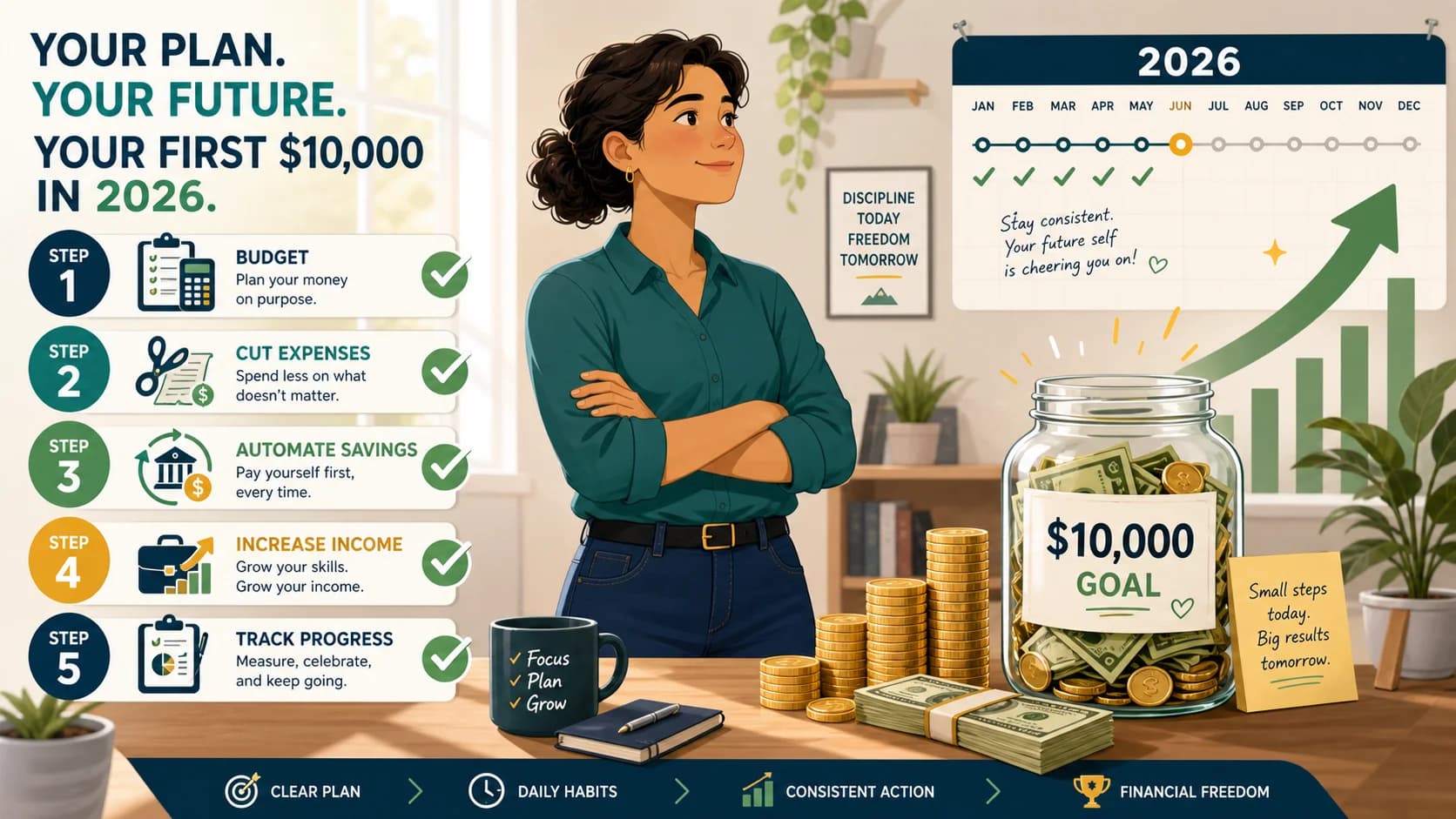
Saving your first $10,000 is the hardest financial milestone — and the most important. Here is exactly how to get there, no matter your income. With US personal savings rates hovering around 3.4% in 2026, most Americans cannot cover a $1,000 emergency. Reaching $10,000 puts you in the top 20% of American savers — and gives you genuine financial breathing room for the first time.
Why $10,000? (And Why It Matters More Than You Think)
The number $10,000 is not arbitrary. It is a financial milestone that actually changes your relationship with money. Here is why it matters so much:
- $10,000 = 3 months of expenses for the average American household, giving you a real emergency cushion
- $10,000 = career runway — enough to quit a toxic job, start a business, or fund a relocation without desperation
- $10,000 = down payment seed for a car, first home, or professional education that advances your earning power
- $10,000 = psychological proof that you can save, which makes every future savings goal feel more achievable
- $10,000 in a HYSA at 4.5% APY earns roughly $450 in interest per year — free money doing nothing
Context matters: most Americans have less than $1,000 in savings at any given time. Getting to $10,000 means you have out-saved roughly 80% of your country. That is not a small thing. That is a fundamental shift in your financial identity.
How Long Will It Take to Save $10,000? (Realistic Timelines)
The honest answer: it depends entirely on your savings rate, not just your income. Here is the math laid out clearly so you can find your starting point:
- $200/month = 50 months (4.2 years) — hard but doable on a $30,000–$40,000 income
- $400/month = 25 months (2.1 years) — moderate difficulty on a $40,000–$55,000 income
- $600/month = 17 months (1.4 years) — achievable on a $55,000–$70,000 income
- $833/month = 12 months (1 year) — comfortable pace on a $70,000–$90,000 income
- $1,667/month = 6 months — aggressive but possible on a $90,000+ income
What the data actually shows: the magic number is a 20% savings rate. A worker earning the US median household income of $65,000 and saving 20% of their take-home pay reaches $10,000 in approximately 18 months. This is the target to aim for. If that feels too far away, start wherever you can — even $100/month — and increase by 1% every time you get a raise.
Step 1: Know Your Numbers (The Savings Math)
Calculate Your Savings Rate
Your savings rate is the single most important number in this entire process. It tells you exactly how fast you are moving toward $10,000. The formula is simple: (Monthly Savings ÷ Monthly Take-Home Pay) × 100 = Savings Rate %. For example, if you take home $4,000/month and save $500, your savings rate is 12.5%. Most financial experts recommend starting at 10% and working toward 20% or higher.
Find Your Savings Gap
Once you know your current savings rate, calculate the gap between where you are and where you need to be. If you need $600/month to reach $10,000 in 17 months but are only saving $300, your gap is $300/month. You can close this gap three ways: earn more, spend less, or extend your timeline. All three are valid. Pick the mix that fits your life.
The 50/30/20 Rule (Modified for Savers)
The classic 50/30/20 budget allocates 50% to needs, 30% to wants, and 20% to savings and debt payoff. For your $10,000 goal, the 20% is your primary target. If 20% feels impossible right now, start at 10% and increase by 1% every single month. Small consistent increases compound just like interest.
Step 2: Open the Right Account (Where Your $10K Lives)
Where you keep your money matters almost as much as how much you save. The wrong account can cost you hundreds of dollars per year in forgone interest and make your money too easy to spend. A high-yield savings account — commonly called a HYSA — is specifically designed to help your money grow faster than a standard savings account, making it the smart choice for anyone serious about hitting $10,000.
High-Yield Savings Account (HYSA) — Best for $10K Goal
A HYSA is the obvious choice for your $10,000 emergency fund. Current APY rates in 2026 range from 4.00% to 5.00%, which means your money grows automatically while you sleep. It is FDIC insured up to $250,000, completely liquid, and earns you roughly $450 per year in interest on $10,000 at a 4.5% rate. Top options include Ally, Marcus by Goldman Sachs, SoFi, CIT Bank, and Capital One 360. If you already have a savings account that earns less than 4%, you are leaving free money on the table every single month — it is worth the 10-minute switch.
Compare the best high-yield savings accounts for 2026 to find the account that fits your goals and deposit amounts, or learn more about high-yield savings account strategies to maximize every dollar you save.
Money Market Account — Similar Rates, Slight Differences
Money market accounts offer comparable rates to HYSAs (4.00%–4.75% APY) and may include check-writing or a debit card. They are slightly less liquid in practice because money market accounts often have higher minimum balance requirements. For a $10,000 goal, a HYSA is typically the cleaner choice.
Certificate of Deposit (CD) Ladder — Advanced Option
A CD ladder involves splitting your savings across multiple CDs with staggered maturity dates — for example, four CDs at 3, 6, 9, and 12 months. This strategy locks in higher rates for portions of your savings while keeping some liquidity. The risk: early withdrawal penalties mean you lose access to money if you need it before the term ends. For your $10,000 goal, a HYSA alone is simpler and nearly as rewarding.
Step 3: Automate Your Savings (The Willpower-Free Method)
Here is the most important secret in all of personal finance: automation is everything. The moment you have to remember to transfer money to savings, you will eventually forget — or talk yourself out of it. Automation removes willpower from the equation entirely. When you pair automation with a high-yield savings account, your money earns 4–5% APY while you sleep — turning every paycheck into a step closer to $10,000.
- Pay yourself first: set up an automatic transfer that fires on payday, before you even see the money in your spending account
- Direct deposit split: ask your employer to send a fixed amount directly to your savings account with each paycheck
- Round-up apps: use Acorns, Qapital, or your bank's round-up feature to save spare change without thinking
- Savings challenges: try the 52-week challenge ($1/week in week 1, $2/week in week 2, up to $52/week — totaling $1,378 for the year) or the $5/day challenge ($1,825/year)
- Windfall rule: commit to saving 50% of any bonus, tax refund, or monetary gift — this alone can accelerate your $10K goal by months
Automation Example: $55,000 Income
If you earn $55,000/year and take home $3,600/month, here is what automation looks like: Payday 1st: $400 auto-transfers to your HYSA. Payday 15th: $400 auto-transfers to your HYSA. Total monthly savings: $800 at an 22% savings rate. Timeline to $10,000: approximately 12.5 months. Interest earned at 4.5% APY: roughly $250. The money saves itself.
Step 4: Earn More (The Fastest Path to $10K)
Here is a truth that does not get enough attention in personal finance advice: earning more is often faster than cutting expenses. If you can add $500/month in side income and save 100% of it, you reach $10,000 in 20 months. The same $500/month through expense cuts requires you to fundamentally alter your lifestyle — which is harder to sustain. Side hustles are not about deprivation. They are about leverage.
"The fastest path to a fully funded emergency fund is rarely through extreme frugality," says Michael Torres, a CFP professional with 12 years of experience advising early-career clients. "It is almost always a combination of automation plus one meaningful income increase — even $300/month changes the math."
- Gig economy (Uber, DoorDash, Instacart): $500–$1,500/month, 10–20 hours/week — flexible, instant pay
- Freelance (Upwork, Fiverr — writing, design, virtual assistant): $300–$2,000/month, 5–15 hours/week — scalable skill-based income
- Pet sitting / dog walking (Rover): $200–$800/month, 5–10 hours/week — enjoyable if you love animals
- Tutoring (online or in-person): $300–$1,000/month, 4–8 hours/week — high hourly rate, especially for math, science, or test prep
- Selling unused items (eBay, Facebook Marketplace, Poshmark): $200–$1,000 as a one-time burst — clean out your closet and fund your savings
- Part-time retail or restaurant work: $600–$1,200/month, 10–15 hours/week — steady, predictable income on evenings or weekends
Step 5: Cut Expenses Strategically (Not Deprivation)
Cutting expenses does not have to mean giving up everything you enjoy. The goal is surgical, strategic cuts that free up money without making you feel deprived — because deprivation leads to burnout, and burnout leads to quitting. The key distinction: cut things that do not add value to your life, not things that do.
High-Impact Cuts ($200–$500+/month)
- Housing: get a roommate, negotiate rent, or move to a lower-cost area — saves $200–$800/month
- Transportation: use public transit, bike, or carpool — saves $100–$400/month
- Insurance: shop rates every 6 months, bundle auto and renters — saves $50–$150/month
- Phone plan: switch to an MVNO carrier like Mint, Visible, or Tello — saves $30–$70/month
Low-Impact Cuts ($20–$100/month)
- Coffee: brew at home instead of buying daily — saves $40–$80/month
- Dining out: reduce from 4 times to 2 times per week — saves $60–$120/month
- Groceries: meal plan, buy store brands, use loyalty programs — saves $50–$150/month
- Alcohol and bars: cut back by half — saves $30–$100/month
- Gym: switch to home workouts or a budget gym — saves $20–$60/month
The 24-Hour Rule
For any non-essential purchase over $50, wait 24 hours before buying it. Most impulse purchases feel significantly less urgent after giving them a night to think. Studies suggest this simple habit alone can save $100–$300 per month for the average person. Keep a running list of wants, and revisit it monthly — you will find most items no longer feel worth it.
Step 6: Stay Motivated (The Psychology of Saving)
Why Saving Feels So Hard
Saving is not just about math — it is deeply psychological. Understanding why it feels hard is the first step to beating it. Present bias is the tendency to value money in your hand today over money you will have tomorrow, which makes saving for a distant goal feel abstract and unimportant. Lifestyle creep is what happens when your income rises and your spending rises to match, leaving your savings rate unchanged no matter how much you earn. Dopamine spending is how your brain's reward system lights up when you buy something new — it is literally addictive, which makes cutting back feel physically uncomfortable. The solution to all three: build systems that do the saving for you, so your brain does not have to fight itself every single payday.
I worked with a client — a graphic designer earning $58,000 — who had tried to save for two years without success. The problem was not math. It was psychology. Every time she logged into her bank app, she would see her savings and transfer some of it "just this once." We moved her savings to a separate HYSA with no debit card, and set up a $300/month auto-transfer. Eighteen months later, she had $5,800 — and she barely noticed the money was gone. The account change did what willpower could not.
Progress Tracking System
- Visual tracker: print a thermometer chart and color it in as you save — making progress visible is deeply motivating
- Milestone rewards: $1,000 = small treat at $20, $5,000 = bigger treat at $50, $10,000 = celebration at $100
- Accountability partner: share your goal with a trusted friend and check in weekly — social accountability works
- App tracking: use YNAB, EveryDollar, or a simple spreadsheet to track every dollar saved
- Monthly review: set a recurring calendar reminder to check your balance, review your progress, and celebrate wins
Real-World Scenarios — How Different People Save $10K
Scenario 1: Recent Grad, $42,000 Salary
Age 24, single, takes home $2,800/month, pays $1,200/month in shared rent, has $200/month in student loan payments. Strategy: automate $300/month to HYSA, earn $200/month from dog walking on Rover, cut dining out from $300 to $150/month. Total monthly savings: $500. Timeline to $10,000: 20 months (1.7 years). Interest earned: approximately $380. The takeaway from this scenario: one side hustle plus one spending cut creates $500/month without major lifestyle sacrifice.
Scenario 2: Family of 3, $65,000 Household Income
Age 34, married with one child, takes home $4,200/month, pays $1,600/month mortgage and $800/month daycare. Strategy: automate $200/month to HYSA, wife earns $400/month from freelance bookkeeping, cut unused subscriptions ($80/month) and reduce grocery waste ($100/month). Total monthly savings: $780. Timeline to $10,000: 13 months. Interest earned: approximately $280. What this family found: a dual-income household can accelerate savings significantly with even modest side income.
Scenario 3: Single Professional, $80,000 Salary
Age 29, single, takes home $5,000/month, pays $2,000/month in city rent, has no debt. Strategy: automate $800/month to HYSA, earns $300/month from freelance graphic design, reduces Uber Eats spending from $400 to $200/month. Total monthly savings: $1,100. Timeline to $10,000: 9 months. Interest earned: approximately $200. For this professional, the math worked out cleanly: a high savings rate from good income combined with one targeted spending cut reaches the goal in under one year.
Scenario 4: Low Income, $30,000 Salary
Age 27, single, takes home $2,000/month, pays $800/month rent, has some credit card debt. Strategy: first 6 months pay off credit card debt ($200/month), then automate $100/month to HYSA, earn $300/month from Instacart on weekends, switch to MVNO phone plan ($40/month saved), cook at home more ($100/month saved). Total monthly savings after debt payoff: $500. Timeline to $10,000: 20 months after the 6-month debt payoff = 26 months total. Interest earned: approximately $300. The key insight: at lower incomes, side hustle income is not optional — it is essential. Debt must be addressed first.
What to Do After You Hit $10,000
Reaching $10,000 is not the finish line — it is a waypoint. Here is how to keep the momentum going once you get there. If $10,000 covers 3 months of expenses, your next milestone is 6 months of expenses ($15,000–$20,000 for most households). If $10,000 is for a specific goal like a down payment or car, keep saving toward that target. Either way, do not stop — the habit you built to reach $10,000 will carry you to every financial goal that comes next.
- $10,000 → $15,000: add 2 more months of expenses to your emergency fund
- $15,000 → $25,000: start investing in a Roth IRA and capture any 401k employer match
- $25,000+: down payment fund, career investment, or aggressive investing
The $10,000 mindset shift is real. You now know you can save. You have a system that works. You have genuine financial breathing room. You are in the top 20% of American savers. The next $10,000 will be easier — and faster.
By David Chen — Personal Finance Writer at Shoninfox, covering savings strategies, emergency funds, and income optimization since 2021.
Common Mistakes to Avoid
- Waiting for the perfect time: there is never a perfect time to start. The best time to save was last month. The second best time is today.
- Trying to save what is left: always pay yourself first. If you wait until the end of the month to see what is left, there will never be anything left.
- Keeping savings in checking: a checking account earns 0% interest and makes your money too easy to spend. Keep your $10,000 in a HYSA.
- Being too aggressive: extreme restriction leads to burnout and quitting. Sustainable progress beats short-term intensity.
- Ignoring high-interest debt: if you have credit card debt above 15% APR, address it before aggressively saving.
- Not celebrating milestones: saving is genuinely hard. Reward progress at $1,000, $2,500, $5,000, and $10,000.
- Comparing your journey to others: your income, expenses, and life circumstances are unique. Your only comparison is yesterday's version of yourself.
FAQ — Saving Your First $10,000
How long does it take to save $10,000?
It depends on your monthly savings. At $200/month: 50 months (4.2 years). At $400/month: 25 months (2.1 years). At $833/month: 12 months. At $1,667/month: 6 months. The average American saving 10% of a $65,000 salary reaches $10K in about 18 months.
How much do I need to save per month to reach $10,000 in a year?
$833/month. If you earn $65,000/year ($4,200/month take-home), that is a 20% savings rate — achievable with a side hustle or significant expense cuts.
Is $10,000 enough for an emergency fund?
For the average American household spending $5,000/month, $10,000 covers 2 months of expenses. Most financial experts recommend 3–6 months ($15,000–$30,000). $10,000 is an excellent starting point and a genuine milestone.
Where should I keep my $10,000 savings?
A High-Yield Savings Account earning 4.00%–5.00% APY. Top options include Ally, Marcus by Goldman Sachs, SoFi, CIT Bank, and Capital One 360. Avoid regular savings accounts (0.01% interest) and checking accounts.
How can I save $10,000 on a low income?
Focus on earning more through a side hustle rather than extreme expense cutting. A $30K earner who saves $500/month through a combination of side income and modest cuts reaches $10K in 20 months. Automate, use a HYSA, and celebrate every small win.
Should I save $10,000 or pay off debt first?
If your debt is high-interest (credit cards above 15% APR), pay it off first. For low-interest debt (student loans, mortgage), save a $1,000 starter emergency fund, then balance debt payoff and saving.
What if I can only save $100/month?
Start there. $100/month = $1,200/year. It will take 100 months (8.3 years) to reach $10K at that rate. Focus on increasing income or reducing expenses to accelerate. The habit of saving matters more than the amount.
How does inflation affect my $10,000 savings goal?
With 3% annual inflation, $10,000 today is worth approximately $9,700 in one year. A HYSA earning 4.5% APY outpaces inflation, preserving and growing your purchasing power. This is why keeping your $10K in a HYSA is critical.
Should I invest my $10,000 instead of saving it?
No — $10,000 is a short-term savings goal and should be kept fully liquid and safe. Invest only after you have 3–6 months of expenses saved and no high-interest debt.
What is the fastest realistic way to save $10,000?
Combine a side hustle earning $500–$1,000/month with aggressive but sustainable expense cuts of $300–$500/month. At $1,500/month in total savings, you reach $10K in approximately 7 months.
Take control of your money today
Start free with Spendmate — track expenses, plan budgets, and reach your financial goals.
Start free with Spendmate