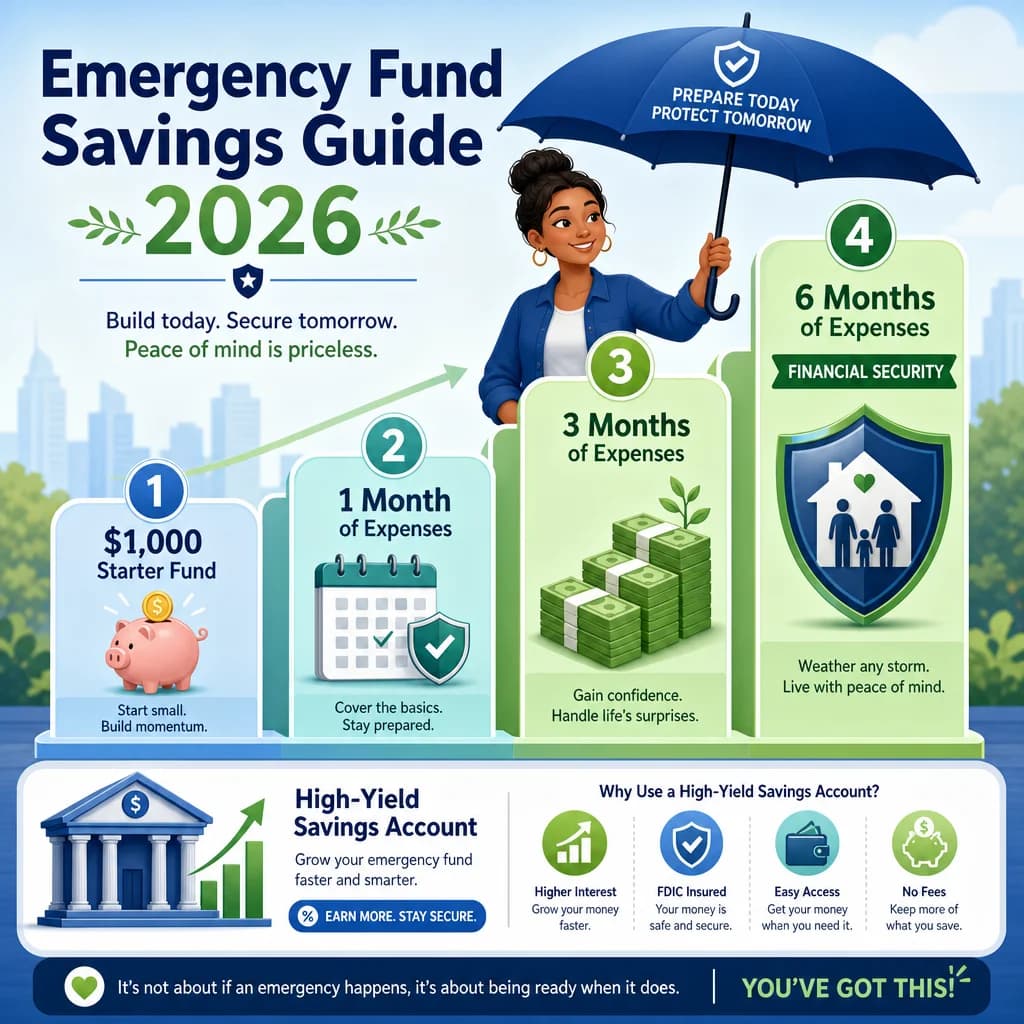
Only 41% of Americans can cover a $1,000 emergency without borrowing. If you are living paycheck to paycheck, the idea of building an emergency fund may feel like a distant dream — but it is more achievable than you think. This guide walks you through a realistic, step-by-step process to build your starter fund and scale it into meaningful financial security, even on a limited income.
Why You Need an Emergency Fund (And Why It Feels So Hard to Start)
An emergency fund exists for one purpose: to catch you when something unexpected happens. A medical bill, a car breakdown, a sudden job loss — these events do not announce themselves, and they rarely come at a convenient time. Without a financial cushion, you end up relying on credit cards or high-interest loans, which deepens the cycle of debt.
The challenge is real. Most households earning under $60,000 per year report that covering a $1,000 expense would require borrowing or selling something. The psychological weight of not having a safety net also creates decision fatigue — every purchase becomes loaded with anxiety because you know you have no backup plan.
The good news: you do not need a high income to start building an emergency fund. You need a realistic system, a clear target, and the willingness to start small. The $1,000 starter fund is a proven first milestone because it is large enough to handle most minor emergencies, yet small enough to reach within a few months for most people.
The Psychology of Starting: Overcoming the "I Cannot Save" Mentality
Before diving into tactics, it is worth addressing the mental barrier. Many people assume they cannot save because their income is too low or their expenses are too high. But research on savings behavior consistently shows that the primary obstacle is rarely a lack of income — it is a lack of systems and mindset.
- Reframe savings as a non-negotiable expense, not an afterthought. If you wait until the end of the month to save whatever is left over, nothing will be left.
- Separate your emergency fund from your spending account. Out of sight truly does mean out of mind.
- Start with an amount so small it feels almost pointless — $10 or $20 per paycheck. The goal is to build the habit before you scale up.
- Track every small win. Seeing your balance grow — even by $50 — changes your relationship with money.
The psychological shift from "I cannot do this" to "I am doing this" is more powerful than any specific savings strategy. Small wins compound. A $500 emergency fund today is the foundation for a $3,000 fund six months from now.
Step 1: Set a Clear Target — Your $1,000 Starter Fund
Vague goals produce vague results. "Build an emergency fund" is not a target — it is a direction. A concrete milestone keeps you motivated and gives you a clear stopping point before you move to the next phase.
The $1,000 starter fund is the most recommended first milestone for several reasons:
- It covers the majority of minor emergencies: a flat tire, a medical co-pay, a appliance repair.
- It is achievable for most income levels within 2 to 6 months.
- It provides meaningful psychological relief — you now have a backup plan, even if it is small.
- It creates the behavioral infrastructure to save more later.
How long it takes depends on your situation. If you can save $50 per week, you will reach $1,000 in five months. If you can save $100 per week, you will get there in ten weeks. Even $25 per week — roughly $100 per month — gets you to $1,000 in ten months. The exact timeline matters less than simply starting.
Step 2: Find the Money — Where Your Starter Fund Actually Comes From
This is where most people get stuck. They look at their budget, see no room for savings, and give up. The problem is not that there is no money — it is that the money is being allocated to things that feel less urgent than an emergency fund actually is.
Audit your spending for one month
Before you can redirect money toward savings, you need to know where it is going. Track every expense for 30 days using your bank statement, a spreadsheet, or a budgeting app. You do not need to judge yourself — you just need data.
Identify three to five areas to trim
Most budgets have obvious leakage once you look closely. Common sources of found money include:
- Subscription services you forgot about — streaming, apps, gym memberships.
- Dining out or coffee spending that can be reduced by 50%.
- Impulse purchases under $30 that add up to $150 per month.
- Unused insurance add-ons or duplicate coverage.
- Cell phone plans that have outdated pricing — most carriers have newer, cheaper plans available.
You do not need to eliminate everything. Cutting $60 to $80 per week from your discretionary spending is enough to fund $240 to $320 per month toward your emergency fund. That is a $1,000 starter fund in three to four months.
Automate the transfer
Once you have identified the money, set up an automatic weekly or bi-weekly transfer from your checking account to your emergency fund savings account. Automation removes willpower from the equation. The money moves before you have a chance to spend it.
Step 3: Choose the Right Account — Keep It Accessible But Not Too Easy
Where you keep your emergency fund matters almost as much as how much you contribute to it. The ideal account meets three criteria:
- High yield — you should earn competitive interest while you build the fund.
- FDIC insured — your money is protected up to $250,000.
- Not linked to your daily spending — reduces temptation to dip into it for non-emergencies.
A high-yield savings account (HYSA) is the standard recommendation for emergency funds. As of 2026, many HYSAs offer 4.00% to 5.00% APY, which means your money actually grows while it sits. Online banks typically offer the best rates because they have lower overhead than traditional banks.
Avoid keeping your emergency fund in a checking account where it blends in with your spending money. Physically separating it — even in a different institution — creates enough friction to prevent casual use while keeping it accessible within one to two business days when you actually need it.
Step 4: Define What Counts as an Emergency — Before You Need It
One of the most common reasons people exhaust their emergency fund is that they did not define what it was for in advance. Without a clear definition, almost anything can feel like an emergency — a sale, a vacation, a new gadget on sale.
Set your own rules before you need to make a decision in a moment of stress. A useful framework:
- It must be unexpected — not a recurring expense you could have anticipated.
- It must be necessary — not a want disguised as a need.
- It must be urgent — delaying action would cause meaningful harm.
- It must be unavailable from another source — your emergency fund is not the first option if savings, side income, or community resources can cover it.
Examples of legitimate emergencies: job loss, medical emergency, major home repair (burst pipe, HVAC failure), essential car repair. Examples that are not emergencies: holiday gifts, vacation, routine car maintenance, shopping sales, debt payoff.
Step 5: The Transition — Moving from $1,000 Starter to 3 to 6 Months of Expenses
Once you have your $1,000 starter fund, you have a foundation. The next milestone is bigger and requires a different approach. Financial experts generally recommend saving three to six months of essential living expenses — not income — for a fully funded emergency reserve.
Essential expenses include: housing (rent or mortgage), utilities, food, transportation, insurance, minimum debt payments, and any other non-negotiable costs. Exclude discretionary spending like dining out, subscriptions, and entertainment.
For a household spending $3,500 per month on essentials, a three-month reserve is $10,500 and a six-month reserve is $21,000. That sounds daunting, but the strategy for reaching it is the same as the one that got you to $1,000: small, consistent contributions plus systematic increases whenever your income rises.
Increase contributions with every raise or windfall
When you get a raise, do not increase your lifestyle spending. Instead, route 50% of the additional income to your emergency fund until it is funded. This approach — called "paying yourself first" — is how most people who have real financial security built it.
Keep the goal visible
Write your target on a sticky note. Put it somewhere you will see it daily. The behavioral science is clear: people save more when they have a specific, visible goal with a progress indicator. Your emergency fund is not just a financial tool — it is a source of genuine peace of mind.
Emergency Fund vs. Paying Off Debt — Which Comes First?
This is one of the most common questions people ask when building an emergency fund: should I focus on saving or on paying off high-interest debt? The answer depends on the type of debt and your employment stability.
General guidance for 2026:
- If you have high-interest credit card debt (above 15% APR), prioritize paying it down aggressively while maintaining a minimum $500 emergency fund.
- If you have stable employment and can cover a three-month fund, you can balance debt payoff and continued savings simultaneously.
- If your job is unstable or you work in a commission-based or gig-based role, prioritize building a full three-month reserve before aggressively paying down debt.
- Student loan and mortgage debt at low interest rates do not require aggressive early payoff at the expense of an emergency fund.
The underlying principle: debt is expensive, but an inadequate emergency fund is often more expensive in the long run. An unexpected layoff while you have zero savings and $10,000 in credit card debt is a much worse situation than having $5,000 in savings and $10,000 in credit card debt.
What If You Lose Your Income While Building Your Fund?
If you are building your emergency fund and you lose your income before it is fully funded, the worst thing you can do is panic and use the fund for non-essentials. Instead:
- File for unemployment immediately if you are eligible — this is the fastest way to replace income.
- Cut all discretionary spending to the absolute minimum: food, shelter, utilities, transportation.
- Use your partially built emergency fund for essentials only while you look for new income.
- Avoid taking on new debt during a job search — credit card debt during unemployment is a trap.
- Reach out to community resources: food banks, utility assistance programs, rental assistance — these exist specifically for people in your situation.
Having $1,000 or $2,000 in your fund during a job loss does not solve the problem, but it buys you time. Time to find a new job without accepting the first offer that comes along. Time to negotiate from a position of relative stability rather than desperation.
The Bottom Line: Start Today, Start Small
Building an emergency fund from scratch is not about finding extra money you do not have. It is about making the decision to prioritize a financial safety net, then building the systems that make it automatic. You do not need a high income to start. You need a $10 or $20 transfer this week.
The path from zero to a $1,000 starter fund to a three-month reserve is not a straight line — it has setbacks, plateaus, and moments where you wonder if it is worth it. But the data is consistent: people who maintain an emergency fund experience significantly less financial stress, make better career decisions, and recover from unexpected events faster than people who do not.
Your next step is simple: open a high-yield savings account today, set up a $20 automatic weekly transfer, and commit to the process. In three months, you will have roughly $240. In six months, you will have around $500. By the end of the year, you could have your $1,000 starter fund — and a completely different relationship with your money.
Take control of your money today
Start free with Spendmate — track expenses, plan budgets, and reach your financial goals.
Start free with Spendmate