
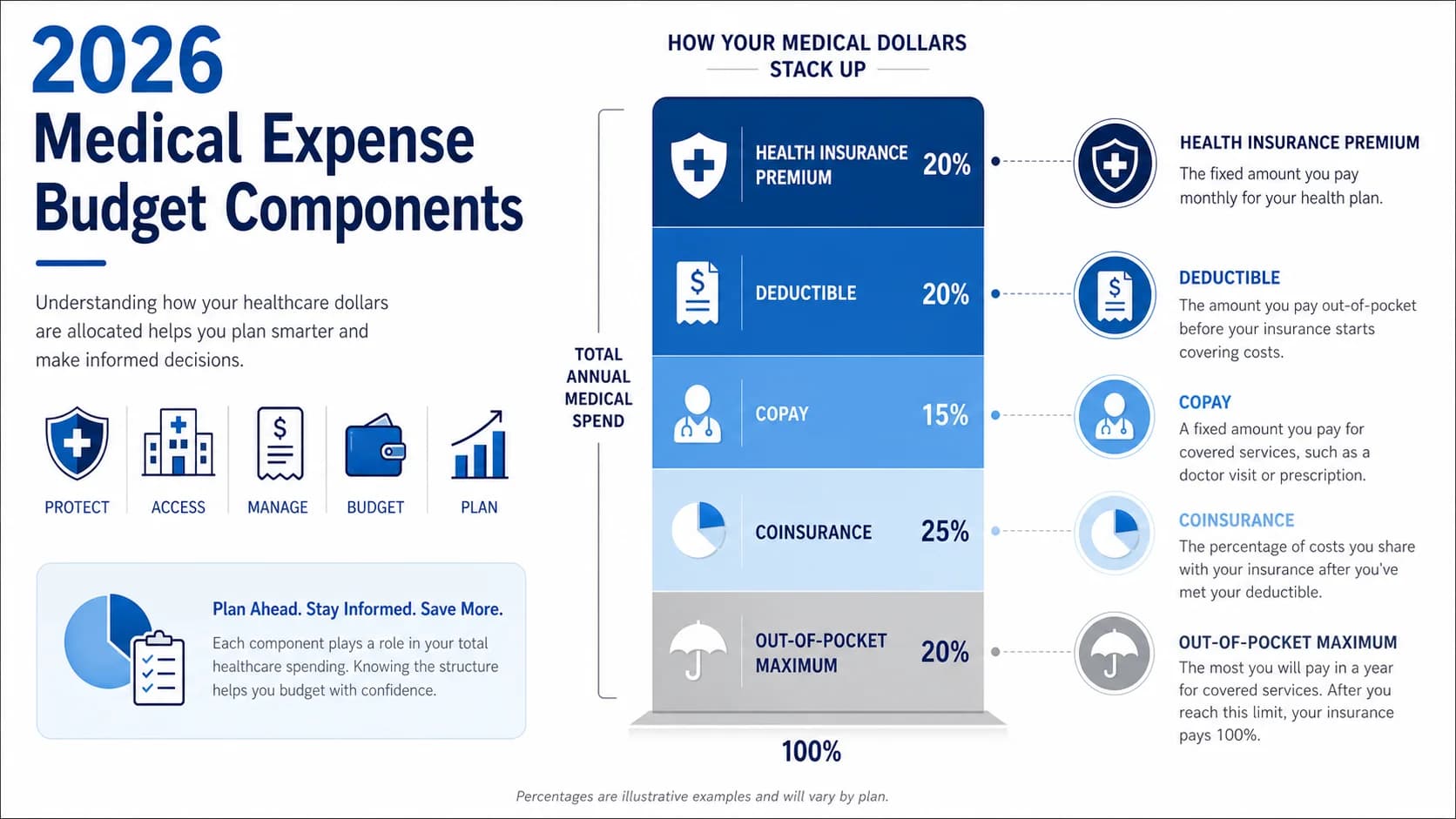
Executive summary: Medical expenses are one of the most unpredictable yet guaranteed costs in American life. With average family deductibles now exceeding $6,500 and out-of-pocket maximums surpassing $18,000 for families, understanding how to budget for medical expenses is no longer optional—it is essential financial planning. This guide provides a complete framework for estimating your annual healthcare costs, setting up sustainable monthly savings through HSA and FSA accounts, and preparing for unexpected medical bills without falling into debt.
Why Medical Expense Budgeting Matters in 2026
The reality of US healthcare costs in 2026 demands proactive financial planning. Average family deductibles have reached $6,500 or higher, prescription drug costs continue climbing 8-12% annually, and surprise billing remains a threat despite federal protections. According to the KFF 2026 Employer Health Benefits Survey, the average individual deductible now sits above $2,800—amounts that can derail a family budget without warning.
Traditional financial advice often falls short here. "Just use your HSA" assumes you have a high-deductible health plan. "Save $10,000 for emergencies" feels unrealistic for most households. Meanwhile, research from the American Journal of Public Health shows that 66.5% of bankruptcies in America remain tied to medical issues. The mindset shift required is simple: medical expenses are not optional—they are guaranteed life events that deserve their own line item in your budget.
Real People, Real Numbers: Case Studies in Medical Budgeting
Maria, a 34-year-old graphic designer in Austin, Texas, thought she was prepared. She had a $500/month premium, a $3,000 deductible, and $2,000 in her HSA when she was diagnosed with a torn ACL in March 2025. Between the MRI ($1,800), arthroscopic surgery ($14,000), six months of physical therapy ($3,600), and a $4,500 out-of-pocket maximum hit, her total out-of-pocket cost reached $11,900 in one calendar year. Her HSA covered the first $2,000. The remaining $9,900 came from her emergency fund. Without prior budgeting, she would have charged it to a credit card at 22% APR.
James and Priya, a couple in their late 40s outside Cleveland, Ohio, carry a family plan with a $6,800 deductible and $16,000 out-of-pocket maximum. In 2025, Priya was diagnosed with early-stage breast cancer. Their total treatment cost (surgery, chemotherapy, radiation, follow-up medications) exceeded $280,000. Insurance covered the bulk of it, but their out-of-pocket responsibility still hit $16,000 (the family OOP max). They had budgeted $700/month for medical expenses and built a dedicated $14,000 medical emergency fund over three years, which covered the OOP max with $2,000 left over. Their only regret: not budgeting for it sooner.
The pattern is consistent: without a dedicated medical sinking fund, even well-insured families face five-figure bills they were not expecting. These are not edge cases—they are the norm in American healthcare.
Step 1 — Understand Your Insurance Coverage
Before you can budget effectively, you need to understand what you are actually paying for. Most Americans have heard terms like "deductible" and "copay" but could not explain the difference. Here is the essential breakdown: your premium is the fixed monthly payment for having insurance coverage. Your deductible is the amount you pay out-of-pocket before your insurance starts sharing costs. Copays are fixed fees per service (like $30 for a doctor visit), while coinsurance is the percentage you pay after meeting your deductible.
The most critical number to know is your out-of-pocket maximum—the absolute most you will pay in a given year before insurance covers 100% of costs. For 2026, this typically means $9,000+ for individual plans and $18,000+ for family plans. Calculate your worst-case annual exposure using this formula: Premium × 12 + Out-of-Pocket Maximum. For example, a $450/month premium with a $9,000 OOP max means worst-case spending of $14,400 per year, or $1,200 monthly. Use this number for stress-testing, not for your actual monthly budget.
Step 2 — Calculate Your Expected Annual Medical Costs
Expected medical expenses fall into predictable categories that repeat annually. For most adults, this includes an annual physical ($150-300, often $20-50 with insurance copay), dental cleanings ($200-400 annually), eye exams and vision correction ($200-600 yearly), and any prescription medications. If you have chronic conditions like hypertension ($400-1,200 annually for medications alone) or Type 2 diabetes ($1,500-4,000 annually), these must factor prominently into your estimates.
Age significantly impacts medical costs. A healthy 20-something typically spends $800-1,500 annually on healthcare, while someone in their 50s can expect $3,500-7,000+ when accounting for increased screenings and specialist visits. Families with children should budget $5,000-10,000 annually, as children bring elevated ER visits, urgent care needs, and vaccination costs. Building an emergency fund is equally important—our guide on how to build an emergency fund from scratch provides actionable steps for creating that financial cushion alongside your medical savings.
Step 3 — Set Up Your Monthly Medical Budget
The most effective approach converts annual costs into monthly savings through a technique financial experts call the sinking fund method. Simply divide your expected annual medical costs by 12 to determine your monthly savings target. If you expect $3,600 in annual medical costs, that translates to $300 per month—a much more manageable figure than facing a $6,500 deductible bill unprepared.
Where you store these funds matters enormously. A Health Savings Account (HSA) offers the most advantages if you have a high-deductible health plan: triple tax benefits (contributions are pre-tax, growth is tax-free, withdrawals for medical expenses are tax-free), funds that roll over indefinitely, and investment potential once your balance exceeds $2,000. For 2026, HSA contribution limits are $4,300 for individuals and $8,550 for families. If you do not have an HSA-eligible plan, a Flexible Spending Account (FSA) through your employer allows up to $3,200 in pre-tax contributions annually, though these typically use-it-or-lose-it provisions.
HSA vs FSA: Which Should You Use?
If you have a high-deductible health plan (HDHP), you may be eligible for both an HSA and an FSA. Here is how they compare on the factors that matter most:
The bottom line: if you have an HSA-eligible HDHP, max out your HSA first. It is the most powerful tax-advantaged account in the US healthcare system, and unlike the FSA, your money does not disappear at year-end. Our guide on best high-yield savings accounts covers where to store your HSA funds for maximum growth.
Step 4 — Optimize Your Healthcare Spending
Strategic healthcare choices can save thousands annually. Always verify provider network status before non-emergency care—using an out-of-network provider can mean paying 40-60% coinsurance instead of your plan standard 10-30%, plus facing balance billing where the provider charges the difference between their rate and your insurer allowed amount. For prescription drugs, GoodRx and SingleCare often provide lower cash prices than insurance copays, especially for generic medications available on $4 lists at major retailers.
Before any procedure, request the CPT code and shop prices across facilities. Independent imaging centers frequently charge 50-70% less than hospital-based facilities for the same MRIs or CT scans. Always ask: Is this provider in-network? What is the CPT code for price comparison? Can I get a discount for paying in full? These three questions alone can reduce a $3,000 imaging bill to under $1,000 with some negotiation.
Step 5 — Handle Unexpected Large Medical Bills
Even with careful planning, surprise bills happen. When they do, the worst thing you can do is ignore them. Unpaid medical bills go to collections and damage your credit score. Instead, request an itemized statement immediately—billing errors occur in over 80% of medical bills according to the Medical Billing Advocates of America. Verify the claim was processed correctly by your insurance and check whether the No Surprises Act protects you from balance billing on emergency services or out-of-network providers at in-network facilities.
Negotiation works. When calling about a bill, use this script: "Hi, I received a bill for $[amount]. I do not have the ability to pay this in full. Do you offer any financial assistance programs or self-pay discounts? I can pay $[offer 30-50% of bill] immediately if we can settle the account." Many hospitals have charity care policies required by federal law for patients earning up to 400% of the federal poverty level. Patient Advocate Foundation also provides free negotiation assistance for anyone facing medical billing disputes.
Step 6 — Build Your Medical Emergency Fund
Your general emergency fund covers job loss and unexpected car repairs, but medical catastrophes require separate preparation. A single air ambulance ride can cost $40,000-80,000 and may not always be covered by insurance. Cancer treatment (even with solid insurance coverage) can mean $5,000-50,000 in out-of-pocket costs. Recommended reserves vary by situation: a healthy single person with a low deductible might need $3,000-5,000, while a family with a high-deductible plan and chronic conditions should target $12,000-20,000.
Store this fund in a high-yield savings account (currently earning 4-5% APY in 2026) or money market fund—liquidity matters more than returns when you might need these funds suddenly. Build gradually if the target feels unreachable: $500-1,000 in months 1-6, $5,000-10,000 by month 18, reaching full recommended reserves within 3 years. Consistency beats speed. If you are managing debt alongside building medical reserves, consider the debt snowball versus avalanche approaches.
Special Scenarios
High-Deductible Health Plan Holders: Maximize your HSA first. With 2026 limits at $4,300 individual/$8,550 family, consider paying current medical expenses from cash flow while letting HSA funds grow for long-term advantage. Keep receipts for every medical expense—you can reimburse yourself from your HSA years or decades later, including in retirement when healthcare costs typically spike.
Medicare Recipients (65+): Medicare has critical gaps. Part B covers medical services but includes no out-of-pocket maximum—you pay 20% coinsurance indefinitely. A Medigap supplement policy costing $100-300 monthly can cover this gap, or Medicare Advantage plans offer integrated coverage with built-in OOP limits. Budget $400-800 monthly for premiums plus expected out-of-pocket costs.
Self-Employed and Freelancers: Health insurance premiums are 100% tax-deductible above-the-line, making them more affordable than their after-tax cost suggests. Calculate your medical budget as 8-12% of income to account for both premiums and out-of-pocket costs. Without employer-sponsored coverage, one major medical event without savings can derail years of business growth.
FAQ — Medical Expense Budgeting Questions
- How much should I budget for medical expenses each month?
- For most healthy adults under 40, budget $100-250 monthly. Ages 40-60 typically need $250-500 monthly. Families should budget $400-800 monthly. Adjust upward for chronic conditions, high-deductible plans, or anticipated procedures. The formula: Expected Annual Costs ÷ 12.
- Should I use my HSA for current medical expenses or save it?
- If cash flow allows, pay current expenses out-of-pocket and let HSA funds grow. Keep receipts and reimburse yourself years later (HSA funds are yours forever). If cash flow is tight, use HSA for current costs—the tax advantage applies either way.
- What happens if I do not spend my FSA money by year-end?
- You lose it unless your plan allows $640 rollover or a 2.5-month grace period. Schedule predictable expenses (glasses, dental work, prescription refills) toward end of the plan year to avoid forfeiture.
- Can I negotiate medical bills even with insurance?
- Yes. You can request financial assistance programs, self-pay discounts for upfront payment, interest-free payment plans, or error corrections. Hospitals have charity care policies mandated by federal law—ask for the Financial Assistance Policy application before any bill goes to collections.
- Are medical expenses tax-deductible?
- Only if you itemize deductions AND total medical expenses exceed 7.5% of your adjusted gross income. For an $80,000 AGI, you can deduct medical expenses above $6,000. Track all qualified expenses: premiums (if not pre-tax), deductibles, copays, prescriptions, and mileage to appointments.
- What is the No Surprises Act and how does it protect me?
- This federal law prohibits surprise billing for emergency services, air ambulance, and non-emergency services by out-of-network providers at in-network facilities. You owe only in-network cost-sharing amounts. File complaints at cms.gov/nosurprises if violated.
- Should I put medical bills on a credit card?
- Generally no. Cards charge 18-28% interest while medical providers often offer 0% payment plans. Using credit also loses your negotiating leverage. Exception: if you have a 0% APR promotional offer AND a clear payoff plan within that period.
- How do I qualify for hospital charity care?
- Most nonprofit hospitals offer free or discounted care for patients earning up to 400% of the federal poverty level (approximately $60,000 for a single person, $125,000 for a family of four in 2026). Request the Financial Assistance Policy application from hospital billing before any bill reaches collections.
Take control of your money today
Start free with Spendmate — track expenses, plan budgets, and reach your financial goals.
Start free with Spendmate