
Here is a number that keeps Americans up at night: medical bills cause 66% of personal bankruptcies in the United States. Not reckless spending. Not lifestyle inflation. Medical bills. The problem is not irresponsibility — it is that nobody teaches you how to budget for healthcare in a system deliberately designed to obscure real costs. Premiums, deductibles, copays, coinsurance, in-network versus out-of-network, surprise bills — it feels impossible to plan ahead. This guide changes that. We will walk through exactly how much to budget based on your specific situation, where to keep your medical savings for maximum benefit, how to reduce costs before and after care, and what to do when a large bill arrives. No fear-mongering. Just a working framework grounded in 2026 cost data you can actually use.
Before building a budget, you need to understand the scale of what you are planning for. US healthcare costs have continued their upward trajectory in 2026, and the numbers are significant enough to warrant serious planning — not just casual awareness.
- Average family health insurance premium: $25,572 per year (KFF 2026 Employer Health Benefits Survey)
- Average individual health insurance premium: $8,900 per year
- Average deductible for employer-sponsored plans: $1,900–$3,500 (single), $4,000–$7,000 (family)
- Average out-of-pocket maximum: $9,100 (individual), $18,200 (family)
- 41% of Americans currently carry some form of medical debt (Commonwealth Fund, 2026)
- Medical bills remain the leading cause of personal bankruptcy in the United States
These are not worst-case scenarios. These are average figures for people with insurance — the group most likely to be searching for guidance on budgeting for healthcare costs.
For the most current premium and deductible data, bookmark these authoritative sources: the KFF Employer Health Benefits Survey provides annual premium benchmarks, CMS healthcare statistics tracks national health expenditures, and Healthcare.gov is your portal for ACA marketplace plans and subsidy calculations. Checking these annually during open enrollment helps you validate whether your current coverage still matches your budget.
Most budget categories are predictable. Your rent is the same every month. Your car payment does not suddenly multiply by five. But medical expenses have a unique combination of factors that make traditional budgeting fail:
- Predictable costs (premiums, routine care) sit alongside completely unpredictable ones (emergencies, new diagnoses)
- Insurance complexity means you cannot just look at a price tag — you need to understand deductibles, copays, coinsurance, and networks
- Price opacity means the same MRI can cost $400 at one facility and $4,000 at another, with no obvious way to know in advance
- Health crises impair financial judgment just when you need it most — pain, fear, and time pressure push people toward immediate payment rather than strategic negotiation
A medical expense budget is not a regular budget. It needs its own framework, its own savings vehicles, and its own crisis protocol. This guide gives you all three.
You cannot budget for healthcare costs if you do not know what your insurance actually covers. Before saving a single dollar, pull together your plan documents and understand the five terms that determine most of your out-of-pocket spending.
Understanding these five terms is the foundation of every budget decision that follows:
- Premium: Your monthly payment for insurance coverage — a fixed, predictable expense that belongs in your regular budget
- Deductible: The amount you must pay out-of-pocket before your insurance kicks in — resets every January 1st
- Copay: A fixed fee per service (such as $30 for a primary care visit) — predictable per visit, but varies by service type
- Coinsurance: The percentage you pay after meeting your deductible (for example, 20%) until you hit your out-of-pocket maximum
- Out-of-Pocket Maximum: The most you will pay in a calendar year — after that, insurance covers 100% of in-network care
Action step: download your Summary of Benefits and Coverage (SBC). US law requires every insurance plan to provide this document, and it is written to be readable — not just legalese. Highlight three numbers: your deductible, your out-of-pocket maximum, and your copays for the services you use most. These three numbers form the spine of your entire medical budget.
Your plan type determines the cost trade-offs you face:
- HMO (Health Maintenance Organization): Lower premiums ($22,000–$26,000 family), narrower networks, requires referrals — works best if you are comfortable with network restrictions
- PPO (Preferred Provider Organization): Mid-to-higher premiums ($25,000–$30,000 family), greater provider flexibility — worth the cost if you see specialists frequently
- HDHP + HSA (High-Deductible Health Plan): Lower premiums ($18,000–$24,000 family), higher deductible, but unlocks tax-advantaged HSA savings — best option for healthy families who can fund the account
- ACA Marketplace Silver Plan: Full premium cost ($7,800–$10,000+ individual), but subsidies may apply based on income — critical option for self-employed and early retirees
- Medicare (Parts B + D + Supplement): Approximately $3,600 per year for Part B, plus Part D and Medigap premiums — necessary infrastructure for retirees 65 and older
Where to keep your medical savings matters almost as much as how much you save. A Health Savings Account (HSA) is the single most tax-advantaged way to fund medical expenses, and if you are building your first emergency fund alongside it, our high-yield savings account guide explains where to keep that reserve for maximum growth, with triple tax benefits that no other account can match. If you have an HDHP, maximizing your HSA contributions should be your first financial priority after building a starter emergency fund.
Not all medical costs are surprises. Roughly half of what most people spend on healthcare follows a pattern that makes it highly predictable — and therefore highly budgetable.
Health insurance premiums are the largest predictable medical expense for most Americans. If you have employer-sponsored coverage, check your pay stub for the employee portion. The average employee share for family coverage is around $450 per month ($5,400 per year), though this varies widely by employer and plan selection. For those on Medicare, Part B runs $185 per month in 2026, with Part D and Medigap adding another $195–$300 per month depending on coverage choices. Self-employed individuals on ACA plans should budget for the full premium amount, though income-based subsidies through Healthcare.gov can significantly reduce this cost.
For a single, healthy adult, routine care is relatively affordable — especially since preventive services are covered at no cost under the Affordable Care Act. Annual physicals, standard vaccinations, and basic lab work often cost nothing out-of-pocket. The larger routine expenses tend to be prescription medications, dental cleanings, and vision exams.
- Primary care visits: 1–2 per year at $0–$30 copay = $60 annually
- Dental cleanings: 2 per year at $0–$50 copay = $100 annually
- Eye exam: 1 per year at $10–$30 = $30 annually
- Prescription maintenance medications: $10–$50 per month per medication = $120–$600 annually
- Total routine care budget (single, healthy adult): approximately $900–$1,550 per year
For a family of four, these costs multiply significantly. Two adults with routine prescriptions plus two children with pediatric visits, vaccinations, and potential orthodontic needs can push routine care budgets to $2,500–$4,000 per year before accounting for any unexpected illness or injury.
This is where most medical budgets fall apart. The unpredictable costs — emergency rooms, specialist visits for new diagnoses, prescription drugs that suddenly enter your life — are exactly the ones that cause financial crises. Planning for them is not optional if you want a budget that actually holds.
Your deductible is the gatekeeper to your insurance. Until you meet it, insurance essentially does not exist for that year. For a single person with a $2,500 deductible, this means the first $2,500 of any medical situation comes directly from your pocket. For a family on a $6,000 family deductible plan, the first $6,000 falls on the family budget. The strategic approach is to save toward your full deductible amount every single year — even if you expect not to use it. In a bad year, you will be glad the money is there. In a good year, it rolls over and builds your medical savings cushion.
Consider this realistic scenario: you need outpatient surgery that costs $50,000 in total provider charges. Here is how the numbers typically break down under a PPO plan with a $3,000 deductible, 20% coinsurance, and a $9,100 out-of-pocket maximum: You pay the $3,000 deductible first. Then 20% coinsurance on the remaining $47,000 equals $9,400. But here is the critical part — once you hit your out-of-pocket maximum of $9,100, insurance covers the rest. So your total maximum exposure is $9,100, not $12,400. That is why knowing your out-of-pocket maximum is non-negotiable for budgeting purposes. This knowledge should inform both your savings rate and your decision about whether to prioritize HSA contributions or higher premium/lower deductible plan options during open enrollment.
One ER visit can trigger $500–$2,000 in patient costs even with good insurance. Urgent care visits are more manageable at $50–$150 per visit for most plans, but they add up if you have children who seem to need them frequently. Budget conservatively: assume two urgent care visits per family member per year as a planning figure, even if you expect fewer.
A new diagnosis requiring a specialty medication — such as a GLP-1 agonist for diabetes management or a biologic for an autoimmune condition — can cost $500–$5,000 per month even with insurance coverage. These costs do not fit into a normal prescription budget. If you have a family history of conditions requiring ongoing specialty medications, research manufacturer copay assistance programs before you need them. Organizations like the PAN Foundation and HealthWell Foundation offer financial assistance for specific medications, and applying early can prevent crisis-level financial strain later.
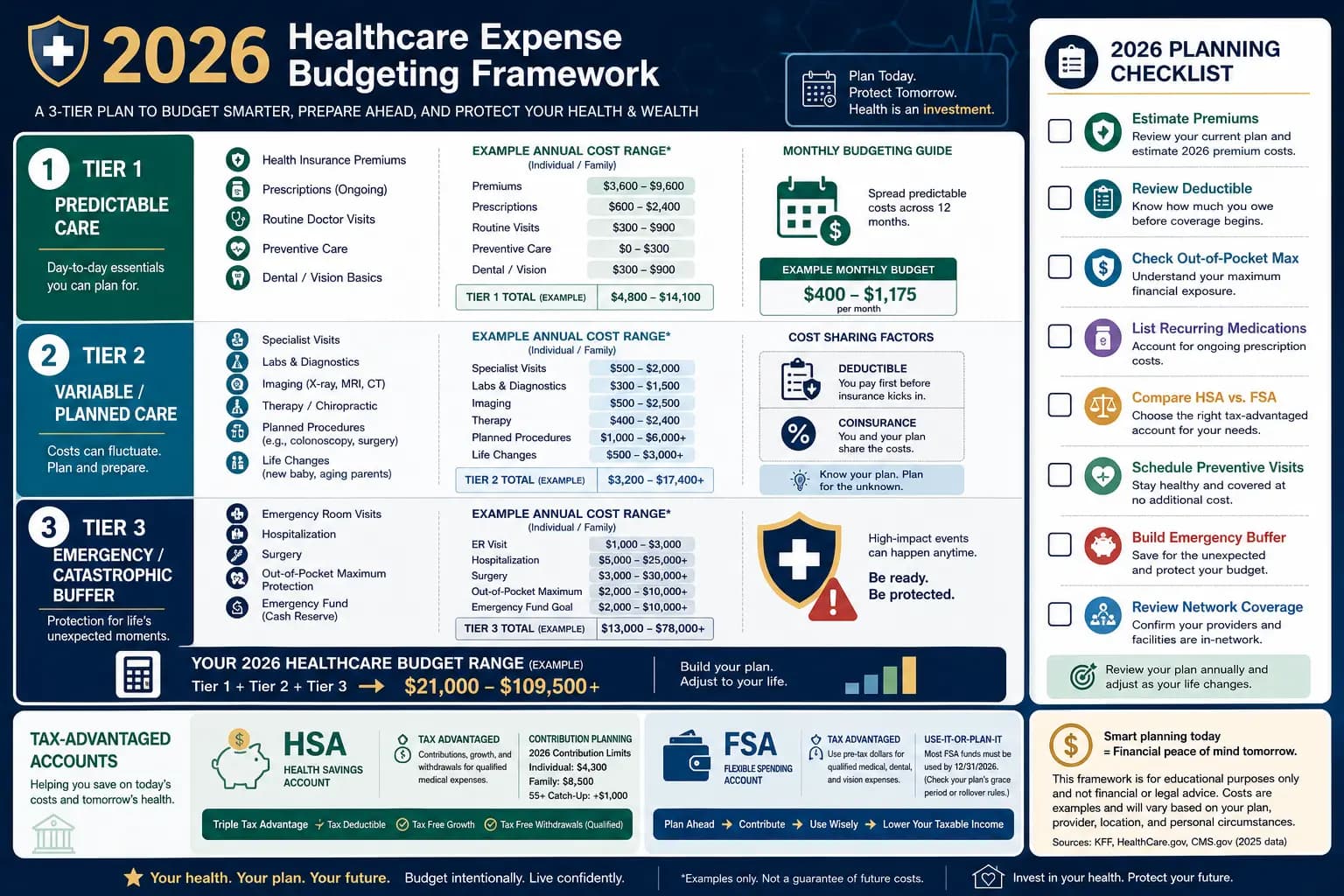
Now that you understand your insurance and know the difference between predictable and unpredictable costs, here is the three-tier framework that actually works for medical expense planning.
Tier 1 covers your predictable monthly expenses: your insurance premium portion, routine copays, and maintenance prescriptions. For a single person on an employer PPO with a $350 monthly premium, $75 monthly routine care reserve, and $40 in prescriptions, Tier 1 totals $465 per month.
Tier 2 is your deductible reserve. Take your annual deductible and divide by 12. If your deductible is $2,500, you save $209 per month toward it. This money sits waiting — if you hit your deductible in a given year, you will be glad you built this reserve month by month rather than scrambling when the medical event happens.
Tier 3 is your catastrophic buffer. This is not about monthly savings — it is about building toward 50% of your out-of-pocket maximum over time. For a single person with a $9,100 OOP max, that means building toward $4,550 in a dedicated medical savings account. You do not need to reach this overnight. This is a multi-year build that protects you against serious illness or injury scenarios that could otherwise derail your entire financial plan.
If you are comparing account options for your medical savings, here is a direct comparison of the three most relevant vehicles. For a full breakdown of high-yield savings accounts as a savings vehicle, see our high-yield savings account explainer.
Single, Healthy, Age 25–35 on an Employer PPO: Total monthly budget of $762 covers your premium contribution ($350), routine care reserve ($75), prescriptions ($20), deductible reserve ($167), and HSA contribution ($150). The HSA grows tax-free and becomes a supplemental retirement vehicle after age 65 if you do not need it for medical expenses sooner. This approach builds both short-term medical security and long-term wealth.
Couple, No Kids, Age 30–40 on an HDHP with HSA: Your $1,735 monthly total reflects the reality of covering two adults. The higher deductible ($4,000 family) and larger HSA contribution ($692 per month to max the $8,300 family limit) actually work in your favor long-term because of the triple tax advantage — but only if you have the income to sustain it. The HSA in this scenario is not just medical savings; it is a stealth retirement account with additional tax benefits unavailable anywhere else.
Family of Four, Age 35–45 on an Employer PPO: At $2,450 per month ($29,400 annually), this is a significant commitment. But it is also reality for a dual-income family with two children. The $500 monthly deductible reserve ensures that when January arrives and the deductible resets, you are not scrambling. The $400 HSA contribution builds savings that can cover the inevitable urgent care visits, ear infections, and sports physicals that define family life. Meanwhile, your separate emergency fund — which you should build using a high-yield savings account earning 4–5% APY — covers income disruption if a job loss or medical leave prevents you from funding this budget. Understanding the relationship between your medical budget and your broader emergency fund is critical for long-term stability. If you are new to budgeting, our budgeting for beginners guide walks through the foundational framework.
Self-Employed Individual on ACA Silver Plan: At $1,342 per month, you are paying full premium without employer cost-sharing. The ACA subsidies are only available if your income falls within certain ranges, so plan carefully for income fluctuations. Your HSA eligibility (if you have a qualifying HDHP through the marketplace) opens up $4,300 in tax-free savings for 2026 — do not overlook this. The self-employed also have a special advantage: HSA contributions are deductible against income regardless of whether you itemize deductions.
Retiree Couple on Medicare: At $1,198 per month, Medicare-based coverage is actually more predictable than employer insurance — but the complexity is different. You are managing three separate insurance products (Part B, Part D, and Medigap supplement) with their own premium schedules, enrollment windows, and coverage gaps. Your $208 monthly deductible reserve should cover Medicare Part B deductible, which is approximately $2,500 annually for both spouses combined.
Budgeting prepares you financially, but actively reducing costs before and after care multiplies the value of every dollar you save. The strategies below are proven to reduce actual out-of-pocket spending — often by hundreds or thousands of dollars per year.
- Call your provider's billing department and ask for the self-pay price — it is sometimes lower than your insurance rate
- Use your insurer's cost estimator tool (required under the Transparency in Coverage rule) to compare facilities before scheduling
- Verify that every provider in your care team is in-network — surgeon, anesthesiologist, radiologist, and lab — or you could face dramatically higher bills
- Ask about cash discounts for upfront payment, especially if you are below your deductible and would be paying out-of-pocket anyway
When you receive a bill, do not pay it immediately. First, wait for your Explanation of Benefits (EOB) from your insurance company and compare it against the provider's bill. Errors are extremely common — one study found that up to 80% of medical bills contain at least one error. Verify that the services listed match what you actually received and that the insurance processed them correctly.
If the bill is genuinely yours to pay, negotiate. The data is striking: 78% of patients who attempt to negotiate their medical bills receive some form of reduction. The negotiation script works like this: "I cannot afford this bill in full. What discounts or payment plans are available?" Asking for an itemized bill first gives you leverage, since itemized bills often reveal charges that should not have been there. Then ask for the prompt pay discount if you can pay something immediately. Finally, inquire about financial assistance programs; nonprofit hospitals are required to have them under the ACA, and applying costs you nothing but could reduce or eliminate your bill entirely based on income.
For prescription costs specifically, always ask "Is there a generic version of this medication?" — generics are typically 80–85% cheaper than brand-name equivalents. Use GoodRx or Cost Plus Drugs to compare pharmacy prices before filling; the same medication can vary by $300 or more between pharmacies in the same city. If you are on an expensive specialty medication, check the manufacturer's copay assistance program — these can reduce costs from thousands of dollars per month to little or nothing for eligible patients.
When a large medical bill arrives, the worst thing you can do is react emotionally. Ignoring it is the second worst choice. Here is the protocol that protects your finances while preserving your healthcare access.
- Do not pay the bill immediately — you have time and options
- Request an itemized bill in writing; do this before making any payment
- Wait for your EOB from your insurance company and compare it to the provider bill
- Check for obvious errors: duplicate charges, services you did not receive, incorrect codes
- Apply for financial assistance before paying anything — especially at nonprofit hospitals
- Negotiate the bill using the script above — worst case they say no, best case you save 30–50%
- Set up an interest-free payment plan if you must pay over time — most hospitals offer 6–24 month plans at zero interest
- Do not put large medical bills on credit cards — this destroys your negotiation leverage and accrues high interest
The rules around medical debt and credit reporting have improved significantly. Paid medical collections are now removed from credit reports entirely. Unpaid medical collections under $500 are not reported at all by the three major bureaus. For larger amounts, there is a one-year waiting period before the collections are reported — versus immediate reporting for most other debt types. This does not mean you should ignore medical bills. Collections accounts still impact your score during the waiting period, and negotiating before an account goes to collections is always preferable to dealing with it after.
The priority order when facing medical expenses that exceed your budget: first, negotiate. Second, apply for financial assistance. Third, set up a payment plan. Fourth, temporarily pause discretionary savings to replenish medical savings faster. Fifth — only as an absolute last resort — tap your emergency fund. And when you do tap it, replenish both accounts before resuming normal discretionary spending.
Budgeting for medical expenses is not about fearing the healthcare system. It is about building enough financial resilience that you can navigate it without going into debt. The three-tier framework works: predictable costs in your monthly budget, deductible reserve in monthly savings, and catastrophic buffer built over time. Combined with active cost reduction tactics and a clear crisis protocol for large bills, this system gives you both protection and peace of mind. Start with your insurance documents today. Know your deductible and your out-of-pocket maximum. Those two numbers determine everything else.
Take control of your money today
Start free with Spendmate — track expenses, plan budgets, and reach your financial goals.
Start free with Spendmate