
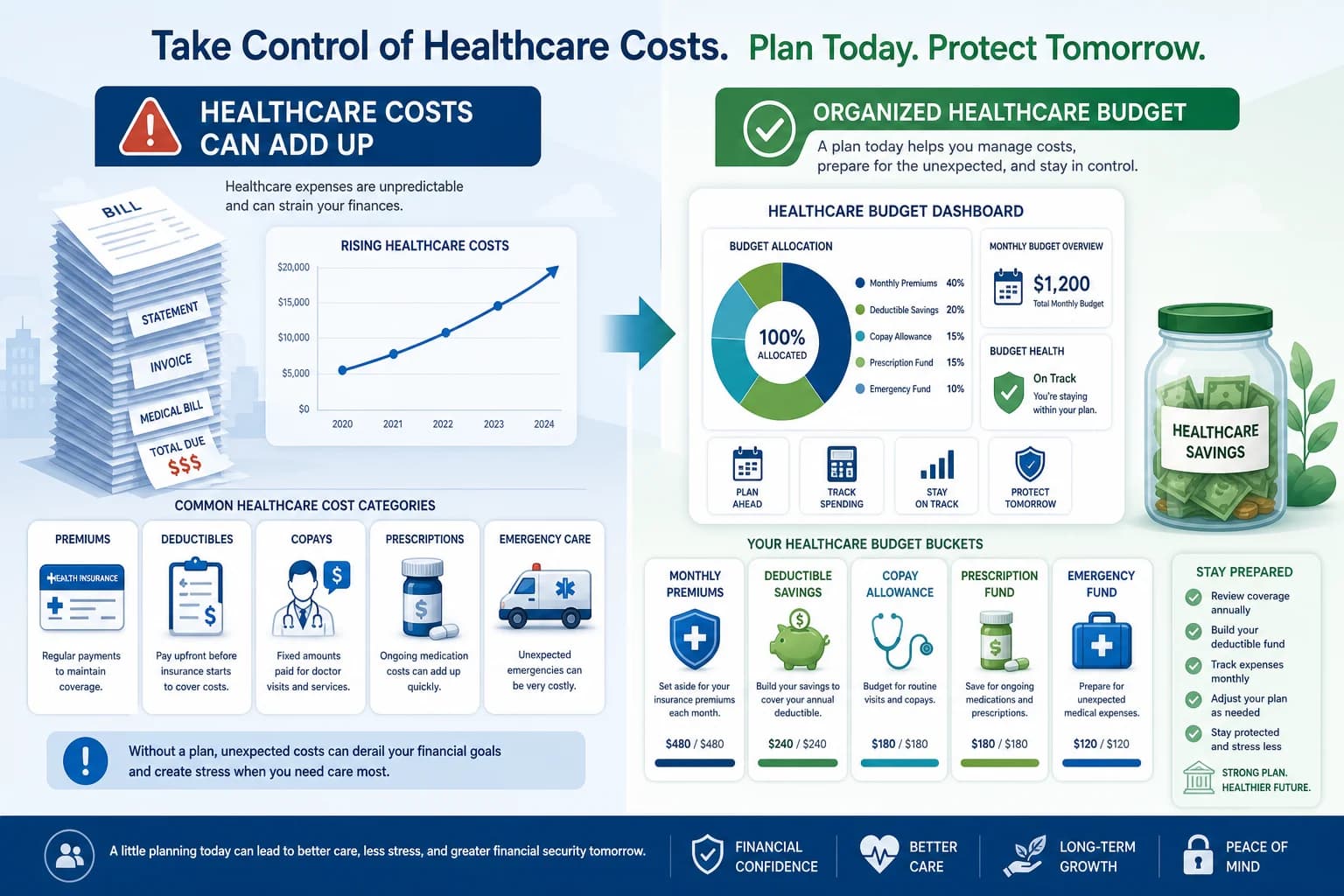
Here is a number that might shock you: the average American family now spends $31,000 per year on healthcare. Of that, about $5,800 comes directly out of pocket—deductibles, copays, prescriptions, and surprise bills. And yet, most household budgets have no dedicated line item for medical expenses. They budget for rent, groceries, and car payments, but healthcare is treated as an afterthought. Until one $3,000 ER bill arrives. This guide fixes that. We will walk through exactly how to build a medical expense budget that accounts for premiums, deductibles, routine care, prescriptions, and the unexpected. No alarmism. No shame. Just a system that prepares you for reality.
The Medical Budget Reality Check
2026 Healthcare Cost Statistics
Before you can budget for medical expenses, you need to understand the scale of what you are dealing with. The following figures represent the latest available data for 2026.
- Average annual healthcare spending per family: $31,000 (KFF 2026 data)
- Average out-of-pocket costs: $5,800/year (includes deductible, copays, prescriptions)
- Average individual deductible (employer plan): $1,900
- Average family deductible (employer plan): $3,800
- Average monthly premium (employer plan, family): $1,450
- Average monthly premium (ACA marketplace, subsidized): $420–$890 depending on plan tier
- 41% of Americans have trouble paying medical bills (Commonwealth Fund 2026)
- Medical debt affects 1 in 7 adults; average balance: $2,300
Why Medical Budgeting Is Different
Medical expenses are unique in personal finance because they combine two competing characteristics: they are predictable in occurrence but unpredictable in timing and amount. Everyone eventually needs medical care, but you cannot predict when a car accident, sudden diagnosis, or emergency will happen. This makes medical budgeting fundamentally different from budgeting for housing or groceries.
- Predictable costs: premiums, routine visits, maintenance prescriptions
- Semi-predictable costs: dental cleanings, vision exams, seasonal illnesses
- Unpredictable costs: ER visits, urgent care, specialist referrals, surprise bills
- Insurance complexity: deductible resets, network changes, prior authorization
- Emotional factor: health decisions feel urgent; people overspend or avoid care entirely
Step 1 — Understand Your Insurance Coverage (Before You Budget)
Key Terms You Must Know
You cannot budget effectively without understanding what your insurance actually covers. Here are the essential terms that directly impact your medical expenses.
Premium is your monthly payment for insurance coverage—a fixed, predictable expense that you must account for first. Your deductible is the amount you pay out-of-pocket before insurance starts sharing costs, and it resets annually on January 1st. A copay is a fixed fee per service (for example, $30 for a primary care visit). Coinsurance is the percentage you pay after meeting your deductible—for instance, 20% of a hospital bill. Your out-of-pocket maximum is the cap on what you will pay in a year; after reaching it, insurance covers 100% of costs. In-network providers are contracted with your insurer and cost significantly less, while out-of-network providers are not contracted and can cost much more—sometimes not even counting toward your OOP maximum. An HSA (Health Savings Account) is a tax-advantaged account that pairs with high-deductible health plans, offering triple tax benefits with funds that roll over forever. An FSA (Flexible Spending Account) is another tax-advantaged option but with a use-it-or-lose-it provision that requires careful planning.
Find Your Plan Details
Log into your insurer portal or check your Summary of Benefits and Coverage (SBC) document. Write down these critical numbers: your deductible (both individual and family amounts), your out-of-pocket maximum, your copays for common services, your coinsurance percentage, and your monthly premium. Also check whether prescriptions are tiered and what your preferred pharmacy costs, and note whether you have HSA or FSA available through your employer and if they make contributions.
Step 2 — Calculate Your Predictable Medical Costs
Fixed Annual Costs (Premium)
Your health insurance premium is often the largest single healthcare cost. Calculate it using this formula: Monthly Premium times 12 equals your Annual Premium Cost. For example, an employer family plan at $1,450 per month equals $17,400 per year. An ACA subsidized marketplace plan at $620 per month equals $7,440 per year. Note that employer premiums are often paid with pre-tax dollars through payroll, which reduces your actual after-tax cost.
Expected Routine Care Costs
Most people have predictable, recurring medical expenses that you can budget for monthly. These are the costs that occur like clockwork every year.
- Primary Care Visit: 1–2 times per year, $20–$50 copay, annual total $40–$100
- Specialist Visit: 0–2 times per year, $40–$80 copay, annual total $0–$160
- Dental Cleaning: 2 times per year, $20–$60 copay or $150–$250 without insurance, annual total $40–$500
- Eye Exam: 1 time per year, $10–$50 copay or $100–$150 without vision insurance, annual total $10–$150
- Prescription (maintenance): Monthly, $10–$50 copay per medication, annual total $120–$600+
- Lab Work: As needed, $0–$50 copay or 10–20% coinsurance, annual total $0–$200
- Vaccinations: As needed, $0 (most covered 100%), annual total $0
- Physical Therapy: Varies, $30–$60 copay per session, annual total $0–$600
Total Routine Care Estimate: $210–$2,310 per year depending on health status and insurance coverage.
Prescription Cost Planning
Prescription medications represent one of the fastest-growing budget categories. Specialty medications and GLP-1 drugs like Ozempic, Wegovy, and Mounjaro are major 2026 budget items that many people underestimate.
- Generic maintenance medications (metformin, lisinopril): $10–$20 per month with insurance, $15–$40 without
- Brand-name maintenance (Advair, EpiPen): $40–$100 per month with insurance, $300–$600 without
- Specialty drugs (biologics, injectables): $100–$500 per month with insurance, $2,000–$10,000+ without
- GLP-1 medications (Ozempic, Wegovy): $25–$100 if covered by insurance, $900–$1,400 without
Action step: Check your plan formulary to see which medications are covered. If a medication is NOT covered, ask your doctor about alternatives or check manufacturer coupons.
Step 3 — Plan for Your Deductible (The Big One)
What Is a Deductible?
Your deductible is the amount you pay out-of-pocket before your insurance starts sharing the cost of most non-preventive care. It resets every January 1st. Until you meet your deductible, you are responsible for 100% of most medical bills (except preventive care, which is usually covered at 100%). After meeting your deductible, you pay coinsurance until you reach your out-of-pocket maximum.
Three Methods for Deductible Budgeting
Method 1: Full Deductible Reserve (Conservative). Save your entire deductible amount at the start of the year. Example: $3,800 family deductible means saving $3,800 by January. Pro: You are prepared for worst-case scenarios. Con: Requires significant upfront cash that may not be realistic.
Method 2: Monthly Deductible Savings (Practical). Divide your deductible by 12 and save that amount monthly. Example: $3,800 divided by 12 equals $317 per month. Pro: Manageable monthly savings that builds over time. Con: Early in the year, you are underfunded if a big expense hits before you have saved enough.
Method 3: Hybrid Approach (Recommended). Start with a seed amount of $1,000–$2,000 in January, then add monthly contributions. Example: Start with $1,500 plus $200 per month equals $3,900 by December. Pro: Balanced approach that protects against early-year surprises. Con: Requires some upfront cash.
When Your Deductible Applies
- Before deductible met: You pay 100% of most non-preventive care
- After deductible met: You pay coinsurance percentage (e.g., 20%) until out-of-pocket maximum is reached
- Preventive care exception: Annual physical, screenings, and most vaccines cost $0 even before you meet your deductible
Step 4 — Build Your Medical Emergency Buffer
Why Separate From Regular Emergency Fund?
Medical expenses should have their own dedicated emergency fund separate from your general emergency fund because medical costs are predictable in occurrence (everyone gets sick or injured eventually), unpredictable in timing and amount, often large enough to derail a normal budget, and can be addressed with tax-advantaged accounts like HSA and FSA.
Recommended Medical Emergency Fund Size
- Single, healthy, low deductible (under $1,500): $1,500–$2,500 recommended buffer
- Single, chronic condition, moderate deductible ($1,500–$3,000): $3,000–$5,000 recommended buffer
- Family, healthy, moderate deductible ($3,000–$5,000): $4,000–$6,000 recommended buffer
- Family, chronic conditions, high deductible (over $5,000): $6,000–$10,000+ recommended buffer
- Near retirement or retired (Medicare gaps): $8,000–$15,000+ recommended buffer
Where to Keep Your Medical Emergency Fund
- HSA (Best Option): Triple tax advantage if paired with HDHP. Funds roll over forever. Can invest for long-term growth.
- HYSA (Good Option): Liquid savings account that earns interest, separate from your general emergency fund.
- FSA (Limited Option): Use-it-or-lose-it provision makes it only good for predictable expenses.
- Regular Checking (Not Recommended): Too easy to spend on non-medical items.
Step 5 — Create Your Monthly Medical Budget
Medical Budget Template
Use this template to build your monthly medical budget. Adjust amounts based on your specific plan and health needs.
- Health Insurance Premium: Your monthly premium from payroll deduction or direct pay
- Dental/Vision Premium: If separate from medical insurance
- HSA/FSA Contribution: Pre-tax contributions; aim to save at least your deductible amount annually
- Routine Care Fund: $50–$150 for copays, prescriptions, over-the-counter medications
- Deductible Savings: $150–$400 per month to build toward your annual deductible
- Medical Emergency Buffer: $100–$300 for unexpected care beyond your deductible
- Prescription Fund: $50–$200 per month if you take maintenance medications
- Total: Add all categories together and adjust based on your situation
Sample Budget: Family of Four with HDHP Plan
- Health Premium (employer plan, family): $1,450 per month
- HSA Contribution (family max 2026: $8,550): $713 per month
- Routine Care Fund: $100 per month
- Deductible Savings ($3,800 annual deductible divided by 12): $317 per month
- Medical Emergency Buffer: $200 per month
- Prescription Fund (2 maintenance medications): $80 per month
- Total: $2,860 per month
Note: HSA contribution is pre-tax, so your actual after-tax cost is lower depending on your tax bracket.
Sample Budgets by Life Stage
Young Adult (Age 25, Single, Healthy, HDHP): Premium $280/month (ACA subsidized), HSA $200/month, Routine Care $40/month, Deductible Savings $130/month ($1,550 deductible), Emergency Buffer $75/month. Total: $725/month.
Family of Four (Age 35–40, Employer Plan, One Child with Asthma): Premium $1,450/month, HSA $713/month, Routine Care $120/month, Deductible Savings $317/month ($3,800 deductible), Emergency Buffer $250/month, Prescriptions $60/month. Total: $2,910/month.
Near-Retiree (Age 62, ACA Plan Pre-Medicare, Chronic Conditions): Premium $890/month, HSA $350/month, Routine Care $150/month, Deductible Savings $400/month ($4,800 deductible), Emergency Buffer $400/month, Prescriptions $180/month. Total: $2,370/month.
Step 6 — Use HSA/FSA Strategically
HSA (Health Savings Account) — The Best Tool
If you have a high-deductible health plan, the HSA is the most powerful medical savings tool available. To be eligible, you must have an HDHP with a 2026 minimum deductible of $1,600 for individual coverage or $3,200 for family coverage. The 2026 contribution limits are $4,300 for individual coverage and $8,550 for family coverage, with an additional $1,000 catch-up contribution allowed for those age 55 and older.
The HSA offers a triple tax advantage: contributions are pre-tax or tax-deductible, growth is tax-free when invested, and withdrawals for qualified medical expenses are tax-free. Your strategy should be to contribute the maximum if possible, invest funds for long-term growth, pay current medical expenses from cash flow while letting HSA grow, and reimburse yourself years later for expenses paid out-of-pocket (keep all receipts). After age 65, you can withdraw for any purpose without penalty, though income tax applies if the withdrawal is not for qualified medical expenses.
FSA (Flexible Spending Account) — Use It Wisely
The FSA has a critical limitation: use-it-or-lose-it. If you do not spend the funds by year-end, you lose them. Some plans allow a $610 rollover or a 2.5-month grace period. The 2026 contribution limit is $3,200 per person. FSAs are best for predictable expenses like prescriptions, therapy, planned procedures, over-the-counter items, and vision and dental expenses not covered by insurance. They are worst for unpredictable expenses where you might lose unused funds, and for people who frequently change jobs since FSAs do not always transfer.
Qualified Medical Expenses (HSA/FSA Eligible)
Eligible expenses include doctor visits, specialist visits, urgent care, and ER visits; prescription medications; over-the-counter medications like pain relievers and allergy meds; insulin and diabetes supplies; vision exams, glasses, contacts, and solution; dental cleanings, fillings, crowns, and orthodontia; mental health therapy, counseling, and psychiatric care; physical therapy and chiropractic care when medically necessary; medical equipment like crutches, blood pressure monitors, and glucose meters; feminine hygiene products; and sunscreen SPF 15 and above.
Not eligible: cosmetic procedures like Botox and elective surgery; general health supplements unless prescribed; gym memberships unless prescribed for a specific condition; weight loss programs unless treating diagnosed obesity; toothpaste and shampoo; and general toiletries.
Step 7 — Handle Surprise Medical Bills
Common Surprise Bill Scenarios
- Out-of-network provider at an in-network facility (anesthesiologist, radiologist, pathologist)
- Lab work sent to an out-of-network lab without your knowledge
- Air ambulance (not covered by the No Surprises Act in all cases)
- Ground ambulance (NOT protected by the federal surprise billing law)
- Balance billing after an insurance denial
Your Rights Under the No Surprises Act (2022+)
- Protected from surprise bills for emergency care at out-of-network facilities
- Protected from surprise bills by out-of-network providers at in-network facilities
- Right to receive a Good Faith Estimate for scheduled services (uninsured and self-pay patients)
- Right to dispute bills that exceed the estimate by $400 or more
What to Do When You Get a Surprise Bill
- Do NOT pay immediately. Request an itemized bill.
- Verify network status. Was the provider actually out-of-network?
- Check if the No Surprises Act applies. If yes, dispute with your insurer.
- Request error correction. Billing mistakes are common (wrong codes, duplicate charges).
- Negotiate. Ask for a cash-pay discount or payment plan.
- Apply for financial assistance. Non-profit hospitals must offer charity care programs.
- Escalate if needed. File a complaint with your state insurance commissioner or CMS.
Negotiation Scripts
For the Billing Department: I received a bill for $X, but this was an out-of-network provider at an in-network facility. Under the No Surprises Act, I should only be responsible for in-network cost-sharing. Can you reprocess this claim?
For Financial Assistance: I am experiencing financial hardship and would like to apply for charity care or financial assistance. What forms do I need to submit?
For Payment Plans: I cannot pay this balance in full. Can we set up an interest-free payment plan of $X per month?
Common Medical Budgeting Mistakes
- Only budgeting for premiums and forgetting deductible, copays, and prescriptions
- Not separating medical from general emergency fund, causing healthcare costs to bleed into rent and groceries
- Ignoring HSA tax advantages and leaving free money on the table
- Overestimating what insurance covers and assuming I have insurance means I am covered
- Not checking network status before receiving care and getting surprise out-of-network bills
- Skipping preventive care to save money, causing small problems to become expensive problems
- Not keeping receipts and being unable to reimburse from HSA later or deduct on taxes
- Using FSA for unpredictable expenses and losing unused funds at year-end
- Not planning for deductible reset on January 1st
- Avoiding necessary care due to cost, leading to worse health outcomes and higher costs long-term
FAQ — Medical Expense Budgeting
- How much should I budget for medical expenses per month?
- Depends on your plan and health status. Typical range: $200–$600 per month for individuals, $500–$1,500+ per month for families, excluding premiums. Add your premium costs separately.
- Should medical expenses come out of my regular emergency fund?
- Ideally, no. Keep a separate medical emergency fund (in an HSA or HYSA) so healthcare costs do not derail your ability to pay rent or buy groceries during a crisis.
- What if I cannot afford my deductible?
- Prioritize building at least a partial reserve of $1,000–$2,000. Use an HSA if you are eligible. Ask providers about cash-pay discounts. Apply for hospital financial assistance programs. Negotiate payment plans.
- Can I use HSA money for health insurance premiums?
- Generally no, except for COBRA continuation coverage, health insurance while receiving unemployment compensation, or Medicare premiums (Part B, Part D, Medicare Advantage) after age 65. Not for regular employer or ACA marketplace premiums.
- What happens to my HSA if I change jobs?
- It is YOUR account. Funds roll over forever. You keep the HSA even if you switch to a non-HDHP plan—you just cannot contribute new funds without HDHP coverage.
- Are over-the-counter medications HSA-eligible?
- Yes, as of 2020 (CARES Act). Pain relievers, allergy meds, digestive aids, and other over-the-counter medications do not require a prescription. Menstrual products are also eligible.
- How do I track medical expenses for taxes?
- Keep receipts in an organized folder (digital or physical). Track in a spreadsheet with columns for date, provider, service, amount, and payment method. Total annual out-of-pocket costs may be tax-deductible if they exceed 7.5% of your adjusted gross income.
- What is the difference between deductible and out-of-pocket maximum?
- Your deductible is what you pay before insurance starts sharing costs. Your out-of-pocket maximum is the MOST you will pay in a year (includes deductible, copays, and coinsurance combined). After hitting your OOP maximum, insurance covers 100% of costs.
- Can I contribute to both HSA and FSA?
- Generally no, unless your FSA is limited-purpose (dental and vision only) or post-deductible (only kicks in after your HDHP deductible is met).
- What if I have medical debt already?
- Prioritize paying off high-interest medical debt. Negotiate balances—many hospitals accept 30–60% lump-sum settlements. Set up interest-free payment plans. Do not put medical bills on credit cards because you lose negotiation leverage and add interest charges.
Building a medical expense budget is not about fear of healthcare costs—it is about taking control. The average American family spends $31,000 per year on healthcare, and $5,800 of that comes out-of-pocket. With a dedicated medical budget, you can handle the predictable costs with ease, build a buffer for surprises, and stop letting medical bills derail your financial life. Start small if you need to—even $100 per month toward your deductible savings is progress. Your future self will thank you when that surprise bill arrives and you have the funds to handle it without stress.
Take control of your money today
Start free with Spendmate — track expenses, plan budgets, and reach your financial goals.
Start free with Spendmate