
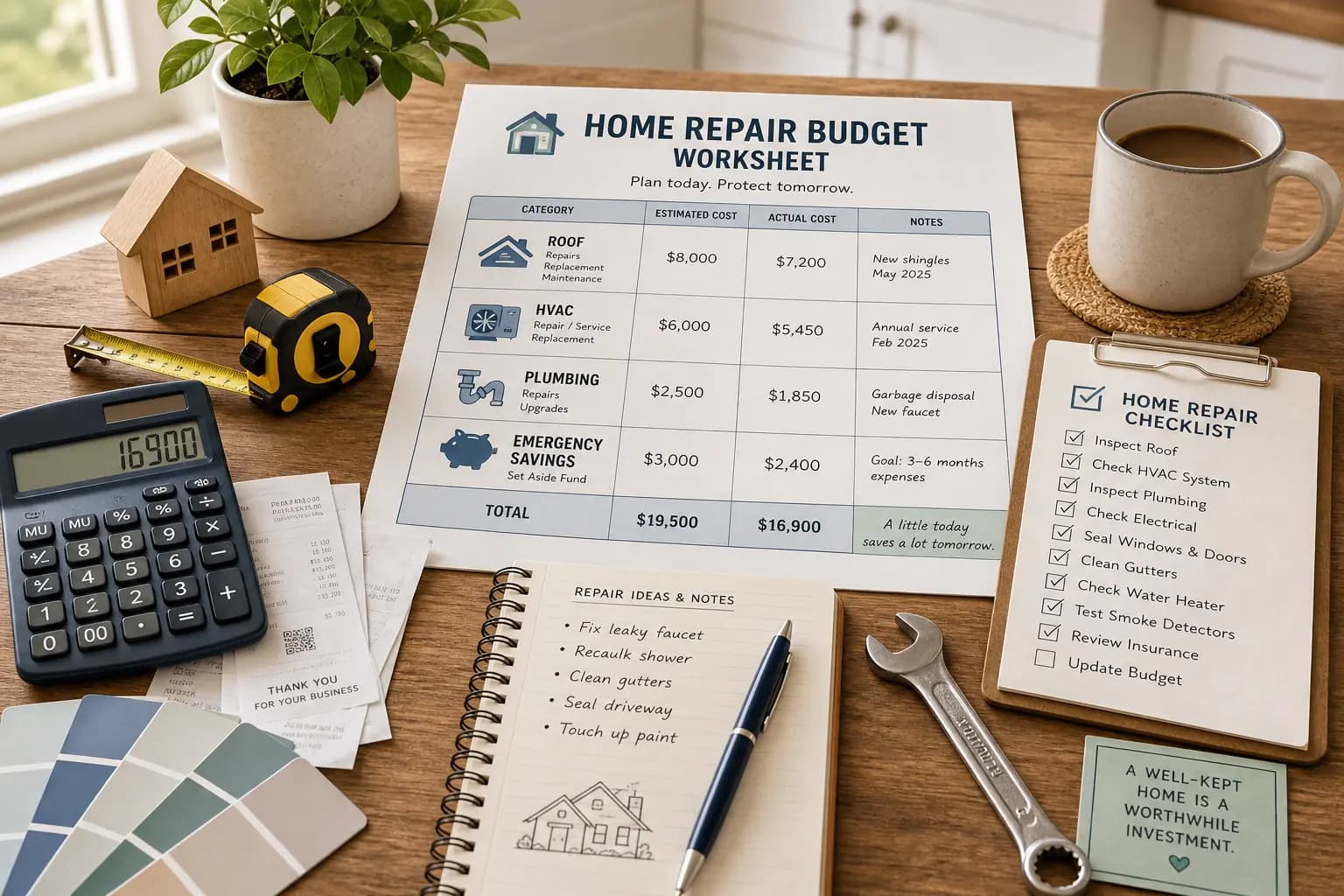
A home repair budget is a plan for the money you will need when part of your house breaks, wears out, or needs fixing sooner than expected. If you are learning how to budget for home repairs, the goal is not to predict every problem perfectly. The goal is to stay calm, save steadily, and avoid turning one broken system into a financial crisis.
Many homeowners know they should save for repairs, but they are not sure what number makes sense. Online advice often throws out a simple percentage, then stops there. That can be useful, but it does not help much when you are trying to decide whether to save for a roof leak, an old water heater, or an HVAC unit that may fail in the next two summers.
This guide keeps it practical. You will separate repairs from maintenance and renovations, estimate your home’s repair risk, set a monthly savings target, build an emergency repair fund, and decide what to fix first when money is tight.
What counts as a home repair budget
A home repair budget is the part of your financial plan that covers fixes to things that break or stop working in your home. In plain English, it is money set aside for problems you do not want to put on a credit card at the worst possible moment.
- Fixing a roof leak
- Replacing a broken water heater
- Repairing plumbing leaks
- Replacing a furnace or AC unit that fails
- Fixing an appliance that is no longer working
This is different from routine maintenance, like changing HVAC filters, cleaning gutters, or servicing equipment before it breaks. It is also different from renovations, like remodeling a kitchen or upgrading countertops for style. Keeping those categories separate makes your budget much clearer.
Step 1: Separate repairs, maintenance, and renovations
This is the first move because many homeowners mix all three together and end up either under-saving or overreacting.
- Maintenance keeps things working: tune-ups, inspections, gutter cleaning, pest treatment, and small seasonal tasks
- Repairs fix something broken or failing: a leaking pipe, dead appliance, damaged roof section, or faulty sump pump
- Renovations improve appearance or function by choice: new cabinets, a bathroom makeover, or flooring upgrades
Why this matters: if you call every home expense a repair, your numbers get messy fast. A clean system lets you budget a steady amount for maintenance, save separately for real repairs, and treat remodels as optional projects.
Minor fixes vs major repairs
Minor fixes are things like patching drywall, replacing a faucet, or fixing a toilet fill valve. Major repairs are the expensive systems and structural problems that can hit your budget hard, like roof work, HVAC replacement, plumbing failures, electrical issues, or a broken water heater. Your repair reserve should be built with the major items in mind, not just the easy fixes.
Step 2: Estimate your annual repair risk
There is no perfect formula, but there are good starting points. Many homeowners use the 1% rule: save around 1% of the home’s value each year for repairs and upkeep. Others use 2% or more for older homes, homes in rough climates, or properties with aging systems.
A better approach is to combine a simple rule of thumb with what you know about your house. Ask yourself how old the roof is, whether the HVAC system is aging, if plumbing or electrical systems are dated, whether major appliances are near the end of their life, and whether your area faces storms, flooding, heat, or freezing risks.
Roof, HVAC, plumbing, and appliance examples
Think in real categories, not vague fear. A roof repair may cost hundreds or a few thousand dollars, while full replacement can be much higher. A water heater or furnace replacement can also come suddenly. Plumbing leaks may start small, but if ignored they can create water damage that makes the bill much worse. Even one appliance replacement in the wrong month can throw off a tight household budget.
HUD homeowner education resources, ENERGY STAR system guidance, and local inspection reports can help you understand likely trouble spots. You do not need exact future bills. You just need enough awareness to avoid pretending nothing will break.
Step 3: Set a monthly repair savings target
Once you have a rough annual target, divide it into a monthly number. That is what turns a stressful idea into a repeatable habit.
- Home value: $300,000
- Annual repair target at 1%: $3,000
- Monthly savings target: about $250
If the house is older and you choose 2%, the target becomes $6,000 per year or about $500 per month. That may sound high, but the point is not to panic. The point is to see the real size of the risk and save what you reasonably can now instead of scrambling later.
If your cash flow is tight, start smaller and build upward. Even $75 to $150 a month is better than nothing if you are also identifying your biggest risks. The habit matters. The number can improve over time.
How much to save for older homes
Older homes usually need a larger repair reserve because systems tend to fail closer together. If your roof, furnace, plumbing, and appliances are all middle-aged or older, use the higher end of the range and build a stronger emergency buffer. First-time homeowners often underestimate this in year one because the mortgage payment feels like the main housing number. It is not. The repair reserve matters just as much.
Step 4: Build an emergency repair fund
Your monthly repair savings target is the long game. Your emergency repair fund is the short-term protection layer. This is the money that helps when something urgent happens before you have saved enough in your sinking fund.
A repair fund works well when it lives in a separate high-yield savings account or another dedicated savings bucket. That keeps it available but not mixed into everyday spending. Checking accounts are too easy to drain accidentally. A separate savings bucket creates a little friction, which is helpful.
- Repair sinking fund: for predictable future repairs and replacements
- Emergency fund: for urgent home problems that cannot wait
- Insurance deductible buffer: for damage events where insurance may apply but you still need cash upfront
Should I use a sinking fund for repairs
Yes, in most cases. A sinking fund is one of the clearest ways to handle house repairs because it spreads the cost over time. Instead of treating every repair like a surprise, you turn part of it into a planned monthly expense. That makes it easier to handle a broken appliance, leak repair, or contractor invoice without wrecking your regular budget.
Step 5: Prioritize repairs by safety and urgency
When several things go wrong at once, you need a framework. The easiest one is: repair now, watch closely, or save and schedule.
- Repair now: safety hazards, active leaks, no heat or cooling in extreme weather, electrical risks, mold risk, sewage issues, or anything causing fast damage
- Watch closely: issues that are working poorly but are not yet dangerous, like a noisy appliance, small crack, or minor plumbing drip you are monitoring with a timeline
- Save and schedule: non-urgent repairs you can plan for, compare quotes on, and tackle after funding them properly
This prevents a common mistake: spending money on the visible annoyance while postponing the truly urgent issue. If your dishwasher is ugly but your roof is leaking, the roof wins. Safety first, damage control second, convenience third.
What if I cannot afford the repair right now
Start by stopping the damage from getting worse. Then get multiple contractor quotes, ask about phased work if appropriate, check whether homeowners insurance might cover part of the problem, and see whether a home warranty applies in limited situations. If savings are low, focus on the repair with the highest safety or damage risk first. It is not ideal, but a clear priority order is still better than reacting blindly.
FEMA preparedness guidance can also be helpful if the repair is related to storm, flood, or weather damage risk. The bigger point is this: urgent repairs should trigger a calm plan, not random spending.
Step 6: Decide when to DIY vs hire a pro
Doing a repair yourself can save money, but only when the work is truly within your skill level and the risk of getting it wrong is low. Small repairs like replacing weather stripping or tightening hardware may be reasonable DIY projects. Electrical work, gas issues, structural damage, roofing, major plumbing, and HVAC problems usually deserve a professional.
Bad DIY work can cost more than the original repair. A cheap fix that causes water damage, voids a warranty, or creates a safety issue is not actually cheap. When in doubt, compare the cost of a pro with the cost of a mistake.
Home warranty vs repair fund
A home warranty is not the same as a repair fund. A warranty may help with some covered systems or appliances, but coverage limits, exclusions, delays, and service fees are common. A repair fund gives you flexibility no matter who does the work or what the fine print says. If you use a warranty, think of it as a limited tool, not a full replacement for savings.
How to budget for common repairs
- Roof: leaks, flashing issues, shingle damage, or eventual replacement
- HVAC: annual wear, repair calls, and full system replacement risk
- Plumbing: leaks, clogs, water heater failure, sump pump trouble
- Appliances: refrigerator, washer, dryer, oven, dishwasher
- Exterior: siding, drainage, fence, or storm-related damage
If one of these categories already looks weak, move it higher on your savings list. A recent inspection report can be incredibly useful here because it helps you budget based on actual conditions instead of vague guesses.
Common home repair budgeting mistakes
- Treating maintenance, repairs, and renovations as the same thing
- Using one percentage rule without looking at the age and condition of the home
- Saving nothing because the ideal monthly amount feels too high
- Spending repair money on optional upgrades
- Ignoring insurance deductibles when planning for emergencies
- Delaying small leaks or system warnings until the repair becomes much more expensive
FAQ
How much should I budget for home repairs each year?
A common starting point is 1% of your home’s value per year, but older homes or homes with aging systems may need 2% to 4%. Use the rule as a baseline, then adjust based on the real condition of your roof, HVAC, plumbing, and appliances.
Is home maintenance the same as home repairs?
No. Maintenance is the routine work that helps prevent breakdowns, while repairs fix something that is already broken or failing. Keeping them separate makes your budget much easier to manage.
Should I keep repair money in savings or checking?
Savings is usually better. A separate savings account or sinking fund keeps the money available for repairs without mixing it into everyday spending. It also makes progress easier to track.
What if a repair is urgent and I’m not ready?
Stop further damage first, then prioritize by safety and urgency. Get quotes, check whether insurance or a warranty applies, and focus available cash on the problem that could cause the most harm if delayed.
Is a home warranty worth it?
Sometimes, but it should not replace savings. Warranties can help in specific cases, yet they often have exclusions, claim limits, and service fees. A repair fund gives you more control.
Pick one monthly number, even if it is modest, and open a dedicated home repair savings bucket. Then list the three systems in your home most likely to need money first. That simple move will make your home repair budget feel more real, more useful, and much less overwhelming.
Take control of your money today
Start free with Spendmate — track expenses, plan budgets, and reach your financial goals.
Start free with Spendmate