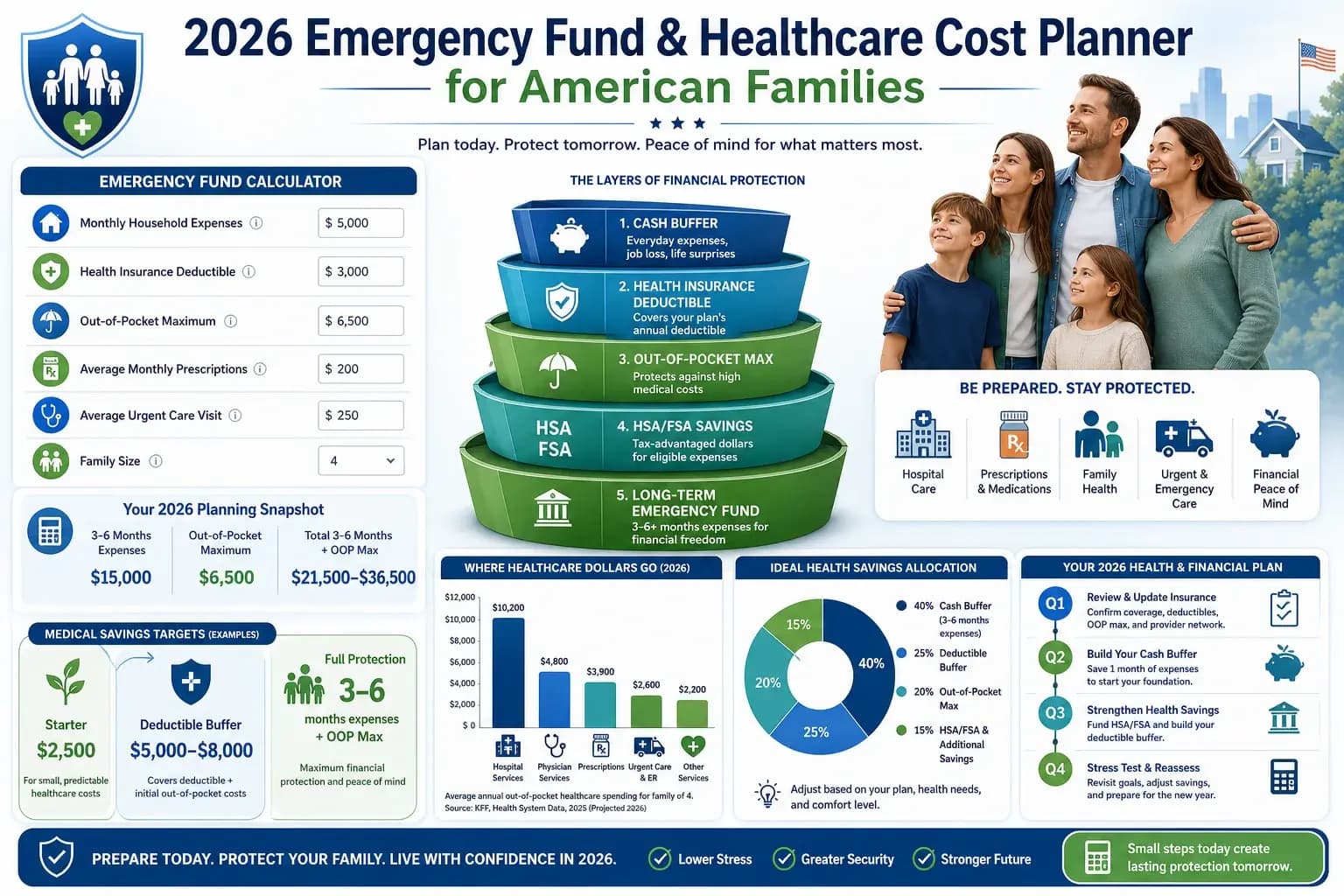
How Much Should Americans Save for Medical Emergencies in 2026? (Situation-Specific Guide)
Most financial advice lumps medical emergencies into the same bucket as job loss or car repairs. That is a mistake. Medical costs have their own logic: they strike without warning, often max out your out-of-pocket exposure in a single event, and unlike a layoff, you cannot simply find a new health plan overnight. If you are wondering how much you should save for medical emergencies in 2026, the short answer is: more than you think, and it depends heavily on your specific situation. This guide gives you exact dollar ranges based on your age, family size, health status, and insurance type.
The Short Answer: Medical Emergency Fund Ranges
Medical emergency funds are separate from general emergency funds. Your general fund covers job loss, car repairs, and home emergencies. Your medical fund covers deductibles, copays, coinsurance, prescriptions, and unexpected procedures. Keeping them separate prevents a hospital bill from wiping out your unemployment buffer.
Recommended ranges by situation:
- Single, healthy, low deductible plan: $3,000–$5,000
- Single adult with a chronic condition: $5,000–$10,000
- Couple without children: $6,000–$12,000
- Family with low deductible (under $3,000): $7,000–$12,000
- Family with high deductible (over $5,000): $12,000–$20,000
- Medicare recipients: $6,000–$10,000 (plus premium reserves)
Rule of thumb: at minimum, save your full deductible amount. The ideal target is your plan out-of-pocket maximum plus a 15% buffer. Build it over 12 to 24 months, not all at once. Think of it as insurance you fund yourself, a little bit every month, before a medical event funds it for you all at once.
Why Medical Emergency Funds Are Different From General Emergency Funds
The Key Distinction
A general emergency fund (3 to 6 months of expenses) protects against income disruption. A medical emergency fund protects against healthcare cost exposure. The reason to keep them separate is mental accounting: if a $15,000 medical bill drains your job-loss fund, you lose both protections at once. Two separate funds mean two independent safety layers.
The Reality of US Medical Costs in 2026
- Average family deductible: $6,500+ (KFF 2026 Employer Health Benefits Survey)
- Average individual deductible: $2,800+
- Out-of-pocket maximums: $9,000+ individual, $18,000+ family (federal limits)
- Air ambulance (out-of-network): $40,000–$80,000+. Often not fully covered despite federal protections.
- Cancer treatment out-of-pocket: $5,000–$50,000+ even with solid insurance.
- 66.5% of bankruptcies tied to medical issues (American Journal of Public Health, 2025)
Step 1: Calculate Your Minimum Medical Emergency Fund
The Deductible Method (Your Absolute Minimum)
Your medical emergency fund should at minimum cover your full plan deductible. This is the amount you pay before insurance starts sharing costs. The worst-case timing scenario is needing care early in the year before you have met your deductible.
Example baselines: an individual plan with a $2,500 deductible means save $2,500 minimum. A family plan with a $6,000 deductible means save $6,000 minimum. HDHP holders with a $4,300 individual deductible should save at least $4,300.
The Out-of-Pocket Maximum Method (Recommended Target)
For full protection, save up to your annual out-of-pocket maximum with a buffer applied. The formula: Target Medical Reserve = Your Plan OOP Maximum × 1.15.
That 15% buffer exists because reality rarely stays within the neat lines of your insurance plan. It covers out-of-network surprise bills that still occur despite the No Surprises Act, non-covered services such as cosmetic or experimental treatments, travel costs for medical care including flights and hotels, lost wages during recovery periods, and caregiver expenses if a family member falls ill.
Practical examples: an individual OOP max of $9,000 means a target of roughly $10,350. A family OOP max of $18,000 means a target of approximately $20,700.
Find your numbers in your Summary of Benefits and Coverage document, your insurance member portal, or by calling customer service. Note that deductibles and OOP maximums reset annually, usually on January 1st.
Step 2: Adjust for Your Specific Situation
Age-Based Adjustments
- Under 30: Base amount. Generally healthier, fewer chronic conditions.
- 30 to 45: Base plus 15%. Increased likelihood of managing conditions, family planning considerations.
- 45 to 60: Base plus 30%. More screenings, specialists, possible chronic diagnoses.
- 60 to 65: Base plus 40%. Pre-Medicare, higher utilization, possible early retirement gap.
- 65 and older (Medicare): See the Medicare section below. Different cost structure entirely.
Health Status Adjustments
- Healthy, no chronic conditions: Base amount.
- One manageable chronic condition (controlled hypertension, mild diabetes): Base plus 20% for medications and quarterly monitoring.
- Multiple chronic conditions: Base plus 40% for multiple specialists, medications, and possible procedures.
- Planning pregnancy within 12 months: Base plus 50%. Prenatal care, delivery, and postpartum add up even with insurance.
- Anticipating surgery or a medical procedure: Base plus 100% of expected out-of-pocket costs. Ask your provider for a cost estimate based on your plan.
- Ongoing mental health treatment: Base plus 25% for therapy copays that run $40–$100 per session across 24 to 52 sessions annually.
Family Size Adjustments
- Single adult: $3,000–$7,000 based on deductible and OOP maximum.
- Couple without children: $6,000–$12,000 covering two deductibles or family plan OOP maximum.
- Family of 3 (two adults plus one child): $8,000–$15,000.
- Family of 4 (two adults plus two children): $10,000–$20,000.
- Family of 5 or more: $12,000–$25,000. Children increase ER and urgent care likelihood from sports injuries and fevers.
Step 3: Choose Where to Store Your Medical Emergency Fund
Health Savings Account (HSA) — Best If You Have an HDHP
The HSA offers the most powerful advantages for medical emergency savings, but it requires enrollment in a High-Deductible Health Plan. The triple tax benefit means contributions are pre-tax, growth is tax-free, and withdrawals for qualified medical expenses are tax-free. Unlike FSAs, HSA funds roll over year to year with no use-it-or-lose-it provision. You can invest funds once your balance exceeds $1,000 to $2,000 depending on your provider, and the account remains yours permanently even after job changes or retirement.
2026 contribution limits are $4,300 for individual coverage and $8,550 for family coverage, with an additional $1,000 catch-up contribution allowed for those age 55 and older. For a deeper look at how to build your HSA strategically, see our guide on budgeting for medical expenses in the US.
Flexible Spending Account (FSA) — Good Short-Term Option
Many employers offer FSAs regardless of plan type, not just HDHPs. The 2026 contribution limit is $3,200 per person. Pre-tax contributions reduce your taxable income, and the full annual election is available immediately even before you have contributed the full amount. The significant drawback is the use-it-or-lose-it nature: funds not spent within the plan year are forfeited, though some plans allow a $640 rollover or a 2.5-month grace period. FSAs are best suited for predictable annual medical expenses like glasses, dental work, known procedures, and regular prescriptions rather than true emergency reserves.
High-Yield Savings Account (HYSA) — Universal Fallback
Anyone can open a HYSA with no insurance plan requirements, no contribution limits, and full liquidity. Current APY rates at top providers range from 4.00% to 5.25% in 2026. The account is FDIC insured up to $250,000, completely portable regardless of employment, and funds can be used for any purpose including non-medical emergencies if absolutely necessary.
There are no tax advantages and interest earned is taxable, but for those without HSA or FSA access or for amounts exceeding those limits, the HYSA is the recommended storage vehicle. Top providers include Ally Bank (4.25% APY), Marcus by Goldman Sachs (4.30% APY), Discover Bank (4.20% APY), Capital One 360 (4.20% APY), and American Express National Bank (4.25% APY). For a broader look at emergency fund building strategies, see our guide on emergency funds and high-yield savings accounts.
Step 4: Build Your Fund Over Time
Realistic Phased Timelines
Do not attempt to fund your entire medical reserve at once. Build systematically across three phases.
Phase 1 (months 1 through 6): Target a starter fund of $1,000 to $3,000. This covers minor emergencies, small deductibles, and urgent care visits. Contribute $167 to $500 per month during this phase.
Phase 2 (months 7 through 18): Target $5,000 to $10,000. This covers most individual deductibles and moderate family expenses. Contribute $333 to $750 per month.
Phase 3 (months 19 through 36): Target $10,000 to $20,000 or more. This covers family OOP maximums, major procedures, and catastrophic events. Contribute $417 to $833 per month.
Acceleration Strategies
To build your fund faster, allocate 50% to 100% of tax refunds, work bonuses, and gift money toward your medical reserve. During high-income months, set aside extra funds to cover low-income periods.
Consider pausing retirement contributions above the employer match temporarily while you build your medical reserve, then resume after the fund is established. Reduce discretionary spending such as dining out by $200 per month to redirect $2,400 annually. Cancel two to three unused subscriptions for $300 to $600 in annual savings. Shop around for better insurance rates on auto and home policies to potentially save $500 to $1,000 per year.
Special Scenarios
Self-Employed and Freelancers
Self-employed individuals face unique challenges: income variability makes consistent contributions harder, there is no employer-sponsored insurance to fall back on, and there is no employer HSA or FSA unless you open an individual HSA if you are HDHP-eligible. The upside is that health insurance premiums are 100% deductible as an above-the-line tax deduction.
Recommended strategy: calculate your medical budget as 10 to 15% of income and build a larger reserve of $15,000 to $30,000 given higher risk exposure. Consider level-payment health insurance plans to smooth premium costs across the year.
Near-Retirement (Age 55 to 64)
This life stage brings peak medical utilization years before Medicare eligibility at 65, possible early retirement creating an insurance gap, higher likelihood of chronic conditions, and less time to rebuild a depleted fund.
Recommended action: aim for the upper end of reserves at $15,000 to $25,000 for couples. Maximize HSA catch-up contributions with the additional $1,000 annual allowance if age 55 or older. Evaluate long-term care insurance as a separate consideration from your medical fund.
Medicare Recipients (65+)
Medicare has distinct cost structures compared to employer insurance. Part B has no out-of-pocket maximum with 20% coinsurance that is essentially unlimited. Part D has a coverage gap commonly called the donut hole. Medigap premiums add another fixed cost layer. Medicare Advantage plans have OOP maximums but come with network restrictions.
Current estimated costs: Part B premium at $174 or more per month ($2,088 annually), Part D premium at $30 to $60 per month ($360 to $720 annually), Medigap Plan G at $150 to $300 per month ($1,800 to $3,600 annually), and the Part A deductible per benefit period at $1,600 or more.
Recommended reserve: $6,000 to $10,000 for medical reserves plus six months of premiums ($3,000 to $5,000).
Chronic Condition Management
For those managing ongoing conditions, add 30% to 50% to your base reserve recommendation. Track annual spending patterns using the past two to three years as your baseline.
Investigate manufacturer patient assistance programs for expensive medications and consider disease-specific foundations such as the PAN Foundation and HealthWell that provide financial assistance for qualifying patients. Keep detailed records for potential medical expense tax deductions if expenses exceed 7.5% of your adjusted gross income.
Planning Pregnancy
Pregnancy-related costs include 10 to 15 prenatal visits plus labs and ultrasounds, delivery costs ranging from $5,000 to $15,000 for vaginal delivery to $10,000 to $25,000 for cesarean section, postpartum care with two to three visits plus possible complications, and newborn care which may carry a separate deductible and OOP maximum depending on your plan.
With insurance, typical out-of-pocket costs run $500 to $2,000 on a low-deductible plan, $2,000 to $5,000 on a moderate-deductible plan, and $5,000 to $10,000 or more on a high-deductible plan. If planning pregnancy within the next 12 months, add $5,000 to $10,000 to your medical reserve and verify that your OB/GYN, hospital, anesthesiologist, and pediatrician are all in-network.
FAQ: Medical Emergency Fund Questions Answered
- Should my medical emergency fund be separate from my general emergency fund?
- Yes. A general emergency fund covers job loss, car repairs, and home repairs. A medical fund covers deductibles, copays, prescriptions, and unexpected procedures. Keeping them separate prevents medical bills from depleting your unemployment buffer and provides clearer tracking of healthcare spending.
- Can I use my HSA as my medical emergency fund?
- Yes, HSAs are excellent for medical emergency reserves if you have an HDHP. Max out your HSA contributions, invest the funds, and let them grow. You can reimburse yourself years later for qualified expenses as long as you keep all receipts. After age 65, HSAs function like a traditional IRA for non-medical withdrawals with ordinary income tax applying but no penalties.
- What counts as a qualified medical expense for HSA purposes?
- IRS Publication 502 defines qualified expenses as deductibles, copays, coinsurance, prescriptions, dental, vision, mental health services, medical equipment, certain over-the-counter items with a prescription, mileage to appointments at 18 cents per mile in 2026, and health insurance premiums if self-employed or over 65. Non-qualified expenses include cosmetic procedures, gym memberships, and general wellness supplements.
- What if my medical bills exceed my emergency fund?
- Do not panic. First, request an itemized bill and check for errors. Apply for hospital charity care which is often income-based and available up to 400% of the federal poverty level. Negotiate a payment plan with 0% interest. Ask about self-pay discounts of 20% to 40% for upfront payment. Contact patient advocacy organizations for assistance. As a last resort, medical credit cards like CareCredit offer promotional 0% periods but avoid standard credit cards with 18% to 28% interest rates.
- How do I know if I have enough saved?
- You have enough if your medical fund covers your full deductible, ideally covers your out-of-pocket maximum plus a 15% buffer, you could handle a worst-case scenario without going into debt, and you are not dipping into retirement accounts or your general emergency fund for medical costs.
- Should I prioritize the medical emergency fund or retirement savings?
- Balance both. The minimum priority is contributing enough to get your employer 401(k) match since that is essentially free money. Then build your medical fund to at least the deductible level. After that, increase retirement contributions to 15% of income. The exception is if you have a chronic condition with near-term expense anticipation, in which case prioritize the medical fund temporarily.
- How much should I save for medical emergencies if I have no insurance?
- If you are uninsured, prioritize enrolling in coverage as your number one action since ACA subsidies can significantly reduce costs. On an interim basis, save $15,000 to $30,000 as a catastrophic medical reserve. This is a stopgap measure until you secure proper coverage.
- Are medical expenses tax deductible?
- Yes, if you itemize deductions and your total qualified medical expenses exceed 7.5% of your adjusted gross income. For example, with an $80,000 AGI you can deduct expenses exceeding $6,000. Track everything including premiums paid post-tax, deductibles, copays, prescriptions, mileage to medical facilities at 18 cents per mile, and parking at healthcare locations.
The Bottom Line
Medical emergency funds are not optional in the current US healthcare landscape. The average family deductible now exceeds $6,500, out-of-pocket maximums can reach $18,000 for families, and surprise bills from out-of-network care can dwarf even well-funded general emergency accounts.
The good news is that you do not have to build this fund overnight. A systematic approach of $300 to $800 per month over 18 to 36 months gets most households to a meaningful protection level. Start with your deductible as the minimum target, adjust upward based on your specific age, health status, family composition, and insurance plan, choose the right account type for your situation, and automate contributions so the fund builds itself.
Take control of your money today
Start free with Spendmate — track expenses, plan budgets, and reach your financial goals.
Start free with Spendmate