
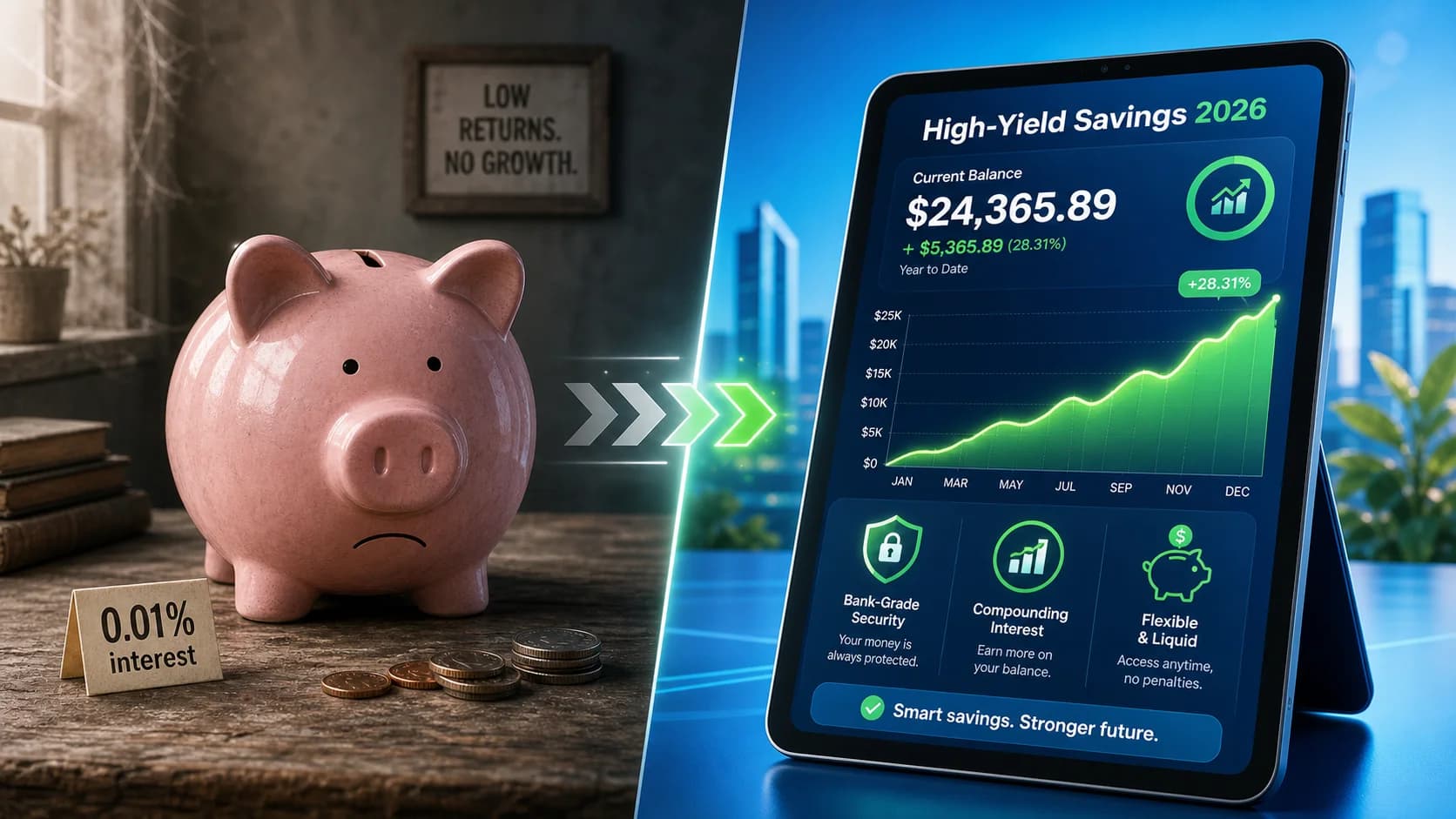
With the Federal Reserve holding rates at 5.25-5.50% through mid-2026 (according to the Federal Open Market Committee's latest projections), high-yield savings account (HYSA) yields remain historically attractive at 4.50-5.25% APY. Yet 58% of Americans still keep emergency funds in traditional savings accounts earning just 0.01-0.09% APY. If you have $10,000 in a standard savings account, you could be losing up to $493 per year in potential interest. This guide shows exactly why switching matters and how to do it in minutes.
The Short Answer -- Yes, You Should Switch
If your emergency fund is sitting in a traditional savings account at a big bank, you are leaving free money on the table. The math is unambiguous: the same $10,000 that earns $7 per year at Chase or Bank of America earns approximately $500 per year in a top high-yield savings account. That $493 difference is yours to keep. You just have to claim it.
The Math in 30 Seconds
- Traditional savings (0.07% APY): $10,000 earns $7 per year
- High-yield savings (5.00% APY): $10,000 earns $500 per year
- Your gain by switching: $493 per year -- essentially free money
Over a 10-year period, that same $10,000 emergency fund would earn approximately $70 in a traditional account versus $6,289 in a HYSA. A difference of $6,219. If you are serious about building long-term wealth, every dollar sitting in a low-yield account is a dollar not working for you.
When HYSA Makes Sense
- Emergency fund (3-6 months of expenses)
- Short-term savings goals under 3 years (vacation, down payment, car purchase)
- Cash reserves while waiting to invest
- Layered savings strategy alongside other financial tools
When HYSA Might NOT Be Best
- Long-term growth goals (5+ years): investing in diversified assets typically outperforms HYSA returns
- If you need in-person branch access regularly
- If you already have a traditional bank relationship you actively value
What Is a High-Yield Savings Account?
A high-yield savings account is a deposit account offered primarily by online banks that pays a significantly higher annual percentage yield (APY) than traditional brick-and-mortar banks. The account functions identically to a standard savings account -- you deposit money, earn interest, and can withdraw at any time -- but the interest rate is substantially higher because online banks pass their lower operating cost savings on to customers.
How HYSA Works
- Same FDIC insurance protection as big banks (up to $250,000 per depositor)
- Variable rate that changes with Federal Reserve policy
- Typically offered by online-only banks (Ally, Marcus, Discover, etc.)
- Interest compounds daily or monthly
- No minimum balance at most top providers
Why Online Banks Pay More
Online banks do not operate physical branches, which means they save significantly on overhead costs including real estate, branch staff, and in-person infrastructure. These savings are passed directly to customers in the form of higher APYs. Additionally, online banks operate in a highly competitive market for deposits, which further drives rates upward.
Current HYSA Landscape (June 2026)
- Top HYSA rates: 4.75-5.25% APY
- Average traditional bank rate: 0.01-0.09% APY
- Federal Reserve target rate: 5.25-5.50% (holding steady)
- Rate gap: approximately 50x higher at online HYSA providers
The Real Cost of Keeping Cash in Traditional Savings
The difference between traditional and high-yield accounts is not trivial. It compounds dramatically over time. Below is a side-by-side comparison showing exactly how much money you lose by staying put.
Lost Interest Calculator: $10,000 Emergency Fund
- Traditional Savings (Chase, BoA, Wells Fargo): $7/year to $35 in 5 years to $70 in 10 years
- High-Yield Savings (Ally, Marcus, Discover): $500/year to $2,763 in 5 years to $6,289 in 10 years
- Money left on the table: $493/year to $2,728 in 5 years to $6,219 in 10 years
Lost Interest Calculator: $30,000 Emergency Fund
- Traditional Savings: $21/year to $105 in 5 years to $210 in 10 years
- High-Yield Savings: $1,500/year to $8,289 in 5 years to $18,867 in 10 years
- Money left on the table: $1,479/year to $8,184 in 5 years to $18,657 in 10 years
The Opportunity Cost Over Time
If you invested the $493 annual difference between traditional and high-yield savings into a diversified index fund averaging 7% annual returns, that money would grow to approximately $2,850 after 5 years and $7,100 after 10 years. Inaction is not a neutral choice -- it is an active decision to forfeit thousands of dollars in potential wealth building. The opportunity cost of not having an adequate emergency fund is also worth considering -- without sufficient savings set aside, unexpected expenses can derail your financial progress and force you into debt.
Understanding how much you actually need for an emergency fund is key to building a savings strategy that works for your specific situation.
Are High-Yield Savings Accounts Safe?
Safety is the most common objection to switching savings to an online bank. The short answer: yes, HYSAs are just as safe as traditional savings accounts from big banks, and often safer in terms of financial returns.
FDIC Insurance -- The Same Protection as Big Banks
For authoritative FDIC coverage information, visit the official FDIC website at fdic.gov. For Federal Reserve monetary policy updates, consult federalreserve.gov. These primary sources provide the most accurate regulatory information available.
- FDIC insurance covers up to $250,000 per depositor, per bank, per ownership category
- All major online HYSA providers (Ally, Marcus, Discover, SoFi) are FDIC-insured
- Credit union equivalent: NCUA insurance with the same $250,000 limit
- Verify FDIC status anytime at official fdic.gov/bankfind tool
What FDIC Insurance Covers
- Bank failure: Yes, your deposits are protected if the bank goes under
- Fraud and unauthorized transactions: Yes, covered under Regulation E consumer protection
- Theft and identity fraud: Yes, standard zero-liability policies apply
- Natural errors: Yes, bank errors in your favor are covered
What FDIC Insurance Does NOT Cover
- Rate decreases: Your APY can drop if the Federal Reserve cuts rates
- Account fees: Some HYSAs charge maintenance or withdrawal fees (most top picks do not)
- Withdrawal limits: Federal Regulation D historically limited savings withdrawals to 6 per month (currently suspended but banks may enforce their own limits)
- Investment losses: HYSA is not an investment -- but you also cannot lose principal
Red Flags to Avoid
- Rates above 6% APY from unknown institutions: Potential scam indicator
- Pressure tactics demanding immediate action via email or text
- Requests for sensitive information through unofficial channels
- No clear physical address, customer service number, or bank website
- Institutions not showing up on the FDIC BankFind tool
HYSA vs Alternatives -- Where Should Your Cash Live?
High-yield savings accounts are not the only option for parking cash. Understanding how they compare to alternatives helps you make the right decision for each financial goal.
HYSA vs Traditional Savings
- HYSA pays 50-100x more interest (5.00% vs 0.05% average)
- Both offer FDIC insurance up to $250,000
- Both provide high liquidity with no lock-in period
- Traditional banks offer physical branches if you value in-person service
HYSA vs Money Market Accounts
- Money market accounts typically pay slightly lower rates (4.50-5.00% vs 4.75-5.25% for HYSA)
- Money market accounts may include check-writing privileges
- Both are FDIC-insured and highly liquid
- HYSAs generally have lower or no minimum balance requirements
HYSA vs Certificates of Deposit (CDs)
- CDs offer fixed rates, good if you want to lock in today's high rates before they fall
- CDs penalize early withdrawal (typically 3-6 months of interest)
- HYSAs offer full liquidity, ideal for emergency funds that need to be accessible immediately
- Best strategy: Use HYSA for emergency funds, CD laddering for goals with known timelines
How to Open a High-Yield Savings Account in 2026
Opening a HYSA takes approximately 10-15 minutes and requires minimal documentation. Here is the step-by-step process.
First, Choose Your Provider
- Compare current APYs across top providers (Ally, Marcus, Discover, SoFi, Wealthfront)
- Check for any account fees or minimum balance requirements
- Verify FDIC/NCUA insurance status
- Review customer service options (phone, chat, email availability)
Then, Prepare Required Information
- Government-issued photo ID (driver's license, passport)
- Social Security number
- Date of birth and contact information
- External bank account routing and account numbers for transfers
Finally, Complete the Online Application
- Fill out personal information on the provider's website or mobile app
- Agree to terms and conditions
- Fund the account with an initial deposit (most require $0-$100 minimum)
Step 4: Transfer Your Emergency Fund
- Link your existing bank account
- Initiate an ACH transfer (typically completes in 1-3 business days)
- Set up recurring deposits if using an auto-save feature
- Update any automatic transfer instructions from your old account
Top High-Yield Savings Accounts in 2026
Based on current APYs, fee structures, and customer experience ratings, these providers stand out in the 2026 HYSA landscape.
Ally Bank
- APY: 4.75% (competitive with market leaders)
- No minimum balance or monthly fees
- 24/7 customer service via phone and chat
- User-friendly mobile app and website
Marcus by Goldman Sachs
- APY: 4.90% (among the highest for well-known institutions)
- No fees, no minimums
- Backed by Goldman Sachs reputation and stability
- smooth integration with other Goldman Sachs products
Discover Online Savings
- APY: 4.80% with Discover's established banking infrastructure
- No account fees or minimum balance requirements
- 24/7 US-based customer service
- Cashback rewards on Discover debit card (where applicable)
Common HYSA Questions Answered
The Bottom Line: Start Earning More Today
The math is unambiguous: keeping your emergency fund in a traditional savings account is one of the most expensive financial habits you can maintain. With top HYSAs paying 4.75-5.25% APY versus the 0.01-0.09% APY at big banks, the difference costs the average saver hundreds of dollars per year. Money that compounds into thousands over a decade.
Switching takes less than 15 minutes, requires no minimum deposit at most providers, and your money remains fully FDIC-insured and accessible. There is no downside and significant upside. If you have been putting off switching your savings, the 2026 rate environment makes now the ideal time to act.
Take control of your money today
Start free with Spendmate — track expenses, plan budgets, and reach your financial goals.
Start free with Spendmate