
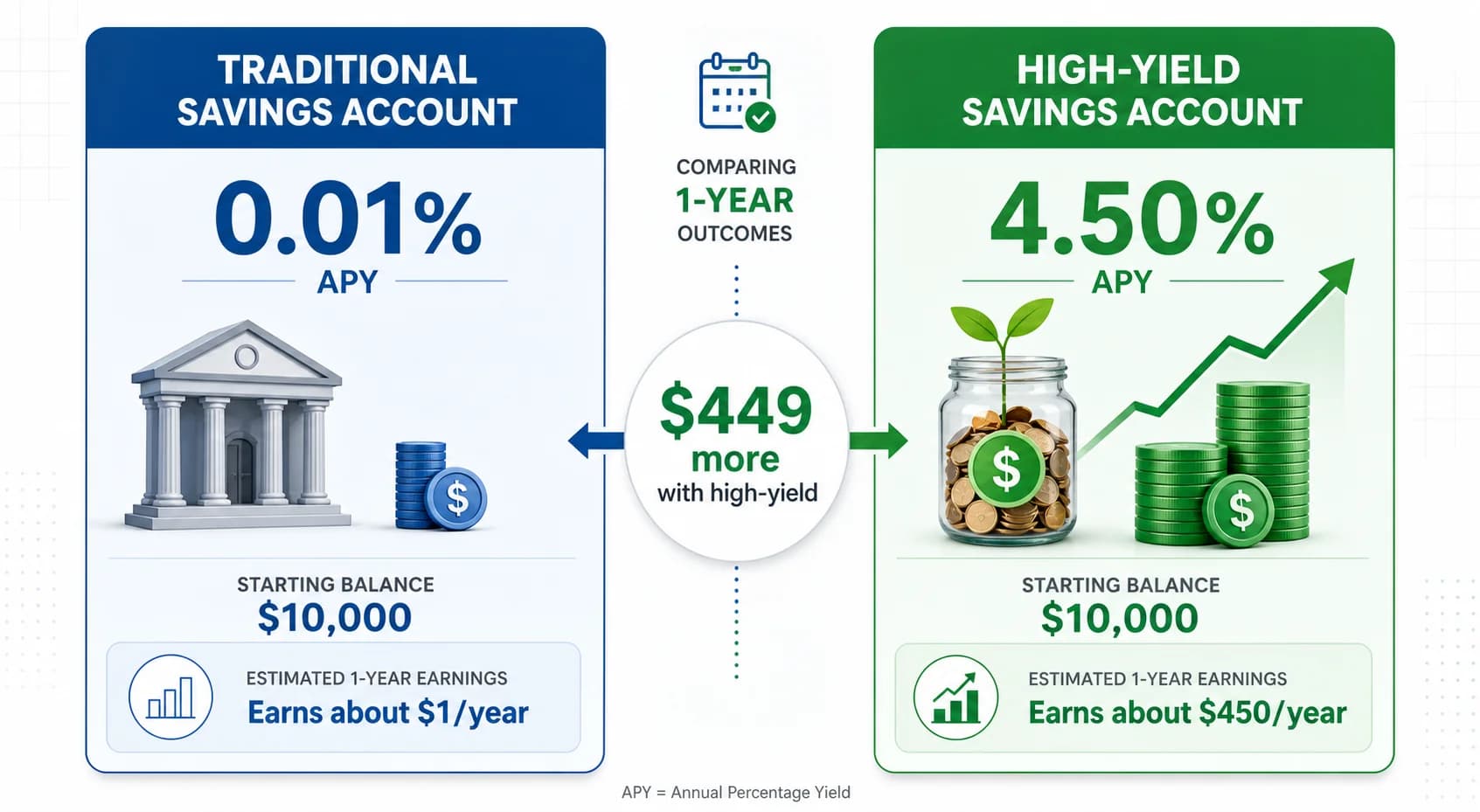
If you have $10,000 sitting in a traditional savings account right now, you are losing roughly $445 per year. That is not a typo. Most big banks pay 0.01% APY — roughly $1 annually on $10,000. Meanwhile, high-yield savings accounts (HYSAs) at online banks like Ally, SoFi, and Marcus by Goldman Sachs are currently paying 4.50–5.00% APY as of July 2026. The same $10,000 earns $450–$500 per year in a HYSA. The switch takes about 10 minutes online. There is no catch, no lock-up, no risk to your principal. This guide gives you a decision system for choosing the right HYSA strategy based on your specific goals — whether that is building an emergency fund, saving for a vacation, or managing a six-figure cash reserve. For most people, Strategy A (single HYSA) is the right starting point.
High-Yield Savings Account Strategies: Maximize Your Savings in 2026
The Short Answer
HYSAs are paying 4.00–5.00% APY right now — the best rates in over 15 years. The Federal Reserve has held rates at 5.25–5.50% through mid-2026. Traditional bank savings accounts still pay 0.01–0.50% APY. On $10,000, that gap costs you $400–$500 per year, every year, for doing nothing different. If you need money within two years and want it liquid, a HYSA is the obvious move. If you are building an emergency fund, a HYSA wins on access alone. For medium-term goals (2–5 years), a CD ladder paired with a HYSA gives you better rates while keeping some cash accessible. Anything longer than five years and you need a brokerage account — a HYSA will not outpace inflation long-term.
Why High-Yield Savings Accounts Matter in 2026
The Rate Environment — Why Now Is the Time
The Federal Reserve has held interest rates at 5.25–5.50% through the first half of 2026, and that has pushed HYSA rates to their highest levels since 2008. As of July 2026, top online banks are paying 4.50–5.00% APY on high-yield savings accounts — Ally Bank at 4.50%, SoFi at 4.60%, Marcus at 4.40%, and Discover at 4.70%. Rate cuts are expected in late 2026 or 2027, which means the window for locking in these yields is not going to stay open forever. Move now, not later.
For context: in 2020–2021, when the Fed funds rate was near zero, HYSAs were paying just 0.50–1.00% APY. The same $50,000 in a HYSA that earns $2,250 today would have earned only $375–$500 back then. This is entirely driven by Fed policy, not by any change in the underlying product. Banks did not suddenly become more generous — the rate environment changed, and so did what they could offer depositors.
The Cost of Doing Nothing
The numbers are not subtle. Here is what you lose annually by staying in a traditional savings account at 0.05% APY instead of a HYSA at 4.50% APY, according to FDIC data and current bank rate disclosures:
- $5,000: Traditional account earns $2.50/year. HYSA earns $225/year. You lose $222.50.
- $10,000: Traditional account earns $5.00/year. HYSA earns $450/year. You lose $445.00.
- $25,000: Traditional account earns $12.50/year. HYSA earns $1,125/year. You lose $1,112.50.
- $50,000: Traditional account earns $25.00/year. HYSA earns $2,250/year. You lose $2,225.00.
- $100,000: Traditional account earns $50.00/year. HYSA earns $4,500/year. You lose $4,450.00.
Over five years at 4.50% APY compounded monthly, $10,000 grows to $12,517 — $2,517 in pure interest. $50,000 grows to $62,586. In a traditional savings account at 0.05% APY, the same $50,000 would be worth just $50,125 after five years. That $12,461 difference is entirely free money you are leaving on the table by not switching.
HYSA vs. Other Savings Vehicles
Before choosing a strategy, know where a HYSA fits:
- HYSA: 4.00–5.00% APY, fully liquid, variable rates, FDIC-insured up to $250K. Best for emergency funds and short-term goals.
- CD (Certificate of Deposit): 4.50–5.50% APY, locked for term, fixed rates, FDIC-insured. Best for medium-term savings where you want to lock in a rate.
- Money Market Account: 4.00–4.75% APY, high liquidity (check/ATM access), variable rates, FDIC-insured. Best for large balances that need regular access.
- Treasury Bills (T-Bills): 4.75–5.25% APY, sell on secondary market or hold to maturity, fixed rates, state tax-exempt. Best for tax-conscious savers in high income-tax states.
The optimal approach is rarely "HYSA OR CD OR T-bills." It is usually a combination. For most people, a HYSA for your emergency fund plus a CD ladder for any medium-term goals is the right setup. You can compare current rates at the FDIC's BankFind tool or at Bankrate.com.
Step 1 — Define Your Savings Goal
Before picking a strategy, know what you are saving for. The right vehicle changes depending on your timeline and how much access you need.
The Four Savings Buckets
Financial planners typically bucket savings by time horizon. Each bucket has a different optimal vehicle.
Bucket 1: Emergency Fund (3–6 Months of Expenses)
Your financial safety net. Liquidity and capital preservation beat yield here. A HYSA earns a competitive rate while staying fully accessible. If you need funds urgently, you want them available within 1–3 business days — not locked in a CD. If you do not have an emergency fund yet, the best approach is to start with $1,000 and build up from there.
Bucket 2: Short-Term Goals (Less Than 2 Years)
Vacations, holiday spending, a wedding fund, a near-term home renovation. These have a defined endpoint and you do not want lock-up risk. A HYSA works here. Some savers also use no-penalty CDs, which allow early withdrawal without fee.
Bucket 3: Medium-Term Goals (2–5 Years)
A house down payment in three years, a new car fund, a major renovation. Here you can sacrifice some liquidity for higher rates. A CD ladder — staggering CDs across 3, 6, 9, and 12-month terms — gives you both rate optimization and regular access as each CD matures.
Bucket 4: Long-Term Goals (5+ Years)
Retirement, a child's college fund, any wealth-building goal beyond five years. A HYSA at 4.50% APY will not outpace inflation at 2.5–3.0% annually over that timeframe. You need a growth portfolio — a diversified index fund in a brokerage or retirement account. A HYSA is a cash tool, not an investment vehicle for long-term goals.
Step 2 — Choose Your HYSA Strategy
Once you know your buckets, pick the strategy that fits. Here are the four most effective approaches.
Strategy A — Single HYSA (Best for Most People)
Open one high-yield savings account at an online bank. Link it to your checking. Set up automatic transfers. Done. Ally Bank, SoFi, Marcus, and Discover all offer competitive rates with $0 minimums and no monthly fees. Ally and Discover both carry A+ ratings from the Better Business Bureau. This is the right starting point if you are new to HYSAs, have one primary savings goal like an emergency fund, and a balance under $250,000.
- Pros: One login, simple to manage, FDIC coverage up to $250K, takes 10 minutes to open online.
- Cons: No goal separation, all savings in one account, single FDIC limit.
- Best for: Beginners, people with one primary savings goal, balances under $250K.
Strategy B — Multiple HYSAs (Goal Separation)
Open two to four HYSAs at different banks, each tied to a specific goal. This approach uses the FDIC insurance limit more effectively — $250K per bank, per depositor — and makes it psychologically easier to track progress toward each goal without balances blurring together. Open one at Ally for your emergency fund, one at SoFi for your vacation savings, one at Marcus for your car fund.
- Pros: Clear goal tracking, multiple FDIC limits, ability to rate-shop across institutions, psychological benefit of separated balances.
- Cons: Multiple logins, more accounts to manage, requires slightly more organization.
- Best for: Goal-oriented savers with multiple short-term goals, anyone with more than $250K in liquid savings.
Strategy C — HYSA + CD Ladder (Rate Optimization)
Keep your emergency fund in a HYSA for liquidity. Build a CD ladder for medium-term goals to capture higher rates. A typical ladder structure: 25% in a 3-month CD at 4.75% APY, 25% in a 6-month CD at 5.00%, 25% in a 9-month CD at 5.10%, 25% in a 12-month CD at 5.25%. As each CD matures, you reinvest at the current rate or withdraw for your goal. You can buy CDs at Bankrate or directly through most online banks. Most CDs carry no penalty for early withdrawal, which reduces your actual risk substantially.
- Pros: Higher average yield than HYSA alone, rate diversification, regular access to funds as CDs mature.
- Cons: More complex setup, requires tracking maturity dates, some CDs have minimum deposit requirements ($500–$1,000 is common).
- Best for: Intermediate savers with medium-term goals — house down payment, car fund, wedding expenses.
Strategy D — HYSA + T-Bills (Tax Optimization)
Keep your emergency fund in a HYSA. Put additional savings into short-term Treasury bills (4, 8, 13, or 26 weeks) through TreasuryDirect.gov or a brokerage account. The key advantage: T-bill interest is exempt from state and local income tax. For high earners in California (9.3% top bracket), New York (10.9%), or other high-tax states, this can make T-bills outperform HYSAs on an after-tax basis.
Example: A California resident in the 32% federal bracket earning 5.00% on T-bills effectively nets 5.00% (federal tax still applies, but no state tax). The same 5.00% HYSA, after 32% federal tax and 9.3% California state tax, nets approximately 3.18%. T-bills win by roughly 1.8 percentage points on an after-tax basis for this saver.
- Pros: State and local tax advantage, competitive rates, backed by the full faith of the US government, short-term maturities provide flexibility.
- Cons: Requires TreasuryDirect account or brokerage account, slightly less liquid than HYSA (sell on secondary market or wait for maturity), not FDIC-insured (though government-backed).
- Best for: High-income savers, people in high state income tax states, anyone with a large cash reserve (>$250K) seeking yield optimization.
Step 3 — Open and Fund Your HYSA
What to Look for in a HYSA Provider
Not all HYSAs are equal. Top factors to evaluate before opening an account:
- APY: Check the current rate and how often it changes. Top online banks adjust within 1–2 weeks of Fed rate changes.
- FDIC Insurance: Confirm the bank is an FDIC member. Coverage is up to $250,000 per depositor, per bank — check using the FDIC's BankFind tool at fdic.gov.
- Minimum Balance: Most online HYSAs have $0 minimum. Avoid accounts with balance minimums that could trigger fees.
- Monthly Fees: Stick with $0-fee accounts. A $10/month fee on a $5,000 balance costs $120/year — wiping out several months of interest.
- Transfer Speed: ACH transfers take 1–3 business days. Some banks offer faster internal transfers or instant transfers to linked accounts.
- Mobile App: You will manage this account regularly. Check app store ratings before committing.
- Sub-Accounts: Some HYSAs let you create virtual buckets within one account for different goals — convenient if you want separation without multiple accounts.
Step-by-Step Setup Process
- Compare three to five HYSA providers at Bankrate, NerdWallet, or the FDIC's BankFind tool. Focus on current APY, fees, and user experience.
- Choose your primary HYSA for your most important goal — typically your emergency fund.
- Open the account online. You will need your SSN, government-issued ID, and bank account information. The process takes 5–10 minutes.
- Link your external bank account. Most banks verify with micro-deposits — two small deposits appear in 1–2 business days, which you confirm to verify ownership.
- Set up automatic transfers. Decide on a monthly amount or per-paycheck contribution. Automating is how you actually build savings consistently.
- Move your existing savings from your low-yield account. Keep only 1–2 months of essential expenses in checking.
- Download the mobile app and enable notifications for deposits, withdrawals, and rate change alerts.
How Much to Transfer Immediately
- Emergency fund: Transfer the full target amount on day one if you can — $15,000–$25,000 for a $5,000/month household is a common benchmark.
- Short-term goals: Transfer current balance, then set up automatic monthly contributions.
- Keep $500–$1,000 in checking for immediate, unplanned expenses to avoid triggering transfers.
- Keep your old savings account open — some banks offer free internal transfers that are faster than external ACH.
Step 4 — Maximize Your HYSA Earnings
Compound Interest — How Your Money Grows
Compound interest is the engine behind HYSA growth. Your principal is guaranteed — you earn interest on your balance, then you earn interest on that interest. Here are realistic projections at 4.50% APY, based on standard compound interest calculations:
- $10,000 initial, no contributions: $10,459 after 1 year, $11,441 after 3 years, $12,517 after 5 years.
- $10,000 initial + $500/month contributions: $16,459 after 1 year, $31,441 after 3 years, $48,517 after 5 years.
- $25,000 initial, no contributions: $26,148 after 1 year, $28,603 after 3 years, $31,293 after 5 years.
- $25,000 initial + $1,000/month contributions: $38,148 after 1 year, $67,603 after 3 years, $100,293 after 5 years.
- $50,000 initial, no contributions: $52,296 after 1 year, $57,206 after 3 years, $62,586 after 5 years.
- $50,000 initial + $2,000/month contributions: $76,296 after 1 year, $135,206 after 3 years, $200,586 after 5 years.
Warren Buffett's advice applies here: "Do not save what is left after spending, but spend what is left after saving." $500/month sounds modest, but over five years at 4.50% APY, those contributions grow to more than $34,000 in interest alone. The automation does the heavy lifting — you do not have to think about it.
Rate Shopping — When to Switch Banks
HYSA rates are variable — they change with the Fed funds rate. Most online banks adjust within 1–2 weeks of a Fed rate change. The practical rule: switch if your current HYSA is more than 0.50% below the top available rate and the difference amounts to $100+ per year in lost interest. On $25,000, that is only a $125 difference — not worth switching. On $100,000, a 0.50% gap is $500/year — worth the 10-minute account setup.
Switching is straightforward: open your new account, link it, initiate an ACH transfer, and close the old account if you want. There is no penalty for closing a HYSA. Budget 3–5 business days for the full transfer. Some banks also offer sign-up bonuses of $100–$500 for new accounts with minimum deposit requirements — worth checking on Bankrate before you open anything.
Maximizing FDIC Insurance
The FDIC insures up to $250,000 per depositor, per bank. If your total liquid savings exceed this, you have two primary strategies: multiple banks or joint account structuring. You can use the FDIC's Electronic Deposit Insurance Estimator (EDIE) at fdic.gov/edie to calculate your exact coverage.
- Multiple banks: $500,000 across two banks = $500,000 in FDIC coverage ($250K per bank). Three banks = $750K coverage.
- Joint accounts: A joint account with a spouse or partner is insured up to $500,000 ($250K x 2). A trust account can go much higher depending on structure.
- Practical recommendation: Two to three HYSAs at different banks is the sweet spot for most high-savers — enough FDIC coverage without excessive account management.
HYSA + Direct Deposit Strategy
Some HYSAs offer bonus rates of 0.25–0.50% extra APY when you set up qualifying direct deposit. If your employer offers direct deposit, split it: route the majority to your checking for bills and daily expenses, and route a fixed amount — even $200–$500 per paycheck — directly to your HYSA. This pay-yourself-first approach automates savings without relying on willpower or remembering to transfer manually.
Step 5 — Avoid Common HYSA Mistakes
Even with a solid strategy, it is easy to undermine your savings progress. Here are the five most costly mistakes.
Mistake 1: Keeping Too Much in Checking
Checking accounts earn 0.01–0.10% APY — fractions of a HYSA rate. Keeping three or more months of expenses in checking costs you hundreds of dollars per year in foregone interest. Keep only 1–2 months of essential expenses in checking. Everything else belongs in your HYSA.
Mistake 2: Chasing Rates Too Aggressively
Switching banks every month for a 0.10% APY bump is not worth the time. On $25,000, that difference is $25/year. Time cost, transfer delays, and the risk of making a mistake in the process do not justify it. Switch only if the gap is 0.50%+ or $100+/year.
Mistake 3: Ignoring Fees
Some HYSAs — particularly those from traditional banks with physical branches — charge monthly maintenance fees of $5–$15 if your balance drops below a minimum threshold. On a $5,000 balance, a $10/month fee costs $120/year. That single fee wipes out more than a month of interest at 4.50% APY. Read the fee schedule before opening any account, and stick with no-fee accounts from online banks.
Mistake 4: Using HYSA for Long-Term Investing
A HYSA at 4.50% APY sounds attractive, but inflation runs 2.5–3.0% annually. Your real return is only about 1.5–2.0% per year in purchasing power terms. Over 20 years, that gap compounds dramatically. For any goal more than five years away, you need a growth investment portfolio, not a savings account. If you are unsure where to start, a low-cost index fund like one tracking the S&P 500 is the right vehicle for most long-term goals.
Mistake 5: Forgetting About Taxes
HYSA interest is taxed as ordinary income at your marginal federal tax rate, plus state income tax in most states. At the 22% federal bracket, $1,000 in HYSA interest costs $220 in federal tax. At the 32% bracket, it costs $320. If you earn $1,000 in interest on a $25,000 balance at 4.00% APY and are in the 24% federal bracket with 5% state tax, your after-tax yield drops from 4.00% to roughly 2.84%. T-bills offer a real tax advantage — their interest is exempt from state and local income tax — and are worth considering if you are in a high tax bracket.
FAQ — HYSA Strategy Questions
- What is a good APY for a high-yield savings account in 2026?
- 4.00–5.00% APY as of July 2026 is competitive. Top-tier HYSAs are paying 4.50–5.00%. If your account is earning below 3.50%, switch immediately — you are leaving money on the table. Compare rates monthly at Bankrate or NerdWallet.
- How much should I keep in a high-yield savings account?
- Keep 3–6 months of essential expenses in a HYSA as your emergency fund. Beyond that, keep short-term goal savings (vacation, wedding, home renovation) in HYSA. For medium-term goals (2–5 years), look at CD ladders. For long-term goals (5+ years), you need the stock market.
- Is a high-yield savings account safe?
- Yes, as long as the bank is FDIC-insured — and most online banks are. FDIC covers up to $250,000 per depositor, per bank. Online banks are just as safe as traditional banks with physical branches. Your deposits are insured the same way.
- Should I use a HYSA or CD in 2026?
- Use HYSA for money you need within 2 years — emergency fund, short-term goals. Use CDs for money you will not need for 6–24 months where you want to lock in a rate. Best setup for most people: HYSA for your emergency fund + CD ladder for medium-term savings.
- Do I pay taxes on HYSA interest?
- Yes. HYSA interest is taxed as ordinary income. You receive a 1099-INT if you earn more than $10 in interest. At the 22% federal bracket, $500 in interest costs $110 in federal tax. State taxes may apply too. T-bills have a tax advantage — interest is exempt from state and local tax.
- Can I lose money in a HYSA?
- No principal loss in an FDIC-insured HYSA. The only real risks are rate drops (your APY goes down) and inflation outpacing your interest. Your balance never goes down due to market movements — FDIC insurance guarantees your principal.
- How do I choose between an online HYSA and a local bank?
- Online HYSAs almost always offer higher rates (4.00–5.00% vs. 0.01–0.50% at traditional banks). Local banks are useful for cash deposits and in-person service. Best approach: small checking account at a local bank or credit union for ATM access, bulk of your savings in an online HYSA for the best rate.
- What happens if the Fed cuts rates?
- Your HYSA APY will drop within 1–4 weeks of a Fed rate cut. If you want to lock in current rates, consider moving some savings to CDs or T-bills before cuts happen. Rate cuts are expected in late 2026 or 2027. A CD ladder approach helps you adapt without doing anything dramatic.
Take control of your money today
Start free with Spendmate — track expenses, plan budgets, and reach your financial goals.
Start free with Spendmate