
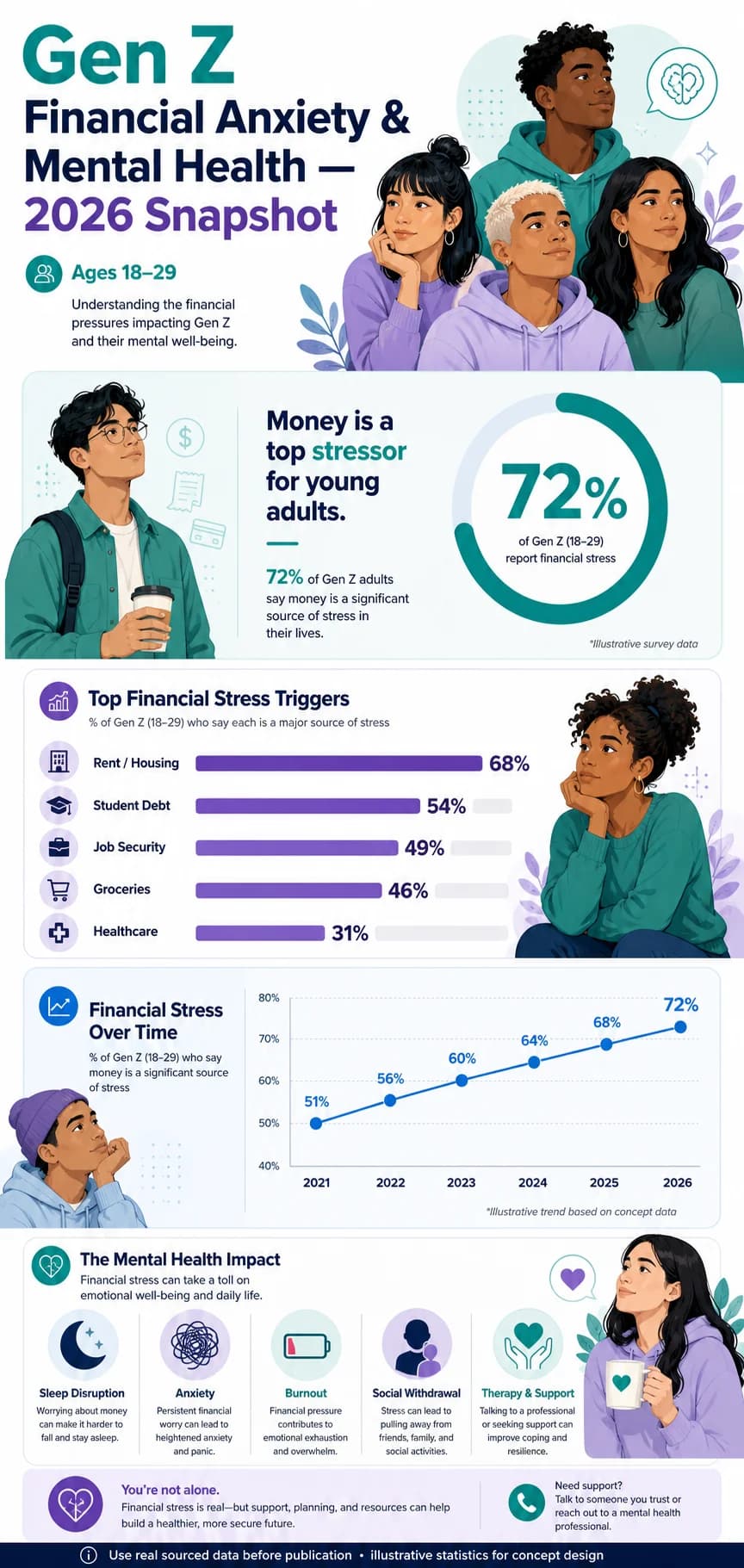
You're not imagining it. Gen Z financial anxiety IS at an all-time high, and there are real structural reasons why. According to the American Psychological Association's 2026 Stress in America survey, 73% of Gen Z report money as their top stressor — higher than any previous generation at the same age. This thorough guide validates your experience with data, explains why your generation faces unique pressures, and provides gentle, practical steps to build financial stability without sacrificing your mental health.
The Data — Gen Z Money Stress by the Numbers
Before looking at why this is happening, let's establish that the stress is real and data-backed — not anecdotal, not personal failure, not "being dramatic." The numbers tell a stark story that validates what millions of young adults feel every time they check their bank account.
- 73% of Gen Z report money as their top stressor — vs. 59% of Millennials and 47% of Gen X (APA 2026 Stress in America survey)
- 68% live paycheck to paycheck (Federal Reserve 2026 data)
- Average Gen Z net worth: $8,200 (ages 18–29) vs. $14,500 for Millennials at the same age (inflation-adjusted)
- Average student debt: $37,000 per borrower (Class of 2025)
- 45% of Gen Z renters spend 45% of income on housing vs. 28% for Boomers at the same age
- 61% report physical anxiety symptoms — racing heart, nausea, panic — when checking their bank account
This is not in your head. The stress is real, systemic, and generational. Your anxiety is an appropriate response to genuinely difficult circumstances — not a character flaw or a spending problem.
Why Gen Z Specifically Faces Unique Financial Pressures
Every generation faces financial challenges, but Gen Z entered adulthood during a perfect storm of economic pressures that previous generations simply did not experience to the same degree. Understanding these six systemic factors is the first step tobreak free from shame and building agency.
Factor 1: Entering the Workforce During Economic Instability
Many Gen Z workers graduated into either the 2020 pandemic recession or the 2024–2026 high-inflation period. Starting salaries did not keep pace with cost of living increases. Remote work reduced entry-level opportunities in some sectors while AI automation anxiety creates uncertainty about future job security. The math is sobering: a starting salary of $45,000 in 2026 buys what $38,000 bought in 2021 — a 16% purchasing power loss before you've even begun your career.
Factor 2: Student Debt Burden
The average Gen Z graduate carries $37,000 in student debt, with monthly payments of $350–$500. This creates a psychological weight of "starting adulthood in a hole" — friends who did not attend college are already saving for a house while you're paying down principal. Many Gen Z are also helping their parents financially, creating a double burden that previous generations rarely faced.
Factor 3: Housing Affordability Crisis
Median home prices have increased 50% since 2020, from $280,000 to $420,000 in 2026. A 20% down payment now requires approximately $84,000 — takes 10+ years to save at typical Gen Z income levels. While Boomer homeownership rate at age 30 was 52%, Gen Z is projected at just 35%. Homeownership does not just feel difficult for your generation — it feels impossible.
Factor 4: Gig Economy and Income Instability
About 44% of Gen Z has a gig or freelance income component, according to Upwork 2026 data. While this offers flexibility and multiple income streams, it also means no employer benefits, unpredictable cash flow, complex tax situations, and no retirement match. Some months bring $4,000, others bring $1,200 — the "feast or famine" cycle creates chronic anxiety that traditional W-2 employment does not.
Factor 5: Social Media Comparison Trap
Gen Z is the first generation to grow up with social media from adolescence, meaning constant exposure to curated wealth displays. Finance influencers showing "I made $10K last month!" create unrealistic expectations. FOMO on experiences peers post about — travel, dining, events — creates pressure to maintain an aesthetic life while actually being broke. The lie of social media: everyone else is thriving except you. They are not — it's curated.
Factor 6: Delayed Traditional Milestones
Homeownership is delayed 7–10 years compared to parents. Average marriage age is 32 (vs. 26 for Boomers), children at 34 (vs. 28), and retirement savings starting 5–8 years later than ideal. The psychological toll of feeling "behind" even when doing everything right is profound — you're not failing, the game has changed.
The Mental Health Impact — When Money Worry Becomes Anxiety Disorder
There is a critical difference between normal financial stress and clinical financial anxiety. Understanding where you fall on this spectrum helps you decide what next steps are appropriate for your situation.
Normal Stress vs. Clinical Anxiety
- Normal stress: Worrying before paying bills, feeling frustrated about prices, mild concern about debt
- Clinical anxiety: Panic attacks when checking bank account, avoiding financial tasks entirely, physical symptoms like nausea, insomnia, or headaches, inability to focus at work due to money worry
Common Manifestations of Financial Anxiety
- Avoidance: Not opening bills, not checking bank account, ignoring debt statements
- Compulsive behaviors: Obsessively checking accounts, refreshing investment apps, scrolling finance TikTok for hours
- Physical symptoms: Chest tightness, stomach issues, tension headaches, sleep disruption
- Emotional symptoms: Shame, guilt, hopelessness, irritability, feeling trapped
The vicious cycle: Financial stress leads to anxiety, which leads to avoidance, which leads to a worse financial situation, which leads to more stress. Breaking the cycle requires BOTH mental health support AND financial action — one alone is not enough.
When to Seek Professional Help
Consider seeking professional help when anxiety is interfering with daily functioning — work, relationships, self-care. When using substances to cope with money stress. When having thoughts of hopelessness or self-harm. Resources include therapy apps like BetterHelp and Talkspace, campus counseling, sliding-scale therapists, and financial therapists who specialize in the intersection of money and mental health.
Coping Strategies — Managing Anxiety While Building Stability
Here's the truth that most personal finance content misses: you cannot out-frugal your way out of systemic anxiety. Real relief comes from mindset shifts AND practical action working together. Below are strategies that actually help — not "stop buying coffee" platitudes.
Mindset Shifts That Actually Help
- Reframe: This is not personal failure — you entered a harder economic game than your parents
- Accept: Some things are genuinely outside your control — housing market, Fed policy, student debt system
- Focus: Identify control zones (spending, savings rate, skill-building) vs. acceptance zones (economy, interest rates)
- Compare less: Curated social media does not equal reality — people posting Lambos also have debt
- Celebrate small: Paid off $500 debt? Saved first $1,000? These ARE victories worth acknowledging
Practical Anxiety-Reduction Tactics
- Scheduled money dates: Check finances once per week for 30 minutes — not daily doom-scrolling
- Automate everything: Reduce decision fatigue — auto-transfer to savings, auto-pay bills
- Create a buffer: Even $500 emergency fund reduces "one surprise away from disaster" anxiety
- Limit finance social media: Unfollow accounts that make you feel inadequate
- Body-based calming: Box breathing before checking accounts, take a walk after money tasks
- Talk about it: Money shame thrives in silence — share with trusted friends or online communities
First Steps — Where To Start When You Feel Overwhelmed
The most important thing to understand: do not try to do everything at once. Pick ONE step this week. Momentum matters more than perfection. Here's a practical starting sequence:
- Step 1: Track spending for 2 weeks — no judgment, just data — use an app or spreadsheet
- Step 2: List all debts — balance, interest rate, minimum payment — see the full picture
- Step 3: Open a high-yield savings account — separate from checking, out of sight
- Step 4: Set up a $500 mini emergency fund — covers small surprises, builds confidence
- Step 5: Pick ONE debt to attack first — smallest balance for quick wins OR highest rate for math optimization
- Step 6: Automate $25–$50 per week to savings — small consistent beats large inconsistent
FAQ — Gen Z Financial Anxiety
Am I the only Gen Z person who feels this stressed about money?
73% of Gen Z report money as their top stressor. You are in the majority, not a minority. The stress is real and structural — not a personal failing.
Is financial anxiety a real thing or am I being dramatic?
Financial anxiety is real and well-documented. 61% of Gen Z report physical anxiety symptoms when checking their bank account. Your response to financial stress is appropriate given the circumstances you entered adulthood into.
Why does checking my bank account make me feel sick?
This is a common physical stress response — your nervous system is responding to genuine threat (financial uncertainty). It does not mean something is wrong with you. Scheduled, limited exposure with calming techniques can help retrain this response over time.
Will this ever get better or am I doomed to be broke forever?
It gets better. Not instantly, not without effort, but genuinely better. Your earning potential typically increases with experience, student debt can be managed and eventually paid off, and housing situations change. The key is building small consistent habits that compound over time.
How do I stop comparing myself to people on social media?
The first step is recognizing that social media is a highlight reel, not reality. Unfollow accounts that trigger comparison. Follow creators who are honest about financial struggles. Remember: people posting luxury lifestyles often have significant debt they are not showing you.
Should I tell my parents I am struggling financially?
If your relationship is safe and supportive, honest conversations can relieve shame and sometimes unlock practical help. However, if your family is a source of financial stress or judgment, it is okay to protect your peace and seek support elsewhere.
Is therapy worth it for money stress?
Yes, especially if financial anxiety is interfering with daily functioning. Financial therapists specialize in the money-mental health intersection. Many offer sliding-scale pricing, and insurance increasingly covers mental health services.
What if I cannot afford therapy right now?
Campus counseling (if student), community mental health clinics, support groups, and apps likeivo and 7 Cups offer free or low-cost options. Building financial literacy and community support can also be powerful complementary strategies.
Ready to Take Your Next Step?
The most important thing to remember: you're not alone, you're not imagining it, and you're not destined to feel this way forever. Small consistent actions build momentum. Pick ONE thing from this article — maybe just tracking your spending for two weeks — for a step-by-step guide, see our Budgeting for Beginners guide — and start there. Progress is not about perfection; it's about direction.
Take control of your money today
Start free with Spendmate — track expenses, plan budgets, and reach your financial goals.
Start free with Spendmate