
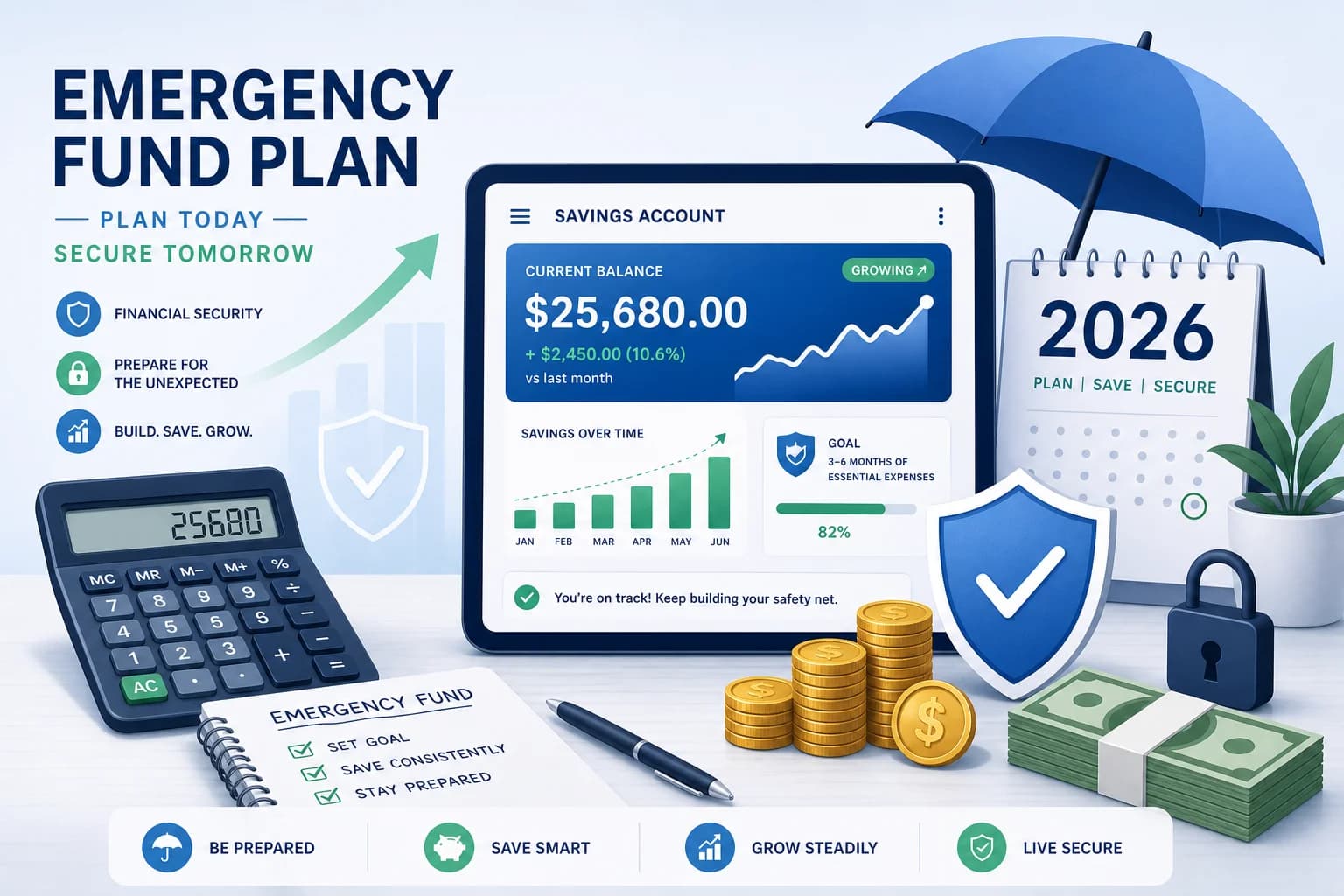
Financial advisors have long said you need 3 to 6 months of expenses set aside for emergencies. But here is the truth: a single parent freelancer needs a very different emergency fund than a dual-income couple with stable government jobs. This guide breaks down exactly how to calculate YOUR personalized number, build it faster than you think possible, and know precisely when you have enough. With 2026 HYSA rates earning 4.5 to 5.2% APY, there has never been a better time to start.
Quick Answer: How Much Should YOU Have in Your Emergency Fund?
The short answer depends entirely on your financial situation. Here is the practical framework:
- Minimum starter fund: $1,000 to $2,000 (covers small emergencies while you build your full fund)
- Full emergency fund for most people: 3 to 6 months of essential expenses
- Lean toward 3 months if: dual income household, stable jobs, no dependents, low fixed expenses
- Lean toward 6 months if: single income household, variable income (freelance or commission), dependents, high fixed expenses, homeowner
- Consider 9 to 12 months if: freelancer or contractor with irregular income, single parent, specialized career with long job search timelines, chronic health issues
The key insight is this: your emergency fund target should be based on your risk profile, not a generic rule. A freelance graphic designer with variable income needs a larger cushion than a tenured government employee with a predictable paycheck.
Why You Need an Emergency Fund (Beyond the Obvious)
Most people know an emergency fund protects against job loss or unexpected car repairs. But the benefits go much deeper:
- Mental health buffer: Reduces financial anxiety and improves decision-making across all areas of life
- Prevents debt spirals: Credit card debt from emergencies derails long-term wealth building for years
- Career flexibility: Allows you to leave a toxic job without taking the first desperate offer that comes along
- Relationship protection: Money conflicts are among the leading causes of divorce and family stress
Here are the 2026 statistics that make the case: 42% of Americans have less than $1,000 in emergency savings. The average unexpected expense runs $2,800 according to AAA car repair data. The average job search for professional roles takes 4.2 months. And medical deductible averages are $1,900 for individuals and $3,800 for families on employer plans. The math is clear: being unprepared is genuinely risky.
Calculate YOUR Emergency Fund Number (Step-by-Step)
Step 1: Track Your Monthly Essential Expenses
List ONLY the necessities you cannot cut if you lost your income. Include: housing costs (rent, mortgage, property tax, insurance), utilities (electric, water, gas, internet), groceries (not dining out), transportation (car payment, insurance, gas or transit pass), insurance premiums (health, life, disability), minimum debt payments (credit cards, student loans), childcare if required for work, and medications or medical essentials.
Do NOT include: dining out, entertainment, subscriptions, hobbies, travel, or shopping. These are the first things to cut during a job loss anyway.
Example essential monthly expenses: Rent $1,800, utilities $200, groceries $450, car payment and insurance plus gas $550, health insurance premium $320, minimum debt payments $480, childcare $800. Total essential expenses: $4,600 per month.
Step 2: Choose Your Multiplier (3, 6, or 9 Months)
Use this decision framework to pick your multiplier:
Choose 3 months of expenses if: you have a dual-income household with both partners employed, both jobs are stable (government, tenured, or essential industries), you have no children or dependents, you rent your home, your fixed expenses are less than 50% of your income, and you have a strong local support network.
Choose 6 months of expenses if: you are a single-income household, you are a working parent with dependents, you own your home (potential for major repairs), your industry has moderate volatility (tech, media, retail), your fixed expenses consume 50 to 70% of your income, and you have a limited local support network.
Choose 9 to 12 months of expenses if: you are a freelancer, contractor, or on commission-based income, you are a single parent as sole caregiver and earner, you have a specialized career with long job search timelines (executive or niche technical roles), you have chronic health issues with higher medical cost risk, you are approaching retirement within 5 to 10 years and need bridge protection, or your industry is in disruption or decline.
Step 3: Calculate Your Target
The formula is simple: Monthly Essential Expenses multiplied by your chosen multiplier equals your target emergency fund. Here are real examples. Dual-income renters with no children and $3,200 in monthly expenses: $3,200 times 3 equals $9,600 target. Single parent who is a homeowner with $4,800 in monthly expenses: $4,800 times 6 equals $28,800 target. Freelancer who rents with $3,500 in monthly expenses: $3,500 times 9 equals $31,500 target.
Starter Emergency Fund: When the Full Target Feels Impossible
If $20,000 or $30,000 feels completely overwhelming and you have zero saved, there is a smarter way to start. Build a mini emergency fund of $1,000 to $2,000 FIRST, then focus on everything else.
This approach works because $1,000 to $2,000 covers most common emergencies (tire blowout, minor medical copay, small home repair). It builds momentum and confidence. It prevents credit card debt while you are building your full fund. And the psychological win of being an emergency fund owner changes your identity.
The practical sequence: Save $1,000 to $2,000 as fast as possible, typically 1 to 3 months. Then pause and attack high-interest debt aggressively. Once credit cards and high-interest loans are gone, expand your emergency fund to the full 3 to 6 month target. This prevents the common cycle of saving $1,000, having an emergency, and going back to zero.
Where to Keep Your Emergency Fund (2026 Best Options)
Your emergency fund storage must meet four criteria: liquidity (can access within 1 to 3 business days), safety (FDIC or NCUA insured, no investment risk), separation (not in your everyday checking account), and it should be earning interest (4.5 to 5.2% APY is available right now).
Option 1: High-Yield Savings Account (Recommended for Most People)
Current APY range is 4.5% to 5.2% as of mid-2026. The pros are FDIC insured protection, instant access when needed, no penalties, and competitive rates that actually grow your money. The main con is that rates are variable and can decrease if the Fed cuts rates. Top providers in 2026 include Marcus by Goldman Sachs at 4.85% APY with no fees, Ally Bank at 4.80% APY with a strong app and buckets feature, Discover Bank at 4.80% APY with cashback checking integration, Capital One 360 at 4.75% APY with optional branch access, and American Express Personal Savings at 4.85% APY with a trusted brand.
Option 2: Money Market Account
Current APY range is 4.3% to 5.0%. The advantage here is FDIC insurance combined with check-writing and debit card access. The downside is potential minimum balance requirements and rates that are often slightly lower than the best HYSAs. Consider this option if you want the fastest possible access to your emergency funds.
Option 3: Treasury Bills (For Advanced Users)
Current yield is approximately 4.8% to 5.1% depending on term length. The upside is federal government backing and state tax exemption on interest earned. The downside is that you must sell before maturity to access funds, requiring slight planning ahead. This option works best for people who already have a fully funded emergency fund and want to optimize yield on a portion of it.
Storage Options to AVOID
- Regular savings accounts earning 0.01% to 0.10% APY (you are losing to inflation)
- Investment accounts in stocks or bonds (too volatile, you could lose value exactly when you need funds most)
- Certificates of Deposit (penalties for early withdrawal defeat the purpose of liquidity)
- Cash at home (theft risk, fire risk, no interest, and too easy to spend)
- Retirement accounts (penalties and tax complications, plus you defeat the retirement savings purpose)
How to Build Your Emergency Fund (Even on a Tight Budget)
Strategy 1: Automate Small Amounts
Set up an automatic transfer from your checking account to your HYSA every payday. Start with $25 to $100 per paycheck, whatever is genuinely sustainable. Increase the amount by $10 to $25 every three months as your budget allows. Example: $50 per paycheck times 26 paychecks equals $1,300 saved in a year, plus the interest earned.
Strategy 2: Windfall Allocation
Commit 50% to 100% of any money you did not expect to receive. This includes tax refunds, work bonuses, cash gifts for birthdays or holidays, side hustle income for the first three to six months, and proceeds from selling items on Facebook Marketplace, eBay, or at garage sales. A realistic example: $2,000 tax refund plus $500 bonus plus $300 from item sales equals $2,800 added to your fund in a single quarter.
Strategy 3: 90-Day Expense Reduction Sprint
For 90 days, cut aggressively: cancel all non-essential subscriptions, meal plan to reduce grocery spending by 20% to 30%, temporarily pause retirement contributions beyond employer match, sell unused items, and reduce dining out to once per month or less. Redirect every dollar saved directly to your emergency fund. After 90 days, reintroduce some quality-of-life spending but keep the higher baseline contribution.
Strategy 4: Income Boost (Temporary Side Hustle)
Take on a short-term side hustle specifically dedicated to building your emergency fund. Options include food delivery at 10 hours per week potentially earning $200 to $300 weekly, TaskRabbit weekend gigs potentially earning $150 to $400 per weekend, freelance work using your existing skills at variable income, or overtime at your current job if available. Set a clear end date: I will do this until I reach $5,000. This prevents burnout. All side hustle income goes directly to your emergency fund without blending into your regular spending.
Strategy 5: The Found Money Rule
Any money you did not plan for or budget goes straight to your emergency fund. This includes credit card cashback rewards, mail-in rebates, refunds for returned items, price adjustments from retailers, utility deposits returned, and rewards points redeemed for cash rather than travel or gift cards. Small amounts genuinely add up over time.
Emergency Fund vs Debt Payoff: Which Comes First?
This is the question everyone asks, and the answer is a phased approach. Here is the balanced framework recommended by most financial experts.
Phase 1: Starter Emergency Fund ($1,000 to $2,000)
Save $1,000 to $2,000 first, taking 1 to 3 months for an aggressive sprint. This prevents new debt when small emergencies inevitably occur.
Phase 2: High-Interest Debt Attack
Pause expanding your emergency fund and focus everything on paying off credit cards and personal loans above 10% APR. The guaranteed return from eliminating 18% to 24% interest exceeds anything your HYSA can earn. This phase typically takes 6 to 18 months depending on total debt.
Phase 3: Full Emergency Fund
Resume emergency fund savings and target 3 to 6 months based on your multiplier. Contribute 10% to 15% of your income. This phase typically takes 12 to 24 months.
Phase 4: Retirement Acceleration
Once your emergency fund is complete and high-interest debt is gone, redirect those payments into retirement accounts beyond your employer match. You are now building long-term wealth while your emergency fund sits safely earning 5%.
What Counts as a TRUE Emergency (And What Does Not)
Yes, These Are Appropriate Uses
- Job loss or income interruption
- Medical emergency including unexpected illness, surgery, ER visit, or high deductible
- Car repair if it is a major repair needed for work transportation (transmission, engine, brakes)
- Home repair for urgent issues preventing habitation or causing major damage like roof leaks, burst pipes, or HVAC failure in extreme weather
- Family emergency including death (travel costs) or urgent caregiving needs
- Essential appliance replacement including refrigerator, stove, or washer dryer when no affordable alternative exists
- Unexpected legal fees for custody battles, immigration issues, or lawsuit defense
No, These Are NOT Appropriate Uses
- Planned expenses like car registration, annual insurance premiums, or property taxes (these are predictable, save separately for them)
- Vacations or travel (even if you feel you need a break, this is not an emergency)
- Holiday or birthday gifts (budget for these annually in advance)
- Shopping sales (a 50% off sale is not an emergency)
- Home upgrades, furniture purchases, or phone upgrades (unless functionally necessary)
- Investment opportunities (use investment dollars, not your emergency safety net)
- Helping adult friends or family members (your emergency fund is for YOUR emergencies)
- Scheduled debt payoff (use your regular budget for this)
Gray Area: Use Your Best Judgment
Wedding expenses are planned unless it is an emergency flight for a family crisis. Career certifications required to keep your current job are legitimate, but nice-to-have certifications for future opportunities are not. Pet emergency surgery is a personal values decision. Job-related relocation that your employer requires should be negotiated for reimbursement first. The rule of thumb is this: if you had 48 hours to decide, would this expense still be necessary? If yes, it is probably an emergency. If no, it probably is not.
When to Replenish Your Emergency Fund
After ANY withdrawal from your emergency fund, replenishment becomes your top financial priority. Pause other savings goals like vacation funds or extra retirement contributions. Temporarily reduce discretionary spending. Aim to restore what you withdrew within 6 to 12 months.
One important exception: if you used your emergency fund due to job loss and your new job pays significantly less, adjust your target downward temporarily. Your emergency fund should match your current reality, not an old salary.
Do not feel guilty about using your emergency fund. That is exactly what it is for. Successfully using it proves the system worked. You were protected instead of going into debt. That is the win.
Common Mistakes That Sabotage Emergency Funds
Mistake 1: Keeping It in Your Checking Account
The problem is that it is too easy to spend and earns no interest. The solution is to open a separate HYSA at a different bank than your regular checking account. The added friction of a 1 to 3 day transfer time reduces the temptation to dip in for non-emergencies.
Mistake 2: Making It Too Hard to Access
Investing your emergency fund in stocks or CDs for better returns defeats the purpose. The purpose of an emergency fund is safety and liquidity, not growth. Accept lower returns in exchange for the ability to access your money when you actually need it.
Mistake 3: Never Starting Because the Target Feels Too Big
A $20,000 target feels impossible when you have nothing saved, so people save nothing. The solution is to start with a $1,000 starter fund. Something is infinitely better than nothing. Starting is the hardest part, and once you have $1,000, getting to $2,000 is much easier.
Mistake 4: Dipping Into It for Non-Emergencies
Saying I will pay it back later becomes a permanent habit that depletes your safety net. The solution is to create separate sinking funds for predictable expenses like car maintenance, holiday gifts, and annual insurance premiums. These are not emergencies, so they should have their own savings buckets.
Mistake 5: Increasing Lifestyle as Your Fund Grows
The thinking goes: I have $10,000 saved, so I can afford nicer things now. But your emergency fund is not net worth and it is not spending money. It is insurance. Do not count it as money you are rich with.
Mistake 6: Not Adjusting for Life Changes
You built your fund when you were single and renting. Now you are married, have two kids, and own a home. If you never update your target, you are underinsured for your actual risk. Recalculate annually and after any major life event including marriage, having a baby, buying a home, or changing jobs.
Mistake 7: Hoarding Beyond Reasonable Need
Having $100,000 or more in an emergency fund while underfunding your retirement is a mistake. Once you reach your target (typically 6 to 12 months depending on your risk profile), redirect excess emergency fund contributions to retirement and investment accounts. Your money should be working harder for you in those accounts than sitting in a savings account earning 5%.
FAQ: Emergency Fund Questions Answered
- Is $10,000 enough for an emergency fund?
- For many people, yes. If your monthly essential expenses are $3,000 or less, $10,000 covers more than 3 months. However, single parents, homeowners, or people in high-cost areas may need $20,000 to $40,000. The only way to know your real number is to calculate it based on YOUR expenses, not an arbitrary dollar amount.
- Should I keep my emergency fund in a separate bank?
- Highly recommended. Keeping it at a different bank than your checking account adds friction through the 1 to 3 day transfer time, which reduces temptation to dip into it for non-emergencies. It also prevents accidental overdrafts from auto-transfers that can happen when your accounts are at the same institution.
- Can I use a credit card instead of an emergency fund?
- Not recommended as your primary strategy. Credit cards work for true emergencies if you can pay off the balance quickly, but most people carry balances and accrue 20% or higher interest. An emergency fund prevents debt.
- Do I need an emergency fund if I have a high income?
- Yes, possibly more than average. High earners often have higher fixed expenses including large mortgages, private school tuitions, and elevated lifestyle costs. Additionally, high-income jobs can be more volatile than average (tech layoffs, commission-based roles, business owners). Your target should be based on your expenses, not your income.
- What if I have both debt and no emergency fund?
- Follow the balanced approach: save a $1,000 to $2,000 starter fund first (1 to 3 months), then attack high-interest debt aggressively, then expand your emergency fund to the full 3 to 6 months. This sequence prevents new debt from small emergencies while you eliminate existing debt.
- Should emergency fund money be invested in stocks for better returns?
- No. The purpose of an emergency fund is safety and liquidity, not growth. If stocks crash 30% the same week you lose your job, you have lost access to your safety net at exactly the moment you need it most. Keep your emergency fund in an FDIC-insured savings account or money market account.
- How do I calculate expenses if my income varies?
- Base your calculation on essential expenses only (housing, food, utilities, insurance, minimum debt payments), not income. Track your actual spending for 3 months to get an accurate number. Freelancers and gig workers should use your highest-expense 3-month average, not your average income.
- Can I use my emergency fund for a down payment on a house?
- Not recommended. A down payment is a planned expense, so you should save for it separately using a sinking fund. Using your emergency fund leaves you financially vulnerable if job loss or a major home repair occurs shortly after closing.
- What if my emergency fund earns interest: do I pay taxes on it?
- Yes, interest earned in a HYSA or MMA is taxable income reported on a 1099-INT form. However, at 5% APY on a $10,000 balance, you earn $500 per year and pay approximately $100 in taxes at an average tax rate, leaving you with $400 in net interest. This is still far better than a regular savings account earning 0.01% APY.
- Should I tell my family or partner about my emergency fund?
- If you share finances with a partner, yes, transparency is critical for the relationship and for planning. If it is your personal fund within a marriage, have a conversation about boundaries and mutual expectations.
Start Your Emergency Fund Today
Building an emergency fund is not about fear. It is about freedom. It is about knowing that whatever life throws at you, you have a financial cushion that gives you options. You can leave a bad job without desperation. You can handle a medical deductible without credit card debt. You can sleep knowing that a flat tire or appliance replacement will not derail your entire month.
The best time to start was yesterday. The second best time is right now. Open a high-yield savings account today, set up a $25 or $50 automatic transfer, and start building your financial safety net. Your future self will thank you.
Take control of your money today
Start free with Spendmate — track expenses, plan budgets, and reach your financial goals.
Start free with Spendmate