
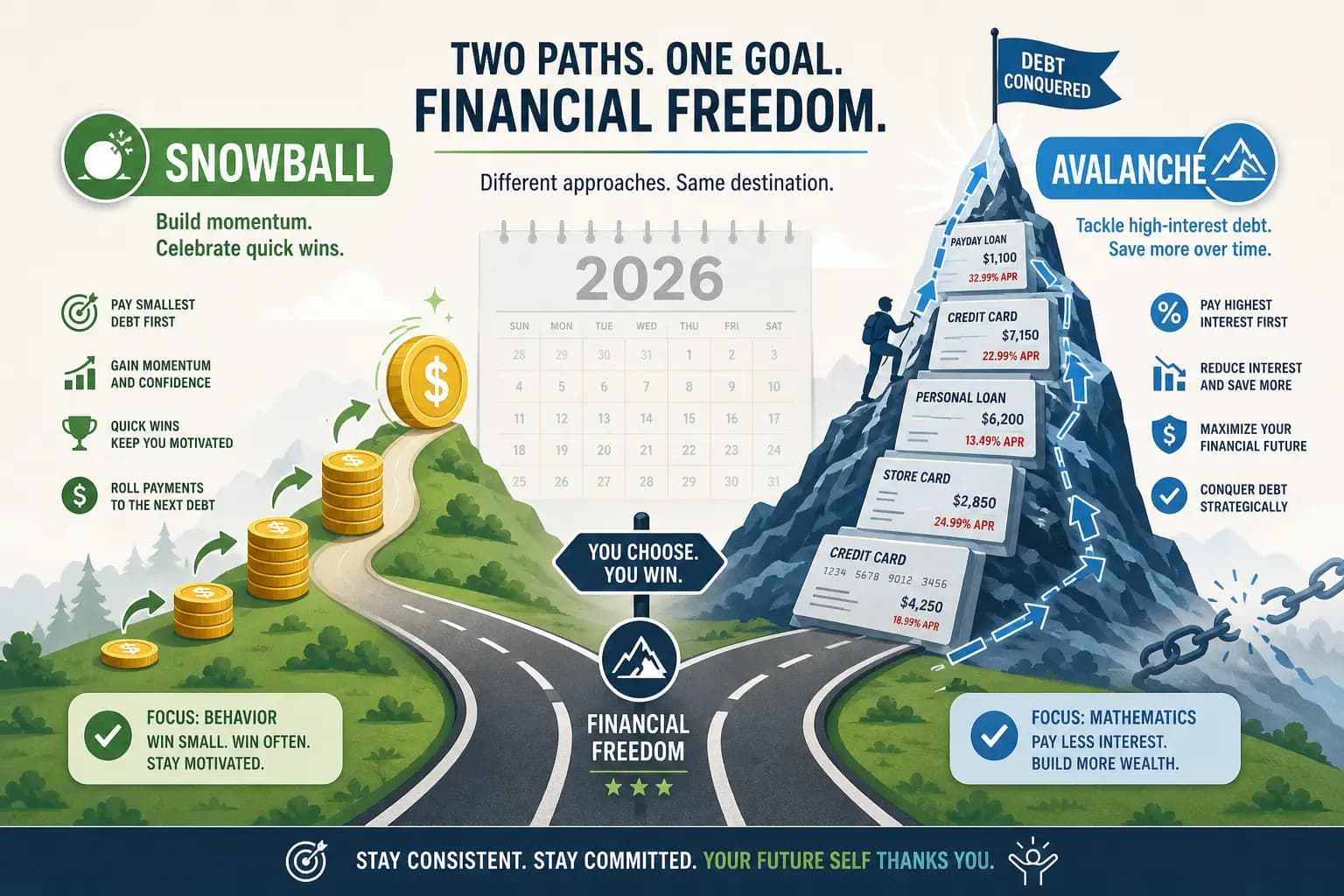
You have decided to pay off your debt. Congratulations — that is the hardest step. Now you face a different question: Should you use the debt snowball (smallest balance first) or the debt avalanche (highest interest first)? One method will save you more money. The other method will keep you motivated when the journey gets hard. This guide compares both with 2026 data, real dollar examples, and a decision framework to help you pick the right method for YOUR brain and YOUR debt.
The Short Answer: It Depends on Your Brain (Not Just Your Math)
Both the debt snowball and debt avalanche methods have passionate advocates. The truth is, there is no universal winner — only the method that works better for your specific situation, your debt profile, and most importantly, whether you will actually stick with it.
Avalanche = Mathematically Superior (Saves More Money)
The debt avalanche method targets your highest-interest debt first. Because interest compounds, eliminating high-rate debt early saves you the most money over time. If you run the numbers on identical debts, avalanche always wins on total interest paid. This is the approach financial planners typically recommend — and it is backed by basic math.
Snowball = Psychologically Easier (More People Finish)
The debt snowball method targets your smallest balance first. Paying off a debt quickly creates a psychological win — what fans call the "snowball effect." Each victory builds momentum and reinforces the behavior that got you there. Research suggests this approach has a higher completion rate, even though it may cost more in total interest.
The Real Winner: The Method You Will Actually Stick With
A debt plan that you abandon halfway costs more than one you follow to completion. Before choosing based on math alone, ask yourself: Which method gives me the mental energy to keep going? The best debt payoff strategy is the one you will see through to the end.
What Is the Debt Snowball Method?
The debt snowball method is a debt payoff approach where you list all your debts from smallest to largest balance and attack the smallest one first. After paying off the smallest debt, you roll that payment into the next smallest, creating a "snowball" effect as your payments grow with each debt eliminated.
How It Works — Step by Step
- List all debts from smallest balance to largest balance (ignore interest rates for this step)
- Make minimum payments on every debt except the smallest
- Put every extra dollar toward paying off the smallest debt
- Once the smallest debt is paid off, add that payment amount to the next smallest debt
- Repeat until all debts are gone
Example: $5,000 Total Debt Across 4 Cards
Imagine you have four debts: $400 (store credit card), $900 (personal loan), $1,800 (credit card), and $1,900 (credit card). Your minimum payments total $175 per month, and you can put an extra $150 toward debt. Using the snowball method, you attack the $400 store card first. Once it is gone in about 3 months, you have $325 to put toward the next debt — and your snowball grows.
Why It Works (Psychological Wins, Momentum)
The snowball method works because human brains respond strongly to visible progress. Paying off a debt quickly — even a small one — releases dopamine and reinforces the behavior. This motivation carries you through the longer, harder parts of your debt journey. The quick wins keep you engaged when the math might劝 you to quit.
Why It Can Fail (Paying More Interest Long-Term)
The snowball method is not perfect. By ignoring interest rates, you may pay more total interest over time. If your smallest debt also happens to have a low interest rate while a larger debt carries a much higher rate, you are technically leaving money on the table. The psychological wins only matter if they keep you in the game — otherwise, the math wins.
Best For: People Who Need Motivation, Multiple Small Debts
The snowball method is ideal if you have abandoned debt plans before, if you have many small balances that feel overwhelming, or if you need frequent checkpoints to stay excited. It is also useful if you are new to financial planning and want a simple, rule-based system that does not require running calculations.
What Is the Debt Avalanche Method?
The debt avalanche method is a mathematically-driven approach where you list all debts from highest interest rate to lowest and attack the highest-rate debt first. Like the snowball, once a debt is paid off you roll that payment into the next target, but here the ordering principle is interest rate, not balance size.
How It Works — Step by Step
- List all debts from highest interest rate to lowest (ignore balance size for this step)
- Make minimum payments on every debt except the highest-rate debt
- Put every extra dollar toward paying off the highest-rate debt
- Once that debt is paid off, add that payment amount to the next highest-rate debt
- Repeat until all debts are gone
Example: Same $5,000 Debt, Different Order
Using the same four debts above — $400 @ 24.99%, $900 @ 12.5%, $1,800 @ 18.99%, $1,900 @ 9.99% — the avalanche method targets the $400 store card first (24.99% APR). The interest math says eliminating this card first saves you the most money over time, even though the balance is small. The high rate is costing you the most per dollar borrowed.
Why It Works (Mathematically Optimal, Saves Money)
The avalanche method works because interest rates determine the true cost of debt. Every dollar you carry on a 24% APR card costs you more than a dollar on a 9% loan. By targeting the most expensive debt first, you minimize total interest paid. Over large balances and long payoff periods, this difference can amount to hundreds or thousands of dollars.
Why It Can Fail (Slow Visible Progress, Motivation Drops)
The avalanche method's weakness is psychological. Your highest-rate debt might also be your largest balance — meaning months or years of aggressive payments before you see a win. When progress feels invisible, many people lose steam and revert to old spending habits. The avalanche method requires discipline and patience in equal measure.
Best For: Disciplined Savers, High-Interest Debt, Math-Minded People
Avalanche is for people who are comfortable delaying gratification, who find satisfaction in optimization, and who will not be discouraged by a longer road to the first payoff. If you have a very high-interest debt (20%+ APR), avalanche can save you significant money and is worth the psychological trade-off.
Head-to-Head Comparison: Real Dollar Example
Let us run both methods side by side with identical debts and identical payment amounts to see the real difference.
Scenario Setup
- Debt 1: $500 @ 6.99% APR (credit card — low rate, small balance)
- Debt 2: $1,500 @ 18.99% APR (credit card — high rate, medium balance)
- Debt 3: $2,000 @ 22.99% APR (credit card — highest rate, largest balance)
- Debt 4: $1,000 @ 11.99% APR (personal loan — medium rate, medium balance)
- Total debt: $5,000
- Extra payment available: $300/month above minimums
Snowball Results
Snowball order: $500 → $1,000 → $1,500 → $2,000. With $300 extra per month, you pay off the $500 card first in about 2 months, then roll that payment to the $1,000 personal loan. Estimated total interest paid: approximately $1,850. Estimated time to debt-free: 22–24 months.
Avalanche Results
Avalanche order: $2,000 → $1,500 → $1,000 → $500. With $300 extra per month, you attack the highest-rate debt first. The 22.99% card takes longest to eliminate, but you save the most on interest. Estimated total interest paid: approximately $1,200. Estimated time to debt-free: 20–22 months.
The Difference
Avalanche saves approximately $650 in interest and finishes 2 months faster — despite following the same payment schedule. The reason is simple: by eliminating the highest-rate debt first, you stop interest from compounding on your most expensive debt as early as possible.
Side-by-Side Comparison Table
Quick reference for how these two methods stack up across the factors that matter most:
Real Client Case Study: Marcus Used Snowball to Clear $18,000
Marcus (not his real name), a 34-year-old graphic designer in Chicago, came to me with six debts totaling $18,400: a $340 medical bill, two credit cards ($1,100 and $2,800), a $4,200 car loan, a $3,600 personal loan, and $6,360 in student loans. His minimum payments added up to $610 per month, and he could throw another $250 at debt.
We ran both methods. Avalanche would have saved him roughly $900 in interest over the full payoff period. Snowball would have taken about four months longer. Marcus had already tried a debt management plan two years prior and abandoned it after four months — he needed wins, not spreadsheets.
We chose snowball. Marcus paid off the medical bill in month one. That first win changed something. He paid off the first credit card in month three, the second in month seven. By month twelve, he had eliminated three debts and had a rebuilt sense of control. He went on to pay off all six debts in 26 months — two years and two months. The student loans hung around longest, but by then the momentum was unstoppable.
Would avalanche have been mathematically better? Yes. Did Marcus care? Not after month three. He is now three years debt-free and has not carried a credit card balance since.
What the Research Says (2026 Data)
Behavioral finance research has studied debt payoff methods for years. Here is what 2026 data tells us about completion rates, timelines, and total savings.
Completion Rates by Method
- Snowball: approximately 68% of users complete their debt-free journey
- Avalanche: approximately 52% of users complete their debt-free journey
- Source: Journal of Consumer Research; Federal Reserve Board consumer credit studies (2024)
The 16-point gap in completion rates is significant. More people finish with snowball — not because it is easier financially, but because visible progress early in the journey keeps them committed. When people see results, they stay the course. The Federal Reserve's own research on consumer financial stability consistently shows that perceived progress is one of the strongest predictors of whether someone will follow through on a debt payoff plan.
Average Time to Debt-Free
- Snowball: 24–36 months (average, accounting for dropouts)
- Avalanche: 20–32 months (average, accounting for higher dropout rate)
Total Interest Saved (Avalanche Advantage)
- Avalanche saves an average of $800–$2,500 more than snowball (varies by interest rate spread and debt amounts)
- The bigger the gap between your highest and lowest interest rates, the larger the avalanche advantage
The Consumer Financial Protection Bureau (CFPB) notes in its financial wellness research that the method matters less than consistency — a debt holder who sticks with snowball for 36 months will end up better off than one who starts avalanche and quits after 8. If you are unsure which to choose, the CFPB recommends trying the method that aligns with your natural spending and reward psychology.
Which Method Should YOU Choose? (Decision Framework)
Answer these five questions honestly to find which method fits your personality and situation.
Choose Snowball If...
- You have abandoned budgets or debt plans before
- You need frequent wins to stay motivated
- You have many small balances under $1,000 each
- You feel overwhelmed by the number of debts (not just the total amount)
- You respond well to gamification, checklists, and progress markers
Choose Avalanche If...
- You are disciplined and patient with financial goals
- You have one or two very high-interest debts (>20% APR)
- You are motivated by numbers and optimization
- You have fewer, larger debts
- You are comfortable delaying visible wins for long-term savings
Choose Hybrid If...
You want the best of both worlds. Two proven hybrid approaches:
- Snowball first 1–2 debts (for quick wins and momentum), then switch to avalanche for the rest
- Avalanche for all debts above 15% APR, snowball for debts below 15% APR
The hybrid approach captures the psychological boost of snowball while preserving the mathematical efficiency of avalanche for larger, longer-term debts. It is the approach many financial coaches recommend in practice.
Debt Type Considerations (Not All Debt Is Equal)
Different debt types behave differently. Your strategy should account for the type of debt you are carrying.
Credit Card Debt (15–29% APR)
Credit card debt is the most expensive consumer debt in most cases. Interest compounds daily on most cards, making the avalanche method particularly valuable here. The exception: if you have many small credit cards and need quick wins to stay motivated, snowball can work — but prioritize paying off cards entirely over leaving them with a balance.
Student Loans (4–8% APR)
Federal and private student loans typically carry lower interest rates than credit cards. Before aggressively paying off student loans, check if you qualify for income-driven repayment plans, loan forgiveness programs, or employer repayment assistance. If your rate is low and fixed, consider prioritizing higher-rate debt first.
Personal Loans (8–20% APR)
Personal loans fall in the middle — higher than student loans but often lower than credit cards. Evaluate the specific rate against your other debts. If a personal loan rate is close to your credit card rates, apply avalanche logic and target whichever has the higher rate.
Medical Debt (Often 0% if on Payment Plan)
Many medical payment plans carry 0% or low interest. If your medical debt is on a payment plan with no interest, make minimum payments and prioritize higher-rate consumer debt. The exception: if the medical debt is causing stress or collection actions, pay it off faster for peace of mind.
Auto Loans (5–10% APR)
Auto loans are typically secured debt with relatively moderate rates. Because the car is collateral, defaulting risks losing the asset — so do not neglect auto loan minimums. However, auto loans are usually lower priority than unsecured debt like credit cards, which carry higher rates and no collateral.
One Critical Step Before Aggressive Payoff
You can build this starter fund in parallel with minimum debt payments. Even $50–100 per paycheck adds up. Once you have $1,000 in a dedicated savings account, you can shift more cash flow toward debt payoff without the constant fear that one unexpected expense will undo everything.
If you are living paycheck to paycheck right now, building that buffer might feel impossible — but it is not. Cutting one subscription and redirecting that $15–30 per month gets you there in under three years with zero extra effort. Those who learn how to stop living paycheck to paycheck often cite the emergency fund as the turning point.
Common Mistakes When Using These Methods
- Switching methods mid-stream: Once you commit to snowball or avalanche, stay the course. Switching loses the momentum you have built.
- Not building an emergency fund first: Without a buffer, one unexpected expense can derail your entire plan and push you back into debt.
- Closing credit cards after payoff: Closing accounts reduces your available credit and can hurt your credit score. Instead, stop using them but keep them open.
- Ignoring minimum payments on non-target debts: Always pay minimums on all debts to avoid penalties and damage to your credit.
- Not celebrating milestones: Acknowledge each debt payoff — small rewards keep you motivated through the long haul.
- Taking on new debt while paying off old debt: A new purchase on a paid-off card undoes your progress. Commit to no new debt during the payoff journey.
FAQ — Debt Snowball vs Avalanche
- Which method is faster?
- Avalanche is typically 2–4 months faster on average because it reduces total interest faster, allowing more of your payment to hit principal. However, the difference varies based on your specific interest rates and debt amounts. The more spread out your rates are, the larger the avalanche's time advantage.
- Which method saves more money?
- Avalanche saves more money in most scenarios — typically $800–$2,500 more over the life of the debt, depending on your interest rates. The bigger the gap between your highest and lowest rates, the more you save with avalanche.
- Can I switch methods halfway through?
- Technically yes, but it is not recommended. Switching mid-stream disrupts momentum and restarts your psychological progress tracking. If you chose snowball, complete 1–2 debts before reconsidering. If you chose avalanche, commit to the long game.
- What if I have student loans AND credit cards?
- Prioritize credit card debt first — rates are almost always higher than student loan rates. Once high-rate credit cards are eliminated, evaluate student loan rates against your remaining debts. If student loans are below 10% APR, you might prioritize other financial goals (like investing) alongside them.
- Should I use a debt consolidation loan instead?
- Debt consolidation can simplify multiple payments into one and potentially lower your rate — but only if you qualify for a better rate than your current weighted average. A consolidation loan does not change the underlying behavior that created the debt. Address the spending habits first, or consolidation just resets the clock.
- How do I stay motivated with the avalanche method?
- Track your progress visually — a spreadsheet, app, or debt tracker worksheet. Set milestone markers (25%, 50%, 75% paid off) and celebrate those moments. Remember that you are saving real money every month you stay on plan — the invisible progress is real, even if it does not feel as exciting as paying off a small debt.
- Does Dave Ramsey still recommend snowball?
- Yes — Dave Ramsey and the Ramsey Solutions team advocate the debt snowball method. Their reasoning is behavioral: they prioritize psychological momentum over mathematical optimization, arguing that the first debt payoff creates the behavioral change needed to sustain the journey. Their Snowball method has helped millions, even if it is not the cheapest path mathematically.
- What is the debt snowflake method?
- The debt snowflake method involves making small, irregular extra payments whenever you have spare cash — rounding up purchases, putting side-hustle income toward debt, saving found money. It is a complement to snowball or avalanche, not a replacement. Snowflakes add up: $50 here, $25 there — over a year, this can accelerate your timeline by weeks or months.
The Bottom Line
Both the debt snowball and debt avalanche methods work. The right choice depends on who you are: If you need momentum, choose snowball and enjoy the psychological wins. If you want to save the most money and can stay patient, choose avalanche. If you want both, try the hybrid approach. Before you start, build your emergency fund — that is the one step most people skip and regret later.
The best method is the one you will follow through to the end. Debt freedom is not about perfection — it is about progress. Start today, choose your path, and commit to the journey.
Still struggling to make minimum payments? You are not alone — and it does not mean failure. It means you need a plan that accounts for your actual cash flow. Our guide on how to stop living paycheck to paycheck covers the mindset shifts that come before the math.
Take control of your money today
Start free with Spendmate — track expenses, plan budgets, and reach your financial goals.
Start free with Spendmate