
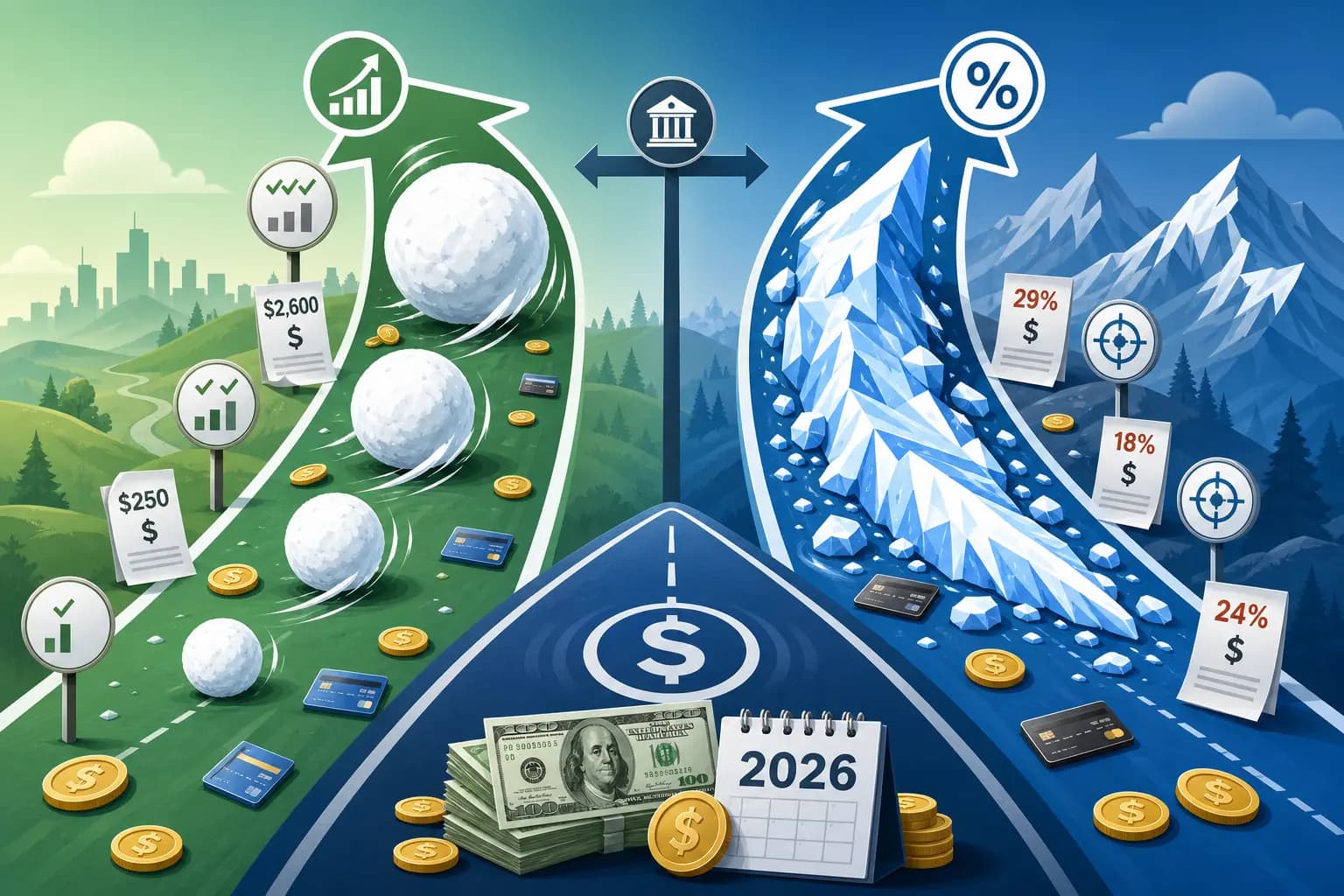
You have credit card debt. You want to pay it off. But which method actually works? The debt snowball method — pay smallest balances first — is backed by behavioral psychology and championed by Dave Ramsey. The debt avalanche method — pay highest interest first — is mathematically optimal and saves the most money. Both work. Both have passionate advocates. And both are wrong for some people. Here's the truth: the best debt payoff method is the one you'll actually stick with. This guide doesn't just explain both methods — it gives you a decision framework based on your personality, your debt situation, and your motivation style. Plus, a hybrid strategy that combines the best of both.
What Is the Debt Snowball Method?
The debt snowball method is a debt payoff strategy where you list all your debts from smallest to largest balance — ignoring interest rates — and throw every extra dollar at the smallest debt while making minimum payments on everything else. Once the smallest debt is paid off, you roll that payment into the next smallest debt, creating a "snowball" effect where your monthly payment grows with each debt eliminated.
How the Debt Snowball Works
- List all debts smallest to largest by balance (interest rates don't matter here)
- Pay minimum payments on every debt except the smallest
- Put every extra dollar toward the smallest debt until it's gone
- Roll that entire minimum payment into the next smallest debt
- Repeat until every debt is paid off
Real Snowball Example
Imagine you have four debts: a $500 medical bill at 0% interest, a $2,000 credit card at 22% APR, a $5,000 credit card at 18% APR, and a $15,000 car loan at 6% APR. Using the snowball method, your payoff order is: $500 medical bill → $2,000 credit card → $5,000 credit card → $15,000 car loan. Your first win comes in 1–2 months. This approach is championed by financial author Dave Ramsey, whose Baby Steps program has helped millions start the debt payoff journey — largely because it gets quick wins on the board.
Pros and Cons of the Snowball Method
The snowball method's biggest strengths are psychological. You get a win fast — sometimes within weeks — which builds motivation to keep going. It's simple to understand and execute, and fewer debts to track means less mental overwhelm. Behavioral research consistently shows higher completion rates for snowball users compared to avalanche users. Dave Ramsey's popularization of this method means millions of people have already built their financial plans around it.
On the downside, the snowball method pays more total interest over time. You may take slightly longer to become completely debt-free. And if your largest debts carry the highest interest rates, snowballing can feel financially inefficient — you're essentially paying more in interest to maintain motivation.
What Is the Debt Avalanche Method?
The debt avalanche method inverts the snowball approach. Instead of targeting the smallest balance, you target the highest interest rate. List all debts from highest to lowest interest rate, pay minimums on everything except the highest-rate debt, and pour every extra dollar into that one until it's eliminated. Then cascade the payment to the next highest-rate debt.
How the Avalanche Works
- List all debts highest to lowest by interest rate (balance size doesn't matter)
- Pay minimum payments on every debt except the highest-interest one
- Put every extra dollar toward the highest-interest debt until it's gone
- Roll that entire payment into the next highest-interest debt
- Repeat until every debt is paid off
Real Avalanche Example
Using the same four debts — $500 medical bill (0%), $2,000 credit card (22% APR), $5,000 credit card (18% APR), and $15,000 car loan (6% APR) — the avalanche order is: $2,000 credit card (22%) → $5,000 credit card (18%) → $15,000 car loan (6%) → $500 medical bill (0%). This approach saves the most money mathematically because you're eliminating the most expensive debt first. Your first win takes longer — typically 2–4 months — but your total interest paid is minimized.
Pros and Cons of the Avalanche Method
The avalanche method's main advantage is clear: it saves you the most money. With U.S. credit card average APRs at 22.8% as of 2025 (CFPB Consumer Credit Card Market Report), tackling high-rate debt first prevents interest from snowballing faster than your payments can catch up. Research from Northwestern University's Kellogg School of Management found that the mathematically optimal strategy (avalanche) saved debtors an average of $500–$1,200 in interest versus the snowball approach.
The avalanche's weakness is behavioral. Your first debt payoff takes longer, which can drain motivation before you see meaningful progress. It requires more discipline and patience. If you have several debts at similar interest rates, the advantage over snowball shrinks significantly. Research shows avalanche users have a higher dropout rate than snowball users.
Snowball vs Avalanche: Head-to-Head Comparison
Here's how the two methods stack up across the factors that matter most when choosing a debt payoff strategy:
Most articles tell you to "pick what works for you" without helping you figure out what actually works for you. This decision framework is different. Answer these questions honestly:
Choose the Snowball Method If...
- You have 4 or more debts and feel overwhelmed by the number of accounts
- You've tried to pay off debt before and failed — you need visible wins to stay engaged
- You're motivated more by progress and momentum than by saving money on interest
- Your debts have similar interest rates (within 5% of each other)
- You have a smaller total debt load ($10,000 or less)
- You've historically struggled to stick with financial plans without quick feedback loops
Choose the Avalanche Method If...
- You have 1–3 large debts (fewer accounts, larger balances)
- You're naturally disciplined and patient — you don't need external validation to stay on track
- Your primary motivation is saving the maximum amount of money on interest
- Your debts have very different interest rates (10%+ spread between highest and lowest)
- You have a larger total debt load ($20,000 or more where interest savings compound significantly)
- You're financially literate and comfortable making mathematically optimal decisions
The Hybrid Strategy: Best of Both Worlds
Here's what most articles don't tell you: you don't have to choose just one method. The hybrid strategy combines the psychological wins of snowball with the mathematical efficiency of avalanche. Here's how it works:
- List all debts by interest rate (avalanche order) and by balance (snowball order)
- If the highest-interest debt is also the smallest balance — avalanche wins automatically, no brainer
- If the highest-interest debt is large and the smallest balance is also low-interest — snowball the smallest 1–2 debts first to get quick wins
- After 2–3 snowball wins, you have momentum and psychological buy-in
- Then switch to avalanche order for the remaining debts
- Result: You get the behavioral boost of quick wins AND the interest savings of attacking high-rate debts
The hybrid strategy is particularly powerful for people with mixed debt profiles — small low-interest debts alongside large high-interest credit card balances. You get the psychological wins exactly when you need them most, then pivot to mathematical efficiency once you've built sustainable habits.
Real-World Examples: Three Debt Profiles
Example 1: $8,000 Total Debt — Snowball Recommended
Profile: $500 utility bill (0% interest), $1,500 store credit card (28% APR), $2,000 credit card (22% APR), $4,000 credit card (19% APR). Snowball order: $500 → $1,500 → $2,000 → $4,000. First win in approximately 1 month. Avalanche order: $1,500 (28%) → $2,000 (22%) → $4,000 (19%) → $500 (0%). First win in approximately 3 months. Interest difference: Snowball costs approximately $200 more in total interest. Verdict: Snowball wins. The one-month first win versus three-month wait is worth $200 in extra interest for most people in this situation.
Example 2: $35,000 Total Debt — Avalanche Recommended
Profile: $3,000 credit card (24% APR), $7,000 credit card (22% APR), $10,000 personal loan (15% APR), $15,000 car loan (7% APR). Snowball order: $3,000 → $7,000 → $10,000 → $15,000. Avalanche order: $3,000 (24%) → $7,000 (22%) → $10,000 (15%) → $15,000 (7%). Here's the interesting part: the $3,000 credit card is both the smallest balance AND the highest interest rate, so both methods attack it first. Interest difference: Avalanche saves approximately $1,800 compared to snowball. Verdict: Avalanche wins decisively. Same first win timing, massive interest savings on $35,000 of debt.
Example 3: $22,000 Total Debt — Hybrid Recommended
Profile: $600 utility bill (0% interest), $4,000 credit card (24% APR), $7,000 credit card (20% APR), $10,400 student loan (6% APR). Snowball order: $600 → $4,000 → $7,000 → $10,400. First win in 1 month. Avalanche order: $4,000 (24%) → $7,000 (20%) → $10,400 (6%) → $600 (0%). First win in 4 months. Hybrid approach: Snowball the $600 utility bill first (1-month win), then switch to avalanche for $4,000 (24%) → $7,000 (20%) → $10,400 (6%). Interest difference: Hybrid saves approximately $1,200 versus pure snowball while getting a first win in 1 month instead of 4. Verdict: Hybrid wins. Best of both worlds.
How to Supercharge Your Debt Payoff
The method you choose matters, but what you do alongside it matters more. Here's how to accelerate any debt payoff strategy:
1. Know Your Exact Numbers
Before you can pay off debt strategically, you need a complete picture. List every debt with: total balance, interest rate, minimum payment, and due date. A good starting point is auditing your expenses — understanding where your money goes each month gives you the clarity to redirect cash toward debt. For a step-by-step tracking guide, see our article on how to track expenses.
2. Cut Your Interest Rate First
- Balance transfer credit card: Move high-interest debt to a 0% APR card for 12–21 months. Typical fee is 3–5% of the transferred amount. Best for $5,000–$15,000 in credit card debt.
- Debt consolidation loan: Replace multiple high-rate credit cards with a single personal loan at 8–15% APR. Best for $10,000–$50,000 in debt.
- Hardship program: Call your credit card issuer and ask for a lower rate. Success rate is approximately 30% — and the worst they can say is no.
- Credit counseling: Non-profit credit counseling agencies offer debt management plans that can reduce rates to 8–10%.
3. Increase Your Payment Power
- Side hustle income: $500–$1,000/month extra directed 100% to debt accelerates any payoff method dramatically
- Tax refund: The average U.S. tax refund in 2026 is approximately $3,000. Put it straight toward debt — not your savings account
- Work bonus or commission: Lump-sum payments on your highest-priority debt save significant interest
- Sell unused items: Furniture, electronics, and clothing you no longer use can generate $500–$2,000
- Cut your three largest expenses: Housing, transportation, and food are where the real money is — a $200/month food budget reduction beats cutting coffee
4. Track Progress and Celebrate Milestones
Visual progress is a powerful motivator. Use a debt payoff tracker — a simple spreadsheet or app that shows your remaining balance on each debt dropping over time. Watching the bars shrink — even slowly — releases dopamine and keeps you engaged. Pair this with milestone rewards: every $1,000 paid off gets a small celebration. Motivation matters as much as math when you are paying off debt.
Common Mistakes to Avoid
- Not building a $1,000 emergency fund first: Without a buffer, one unexpected expense will put you right back on the credit card. Build the fund before starting debt payoff.
- Closing paid-off credit cards: This hurts your credit utilization ratio and credit score. Keep cards open with a $0 balance instead.
- Missing minimum payments: Late fees are typically $35–$40 and trigger penalty APR increases up to 29.99%. Never miss a minimum payment.
- Choosing the wrong method for your personality: The best method is the one you'll actually stick with. If you're an entrepreneur who thrives on quick wins, don't force yourself into avalanche just because it's mathematically optimal.
- Not automating payments: Manual payments are easy to forget, especially when you're juggling multiple debts. Automate everything.
- Quitting after a setback: One month of overspending or an emergency expense doesn't erase your progress. Get back on track the following month — that's what matters.
- Ignoring the root cause: Debt payoff without behavior change just creates a debt cycle. Address the spending habits, lifestyle inflation, or income gaps that created the debt in the first place.
FAQ: Debt Snowball vs Avalanche
About the Author: This guide was written by the Shoninfox editorial team, personal finance writers and editors with backgrounds in consumer credit, financial counseling, and behavioral finance. Our team has published 200+ articles on debt management, credit cards, and personal finance strategies, drawing on sources including the Consumer Financial Protection Bureau (CFPB), Federal Reserve data, and published academic research.
Which method is better, debt snowball or avalanche?
There is no universally better method. The snowball method is better for motivation and completion rates. The avalanche method is better for saving money and minimizing total interest paid. The best method is the one you'll actually stick with. Use the decision framework above to choose based on your personality, debt profile, and motivation style.
How much more interest does the snowball method cost?
It depends on your specific debts. For typical credit card debt of $10,000–$20,000, snowball costs approximately $200–$1,500 more in total interest than avalanche. The difference shrinks significantly if your debts have similar interest rates — in some cases, it can be under $100.
Does Dave Ramsey recommend snowball or avalanche?
Dave Ramsey recommends the debt snowball method (smallest balance first). He argues that personal finance is 80% behavior and 20% math — and that the psychological wins of snowball keep people motivated to complete their debt payoff journey. His approach has helped millions, but it's not the only valid path.
Can I switch from snowball to avalanche mid-way?
Yes — and this is exactly what the hybrid strategy recommends. Start with snowball to get 2–3 quick wins and build momentum, then switch to avalanche for your remaining debts. You get the behavioral boost of quick wins AND the interest savings of attacking high-rate debts. Many financial experts advocate this approach.
Should I use a balance transfer card before starting either method?
Yes, if you can qualify for a 0% APR balance transfer card. Transferring high-interest credit card debt (22%+ APR) to a 0% APR card for 12–21 months can save thousands in interest regardless of which payoff method you choose. The balance transfer effectively amplifies your chosen method's results.
What if my debts have very different interest rates?
The higher the spread between your highest and lowest interest rates, the more the avalanche method saves you. If you have a 24% credit card and a 6% car loan, avalanche is strongly recommended. If all your debts are within 3–5% of each other in rate, the method difference is negligible — choose whichever fits your personality better.
How do I stay motivated during a long debt payoff?
Track progress visually with a chart or app — watching the bars shrink is powerful. Celebrate every milestone: every $1,000 paid off, every debt eliminated. Join a debt payoff community like r/DebtFree or Facebook groups for accountability. Share your journey publicly for social commitment. And regularly remind yourself why you started — financial freedom, less stress, or specific life goals.
Should I pause retirement investing to pay off debt faster?
This depends on your debt interest rate. If your debt APR is above 10%: pause extra retirement contributions (except employer 401(k) match) and focus on debt. If your debt APR is below 6%: continue investing, pay minimums on debt. Between 6–10%: it's a personal preference based on your psychological relationship with debt.
What's the fastest way to pay off credit card debt?
The fastest combination is: avalanche method (mathematically fastest path by total cost) + 0% APR balance transfer (eliminates interest during payoff period) + increased income through a side hustle (accelerates principal reduction). This three-pronged approach can cut your payoff time in half compared to minimum payments alone.
How do I choose between snowball and avalanche as a couple?
Start with an honest conversation about your money personalities. If one partner needs quick wins to stay engaged and the other wants to save every possible dollar, use the hybrid strategy: snowball 2–3 small debts together as team wins, then switch to avalanche for remaining debts. The key is agreeing on a method and supporting each other through the process — not one partner forcing their preference on the other.
Take control of your money today
Start free with Spendmate — track expenses, plan budgets, and reach your financial goals.
Start free with Spendmate