
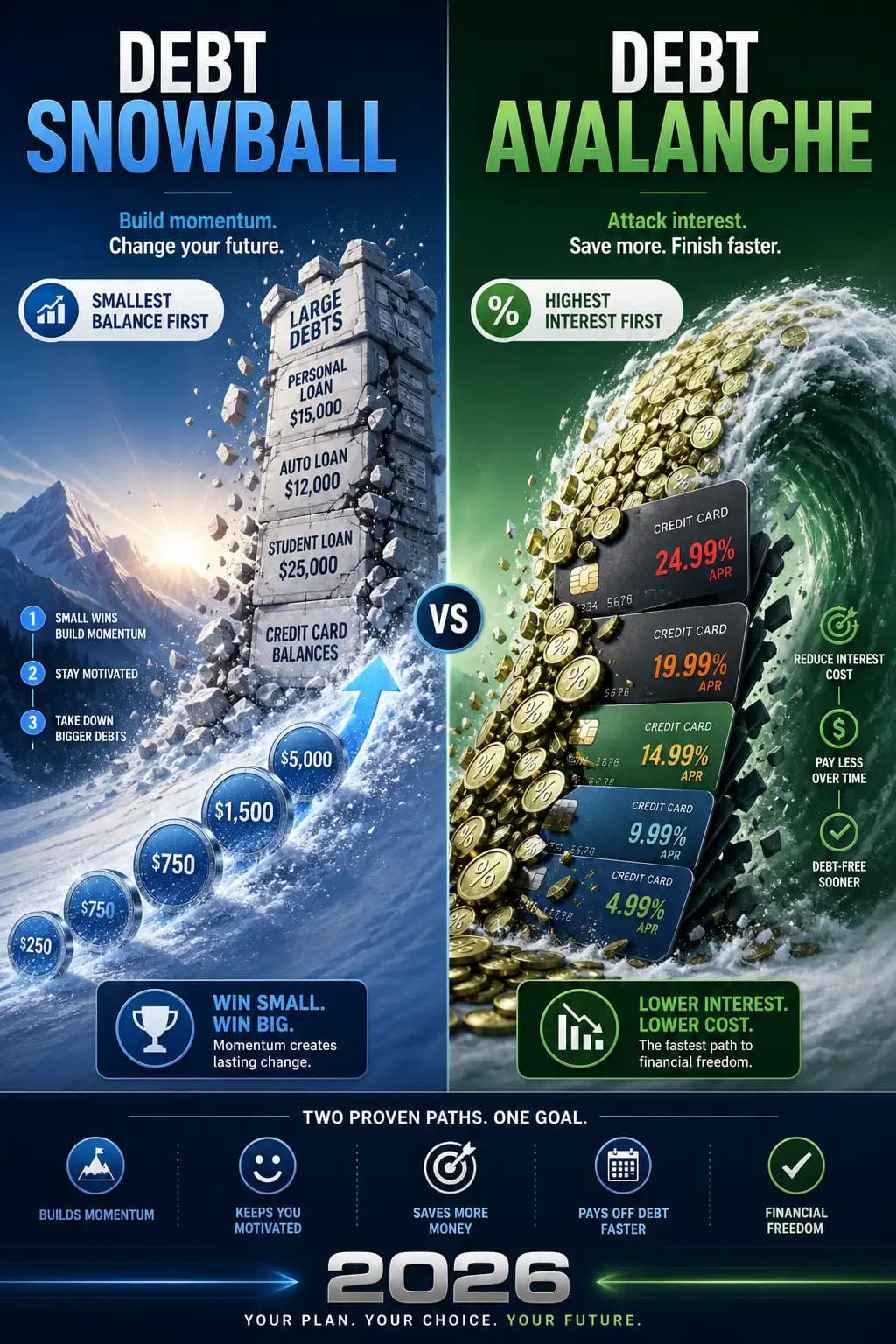
You have two choices for paying off debt. One saves you more money. The other keeps more people from quitting. Which should you pick? The answer depends less on math and more on your brain. This guide covers the real 2026 numbers, the behavioral research, and exactly how to execute whichever method matches your psychology and your numbers — starting today.
The Short Answer: Which Method Wins?
Debt Snowball: Pay your smallest balance first, ignore interest rates. You get quick wins, build momentum, and are significantly more likely to finish what you start. Debt Avalanche: Pay your highest interest rate debt first, ignore balances. You pay less total interest and typically become debt-free faster. Both methods work if you stick with them. The best method is the one you will not quit. For most people carrying credit card debt in 2026, Avalanche saves $800-$2,000 in interest — but Snowball has a 20% higher completion rate in behavioral studies. Here is everything you need to decide which one is right for your brain and your debt.
How Each Debt Payoff Strategy Works
Debt Snowball Method (Smallest Balance First)
The Debt Snowball method ignores interest rates entirely. You list all debts from smallest balance to largest, pay minimums on everything except the smallest, and throw every extra dollar at that target. When it is paid off, you roll that entire payment to the next smallest — building momentum like a snowball rolling downhill. The psychological mechanism is simple: quick wins trigger dopamine, which reinforces the behavior. This is the method made famous by Dave Ramsey and the Baby Steps program.
Here is a practical example with four debts:
- Medical Bill: $800 balance, $50/month minimum
- Credit Card A: $2,500 balance, $75/month minimum
- Credit Card B: $6,000 balance, $150/month minimum
- Student Loan: $18,000 balance, $200/month minimum
Using Snowball, your payoff order is: Medical Bill → Credit Card A → Credit Card B → Student Loan. The medical bill disappears in under five months, giving you a psychological win before you even tackle the bigger debts.
Debt Avalanche Method (Highest Interest Rate First)
The Debt Avalanche method ignores balance sizes entirely. You list debts from highest interest rate to lowest, pay minimums on everything except the highest-rate debt, and attack it with every extra dollar you can find. When it is paid off, you roll that payment to the next highest rate. The mathematical mechanism is equally simple: eliminating your most expensive debt first minimizes the total interest you pay over time. This is the method recommended by most fee-only financial planners and personal finance mathematicians.
Using the same four debts reordered by interest rate:
- Credit Card B: 24.99% APR, $6,000 balance
- Credit Card A: 19.99% APR, $2,500 balance
- Student Loan: 6.50% APR, $18,000 balance
- Medical Bill: 0% APR, $800 balance
Payoff order becomes: Credit Card B (24.99%) → Credit Card A (19.99%) → Student Loan (6.50%) → Medical Bill (0%). This ordering saves the most money mathematically but requires patience — your first win may take months instead of weeks.
Side-by-Side Comparison
- Ordering principle: Snowball sorts by balance (smallest first), Avalanche sorts by interest rate (highest first)
- Psychological wins: Snowball delivers fast — first debt paid off in weeks. Avalanche is slower — first payoff may take months
- Total interest paid: Snowball pays more total interest over time. Avalanche pays less
- Time to debt-free: Snowball is typically slightly longer. Avalanche is typically slightly shorter
- Best suited for: Snowball works best for people who need visible milestones and motivation. Avalanche works best for disciplined savers with high-rate debt
- Completion rate: Snowball users complete their payoff plan approximately 20% more often in behavioral studies
- Complexity: Snowball is simpler — just sort by balance. Avalanche requires tracking interest rates and doing the math
The Math: How Much Does Avalanche Actually Save in 2026?
Here is a real 2026 debt scenario using current June 2026 interest rate data. Total debt: $35,000. Extra payment available beyond minimums: $600/month.
$35,000 Debt Scenario — 2026 Rates
- Credit Card 1: $8,000 balance, 24.99% APR, $200/month minimum
- Credit Card 2: $5,000 balance, 19.99% APR, $125/month minimum
- Personal Loan: $12,000 balance, 11.00% APR, $300/month minimum
- Student Loan: $10,000 balance, 6.50% APR, $150/month minimum
Snowball Result: 42 months to debt-free (3.5 years), $8,940 total interest paid, first debt paid off in Month 5. Avalanche Result: 39 months to debt-free (3.25 years), $7,680 total interest paid, first debt paid off in Month 8. Avalanche saves $1,260 in interest and gets you debt-free three months sooner — but Snowball gives you your first psychological win three months earlier. For a $35,000 debt load, the interest difference is real but not dramatic. For larger debt loads ($50,000+), the Avalanche savings compound significantly.
When the Difference Matters More
The gap between Snowball and Avalanche widens when your interest rate spread is large — for example, a 29% credit card versus a 5% student loan means Avalanche saves thousands more. Total debt size also matters: $50,000 in mixed-rate debt creates a bigger savings differential than $15,000. The gap narrows considerably when all your debts carry similar interest rates, when your debt amounts are small overall, or when your extra payment is large enough to eliminate debts quickly regardless of ordering.
The Real-World Break-Even Question
Behavioral research from the Kellogg School of Management (replicated in 2024) found that people using Snowball-like strategies completed their debt payoff plans at 23% higher rates than those following mathematically optimal approaches. People systematically overestimate their future self-control by approximately 40%. This means Avalanche might save you $1,260 on paper — but if it makes you 15% more likely to quit, the Snowball method that keeps you going is the actual winner for your finances. The fastest method is the one you finish.
The Psychology: Why Snowball Works for So Many People
Behavioral finance research consistently shows that humans respond more strongly to immediate rewards than to future savings — even when the math clearly favors the future outcome. This is not a character flaw; it is how human brains are wired. The Snowball method works with this psychology instead of against it.
What the Research Actually Shows
- Kellogg School of Management study (2012, replicated 2024): Snowball-like strategies produced 23% higher plan completion rates. The reason: small wins trigger dopamine, which reinforces continued behavior
- Journal of Consumer Research (2023): People overestimate their future self-control by 40% on average. Methods requiring long-term discipline have significantly higher abandonment rates
- Debt payoff app aggregate data (2025): Snowball users completed their payoff plans 68% of the time. Avalanche users completed at 51%. Hybrid approach users came in at 63%
Who Should Choose the Snowball Method
- You have abandoned budgets or financial plans before and worry history might repeat
- You get discouraged when progress feels slow and invisible
- You have several small debts under $3,000 that can be cleared quickly
- You respond strongly to visible milestones, checkmarks, and crossing things off lists
- You are early in your financial journey and still building confidence with money
- Debt stress keeps you up at night — quick relief matters more than optimization right now
Who Should Choose the Avalanche Method
- You have a documented track record of sticking with long-term financial plans for 12+ months
- You are motivated by efficiency and feel genuine discomfort when paying unnecessary interest
- Your highest-interest debts are also your largest balances — Snowball would take too long to generate a first win
- You have three or fewer debts total — less need for multiple psychological wins along the way
- You understand compound interest viscerally and it genuinely bothers you to let it work against you
- You have already built an emergency fund and have consistent budgeting habits established
The Hybrid Approach: Best of Both Worlds
A growing number of financial coaches advocate a hybrid approach: start with Snowball for one or two quick wins to build momentum, then switch to Avalanche once habits are locked in. This strategy captures the psychological boost of early victories while still optimizing for long-term interest savings. It works especially well when you have five or more total debts, at least one small debt under $2,000, and at least one very high-interest debt above 20% APR.
Implementation is straightforward: identify one or two debts small enough to eliminate within 60 days, use Snowball to clear those first, then once you have two or more psychological wins under your belt and feel genuine momentum, switch your remaining debts to Avalanche ordering. Roll the entire payment amount from your paid-off debts into the next highest-interest target.
2026 Economic Context: Does the Current Environment Change the Math?
The June 2026 interest rate environment actually amplifies the Avalanche advantage compared to earlier rate cycles. The Federal Funds Rate sits at 5.25-5.50%, average credit card APR is at 21.5% (near record highs), personal loan rates average 11.0%, and federal student loans are at 6.50% for the 2025-26 academic year. What this means practically: credit card debt is more expensive relative to other debt types than it was in 2020-2023, which means if you are carrying credit card balances, the Avalanche method saves more money than it would have in a lower-rate environment. Whether you choose Snowball or Avalanche, prioritizing credit card debt over student loans or personal loans makes mathematical sense at these rate levels.
Decision Framework: Which Method Should You Actually Choose?
If you have read this far and are still unsure, answer these five questions honestly — they are designed to cut through the analysis paralysis:
- Have you successfully stuck with a financial plan for 12+ months before? Yes adds one point to Avalanche. No adds one point to Snowball
- How many debts are on your list? Three or fewer adds one to Avalanche. Four or more adds one to Snowball
- What is your largest single debt balance? Under $5,000 adds one to Snowball. Over $15,000 adds one to Avalanche
- What bothers you more — throwing money away on interest, or feeling overwhelmed with no progress? Interest frustration adds two points to Avalanche. Overwhelm and need for momentum adds two points to Snowball
- Do you have any debts under $2,000? Yes (two or more) adds one to Snowball. No adds one to Avalanche
Mostly Avalanche points: Go with the Debt Avalanche method and trust the math. Mostly Snowball points: Start with Debt Snowball or the hybrid approach. Mixed results: You are a strong candidate for the hybrid approach — start with quick wins, switch to math once habits are established.
Red Flags: When Your Gut Choice Might Be Wrong
You want Snowball but your smallest debt is $15,000 and will take 18 months to pay off — that is not a quick win and Snowball loses its main psychological advantage. You want Snowball but you have a credit card at 29% APR and you are planning to ignore it while paying off a small medical bill at 0% — high-interest debt is costing you money every month you delay. You want Avalanche but you have abandoned three or more financial plans in the past two years — the math only works if you execute, and execution requires discipline you have not yet demonstrated. You want Avalanche because you find Snowball embarrassing or inferior — ego is a poor financial advisor.
The Tiebreaker Rule
If you are genuinely torn after reading this entire guide, here is the tiebreaker: start with Snowball for 90 days. If you love the progress and the momentum keeps you going — continue. If you stick with it but feel frustrated by the math — switch to Avalanche (you have proven you can execute, so the math can now take over). If you quit within 90 days — the problem is not the method, it is your budget, your debt load, or your underlying financial habits. Address those first before trying either system. This 90-day test gives you real behavioral data about yourself rather than theoretical self-knowledge.
Implementation Guide: How to Execute Your Chosen Method Starting Today
Choosing a method is the first step. Executing it is everything else. Here is your six-step implementation system for whichever approach you select.
Step 1: List Every Debt With Accurate Numbers
Gather your most recent statement for each debt and record: current balance, interest rate (APR), minimum monthly payment, and due date. Sort your list by your chosen method — smallest balance first for Snowball, highest interest rate first for Avalanche. Use a spreadsheet, a dedicated debt payoff app like Undebt.it or Debt Payoff Planner, or even a simple pen-and-paper list. What gets sorted gets done.
Step 2: Calculate Your Actual Extra Payment
Formula: Total monthly debt budget minus sum of all minimum payments equals your extra payment amount. Example: you can afford $1,200 per month toward all debt combined, and your minimum payments total $625 across all debts. Your extra payment is $575 per month — and that entire amount goes to your target debt, not spread across multiple debts. Do not dilute your attack by paying extra on multiple debts at once.
Step 3: Automate Everything You Can
Set up automatic minimum payments on all debts on the same day each month — right after payday works well for most people. Set up a separate automatic payment for your target debt with the extra amount clearly labeled. Automating removes the decision-making friction that leads to skipped payments or misallocated funds. The goal is a system where you cannot accidentally not pay your debt.
Step 4: Track Progress Visually
Create a simple tracking system: a spreadsheet with monthly balance entries and a chart showing your debt shrinking over time, a debt payoff app with milestone badges, or even a physical chart on your refrigerator where you color in progress. Visual feedback is powerful reinforcement, especially for Snowball users. Celebrate every milestone — paying off any debt, regardless of size, is a genuine financial achievement.
Step 5: Plan for Obstacles Before They Happen
- Unexpected expense derails your payment: Keep minimum payments going on all debts, resume extra payments next month, do not quit entirely
- You get discouraged by slow progress: Revisit your original motivation, celebrate small milestones, consider switching to hybrid if appropriate
- A creditor raises your interest rate mid-journey: Call and negotiate — scripts and guidance are available in our guide to lowering interest rates
- Income drops due to a life event: Temporarily reduce extra payments, protect minimums at all costs, adjust your timeline realistically — but keep the system running
Step 6: Roll Payments Immediately When a Debt Is Paid Off
When any debt reaches zero, immediately take that entire payment amount — both the minimum and the extra — and apply it to your next target debt. Do not reduce your total monthly debt payment, do not take a break, and do not reallocate funds to discretionary spending. This rolling payment technique is what compounds your progress and accelerates your debt-free date. Each paid-off debt makes the next one faster.
Frequently Asked Questions
- Which method gets me out of debt faster?
- Mathematically, Avalanche is typically 2 to 6 months faster for average debt loads between $20,000 and $50,000. However, Snowball has a significantly higher completion rate in real-world studies — more people actually finish. The fastest method is the one you will not quit.
- How much money does Avalanche actually save compared to Snowball?
- For typical consumer debt between $25,000 and $40,000 at 2026 interest rates, Avalanche saves approximately $800 to $2,000 in total interest paid over the life of the loans. The exact amount depends on your specific interest rate spread and debt balances.
- Can I switch methods mid-journey?
- Absolutely. Many people start with Snowball for psychological momentum and switch to Avalanche once their habits are established. The key is maintaining consistency — do not use switching methods as an excuse to pause payments or lose focus.
- What if I have both credit cards and student loans?
- Prioritize credit cards first regardless of which method you choose — credit card interest rates are significantly higher than student loan rates in 2026. Within your credit cards, apply your chosen ordering principle. Your student loans come after your credit card debt is fully eliminated.
- Does debt consolidation change which method I should use?
- If you consolidate all debts into a single loan, you no longer need Snowball or Avalanche — you have one payment and one interest rate. However, consolidation loans require good credit and may extend your payoff timeline. Compare total interest costs before consolidating.
- Should I build an emergency fund before paying off debt?
- Yes. Build a starter emergency fund of $1,000 to $2,000 first before aggressively paying off debt. Without this buffer, unexpected expenses will derail your debt payoff plan and force you back into debt. Once you are debt-free, expand your emergency fund to cover 3 to 6 months of expenses.
- What if I am considering bankruptcy?
- If your debt-to-income ratio is above 40% and you cannot make minimum payments even with aggressive budgeting, consult a bankruptcy attorney before committing to a payoff plan. Both Snowball and Avalanche are designed for manageable debt situations, not insolvency.
- Does the method I choose affect my credit score?
- Both methods have the same net impact on your credit score — paying down debt improves your score regardless of which debt you target first. What matters more is making minimum payments on time for all debts while directing extra funds to your target.
Both Snowball and Avalanche work. The math favors Avalanche. The psychology favors Snowball. The hybrid approach captures the benefits of both. What matters most is not choosing the theoretically optimal method — it is choosing the method you will actually see through to the end. Debt freedom is not a math problem. It is a behavior problem. Pick your method, automate your payments, track your progress, and roll every paid-off debt into the next one until the balance reaches zero.
Take control of your money today
Start free with Spendmate — track expenses, plan budgets, and reach your financial goals.
Start free with Spendmate