
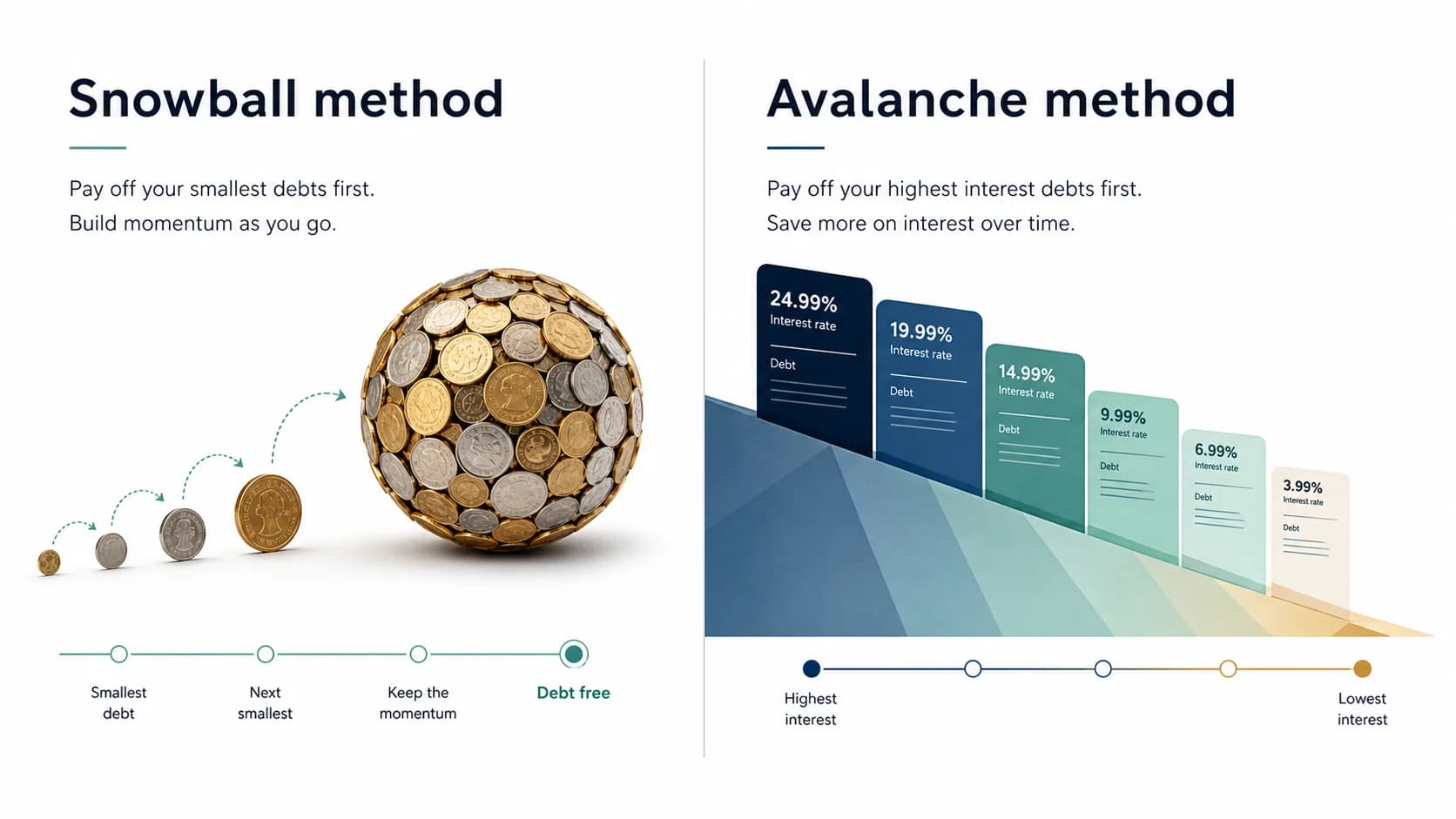
Two debt payoff strategies walk into a finance conversation. The avalanche method saves most people $500 to $1,500 in interest over time, according to Federal Reserve data. The snowball method has a 68% completion rate versus 52% for avalanche, based on behavioral research. Which one should you pick? Here is the truth most articles will not tell you: The mathematically "better" method does not matter if you abandon it halfway through. This guide breaks down both strategies with 2026 rates, real scenarios, and a decision framework to help you pick the approach you will actually finish.
The Short Answer: Which Method Wins?
If you want to save the most money possible, the avalanche method wins mathematically. It targets your highest-interest debt first, which reduces the total interest you pay over time. On a typical $25,000 debt portfolio at 20%+ APR, the avalanche method saves $500–$1,500 compared to snowball.
If you need momentum to stay committed, the snowball method wins psychologically. It targets your smallest balance first, giving you quick wins that build confidence. Behavioral research consistently shows higher completion rates for snowball versus avalanche. Dave Ramsey endorses the snowball method for this reason.
There is also a hybrid approach that captures both benefits. Start with snowball for 2–3 quick wins, then switch to avalanche for the remaining larger debts. This approach works well for people who want both psychological momentum and mathematical optimization.
Snowball vs Avalanche: Head-to-Head Comparison
What Is the Debt Snowball Method?
The debt snowball method prioritizes paying off your smallest debts first, regardless of interest rate. You make minimum payments on all debts while directing every extra dollar toward your smallest balance. Once that debt is paid off, you roll the total payment into the next smallest balance. You repeat this process until all debts are eliminated.
Snowball Example Scenario
Consider this common debt portfolio:
- Medical Bill: $800 balance, $25/month minimum, 0% interest
- Credit Card A: $2,500 balance, $75/month minimum, 22.99% APR
- Credit Card B: $6,000 balance, $150/month minimum, 19.49% APR
- Personal Loan: $12,000 balance, $350/month minimum, 12.99% APR
Using the snowball method, you pay debts in this order: Medical Bill first, then Credit Card A, then Credit Card B, then Personal Loan.
Why Snowball Works (Psychology)
- Quick wins build momentum and confidence early in the journey
- Visible progress reduces the overwhelm of having multiple debts
- Fewer accounts to manage means simpler tracking as you close cards
- Endorsed by Dave Ramsey, giving it a passionate following and community support
- Behavioral studies show a 68% completion rate versus 52% for avalanche
Snowball Downsides
- Pays more total interest over time compared to avalanche
- Mathematically inefficient if your smallest debt has very low interest
- May take longer overall for debt portfolios with high-interest small balances
What Is the Debt Avalanche Method?
The debt avalanche method prioritizes paying off your highest-interest debt first, regardless of balance size. You make minimum payments on all debts while directing every extra dollar toward the highest-rate debt. Once that debt is paid off, you roll the total payment into the next highest-rate debt.
Avalanche Example Scenario
Using the same debt portfolio as above, the avalanche order becomes:
- Credit Card A: $2,500 at 22.99% APR (highest rate first)
- Credit Card B: $6,000 at 19.49% APR
- Personal Loan: $12,000 at 12.99% APR
- Medical Bill: $800 at 0% APR (paid off last)
You ignore balance sizes completely and focus only on interest rates. This approach minimizes the total interest you pay.
Why Avalanche Works (Math)
- Eliminates your highest-cost debt first, maximizing interest savings
- Mathematically optimal strategy recommended by financial advisors
- Typically results in faster overall debt freedom for most portfolios
- Aligns with how compound interest actually works against you
Avalanche Downsides
- First debt may take months or years to eliminate, which feels demotivating
- No quick wins to celebrate in the early stages
- Requires more discipline and tolerance for delayed gratification
- Behavioral studies show a 52% completion rate versus 68% for snowball
Head-to-Head Comparison
Here is a direct comparison using the same $21,300 debt portfolio with an $800/month payoff budget.
Snowball Results
- Order of payoff: Medical Bill, Credit Card A, Credit Card B, Personal Loan
- Time to debt-free: 28 months
- Total interest paid: $3,847
- First debt eliminated: Month 2 (Medical bill)
Avalanche Results
- Order of payoff: Credit Card A, Credit Card B, Personal Loan, Medical Bill
- Time to debt-free: 26 months
- Total interest paid: $3,312
- First debt eliminated: Month 5 (Credit Card A)
The Verdict
- Avalanche saves $535 in interest (14% less than snowball)
- Avalanche gets you debt-free 2 months faster
- Snowball delivers first win at month 2 versus month 5 for avalanche
- Snowball has a 68% completion rate versus 52% for avalanche in behavioral studies
When to Choose Snowball (Psychological Fit)
Choose snowball if you match any of these profiles:
- You have struggled to stick with financial plans before
- You feel overwhelmed by the number of debts (5 or more accounts)
- You need visible progress to stay motivated
- You respond well to checking things off a list
- Your smallest debts are relatively small (under $2,000 each)
- You are inspired by Dave Ramsey or similar financial coaches
Snowball is especially effective for people recovering from financial trauma or shame, those who have failed at debt payoff before.
When to Choose Avalanche (Mathematical Fit)
Choose avalanche if you match any of these profiles:
- You are disciplined and patient with financial commitments
- Your interest rates vary widely (more than 5% spread between highest and lowest)
- You have fewer debts (3–5 accounts)
- You are motivated by long-term optimization and data
- You understand compound interest and want to minimize it
Avalanche is especially effective for engineers, analysts, data-driven personalities, people with one or two high-interest credit cards.
The Hybrid Approach: Best of Both Worlds
The hybrid approach starts with the snowball method for 2–3 quick wins, then switches to the avalanche method for the remaining larger debts.
How to Execute the Hybrid Method
- List all debts by balance (snowball order)
- Pay off the first 2–3 smallest debts using snowball
- Once you have momentum and confidence, re-list remaining debts by interest rate (avalanche order)
- Continue with avalanche until you are completely debt-free
Real Scenarios: Which Method Wins?
Scenario 1: The Overwhelmed Parent
Debts: 8 accounts totaling $34,000. Interest rates range from 0% to 24.99%. Monthly extra payment available: $600. Recommendation: Snowball.
Scenario 2: The High-Income Professional
Debts: 3 credit cards totaling $18,000. Interest rates: 21.99%, 19.49%, 17.99%. Monthly extra payment available: $1,500. Recommendation: Avalanche.
Scenario 3: The Recent Graduate
Debts: Student loans ($42,000 at 5.5%) plus credit card ($3,200 at 22.99%). Monthly extra payment available: $400. Recommendation: Hybrid.
Scenario 4: The Second-Chance Builder
Debts: 12 accounts totaling $28,000. Interest rates: 0% to 29.99%. Monthly extra payment available: $350. Recommendation: Snowball.
Common Mistakes That Sabotage Debt Payoff
- Switching methods mid-stream: Pick one and commit for at least 90 days before evaluating
- Not automating payments: Relying on willpower instead of systems leads to missed payments
- Ignoring emergency funds: One surprise expense can derail your entire payoff plan
- Celebrating with spending: Paying off a card then buying something new restarts the cycle
- Not adjusting your budget: The same spending habits that created debt will keep you in it
- Comparing your journey to others: Your debt, your rules, your timeline
- Giving up after one slip-up: Perfection is not required; persistence is what matters
FAQ: Debt Snowball vs Avalanche Questions
- Which method is mathematically better?
- Avalanche is mathematically optimal. You will pay less interest and typically become debt-free faster. However, better only matters if you complete the program.
- Which method is psychologically easier?
- Snowball is psychologically easier. Behavioral studies show a 68% completion rate for snowball versus 52% for avalanche.
- How much money does avalanche save versus snowball?
- Typical savings range from 10–20% less interest paid. On $25,000 debt at 20% APR, this could mean $500–$1,500 saved.
- Can I switch methods if one is not working?
- Yes, but give each method at least 90 days before switching. Commitment to a flawed method still beats constant pivoting.
- Does Dave Ramsey recommend snowball or avalanche?
- Dave Ramsey strongly advocates the snowball method. His reasoning: Personal finance is 20% knowledge and 80% behavior.
Action Plan: Start Your Debt-Free Journey Today
- List all debts: Creditor name, balance, minimum payment, and interest rate for each account
- Choose your method: Use the decision framework above. Commit to a 90-day trial
- Automate everything: Set up automatic minimum payments on all debts
- Find extra money: Look for $100–$500/month to redirect toward debt
- Track progress weekly: Update your debt tracker. Celebrate milestones along the way
The method you choose matters less than the commitment you make. Both snowball and avalanche work when applied consistently. Pick the one that fits your personality, commit for 90 days, and watch your debts disappear.
Take control of your money today
Start free with Spendmate — track expenses, plan budgets, and reach your financial goals.
Start free with Spendmate