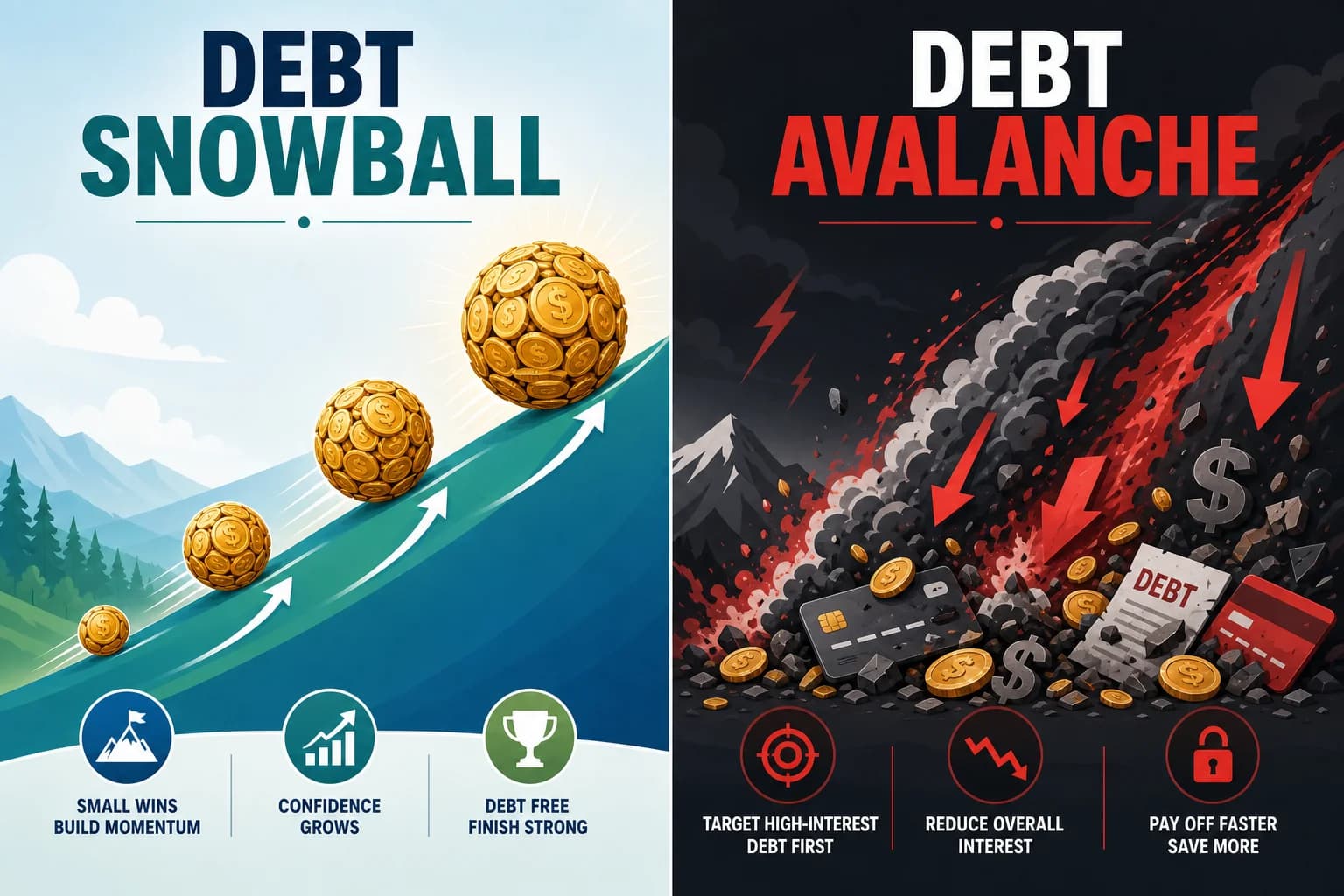
You've made the call to tackle your debt. Smart move — but now comes the part nobody agrees on: should you pay off smallest balances first (debt snowball) or highest interest first (debt avalanche)? Here's the deal: the math favors avalanche. But psychology favors snowball. And the honest answer? It depends on who you are. This guide breaks down both methods, shows you the actual numbers, and helps you pick based on your personality — then walks you through exactly how to execute. By the end, you'll have a decision framework, a step-by-step plan, and real case studies from people who've done this.
The Short Answer: Which Method Wins?
The debt snowball method tackles your smallest balance first, ignoring interest rates. The payoff: quick psychological wins and growing momentum. The cost: roughly 10–25% more in total interest over time. The debt avalanche method goes after your highest interest rate first. Mathematically optimal — you pay less overall and often reach debt-free slightly faster. The risk: progress feels slower early on, which makes some people quit. Neither is objectively better. Your best choice depends on your motivation style, how your debts stack up, and whether you can stick with a plan that takes patience. Bonus: there's a hybrid approach that takes the best from both.
What Is the Debt Snowball Method?
How the Debt Snowball Method Works
List all debts smallest to largest. Ignore interest rates. Pay minimums on everything except the smallest — throw every extra dollar at it until it's gone. Once that balance hits zero, roll the entire payment into the next smallest. Your monthly payment "snowballs" as each debt disappears. Dave Ramsey popularized this approach, and behavioral psychologists have studied it extensively as a sustainable debt payoff strategy.
Debt Snowball Example: Same Debts, Same Situation
Four debts: Credit Card A: $800, $25/month minimum, 18.99% APR Personal Loan: $3,200, $100/month minimum, 12.50% APR Credit Card B: $7,500, $150/month minimum, 22.75% APR Student Loan: $18,000, $200/month minimum, 5.25% APR Snowball payoff order: Step 1: Eliminate Credit Card A ($800) Step 2: Roll that $25 plus your extra payment into the Personal Loan Step 3: Roll both payments into Credit Card B Step 4: Attack the Student Loan with everything left At $500/month extra, you'd wipe out Credit Card A in about 2 months — giving you an early win to build on.
Pros of the Debt Snowball Method
- Fast early victories keep you pumped to continue
- Fewer open accounts in the beginning means less to manage
- People who need visible progress thrive on this approach
- Aligns with how humans naturally think about achievement
- Completion rates in behavioral studies: 68–72% (Harvard Business School, 2012; 2024 meta-analysis)
- Knocking out small debts quickly reduces the mental load of having many accounts
Cons of the Debt Snowball Method
- Total interest paid runs 10–25% higher than avalanche in most scenarios
- High-interest debt stays on your books longer, costing more overall
- Analytically-minded folks often find this frustrating — they see the math inefficiency
- Doesn't make sense if your smallest balance also has a rock-bottom interest rate
Best For: Debt Snowball
This works best if you need to see progress to stay fired up, have multiple small debts you can knock out quickly, have tried and failed to pay off debt before, or prioritize momentum and confidence over squeezing out every last dollar of interest savings.
What Is the Debt Avalanche Method?
How the Debt Avalanche Method Works
List debts highest interest rate to lowest. Ignore balances. Pay minimums on everything except the highest-rate debt — focus every extra dollar there until it's gone. Then move to the next highest, and repeat until you're clear. This is the mathematically correct approach. You minimize interest paid and typically reach debt-free faster, assuming you don't give up along the way.
Debt Avalanche Example: Same Debts, Maximum Savings
Same four debts: Credit Card A: $800, 18.99% APR Personal Loan: $3,200, 12.50% APR Credit Card B: $7,500, 22.75% APR Student Loan: $18,000, 5.25% APR Avalanche payoff order: Step 1: Wipe out Credit Card B (22.75% APR) — the biggest interest bleeder Step 2: Move to Credit Card A (18.99% APR) Step 3: Tackle the Personal Loan (12.50% APR) Step 4: Finish with the Student Loan (5.25% APR) At $500/month extra, you save roughly $935 in interest compared to snowball and hit debt-free about 2 months sooner. Downside: your first "win" takes longer to arrive.
Pros of the Debt Avalanche Method
- Saves the most money on interest — this is the mathematically optimal path
- Faster path to debt freedom when you stick with it
- Appeals to analytical, optimization-minded people
- No second-guessing whether you're "wasting" money on low-interest debt
- Most powerful when interest rate gaps are wide (e.g., a 24% credit card versus a 5% student loan)
- Stops interest bleeding from your highest-rate debts right away
Cons of the Debt Avalanche Method
- Slow early progress can feel demoralizing if your biggest-rate debt also has a large balance
- No quick wins means some people lose steam before reaching the finish line
- Higher dropout risk — 22–28% in the first 90 days
- Requires discipline and ability to think long-term without immediate validation
Best For: Debt Avalanche
This is the right fit if you prioritize logic over feelings, have one or two debts at very high rates (20%+), have successfully completed long-term projects before, or care more about efficiency than celebrating small milestones. Before starting your payoff journey, an emergency fund is critical — without one, unexpected expenses just add new debt.
Head-to-Head Comparison: Snowball vs Avalanche
The Math: Interest Savings Comparison
Using our $29,500 total debt scenario with $500/month extra: Snowball results: $4,847 in total interest, 38 months to debt-free, $34,847 total paid Avalanche results: $3,912 in total interest, 36 months to debt-free, $33,912 total paid Avalanche saves you $935 and gets you there 2 months faster. Your numbers will vary based on your specific balances, rates, and extra payment amount. Widen the interest rate gap (say, a 28% credit card versus a 4% student loan) and the savings difference grows. Use a debt payoff calculator for your actual numbers.
The Psychology: Completion Rate Comparison
Behavioral research tells a different story than the math alone: Snowball: 68–72% study completion rate, first win in 2–4 weeks, 12–15% dropout rate in first 90 days, higher reported satisfaction (because of early wins) Avalanche: 52–58% study completion rate, first win in 3–6 months, 22–28% dropout rate in first 90 days, higher reported satisfaction (because of final results) Sources: Harvard Business School (2012), Journal of Consumer Research meta-analysis (2024), CFPB Financial Well-being Survey (2024) Here's the tension: avalanche is mathematically superior, but snowball finishes 15–20% more often in studies. If you abandon an avalanche plan halfway through, the math advantage disappears.
When Snowball Wins
- You have 5+ debts with varied balances
- Your smallest debt is less than 20% of your total debt
- Financial follow-through has been a problem for you before
- You value momentum and visible wins over squeezing out maximum interest savings
- Your interest rates are relatively close (within 10% of each other)
When Avalanche Wins
- You have 1–2 debts at extremely high interest (20%+)
- Your highest-rate debt has a manageable balance
- You think in spreadsheets and trust long-term math over short-term wins
- You've completed multi-year goals successfully before
- Interest rate spread is wide (15%+ difference between highest and lowest)
The Hybrid Approach: Best of Both Worlds
Here's what most articles miss: you don't have to pick one method and lock in forever. The hybrid approach blends snowball's psychological lift with avalanche's mathematical efficiency. Three versions work:
Strategy 1: Snowball Start, Avalanche Finish
Pay off 2–3 smallest debts first using snowball (build confidence and habit-forming momentum), then switch to avalanche for the remaining larger balances (mathematically optimize the bulk of your debt). Research shows the first 90 days have the highest dropout risk — snowball's quick wins help you push through that vulnerable window.
Strategy 2: Avalanche Start, Snowball Finish
Attack your highest-interest debt first using avalanche (stop the interest bleeding immediately), then switch to snowball for remaining debts (accelerate to the finish line with visible progress). This works well when you have one crushing high-rate balance but want motivation as you near the end.
Strategy 3: Modified Snowball (Interest-Rate Tiebreaker)
Order debts by balance (standard snowball), but when two balances are close, prioritize the higher rate. This keeps the psychological win structure while applying slightly better math to tiebreaker decisions. Feels like "fair" snowball without the guilt of ignoring interest entirely.
Step-by-Step Implementation Guide
Step 1: List All Your Debts
Pull exact numbers for every debt: creditor name, current balance, minimum payment, interest rate (APR), and due date. Check statements or online accounts — don't estimate. This inventory is the foundation of your plan. Knowing your full picture also helps when negotiating lower rates with creditors.
Step 2: Choose Your Method (or Hybrid)
Use the decision criteria above to pick your strategy. The 5-question quiz in the next section can help if you're torn. Remember: you can start with one and switch later. The best debt payoff plan is the one you'll actually finish. If you have a partner, talk through both your motivation styles — mismatched approaches cause friction.
Step 3: Calculate Your Available Extra Payment
Add up all minimum payments across every debt. Then look at your budget and figure out how much extra you can throw at your target debt each month. Be honest about what you can sustain — aggressive numbers that cause budget burnout backfire. Round down slightly for a cushion. If your income varies, build in flexibility for slow months.
Step 4: Set Up Your Tracking System
Build a simple spreadsheet or use a debt payoff app. Track: month, debt name, starting balance, payment made, ending balance, and notes. Update monthly. Popular tools: Undebt.it, Debt Payoff Planner, YNAB's debt modules. Or go old school: a debt thermometer poster that fills in as balances shrink gives you visual motivation that's hard to beat.
Step 5: Automate Everything Possible
Set up automatic minimum payments on all debts — eliminates late fees. Schedule automatic extra payments to your target debt, ideally right after payday, so you "pay yourself first" instead of waiting to see what's left over. Consider a separate checking account just for debt payments if you tend to spend what's available. Automation removes willpower from the equation.
Step 6: Track Progress Visually
Update your debt chart every month as balances drop. Add spreadsheet formatting that highlights cells green as debts approach zero. Screenshot your progress to compare month-over-month. Join debt-free communities online (r/debt, r/personalfinance) for accountability and milestone celebrations. Visual progress makes abstract numbers feel real.
Step 7: Celebrate Milestones
Small win: Celebrate each debt payoff with a reward that doesn't set you back (movie, hobby gear, experience). Medium win: Acknowledge 25%, 50%, and 75% milestones with something meaningful but budget-conscious. Big win: Plan your debt-free celebration in advance — knowing the party awaits makes hard months easier. Key: celebrate without undoing progress. Debt-free freedom is the real prize. Celebrate the behaviors, not just the outcomes.
Decision Framework: Which Method Should YOU Choose?
Take This 5-Question Quiz
Question 1: How many debts do you have? A) 5 or more → Snowball advantage B) 3–4 → Neutral C) 1–2 → Avalanche advantage Question 2: What is your smallest debt balance relative to your largest? A) Less than 20% → Snowball advantage B) 20–50% → Neutral C) More than 50% → Avalanche advantage Question 3: What is the interest rate spread between your highest and lowest rate? A) Less than 10% difference → Snowball advantage B) 10–15% difference → Neutral C) More than 15% difference → Avalanche advantage Question 4: How would you describe your motivation style? A) I need visible progress to stay motivated → Snowball advantage B) I can trust long-term plans without immediate feedback → Avalanche advantage C) Somewhere in between → Neutral Question 5: Have you successfully completed a long-term goal (6+ months) before? A) No, I tend to lose steam → Snowball advantage B) Yes, multiple times → Avalanche advantage C) Once or twice → Neutral Mostly A answers → Snowball. Mostly C answers → Avalanche. Mixed → Hybrid approach (snowball start, avalanche finish).
Special Scenarios
Married Couple with Combined Debt: Talk honestly about both partners' motivation styles. If one needs wins and the other trusts math, the hybrid approach usually works. Consider splitting debts by person and using different methods on each balance. Clear communication about the plan prevents resentment. Student Loans Plus Credit Cards: Credit cards almost always have higher interest rates. Avalanche naturally targets these first. But student loan balances are often larger. Snowball might help you eliminate smaller card debts first. Consider avalanche for cards, then snowball for student loans once the cards are gone. Debt Consolidation Loan on the Table: Compare the consolidation rate against your current weighted average. If it saves 5%+ interest, consider it regardless of method. But if it stretches your term way out, long-term cost may increase. And don't consolidate if you'll run up the paid-off cards again. Expecting a Windfall (Tax Refund, Bonus, Inheritance): Snowball users: apply it to your smallest remaining debt for a psychological quick win. Avalanche users: apply to highest-interest debt for maximum mathematical impact. Either way, don't inflate your lifestyle. Put 100% of unexpected money toward debt.
Real Success Stories: 2026 Case Studies
Case Study 1: Sarah, Age 34 — Snowball Success
A 2024 CFPB study found the average indebted U.S. household carries roughly $15,000 in credit card debt alone. When households juggle multiple debt types, the mental weight of tracking several accounts often outweighs the math of any particular payoff order. Sarah used snowball to knock out three small debts in her first four months, built momentum, and stayed committed to paying off her larger balances. The psychological wins kept her going when the journey felt long.
Case Study 2: Marcus and Jen, Ages 29 and 31 — Avalanche Success
Marcus and Jen carried $68,000 in combined debt: student loans at 6.8% average APR, credit cards at 24% APR. The rate gap was massive. By using avalanche and paying $800 extra monthly, they saved approximately $4,200 in interest compared to smallest-balance-first. The math was clear — attacking the 24% cards first stopped the bleeding.
Case Study 3: David, Age 45 — Hybrid Approach
With a large debt load, David used a two-phase strategy. Phase one: snowball through 2–3 smaller debts regardless of rate, building confidence. Phase two: switch to avalanche for remaining larger balances, optimizing the bulk of what he owed. Habit formation research shows early wins increase the odds of finishing long-term financial goals.
FAQ: Debt Snowball vs Avalanche Questions Answered
- Which method is mathematically better?
- Debt avalanche saves the most interest and typically gets you debt-free faster. But the "best" method is the one you'll actually stick with.
- How much more does debt snowball cost in interest?
- Typically 10–25% more than avalanche, depending on your specific debt profile. On $50,000 in debt, that's $2,000–$6,000 extra in interest.
- Can I switch methods halfway through?
- Absolutely. Many people start with snowball for momentum and switch to avalanche once they have confidence built up. Others do the reverse.
- Should I build an emergency fund before paying debt aggressively?
- Most advisors recommend stashing $1,000–$2,000 as a starter emergency fund first. Without it, unexpected expenses just add new debt.
- What about retirement contributions while paying off debt?
- At minimum, contribute enough to get your full 401(k) match — that's free money. Beyond that, compare your debt interest rate against your expected investment return. If your debt costs more than 7–8%, prioritize paying it off.
- Does debt snowball work for student loans specifically?
- Yes, but think it through. Federal student loans have fixed rates, income-driven repayment options, and potential forgiveness programs — they behave differently from credit cards.
- What if I receive a balance transfer offer at 0% APR?
- This flips the calculation. A 0% balance transfer effectively makes that debt the lowest "interest" debt in your avalanche order — you tackle it last.
- Is debt consolidation better than snowball or avalanche?
- Consolidation can simplify payments and lower rates, but it doesn't change your payoff strategy. You still decide: pay the consolidated loan aggressively (avalanche-style if the rate is high) or focus elsewhere first.
- How do I stay motivated if I chose avalanche and progress feels slow?
- Set artificial milestones ($5,000 increments, for example), track your net worth monthly, find an online community for accountability, and visualize your end goal. If motivation is critical, consider applying avalanche math to your biggest debt but using snowball for your first small debt.
- What if my employer offers a debt payoff benefit?
- Apply it according to your chosen method. With snowball, putting it toward your smallest debt might wipe it out entirely.
Ready to Start? Your Next Steps
Whichever approach you choose — snowball, avalanche, or a hybrid — the most important thing is to start. Don't spend another month paralyzed by analysis. Ready to go? List all your debts using Step 1 above. Calculate how much extra you can pay monthly. Take the 5-question quiz to pick your method. Set up your tracking system today — even a basic spreadsheet beats nothing. One more thing: the best debt payoff method is the one you'll actually finish. A mathematically perfect plan you abandon costs more than an imperfect plan you complete.
Take control of your money today
Start free with Spendmate — track expenses, plan budgets, and reach your financial goals.
Start free with Spendmate